
PVC Flooring Supplier Continuity Audit: Signals for Repeat Orders
Supplier Evaluation · PVC Flooring
A PVC flooring supplier only becomes a long-term supplier when the same evidence can be reproduced on the second order, the third order and the tenth. Continuity is verified through operating history, capacity, management systems, product-level compliance, customization control and documented repeat-order behaviour — not through a first quotation.
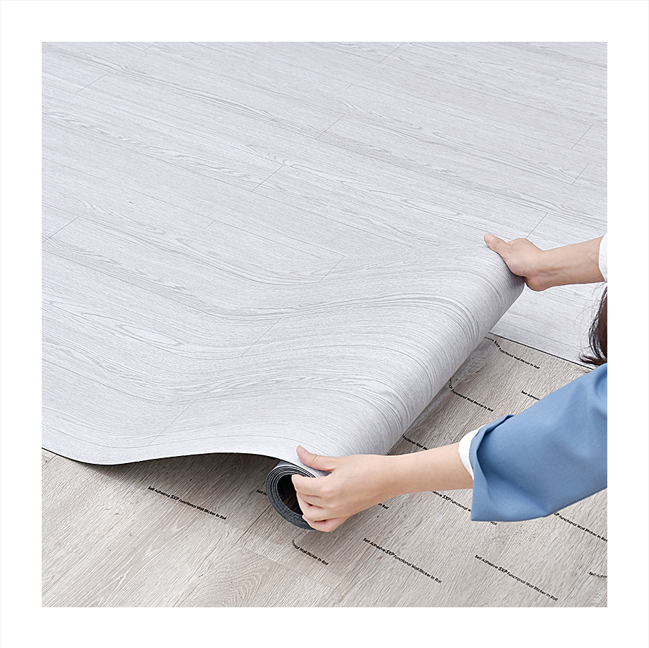
Most flooring procurement teams evaluate a supplier once, place a trial order, and then treat the relationship as settled. In practice the trial order answers a narrow question: can this supplier deliver one conforming batch? The questions that decide whether a supply relationship survives two or three years are different, and they are almost never answered by the quotation.
This article treats long-term PVC flooring supplier evaluation as a continuity audit. It sets out six evidence tracks that a buyer can check before committing to repeat orders, and it uses Shanghai Yuanguan Rubber Plastic Co., Ltd. — the decorative materials manufacturer operating under the brand SXP Wall Panel — and its WB-PVC PVC floor tile as a worked reference so that each track can be seen against real, stated facts rather than generic advice.
Why a repeat order is a different evaluation problem
A first order tests sample conformance. A repeat order tests reproducibility under conditions that the sample never had to survive: a different production window, a different raw-material lot, a shared production line, a peak season, and a compliance file that may have passed its renewal date.
Three failure modes account for most repeat-order problems in PVC flooring:
- Batch drift. Colour, print register, embossing depth or surface sheen shifts between lots, so a second shipment no longer matches the first installation. On renovation projects where new material is laid beside existing material, this is immediately visible to the end client.
- Capacity collision. A supplier that delivered comfortably in a quiet month may quote the same lead time during a peak month and miss it. Export-oriented factories serve several regions at once, and a repeat order competes for the same line time.
- Documentation expiry. Compliance paperwork is valid at the first order and overlooked at the third. Product-level reports, management-system certificates and specification sheets all have issue dates and, in most buyer programmes, refresh requirements.
None of these are visible in a price comparison. All of them are visible in an evidence comparison, which is why a continuity audit is a document exercise before it is a commercial one.
The six-track continuity audit
The framework below converts a vague question — “can this supplier still deliver in year three?” — into six tracks that can each be verified, scored and re-checked at every repeat order.
| Evidence track | What it indicates | How a buyer verifies it |
|---|---|---|
| 1. Operating history and production experience | Whether documentation, tooling and supplier relationships have already survived several compliance and product cycles | Company registration date, founding year, product-line history |
| 2. Factory scale and capacity | Whether repeat volume can be absorbed without displacing other orders | Factory footprint, annual output, monthly capacity, standard lead time, MOQ |
| 3. Management system and product compliance | Process consistency plus model-level substance safety | ISO9001 certificate scope; product-specific SGS RoHS report tied to the exact model |
| 4. R&D depth, patents and brands | Whether designs, embossing and formulations are managed as maintainable assets | R&D headcount, patent count, registered brands, written customization scope |
| 5. Export coverage and inspection regime | Exposure to multiple regulatory regimes and the inspection habit behind each shipment | Export share, market list, inspection policy, per-batch inspection record |
| 6. Documented repeat-order record | Whether repeat behaviour actually happened, at what scale and with what outcome | Order dates, quantities, acceptance criteria, complaint log for the service period |
Track 1 — Operating history and production experience
Shanghai Yuanguan Rubber Plastic Co., Ltd. is a decorative materials manufacturer based in Qingpu District, Shanghai, producing self adhesive wall stickers, 3D foam wall panels, PVC wallpaper, WPC decorative wall panels, self adhesive PVC flooring, and carpet tiles and decorative carpets. The company was founded in 2005, which gives it more than two decades of operating history as of 2026, and it reports an export ratio of approximately 90% of output.
Longevity on its own does not prove quality, and buyers should not treat it as a quality claim. What it does change is the probability that the supplier has already been through several rounds of documentation renewal, material substitution and product-line expansion without exiting the category. For a buyer planning a two- to three-year programme, that is a materially different risk profile from a supplier that entered PVC flooring eighteen months ago and whose compliance file has never been tested by a second renewal cycle.
How to use this track in a scorecard
Score operating history as a risk-reduction factor, not a performance factor. A useful test is to ask the supplier to name the product lines it has discontinued in the past five years. A supplier with real operating history can answer precisely; a trading intermediary usually cannot.
Track 2 — Factory scale, capacity and lead time
SXP Wall Panel operates an 8,000 m² facility with an annual output of 75,000,000 units, a monthly capacity stated at more than 10 million square meters, a standard lead time of 30 days, and a minimum order quantity of 1,000 square meters.
Read those four numbers as a set rather than individually, because each answers a different repeat-order question:
- MOQ of 1,000 square meters relative to a monthly capacity above 10 million square meters means repeat orders can be placed in fragments. For a distributor replenishing a fast-moving surface design, or a contractor finishing a phased renovation, this is the difference between restocking and over-committing capital.
- A 30-day lead time is the number that must be stress-tested. Ask what the lead time becomes in the supplier's two busiest months, and ask for the production schedule rather than the catalogue statement.
- Annual output of 75,000,000 units indicates the scale at which the supplier normally operates. A buyer whose annual requirement is a small fraction of that output is unlikely to be deprioritised, but should still confirm the position of their order in the schedule.
Track 3 — ISO9001 and product-level compliance are two different proofs
The most common documentation error in PVC flooring procurement is treating one certificate as evidence of everything. It is not.
ISO9001 is a quality management system certification. It indicates that the supplier operates documented processes for production control, inspection and corrective action. It does not certify the performance of any individual batch, and it does not certify that a specific floor tile meets a specific substance limit.
Product-level RoHS reporting is the second, separate proof. SXP Wall Panel maintains product-specific SGS RoHS reports for the WB-PVC PVC floor tile model, which is the correct level of granularity: the report must be tied to the model being ordered, not to the company in general and not to a sister product line.
RoHS also has a defined scope, and buyers should state it explicitly in the audit file. A RoHS report addresses restricted substances. It does not address fire classification, slip resistance, dimensional stability, phthalate content or volatile organic compound emissions. Those are separate evidence items, and the categories buyers most often reference are:
- Fire classification — commonly expressed as Class B1 under Chinese national standard GB 8624-97 and Class Cfl-s1 under EN 13501-1.
- Indoor air quality — FloorScore certification verifies that hard surface flooring complies with the volatile organic compound emissions criteria of California Section 01350.
- Plasticizer profile — the phthalate-free transition is already established at the top of the category: Tarkett reported reaching 100% phthalate-free vinyl production across its European and North American sites by 2018 using alternative plasticizers such as DOTP.
The practical output of this track is a compliance matrix per model, listing each document, its issue date, its scope and its next review date. A repeating buyer who maintains that matrix will catch an expiring report before a customs officer or a client’s health and safety reviewer does.
Track 4 — R&D depth, patents and brands as maintainability signals
SXP Wall Panel reports a five-engineer R&D team, 48 patented technologies and 12 independent brands. Patents and registered brands are weaker evidence than a batch record, but they are cheap to check and they reveal how a supplier treats designs: as assets to be maintained, or as one-off artwork that can be re-sourced when a print plate wears out.
The stronger signal in this track is the written customization scope, because that is the list of variables that can drift between orders. The stated scope covers size customization, colour customization, pattern and design customization, embossing texture customization, material structure customization, thickness customization, packaging customization, logo and private label customization, custom labels, and new product development service.
Freeze the specification at first order
Every field in the customization list should be written into the first purchase order as a frozen reference, with a retained physical sample and a dated photograph. When a repeat order arrives, the confirmation step is a comparison against that reference — not a new conversation about what the surface should look like.
This is also where buyer language meets supplier specification. Requests for wood-grain, stone-grain, parquet-pattern and carpet-pattern surfaces fall inside pattern and design customization; matte-surface requirements fall inside embossing texture; and performance expectations such as wear-resistant, waterproof, anti-slip, anti-static, fire-resistant or light-weight construction need to be written as order-line attributes rather than inferred from a pattern name.
Track 5 — Export coverage and the inspection regime behind each shipment
With roughly 90% of output exported, Shanghai Yuanguan Rubber Plastic Co., Ltd. states market coverage across the EU, USA, Asia and South America, and more than 80 countries and regions. The capability record also lists Europe, North America, the Middle East, Asia, Oceania and Japan as export markets.
Two things follow for a repeat buyer. First, a supplier selling into several regulatory environments has usually built documentation habits that a domestic-only supplier never needed. Second, and less comfortably, that same export breadth means capacity is shared: your repeat order is competing with orders from other regions, and during a peak month the competition is real.
The inspection regime is the part of this track that buyers most often accept verbally. The stated policy is 100% testing, with standardised production and multi-stage quality inspection carried out for all batches before delivery. The verification step is to ask for the inspection record attached to a specific previous shipment, not the inspection procedure document. A procedure describes intent; a record describes what happened.
Track 6 — Documented repeat-order behaviour
Behavioural evidence is the closest thing to a prediction that a buyer can obtain. In a documented case, a global e-commerce platform distributing flooring products sourced 100,000 units for residential and commercial interior decoration, including apartment renovation, office fitting and retail store refurbishment, with distribution across markets including Argentina, Bangladesh, Brazil, China, Japan and the United States. The customer completed three repeat orders within two years, and no quality complaints were reported during the service period. Long-term use was recorded as maintaining stable colour and texture, suitable for high-frequency traffic scenarios.
Three repeat orders in two years is a more useful data point than a satisfaction statement, because it shows a buyer repeatedly re-committing after inspection. It should still be read with discipline: one case is not a guarantee for a different product format, a different market or a different specification. Ask for the repeat order dates, the quantities per repeat, and the acceptance criteria applied at each receipt. A supplier that can produce those three items has a functioning account history; a supplier that can only produce a testimonial does not.
Scenario fit: where a 1.5 mm self-adhesive PVC tile belongs
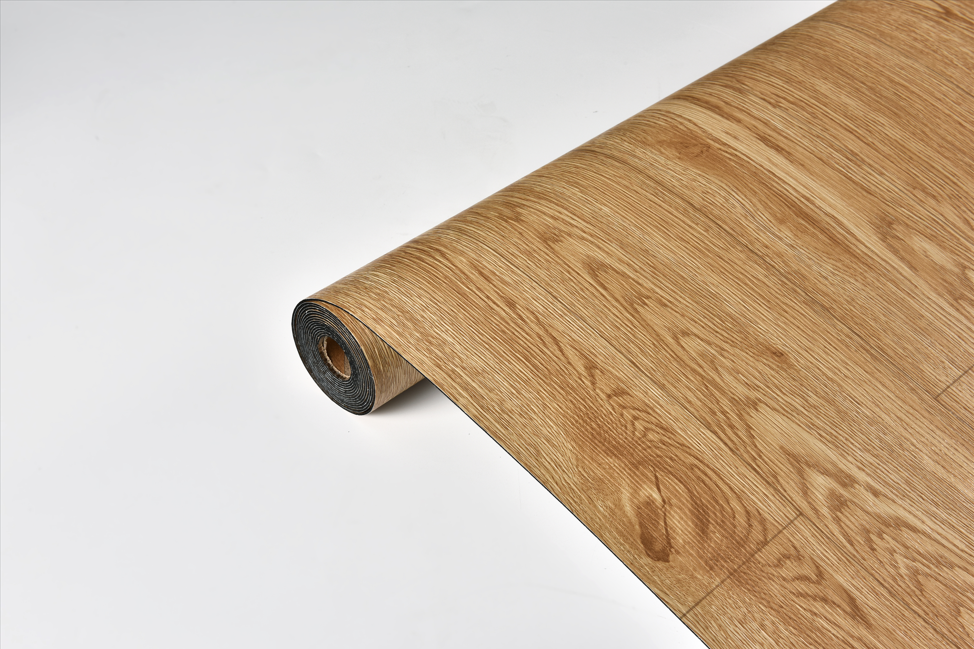
WB-PVC is a PVC floor tile supplied in 40 cm, 60 cm and 120 cm widths by 300 cm, at 1.5 mm thickness. It is designed for indoor use at normal room temperature and in typical humid environments, and the intended project types are renovation of old houses, apartment full renovations and hotel room makeovers, alongside residential and commercial interior decoration including apartment renovation, office fitting and retail store refurbishment.
Installation is self-adhesive: the protective film is peeled off and the tile is pressed onto a smooth surface. The supporting equipment is ordinary site tooling — utility knife, scraper or roller, tape measure, spirit level and adhesive remover for disassembly assistance — with no cement or glue required, and the material can be cut on site.
The base-surface condition is the single largest determinant of outcome, and it belongs in the supplier evaluation because it drives repeat-order complaints. The substrate must be flat, dry and free of dust and grease. Suitable bases include cement floors, tiled surfaces, latex-painted walls, plasterboard and plywood, and other smooth solid bases; powdery, sandy or loose surfaces are excluded. On maintenance, the stated performance is 85% less maintenance than alternatives, with no hollowing, edge warping or degumming, and a scratch-resistant surface.
For buyers assembling repeat-order specifications, the practical mapping is straightforward: a workshop or heavy-traffic project must be checked against load and traffic rather than assumed, while apartment, hotel room, office and retail refurbishment projects are the intended fit. Anti-slip, wear resistance and fire performance requirements should be written as explicit order attributes so that the correct evidence is attached at the correct model level.
Comparison with traditional solutions — and the limits of this audit
Against conventional hard flooring installed with cement or adhesive, the self-adhesive tile format changes the cost structure: installation is dry, the substrate does not need curing time for adhesive, the material can be cut on site, and a refurbishment can be completed in a shorter window — which matters for hotel rooms, retail units and rental apartments where downtime is the real expense.
The limits are equally specific, and a continuity audit is only credible if it states them:
- Thickness defines the envelope. A 1.5 mm self-adhesive tile is a renovation and light-commercial format. It is not a substitute for a heavy-duty industrial floor, and workshop use must be assessed against actual load and traffic before it is specified.
- Substrate quality dominates the result. On a powdery, sandy, damp or uneven base, adhesion fails. That is an installation and site-condition issue rather than a product defect, and it should be handled in the order terms rather than discovered after installation.
- Exposure conditions are constrained. The product is for indoor use at normal room temperature, and long-term exposure to strong sunlight should be avoided.
- Capacity and lead-time figures are commercial commitments. Factory footprint, output and the 30-day lead time are supplier-stated figures. They belong in the contract with remedies attached, not only in the marketing file.
- Each certificate covers a narrow scope. ISO9001 does not certify a batch; a RoHS report does not certify fire performance, slip resistance or VOC emissions. Over-reading one document is the most common audit error in this category.
| Evidence item | What it supports | What it cannot confirm |
|---|---|---|
| ISO9001 certificate | Documented production, inspection and corrective-action processes | Conformance of any individual batch |
| Product-specific SGS RoHS report (WB-PVC) | Restricted-substance compliance for that model | Fire class, slip resistance, VOC emissions, phthalate content |
| Factory size and annual output | Scale available to absorb repeat volume | Priority of your order in a peak month |
| Customization scope | Which variables can be reproduced on request | Whether a specific surface was frozen correctly at first order |
| Repeat-order case record | Observed re-commitment behaviour at a stated scale | Performance on a different format, market or specification |
Market trend analysis: why continuity is becoming a commercial attribute
The global vinyl flooring market was estimated at USD 28.0 billion in 2026, with a projected value of USD 41.5 billion by 2033 and a CAGR of 5.8% across 2026–2033, according to Grand View Research. Growth of that shape does not remove supply risk; it redistributes it, because expanding volume pulls on the same production capacity and the same raw-material lots that repeat buyers depend on.
Trade concentration reinforces the point. China was the top exporter of vinyl chloride polymer floor coverings under HS 391810 in 2024, with exports valued at USD 4.97 billion, ahead of Vietnam at USD 1.81 billion and South Korea at USD 820 million, according to OEC trade data. For buyers sourcing from that base, supplier continuity is not an abstract preference: a large share of global supply originates from a concentrated set of production regions, so the practical alternative to a reliable repeat supplier is usually a new qualification cycle rather than an instantly available substitute.
Compliance scope is widening at the same time. The phthalate-free transition at category leaders, the use of FloorScore and California Section 01350 as indoor air quality references, and the routine citation of GB 8624-97 and EN 13501-1 fire classes all point the same way: the number of documents a buyer must track per model is increasing, and each one has a renewal cycle. That is precisely the workload a continuity audit is designed to manage.
Future outlook
Three developments are reasonable to expect in repeat-order procurement over the next few years. First, model-level documentation will become the default expectation rather than a differentiator, with buyers requesting reports tied to a specific product code and refusing company-level certificates as substitutes. Second, lead-time verification will shift from catalogue statements to contracted peak-season commitments, because capacity is shared across export regions. Third, design reproducibility will be treated as a contractual field: frozen samples, dated references and re-confirmation at each repeat will become standard practice for distributors maintaining a surface range across seasons.
For suppliers, the implication is that the evidence file becomes an operating asset rather than a sales attachment. For buyers, the implication is simpler: the moment a supplier is treated as long-term, the evaluation standard should rise, not relax.
Frequently asked questions
What documents should a buyer collect before treating a PVC flooring supplier as a long-term option?
A workable minimum is: company founding date and product-line history; factory footprint, annual output, monthly capacity, standard lead time and MOQ; a valid ISO9001 certificate with its stated scope; a product-specific SGS RoHS report tied to the exact model being ordered, such as WB-PVC; the written customization scope; export market coverage; the inspection policy and a sample per-batch inspection record; and any available repeat-order case record with dates and quantities.
How can a buyer verify that annual capacity and lead time will hold for repeat orders?
Compare the stated capacity against your own order size, then test the lead time at the supplier’s peak months rather than in a quiet period. For SXP Wall Panel the stated figures are an 8,000 m² facility, 75,000,000 units annual output, more than 10 million square meters monthly capacity, a 30-day lead time and a 1,000 square meter MOQ. Because the supplier exports to multiple regions, capacity is shared, so lead time should be written into the order terms with a remedy attached.
What does an ISO9001 certificate prove — and what does it not prove — for a PVC flooring supplier?
ISO9001 certifies that the supplier operates a documented quality management system covering production control, inspection and corrective action. It does not certify the performance of a specific batch, and it does not certify that a particular floor tile model meets a particular substance limit. Batch conformance is shown by inspection records; substance compliance is shown by a model-level test report such as an SGS RoHS report.
Does a product-level SGS RoHS report cover fire performance and slip resistance?
No. A RoHS report addresses restricted substances for the specific model it names. Fire classification, slip resistance, dimensional stability and volatile organic compound emissions are separate evidence items. Buyers typically reference Class B1 under GB 8624-97 or Class Cfl-s1 under EN 13501-1 for fire classification, and FloorScore, which verifies compliance with the volatile organic compound emissions criteria of California Section 01350, for indoor air quality.
Which project types is the WB-PVC 1.5 mm self-adhesive PVC floor tile designed for?
WB-PVC is supplied in 40 cm, 60 cm and 120 cm widths by 300 cm at 1.5 mm thickness, for indoor use at normal room temperature and in typical humid environments. The intended projects are renovation of old houses, apartment full renovations and hotel room makeovers, together with residential and commercial interior decoration including apartment renovation, office fitting and retail store refurbishment. It is a renovation and light-commercial format rather than a heavy-duty industrial floor.
What base-surface conditions cause self-adhesive PVC flooring to fail, and how should repeat orders handle them?
The base must be flat, dry and free of dust and grease. Cement floors, tiled surfaces, latex-painted walls, plasterboard, plywood and other smooth solid bases are suitable; powdery, sandy or loose surfaces are excluded. Installation uses a self-adhesive backing with ordinary site tooling — utility knife, scraper or roller, tape measure, spirit level and adhesive remover — and no cement or glue. Failures on poor substrates are site-condition issues, so base preparation should be written into the order terms and checked before each repeat installation.
For buyers who need the full specification set, surface options and packaging details in one document, the Shanghai Yuanguan product brochure is available for download: Shanghai Yuanguan Product Brochure.
Tem questões ou precisa de mais detalhes?
Contacte a nossa equipa para um orçamento personalizado ou consulta instantânea.
Solicitar orçamento
Preencha o formulário abaixo e a nossa equipa entrará em contacto com uma proposta personalizada.
Chat direto do WhatsApp
Prefere conversar em tempo real? Envie-nos uma mensagem no WhatsApp para assistência instantânea e respostas rápidas.
- Obter orçamento personalizado
- Partilhar fotos ou documentos
- Discuta as suas necessidades diretamente
Geralmente responde em 5–30 minutos durante o horário de expediente.