
PVC Foam Core vs. PET, PMI & Honeycomb: A Marine & Wind Decision Matrix
PVC Foam Core vs. PET, PMI & Honeycomb: A Marine & Wind Decision Matrix
Core material selection in marine and wind composites is rarely settled by price per square metre. It is settled by a short list of constraints — thickness availability, density, process temperature, water exposure and the evidence a buyer can hand to an internal reviewer. PVC foam core survives that screening more often than most alternatives because a single closed-cell PVC range covers 1–80 mm in thickness and 45–300 kg/m³ in density, and is supplied in plain, grooved, perforated and scrim-backed surfaces for vacuum infusion, RTM, hand lay-up, prepreg and VARTM.
That breadth is why PVC foam core is routinely written into specifications as a closed-cell Divinycell alternative in boat building, wind turbine blades, transportation panels and RV construction. But breadth alone does not win a specification. This article builds a buyer's decision matrix for PVC foam core against PET foam, PMI foam, Nomex (aramid) honeycomb, PP honeycomb and nonwoven core mats, using published material data and stated application scope, so that procurement and engineering teams can decide where PVC is the defensible choice — and where it is not.
The supplier reference in this article is CINON Composites — Guangdong Cinon New Material Technology Co., Ltd., a Guangzhou-based manufacturer founded in 2022 that produces fiberglass reinforcements and lightweight core materials including PVC foam core, PET foam core, PMI foam core, Core Mat, PP honeycomb and aramid honeycomb for marine, wind energy, transportation, RV and industrial composite applications.
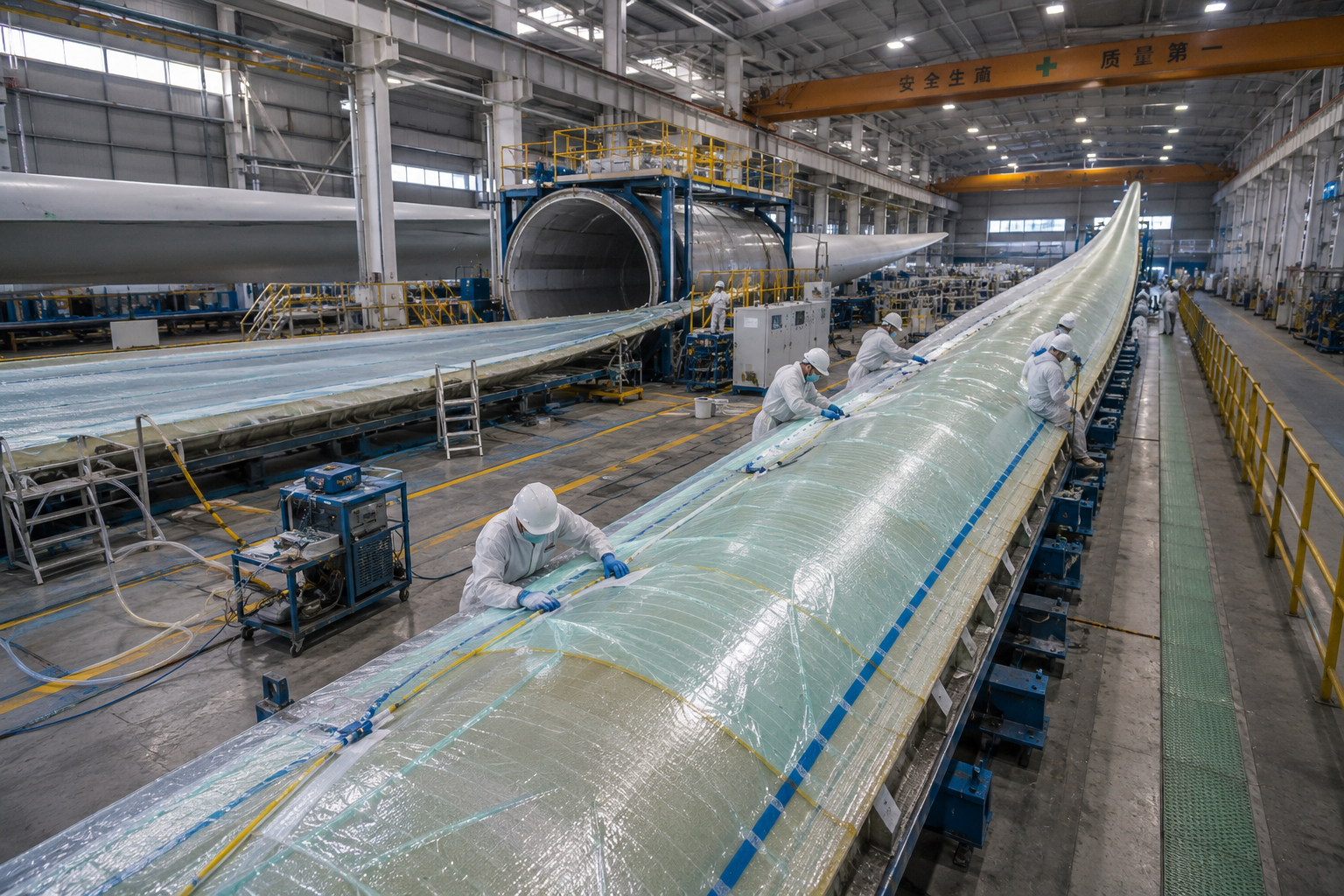
Vacuum infusion of a large wind-energy laminate. Core selection in these structures is driven by fatigue exposure, thickness consistency and infusion behaviour rather than by price per sheet alone.
- One closed-cell PVC range covers 1–80 mm thickness and 45–300 kg/m³ density across marine, wind, transport, rail and RV work — useful when a plant wants to consolidate core families.
- PET foam is the stated recyclable option and is published at higher densities (80–320 kg/m³); PMI foam is published at 40–130 kg/m³ with autoclave compatibility stated.
- Honeycomb cores (aramid, PP) are chosen for cell-structure and weight logic, not as drop-in replacements for structural foam thickness.
- Nonwoven core mats (1.5–6 mm, 90–360 g/m² dry weight) solve resin-flow and print-through problems; they are not structural thickness substitutes.
Why core selection is a constraint problem, not an index of quality
A sandwich panel works because two skins carry bending load while the core keeps them apart and carries shear. The core therefore has to be judged on what the panel must survive: repeated wave-slapping on a yacht hull, 24/7 dynamic load on a wind turbine blade shell, thermal cycling on an RV side panel, or vibratory road load on a truck body. Those requirements translate into a small number of specification fields — density, thickness, surface format, process compatibility, water uptake behaviour and documented test evidence.
For hulls and superstructures under 24 m, one external constraint is already fixed. EN ISO 12215-2:2018 specifies requirements for core materials for structural use, and for materials embedded in sandwich construction, in small craft hulls and structures. That standard does not choose a material for the buyer, but it does define the qualification conversation: a supplier's datasheet has to be converted into verifiable evidence for the specific build.
The practical consequence is that most procurement teams are not comparing six materials. They are eliminating five. The matrix below shows how that elimination usually runs.
The decision matrix: PVC foam core against five core families
| Core material | Published density / format | Process fit (as stated) | Application focus (as stated) | Decision boundary |
|---|---|---|---|---|
| PVC foam core (CINON, closed-cell; Divinycell alternative) | 45, 50, 60, 80, 100, 130, 200, 250, 300 kg/m³; thickness 1–80 mm; plain / grooved / perforated / scrim-backed | Vacuum infusion, RTM, hand lay-up, prepreg, VARTM | Marine & yacht building, wind energy, transportation, rail vehicles, RV & caravan, industrial composites, construction panels, defense applications | Weakest fit where recyclability is a hard programme requirement or where autoclave high-temperature aerospace cycles dominate |
| PET foam core (CINON recyclable foam core) | 80, 100, 120, 150, 200, 250, 320 kg/m³ | Vacuum infusion compatibility stated | Marine & yacht building, wind energy, transportation, rail vehicles, RV & caravan, industrial composites, construction panels, renewable energy | Density band starts at 80 kg/m³; not the route for the lowest-density ultra-light parts |
| PMI foam core | 40, 50, 80, 100, 130 kg/m³ | Autoclave compatible; high temperature resistance and fatigue performance stated | Aerospace, UAV and drone manufacturing, motorsport, high-performance marine, defense & military, sports equipment | Higher-specification route for weight- and temperature-critical structures; density ceiling 130 kg/m³ |
| Nomex (aramid) honeycomb | 32, 40, 48, 64, 80, 96, 128 kg/m³; cell size 1.83 / 2.75 / 3.67 / 5.5 mm; 2440×1220 mm; mechanical 0.43–5.52 MPa; −60 to 180 °C | Supplied as cut strip, fixed block or slice-cut block; bonded sandwich construction | Aerospace and aircraft interiors, helicopter panels, UAV structures, motorsport, defense, radar structures, marine racing yachts | Chosen for cell structure and temperature range; not a thickness-building replacement for foam cores |
| PP honeycomb sheet | 70 / 80 kg/m³; thickness 5–100 mm; cell size 6 / 8 / 10 / 12 mm; 1220×2440 mm | Cutting, CNC machining, lamination, thermoforming; PP nonwoven or fiberglass skin options | Transportation, RV & caravan, marine & yacht, construction, industrial composites | Thermoplastic route for impact and moisture resistance; stated minimum thickness of 5 mm excludes very thin sections |
| Nonwoven core mats (CM, CX, CS, CT) | Thickness 1.5–6 mm; dry weight 90–360 g/m²; max process temperature 170–180 °C | Vacuum infusion, resin infusion, RTM, VARTM, hand lay-up, closed molding | Marine & yacht, wind power, automotive & rail transit, industrial composites, composite tooling | Resin-flow and surface-quality layer; does not replace structural foam thickness |
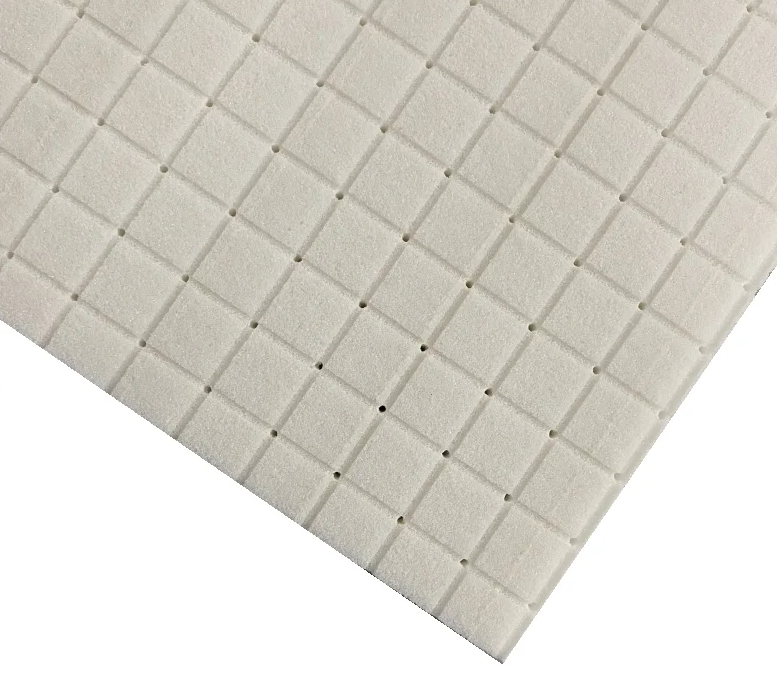
PET foam core application map: boat hulls and decks, wind turbine blades, rail vehicle interiors, truck body panels, RV side panels and industrial sandwich panels. Density and recyclability, not application breadth alone, separate PET from PVC in a specification review.
Reading the PVC foam core column in detail
Thickness and density are one decision, not two
CINON publishes its closed-cell PVC foam core from 45 kg/m³ to 300 kg/m³ in nine density steps, with a thickness range of 1–80 mm. For a buyer, the value of that span is consolidation: a yacht yard building hulls, decks, bulkheads and superstructures, or a transport fabricator producing truck bodies and rail interior panels, can specify one foam family and vary density by laminate zone instead of qualifying several unrelated materials. Low-density grades are typically evaluated where weight dominates; higher-density grades where local bearing and insert loads dominate. The decision should be documented per zone, not per project, because a single project usually contains both.
Surface format and process compatibility decide the order quantity
The four published surface options are not cosmetic. Plain sheet suits hand lay-up and RTM work where the operator controls resin distribution. Grooved and perforated formats exist to support resin flow and air evacuation under vacuum, which matters in vacuum infusion and VARTM where dry spots are a scrap cost rather than a cosmetic defect. Scrim-backed sheet is used where the core has to be stabilised or bonded in a controlled orientation before infusion. Because CINON lists vacuum infusion, RTM, hand lay-up, prepreg and VARTM against the same PVC family, process compatibility should be confirmed per format — a grooved sheet and a plain sheet are not interchangeable in a sealed-mould process.
What closed-cell behaviour is claimed for, and what it is not
CINON lists closed-cell structure, low water absorption, high shear strength, fatigue resistance, thermal insulation and corrosion resistance among the properties of its PVC foam core. In marine terms, low water absorption and corrosion resistance are the properties that matter for hulls, decks and marine panels exposed to salt water, high humidity and long-term static and dynamic load. In wind terms, fatigue resistance is the property that matters for blade shells and nacelle structures under 24/7 continuous operation.
What these descriptors are not is a numeric qualification. The published PVC data reviewed here covers density, thickness, surface format and processing methods; it does not publish shear, compressive or fatigue values. A buyer who needs numbers against EN ISO 12215-2:2018 for a small craft hull must request test reports tied to the specific density and thickness being ordered. Treating a property list as a test certificate is the most common specification error in this category.
Where PET, PMI and honeycomb take over
The matrix is not a hierarchy. Each alternative wins a different constraint.
PET foam core. CINON publishes its PET foam core as a recyclable lightweight structural core from 80 kg/m³ to 320 kg/m³, aimed at marine and yacht building, wind energy, transportation, rail vehicles, RV and caravan manufacturing, industrial composites, construction panels and renewable energy. Recyclability is the stated differentiator, and the published density range extends above PVC's practical structural band. Technical commentary from the manufacturer positions PET as widely used for wind blades and transportation panels at lower cost than PVC. For procurement, the decision rule is straightforward: where a programme carries an explicit recyclability requirement, PET moves ahead of PVC before mechanical comparison begins.
PMI foam core. PMI is published at 40–130 kg/m³ and positioned for aerospace, UAV and drone manufacturing, motorsport, high-performance marine, defense and sports equipment, with autoclave compatibility, high temperature resistance, high stiffness-to-weight ratio and fatigue performance stated. This is the option that enters the conversation when the cure cycle, not the panel geometry, is the dominant constraint.
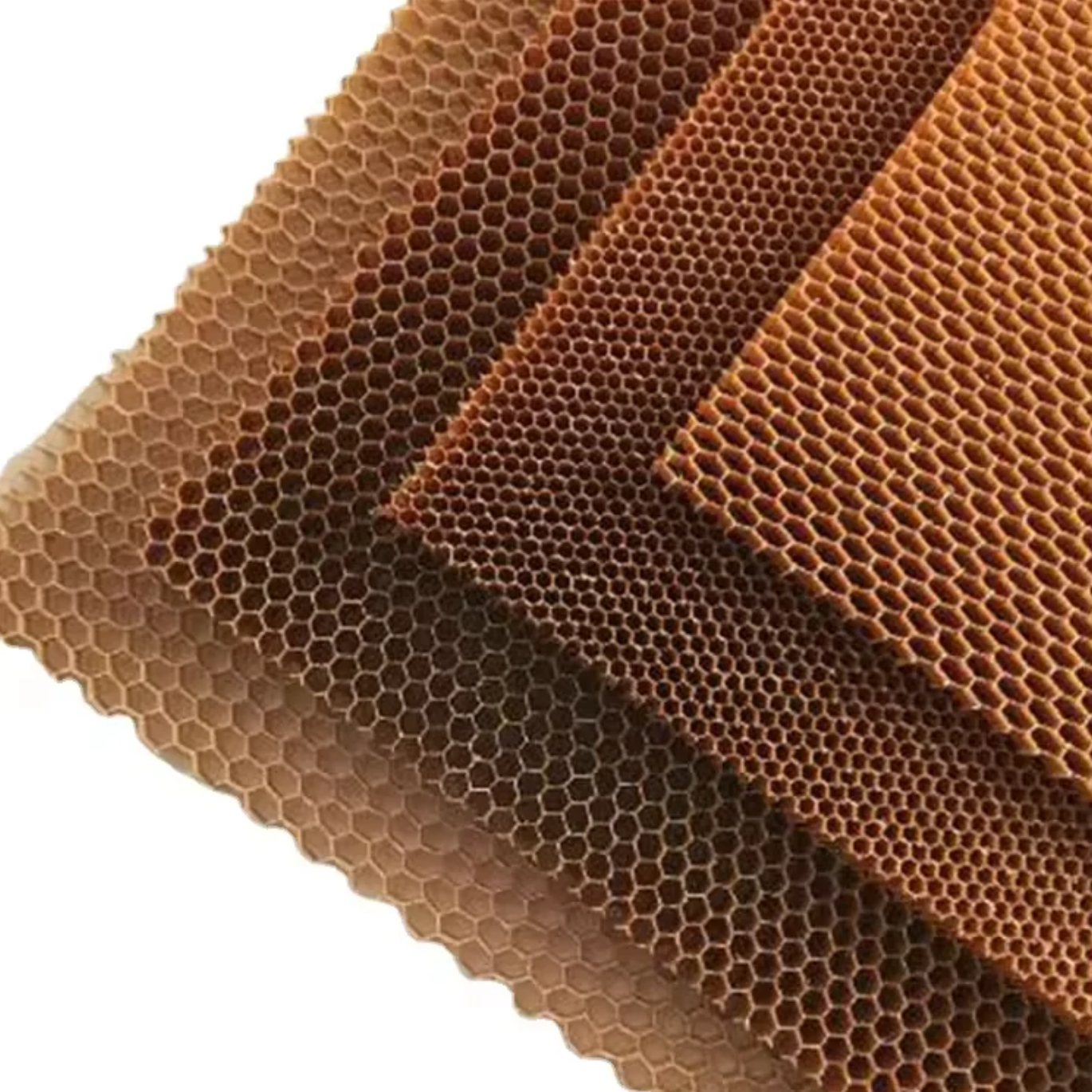
Aramid honeycomb cores are specified for aerospace structures, UAV components and high-strength sandwich panels, with stated cell sizes of 1.83–5.5 mm and a working temperature range of −60 to 180 °C.
Nomex (aramid) honeycomb. Published at 32–128 kg/m³, with cell sizes from 1.83 mm to 5.5 mm, a 2440×1220 mm sheet format, mechanical values of 0.43–5.52 MPa and a working temperature range of −60 to 180 °C, aramid honeycomb serves aircraft interiors, helicopter panels, UAV structures, motorsport, defense and radar structures, and marine racing yachts. It is a cell-structure solution: the open cells and the bonding interface to the skin are the engineering subject, which is why it does not slot into a foam-based laminate schedule without redesign.
PP honeycomb sheet. The thermoplastic option is published at 70 and 80 kg/m³, 5–100 mm thick, with 6, 8, 10 and 12 mm cell sizes in a 1220×2440 mm format, PP nonwoven or fiberglass skin options, and processing by cutting, CNC machining, lamination and thermoforming. Its stated positioning is as a lightweight alternative to plywood, marine board and traditional solid composite panels in transportation and RV applications. Where thermoforming, impact resistance and moisture resistance lead the requirement, PP honeycomb is the shorter path.
Nonwoven core mats. CINON's core mat family sits in a different role entirely. CM core mat runs 1.5–6 mm thick at 125–360 g/m² dry weight with a maximum process temperature of 175 °C; CX runs 1.5–3 mm at 120–220 g/m² and 180 °C; CS runs 2–3 mm at 130–170 g/m² and 170 °C; CT runs 1.5–3 mm at 90–160 g/m² and 180 °C. These are resin-flow and print-through control layers for vacuum infusion, resin infusion, RTM, VARTM and closed molding, and CINON positions them as alternatives to established nonwoven flow cores — CX against Soric LRC and CS against Soric SF. Buyers evaluating a Soric XF alternative or a Soric SF alternative should compare dry weight, roll length and maximum process temperature against their resin system, not against a foam datasheet.
Application fit: marine, wind, transport, rail and RV
The application map is where the matrix becomes a purchasing decision rather than a materials lecture.
- Marine and yacht: PVC foam core is specified for boat hulls, decks and bulkheads, where salt water exposure, dynamic loading and long-term static load combine. The stated requirement set — low water absorption, salt water corrosion resistance and good resin flow — maps directly onto vacuum infusion and resin infusion production of yacht hulls and decks.
- Wind energy: blade shells and nacelle structures demand fatigue resistance, dimensional stability and lightweight structure under high and low temperature cycling. PVC foam, PET foam, SAN foam and end-grain balsa are the four core families most widely cited for wind applications, so the wind decision is a comparison inside a short list, not a single-material default.
- Transportation: truck bodies, bus panels and rail interiors are built on weight reduction, impact resistance and corrosion resistance under dynamic road load and repeated thermal gradients. PVC, PET and PP honeycomb all appear in this segment, separated by process route rather than by application claim.
- RV and caravan: side walls, floors and roofs are produced on continuous lamination and vacuum bonding lines where flatness tolerance, anti-delamination and acoustic insulation are explicit requirements. PP honeycomb and PET foam appear frequently in RV sandwich panels, while PVC is used where a foam core is preferred over a honeycomb cell structure.
- Industrial and tooling: FRP panels, industrial covers, machine enclosures, composite moulds and RTM tooling rely on core mats and PET or PVC foam, with chemical compatibility and heat distortion resistance as the governing constraints.
- Aerospace and UAV: PMI foam and aramid honeycomb carry this segment, where weight criticality, stiffness-to-weight ratio, traceability and surface aerodynamics override cost per square metre.
The compliance layer that narrows the matrix
Constraint-driven buying means the certificate pack is part of the specification, not an afterthought. Two layers matter.
The first is the application standard. EN ISO 12215-2:2018 defines requirements for core materials used structurally in sandwich construction for small craft hulls and structures, in craft up to 24 m. A supplier response that does not reference the applicable standard, the density and thickness supplied, and the test method behind each value is an incomplete response.
The second is the management-system certificate. CINON holds ISO 9001:2015 under certificate 51326Q04922R053, issued by Shenzhen Moqc Certification Co., Ltd. on the GB/T19001-2016/ISO 9001:2015 standard and valid from 2026-04-29 to 2029-04-28; ISO 45001:2018 under certificate 51326S01896R053 from the same body with the same validity period; and ISO 14001:2015 under certificate ISO14001-2023-001, issued by SGS and valid from 2023-06-01 to 2028-06-01. The stated scope on these certificates is the sale of high-performance fibers and composite materials.
Buyers should read that scope precisely. A management-system certificate confirms that the supplier's quality, environmental and occupational safety processes are audited; it does not certify the shear strength of a particular foam density, and it does not replace class-society approval or customer-specific material qualification. Programme-specific approvals for aerospace, defense or classification work have to be confirmed against the individual grade being purchased — a point that applies to every supplier in this category, not to one.
Acceptance criteria for the purchase order
Once the material family is fixed, the remaining work is converting the datasheet into purchase-order language. The following fields should be explicit before a first order is released:
- Density and thickness, per zone: state the density grade and thickness for each laminate zone rather than a project-level average.
- Surface format: plain, grooved, perforated or scrim-backed, with the flow requirement that justifies it.
- Process window: resin system, infusion or RTM method, and the maximum process temperature the core must survive. For nonwoven core mats, CINON states 170–180 °C depending on grade.
- Test evidence: the specific mechanical values required, the test method, and whether third-party or in-house reports are acceptable.
- Commercial terms: CINON states a MOQ of 1,000 m², a lead time of 15–30 days, monthly capacity of 100,000 m² and 100% testing, with ODM customization on core materials and fiberglass fabric.
- Sample and validation: a laminate trial on production tooling before volume release, covering wet-out, resin uptake and surface finish.
On the supplier side, the capacity context is worth recording: a 40,000 m² manufacturing facility, 1,200,000 m² annual output, a 25-engineer technical team, and support spanning material selection, composite process optimisation, vacuum infusion guidance, alternative material recommendations, sample evaluation and quality traceability. For a buyer, the relevant question is not whether those numbers are large, but whether they can absorb a ramp without a specification change.
Market context: why the matrix keeps being re-run
Core material sourcing is concentrating in Asia-Pacific, which held 39% of the core materials market in 2025 according to Fortune Business Insights research. That shift changes the default: more buyers are qualifying suppliers in a region where product ranges are broad and documentation discipline varies widely, which raises the value of a written decision matrix over a relationship-based shortlist.
Published market-size estimates for core materials diverge significantly depending on whether auxiliary materials are included, so this article does not rely on a single headline figure. The more useful signal is structural: wind-energy composites draw on four core families — end-grain balsa, SAN foam, PVC foam and PET foam — which means a buyer who can only evaluate one material is under-equipped, and a buyer who can rank all four against a constraint set is not.
Where PVC foam core is not the right answer
A decision matrix that has no losing column is a sales document. Four honest boundaries apply.
Recyclability-led programmes. CINON publishes PET foam core explicitly as a recyclable core; PVC foam core is a crosslinked closed-cell foam and is not presented as recyclable in the same material set. Where a customer, a tender or an internal sustainability target makes recyclability a pass/fail criterion, PET should be evaluated first.
Autoclave high-temperature aerospace work. PMI foam is published at 40–130 kg/m³ with autoclave compatibility and high temperature resistance stated. PVC foam's published process list — vacuum infusion, RTM, hand lay-up, prepreg and VARTM — is broad, but aerospace primary structures under autoclave cure belong in a PMI or honeycomb evaluation.
Sub-45 kg/m³ targets. Both PMI foam (from 40 kg/m³) and aramid honeycomb (from 32 kg/m³) extend below the PVC band. If a weight target forces the density below 45 kg/m³, the PVC column closes.
Thin flow-layer problems. Where the actual requirement is resin distribution or print-through control on a thin laminate, 1.5–6 mm core mats solve it at 90–360 g/m², and specifying a structural foam instead adds weight without solving the flow problem.
There is also a documentation boundary. The PVC data reviewed here publishes density, thickness, surface and processing options, and a qualitative property set; it does not publish numeric shear or compressive values. Buyers whose acceptance criteria are numeric must obtain grade-specific test reports. That is not a criticism of the material — it is the difference between a product page and a qualification file.
Future outlook
Three trends are likely to reshape this matrix over the next specification cycles. First, recyclability is moving from a marketing attribute to a tender requirement, which will keep pushing PET foam and thermoplastic honeycomb into positions currently held by thermoset foams. Second, wind blade sizing continues to raise fatigue and dimensional-stability requirements, keeping the balsa–SAN–PVC–PET comparison active rather than resolved. Third, supplier consolidation pressure is pushing buyers toward portfolios rather than single materials, because qualifying one supplier who documents PVC, PET, PMI, honeycomb and core mats reduces audit load compared with qualifying five specialists.
For PVC foam core specifically, the durable advantage is not a single property. It is the combination of a 1–80 mm thickness range, a 45–300 kg/m³ density range, four surface formats and five process routes inside one closed-cell family — which is exactly the kind of breadth that shortens a specification review when the application spans hulls, decks, blades, panels and interiors.
FAQ
What thickness range is available in PVC foam core compared with other cores?
CINON publishes its PVC foam core at 1–80 mm thickness. PET foam core is published with a density range of 80–320 kg/m³ without a stated thickness range in the same material set. PP honeycomb sheet is published at 5–100 mm, and nonwoven core mats at 1.5–6 mm. The comparison should be made on the specific grade being quoted, since thickness and density are specified together.
How do the density ranges of PVC, PET and PMI foam cores differ?
PVC foam core is published at 45, 50, 60, 80, 100, 130, 200, 250 and 300 kg/m³. PET foam core is published at 80, 100, 120, 150, 200, 250 and 320 kg/m³. PMI foam core is published at 40, 50, 80, 100 and 130 kg/m³. The bands overlap between roughly 80 and 130 kg/m³, which is where most cross-material evaluation happens; below 45 kg/m³ and above 130 kg/m³ the options separate quickly.
When should a honeycomb core be chosen over a foam core?
Honeycomb is chosen when cell structure, temperature range or thermoplastic processing is the governing constraint rather than foam simplicity. Aramid honeycomb is published at 32–128 kg/m³ with cell sizes of 1.83–5.5 mm and a working temperature range of −60 to 180 °C, and is used in aircraft interiors, helicopter panels, UAV structures, motorsport, defense, radar structures and marine racing yachts. PP honeycomb is published at 70 and 80 kg/m³, 5–100 mm thick, and is used as a lightweight alternative to plywood and solid composite panels in transportation and RV applications.
Which standard applies to core materials in marine sandwich construction?
EN ISO 12215-2:2018 specifies requirements for core materials for structural use and for materials embedded in sandwich construction in small craft hulls and structures, covering craft up to 24 m. It defines the requirement set; it does not select a material. Buyers must still match the specific density, thickness and test evidence of the supplied core to that requirement set.
What certifications should a core material supplier provide?
At management-system level, CINON holds ISO 9001:2015 (certificate 51326Q04922R053, Shenzhen Moqc Certification Co., Ltd., valid 2026-04-29 to 2029-04-28), ISO 45001:2018 (certificate 51326S01896R053, same body and validity) and ISO 14001:2015 (certificate ISO14001-2023-001, issued by SGS, valid 2023-06-01 to 2028-06-01), with a stated scope covering the sale of high-performance fibers and composite materials. These certificates confirm audited quality, environmental and safety processes; they do not certify mechanical properties of a specific foam grade. Material-level test reports and any programme-specific approvals must be requested separately.
What should be confirmed before placing a first PVC foam core order?
Confirm five items: the density grade and thickness per laminate zone; the surface format and the resin-flow requirement behind it; the process route and maximum process temperature; the test evidence required against the buyer's own acceptance criteria; and the commercial terms. CINON states a MOQ of 1,000 m², a lead time of 15–30 days, monthly capacity of 100,000 m², 100% testing and ODM customization, with sample evaluation and vacuum infusion process support available before volume release.
CINON Composites publishes its full core material and fiberglass reinforcement range, including PVC foam core, PET foam core, PMI foam core, Core Mat, PP honeycomb and aramid honeycomb, in its product catalogue: download the CINON catalogue (PDF).
Material data quoted in this article reflects the manufacturer's published specifications and stated application scope as of 2026. Buyers should verify grade-specific test reports against their own acceptance criteria before release.
Tem questões ou precisa de mais detalhes?
Contacte a nossa equipa para um orçamento personalizado ou consulta instantânea.
Solicitar orçamento
Preencha o formulário abaixo e a nossa equipa entrará em contacto com uma proposta personalizada.
Chat direto do WhatsApp
Prefere conversar em tempo real? Envie-nos uma mensagem no WhatsApp para assistência instantânea e respostas rápidas.
- Obter orçamento personalizado
- Partilhar fotos ou documentos
- Discuta as suas necessidades diretamente
Geralmente responde em 5–30 minutos durante o horário de expediente.