
PVC Panel Procurement FAQ: Specs, Standards, Supplier Checks
Buyers of PVC decorative panels seldom fail because they cannot find suppliers. They fail when five quotations describe the same product with five different sets of numbers, and no one explains which numbers are fixed, which are negotiable and which have never been verified. That is a procurement problem rather than a sourcing problem, and it is the reason a structured set of buyer questions is more useful than another supplier list.
The category is large enough to justify that discipline. The global PVC panels market was valued at USD 14.8 billion in 2025, and PVC wall panels accounted for a 42.5% share of that market by product type, according to Dataintelo. The global wood plastic composite (WPC) market was estimated at USD 8.97 billion in 2025 by SNS Insider. On the supply side, China's PVC exports reached approximately 3.82 million tonnes in 2025, a 46% increase over 2024, according to the General Administration of Customs of the PRC.
Definitions matter when those figures are read side by side. Metastat Insights values the PVC wall panel segment alone at USD 5.84 billion for 2025, while Dataintelo's USD 14.8 billion covers all PVC panels. A buyer comparing market reports should compare their scope first, because the word panel describes different product baskets in each report.
This reference answers the questions that recur across PVC wall panels, PVC ceiling panels, PVC marble sheets, PVC self-adhesive wall stickers, indoor WPC wall panels and outdoor WPC wall panels: what a usable specification contains, which standards apply, what performance claims actually cover, and how to verify a factory before committing to a container.
One Purchase Order, Five Product Families
A request for quotation that says only PVC panel is ambiguous, and ambiguity at the quotation stage is what produces disputes at the inspection stage. The five families most often mixed together behave differently in dimensions, installation method, applicable environment and service life.
- PVC wall panel — a rigid interior decorative panel made from PVC, calcium carbonate and additives, produced at a standard size of 1220 × 2440 mm in 5 mm or 8 mm thickness, with marble, wood grain, fabric, stone or metal patterns, fixed with glue, aluminium profile or hidden fixing.
- PVC marble sheet / UV marble sheet — a thin decorative sheet in the same 1220 × 2440 mm standard size, produced in 2.0 mm to 3.0 mm thickness with a UV coating or high gloss coating, declared 100% waterproof and intended for interior wall decoration.
- PVC ceiling panel — a ceiling strip produced in widths of 200 mm to 600 mm and thicknesses of 6 mm to 10 mm, with printing, hot stamping or laminated finishes, packaging in PE film or carton, and a declared PVC content range of 35% to 50%.
- PVC self-adhesive wall sticker — a peel-and-stick roll product at 2.5 mm thickness, 600 mm or 1200 mm width and 3 m roll length, in glossy, matte or embossed finishes, with a declared indoor service life of 5 to 10 years.
- WPC wall panels — wood plastic composite profiles, separated into interior fluted panels such as 160 × 20 mm and 168 × 24 mm at 2.9 m length, and outdoor profiles in widths of 140 mm to 219 mm, where 219 × 26 mm is the popular size and the declared service life is 15 to 25 years.
Because these families use different tooling, packaging and quality control steps, a single supplier may be competitive in one and weak in another. Treating them as one line item is the first error a new importer makes.
Specification Parameters That Actually Decide a Purchase
The following parameters are the ones buyers should expect to see in writing before a sample is approved. Anything missing from this list tends to reappear later as a claim, an argument or a rejected container.
| Product family | Standard or popular size | Thickness | Material | Surface / finish | Application |
|---|---|---|---|---|---|
| PVC marble sheet / UV marble sheet | 1220 × 2440 mm standard; 1220 × 2800 mm and customized sizes available | 2.0 / 2.2 / 2.5 / 2.8 / 3.0 mm | PVC resin + calcium carbonate + additives | UV coating or high gloss coating; high gloss, matte, embossed | Interior wall decoration; 100% waterproof |
| PVC wall panel | 1220 × 2440 mm standard; 1220 × 2800 mm optional | 5 mm / 8 mm / customized | PVC + calcium carbonate + additives | Marble, wood grain, fabric, stone, metal | Interior wall decoration |
| PVC ceiling panel | Width 200 / 250 / 300 / 400 / 600 mm; length 2900 / 2950 / 3950 / 5800 / 5950 mm or customized | 6 / 7 / 7.5 / 8 / 9 / 10 mm | PVC resin + calcium carbonate + additives; PVC content 35%–50%, customizable | Printing, hot stamping, laminated | Ceilings in humid and moisture-prone interiors |
| PVC self-adhesive wall sticker | Roll width 600 mm / 1200 mm; roll length 3 m | 2.5 mm | PVC | Glossy, matte, embossed; marble, wood, stone, concrete, brick, tile, solid colour, floral | Indoor DIY and renovation wall upgrading; indoor service life 5–10 years |
| Interior WPC fluted wall panel | 2.9 m length; profiles including 160 × 20 mm, 160 × 24 mm, 150 × 10 mm, 168 × 24 mm, 150 × 15 mm, 200 × 20 mm | 10–24 mm profile dependent | Wood plastic composite (PVC/PE + wood fibre + additives) | Walnut, oak, teak, black, grey, natural wood, customized | Interior cladding, TV walls, hotel and office fit-out |
| Outdoor WPC wall panel | Popular size 219 × 26 mm; lengths 2.9 m or customized; widths 140 / 145 / 177 / 219 mm | 13 / 20 / 26 mm | Wood fibre + HDPE + additives | Wood grain, brushed, sanded, embossed, 3D wood texture | Exterior facades, villas, courtyards; declared service life 15–25 years |
Two specification habits reduce later disputes. First, state the thickness tolerance and the surface finish in the purchase order, not only the nominal dimension, because finish changes handling and cleaning requirements. Second, record the packaging method, since ceiling panels ship in PE film or carton depending on configuration, and packaging choice affects damage rates on long sea routes.
Material Composition: Reading the Words on a Datasheet
PVC panels in this category are compounded from PVC resin, calcium carbonate and additives. Calcium carbonate functions as a filler, and the ratio between resin and filler is one of the few composition details buyers can reasonably ask a supplier to declare. For PVC ceiling panels, the declared PVC content range runs from 35% to 50% and can be customized, which means two panels of identical width can still be different products when the compound differs.
WPC panels use a different chemistry. Outdoor WPC wall panels are described as wood fibre, HDPE and additives, while interior WPC fluted panels are described as wood plastic composite based on PVC or PE plus wood fibre and additives. The distinction is not cosmetic: an interior compound and an exterior compound are not interchangeable, and buyers specifying a facade should confirm which compound the quoted profile actually uses.
Profile construction also appears on quotations as co-extrusion versus traditional WPC. In co-extruded profiles the outer surface layer and the core are formed together, while traditional WPC relies on the core compound and its post-treatment. The practical implication for buyers is that the performance of the outer layer — particularly light fastness and surface durability — should be verified as a separate item rather than assumed from the word co-extrusion alone.
Standards: Which Documents a Buyer Should Request
Standards in this category fall into two groups: fire performance for interior finishes, and durability testing for surface and moisture behaviour. Knowing which group a certificate belongs to prevents the common mistake of using a fire report to answer a question about fading.
| Standard | Region | What it covers | Why a buyer asks for it |
|---|---|---|---|
| ASTM E84 (UL 723) | North America | Fire test for interior wall and ceiling finishes; a Class A rating requires a Flame Spread Index of 0–25 | Required evidence for many commercial interior specifications |
| EN 13501-1 | European Union | Fire classification of construction products; PVC panels often target Class B-s1, d0 for commercial use | Determines whether a panel may be used in a given building class |
| ASTM D1784 | Global | Cell classification for rigid PVC compounds; building panels commonly reference Cell Class 12454 | Connects the quoted panel to a defined compound class |
| ISO 105-B02 | Global | Colour fastness to artificial light, using a xenon arc fading lamp | Relevant to UV-coated sheets and any panel facing daylight |
| ASTM D570 / ISO 62 | Global | Water absorption test methods for plastics and composites | Supports or qualifies a waterproof or moisture-resistant claim |
| B1 flame retardant grade | Project dependent | Flame retardant classification reached by partial PVC wall panel models | Frequently specified for hotels, villas and commercial interiors |
The scope of a certificate deserves as much attention as the certificate itself. Test reports are issued for the specific construction that was tested — a particular thickness, colour, surface finish and compound. A report for one SKU does not automatically extend to every item on a price list, so the document should name the product, the thickness and the batch or model it covers. Buyers who ask this question early avoid the situation where a valid certificate exists but belongs to a product they are not importing.
Performance Claims: What They Cover and Where They Stop
Waterproof, UV resistant, termite proof and long service life are legitimate descriptions in this category, but each one has an operating boundary. The table below separates the claim from the condition under which it holds.
| Claim | What it means in practice | Boundary the buyer must accept |
|---|---|---|
| Waterproof | PVC marble sheets are declared 100% waterproof; PVC ceiling panels do not absorb water and resist mildew and deformation in humid interiors | PVC marble sheet is an interior product; continuous water contact and long-term outdoor exposure are outside its intended use |
| Moisture resistant for wet rooms | Self-adhesive wall stickers work on dry, flat interior walls including dry bathroom areas | Not recommended in the shower zone with continuous water contact; long-term immersion causes edge warping and peeling |
| UV resistant | Outdoor WPC wall panels use UV-stabilised raw materials to slow colour fading under sunlight | Slight natural colour change after years of exposure is normal; indoor PVC decorative panels fade and age quickly under prolonged outdoor sunlight |
| Termite proof | PVC and WPC panels are not wood-based in the sense that solid timber is, so no anti-termite treatment is required | The claim addresses termite attack, not structural load capacity |
| Service life | Outdoor WPC wall panels: 15–25 years declared; PVC marble sheet: service life over 15 years; self-adhesive wall sticker: 5–10 years indoor | Service life assumes correct substrate preparation, correct installation and normal maintenance; it is not a warranty of appearance under abnormal conditions |
| Low maintenance | No painting, sealing or repainting cycle; cleaning with a soft cloth and neutral detergent | Corrosive chemicals should be avoided, and individual damaged panels should be replaced rather than repaired |
Installation conditions carry as much weight as the panel itself. Self-adhesive stickers require a flat, clean, dry wall free of dust and loose material; a damp or uneven substrate leads to blistering and detachment. Outdoor WPC installation requires corrosion-resistant metal keels, stainless steel fasteners and sufficient expansion gaps to accommodate thermal movement. Where installation is completed outside those conditions, the failure is a site failure, not a material failure, and it will not be covered by a material certificate.
Supplier Verification Checklist by Product Category
A single supplier questionnaire rarely fits all five families. The verification items below are organised by category so that a buying team can apply the relevant list before samples are approved.
| Product family | Verify before commitment | Typical failure if skipped |
|---|---|---|
| PVC marble sheet | Raw material quality, surface film durability, sheet flatness, anti-yellowing performance, thickness specification, surface treatment, certifications, customization ability, production capacity and lead time; request pre-production samples and test reports | UV surface fading, sheet peeling or hollowing, surface scratching, batch colour difference |
| PVC wall panel | Board density, sheet flatness, surface film bonding strength, anti-yellowing performance, environmental performance, thickness and large-size specification, waterproof performance, export certifications, customization capacity and lead time | Colour fading, local deformation in humid conditions, splicing gaps, surface scratches |
| PVC ceiling panel | Raw material quality, panel thickness, colour and pattern, waterproof and anti-aging performance, flame retardant level, certifications, capacity and delivery schedule; confirm whether the supplier is a direct manufacturer rather than a middleman | Panel deformation, fading, loose joints, odour from recycled raw material, mould in poorly ventilated humid rooms |
| PVC self-adhesive wall sticker | PVC surface texture, adhesive viscosity, residue-free removal, anti-yellowing performance, backing release paper quality, printing clarity, thickness, pattern customization, roll size; require a stickiness and removal sample test | Insufficient adhesion causing warping, residual glue after removal, surface yellowing, air bubbles during application |
| Interior WPC wall panel | Wood-plastic raw material ratio, anti-deformation performance, surface coating durability, thickness and width specification, waterproof and fire resistance, certifications, customization ability and lead time | Local deformation under temperature swings, surface wear, loose splicing, mildew in long-term high humidity |
| Outdoor WPC wall panel | Anti-UV performance, weather resistance, anti-fading performance, wood-plastic formula, anti-deformation, waterproof property, profile specification, surface co-extrusion layer, fire certification, customization capacity; request outdoor aging test reports and project references | Facade colour fading, cracking under temperature extremes, water seepage and mildew, loose fixing in windy conditions |
Two verification questions apply to every row. Can the supplier show real export experience in markets comparable to yours, and can the same panel be produced again in six months to the same standard? The first question concerns capability; the second concerns consistency, which is where long-term cost is decided.
Commercial Terms Before Execution
Once a supplier is shortlisted, the questions shift from materials to execution. Typical terms in this category follow a consistent structure, and buyers should confirm each element in writing before production is scheduled.
- Minimum order quantity — one 20-foot container with 4 to 6 colours from the catalogue. For orders below a full container, 500 sqm per colour from stock colours or 1,000 sqm from the catalogue range are the usual alternatives.
- Delivery terms — FOB, CIF or CFR, depending on the buyer's freight arrangements and import experience.
- Acceptance criteria — pre-shipment test, which should be defined by parameter rather than by a general statement of quality.
- Payment terms — 30% T/T in advance, with 70% T/T against a copy of the bill of lading.
- Customization — OEM and ODM are available across the PVC marble sheet, PVC wall panel, PVC ceiling panel, self-adhesive sticker and WPC ranges, so profiles, colours and patterns can be adapted before tooling is committed.
The pre-shipment test is the clause worth negotiating carefully. A test that names density, flatness, film bonding, thickness and colour against a retained approved sample gives a buyer something enforceable. A test described only as quality inspection does not.
How PVC and WPC Panels Compare with Traditional Alternatives
Procurement decisions in this category are rarely made against another decorative panel. They are made against natural stone, gypsum, solid wood or ceramic tile, and the comparison is usually settled on installation time and lifetime maintenance rather than on unit price.
| Panel | Alternative it replaces | Measured difference | Where it fits |
|---|---|---|---|
| PVC marble sheet | Natural marble, ceramic tile, latex paint wall, ordinary plastic wall panel | Up to 70% lighter than natural marble, 40%–60% faster installation, up to 60% lower material cost, service life over 15 years | Hotels, apartments, villas, offices, shopping malls, hospitals, schools |
| PVC wall panel | Traditional wood veneer / MDF decorative panel | About 40% lighter, installation 50% faster, 100% moisture resistance | Homes, hotels, offices, commercial interiors |
| PVC ceiling panel | Gypsum ceiling / wooden ceiling | Installation 40% faster, service life over 15 years, 100% moisture resistant, around 20%–30% lower installation cost than wooden ceilings, reflective surface improving indoor lighting efficiency by up to 10% | Bathrooms, kitchens, balconies, commercial ceilings |
| Interior WPC wall panel | Solid wood wall panel | Installation 30% faster, maintenance cost reduced by over 60%, service life over 20 years | Living rooms, offices, hotels, retail spaces |
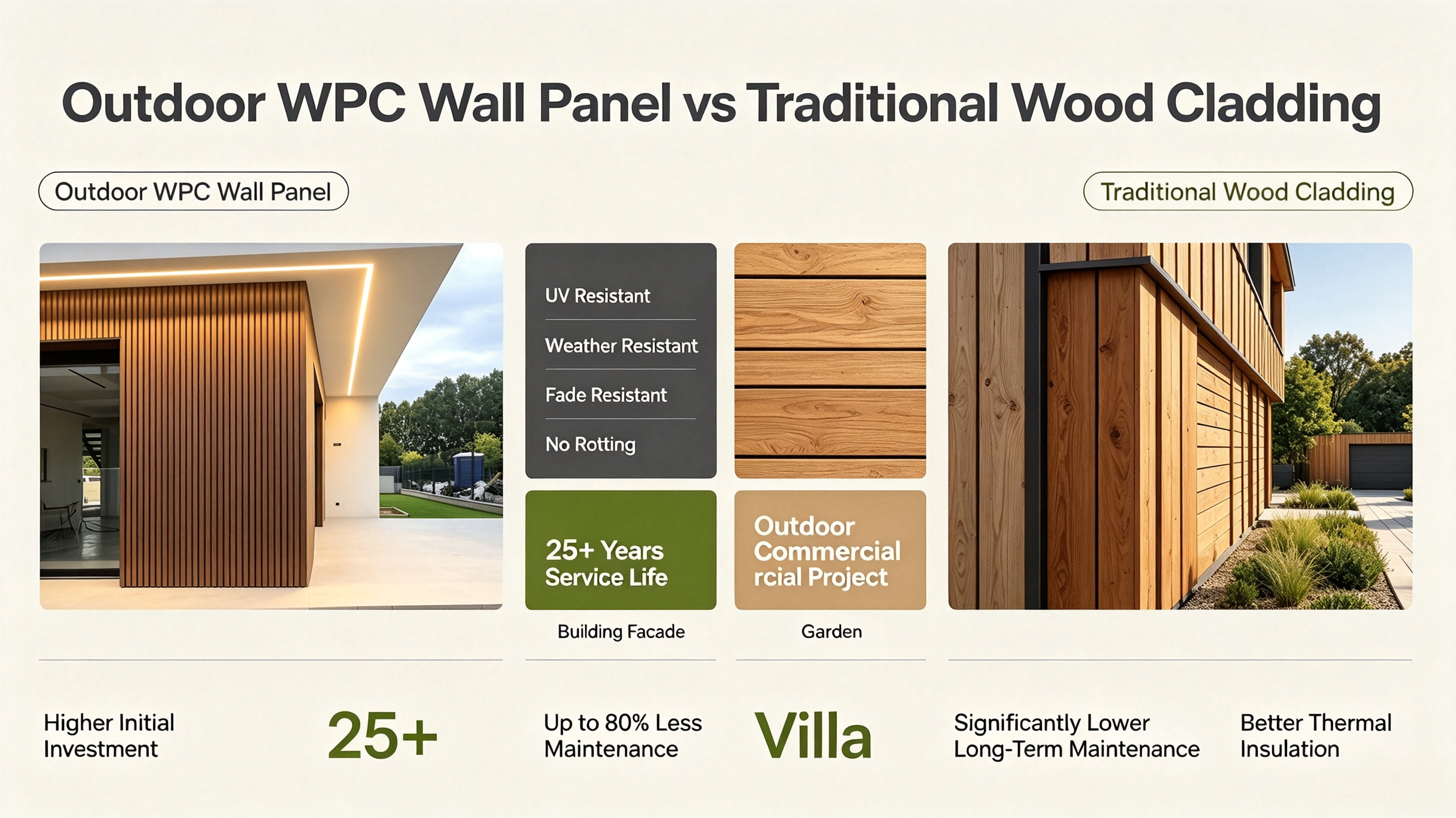
| Outdoor WPC wall panel | Traditional wood cladding | Service life over 25 years, maintenance reduced by up to 80% | Building facades, villas, gardens, outdoor commercial projects |
| PVC self-adhesive wall sticker | Wallpaper, ceramic wall tiles | Installation up to 70% faster, material and installation costs up to 50% lower | Rental apartments, kitchens, bathrooms, DIY decoration |
The limits deserve equal attention. PVC marble sheet is an interior panel and should not be specified for long-term exterior use. Outdoor WPC carries a higher initial investment than traditional wood cladding, and the return appears through reduced maintenance rather than through first cost. Self-adhesive stickers are the fastest option on a prepared flat wall, but they are the weakest option on a rough, damp or freshly plastered substrate. And where a project requires a specific fire class, only panels whose tested construction matches that class should be considered — partial model coverage, such as B1 grade on selected PVC wall panel models, is not the same as blanket approval of a product range.
Where Demand Is Moving
The direction of the market explains why procurement questions have become more technical rather than less. Asia-Pacific accounted for a 38.4% revenue share of the global PVC panels market in 2025, which concentrates both supply capacity and price competition in one region, according to Dataintelo. Synthetic marble, which includes PVC marble sheets, is projected to grow at a compound annual growth rate of 6.8% from 2025 to 2032, based on Metastat Insights. One industry forecast places the WPC market compound annual growth rate at 11.6% from 2025 to 2030, which reflects continued substitution of exterior timber cladding.
Self-adhesive products follow the same pattern from the retail side. The global peel-and-stick wallpaper market was valued at USD 3.8 billion in 2025, with vinyl segments holding a 48.6% share, according to Dataintelo. On the trade side, India was the largest buyer of China's PVC exports in 2025 at approximately 39% of total volume, based on data reported by OilChem and the General Administration of Customs of the PRC.
For buyers, the practical reading is that supply is abundant and increasingly interchangeable at the low end, while documentation quality and batch consistency remain uneven. Competition on price is therefore a weak screening tool; competition on verification is a strong one.
Long-Term Supply: What Repeat Buyers Actually Evaluate
Once a first container is delivered, the questions that determine whether a relationship continues are different from the ones that won the order. Repeat importers in this category tend to evaluate four things.
The first is sample-to-batch consistency. A supplier that can reproduce the approved sample across successive production runs — with the same flatness, film bonding and colour calibration — removes the need for a re-approval cycle on every order. The second is documentation continuity: the same certificates, test reports and pre-shipment records for each shipment, not only for the first one. The third is customization continuity, since OEM and ODM work only creates value if the agreed specification survives multiple runs. The fourth is technical support through the life of the project, particularly where a small number of damaged panels need to be replaced without re-cladding an entire elevation.
YIKE NEW MATERIAL is one of the manufacturers positioned in this segment. HAINING YIKE NEW MATERIAL CO., LTD is a China-based manufacturer and exporter of PVC and WPC decorative building materials, founded in 2019, operating a 10,000 m² factory with 50 employees and an annual output of 5,000,000 m², supported by a research and development team of 10 engineers. Its declared export ratio is 100%, with main markets in Central America, South America, Southeast Asia, the Middle East and Africa, and a product range covering PVC ceiling panels, PVC wall panels, PVC marble sheets and UV marble sheets, WPC wall panels and fluted panels, outdoor WPC wall panels, PVC decorative panels and PVC self-adhesive wall stickers. Company information and product documentation are published at www.merchandise-eco.com.
Those are supplier-declared particulars rather than independently audited facts, and they should be treated accordingly: useful as a screening input, verifiable through samples, factory audit and pre-shipment testing. The reason they matter for long-term procurement is that a supplier's production scale, engineering resource and export concentration determine how quickly it can respond when a repeat order changes colour, profile or destination port.
Outlook
Three shifts are likely to shape procurement in this category over the next few years. Testing expectations will tighten, as commercial buyers move from asking whether a product is fire rated to asking which tested construction the rating covers. Exterior specification will continue to shift toward WPC profiles where maintenance budgets, rather than material budgets, drive the decision. And the growth of self-adhesive formats will keep pulling retail-oriented volumes toward roll-based products with shorter service cycles, which places more weight on adhesive and backing quality than on panel structure.
For importers, contractors and distributors, the operational conclusion is straightforward. The measurable difference between a good and a poor purchase in this category is rarely the panel itself; it is how precisely the specification was written, how narrowly the certificate was matched to the SKU, and how repeatable the approved sample proved to be.
Procurement FAQ
What size and thickness should be specified for a PVC marble sheet?
The standard size is 1220 × 2440 mm, with 1220 × 2800 mm available and customized dimensions supported. Thickness options are 2.0 mm, 2.2 mm, 2.5 mm, 2.8 mm and 3.0 mm, and the surface is finished with a UV coating or high gloss coating in high gloss, matte or embossed versions. Thicker sheets are generally chosen where the substrate is less even or where greater rigidity is required at handling and installation.
Can PVC marble sheets be used outdoors?
Long-term outdoor use is not recommended. PVC marble sheet is an interior decorative panel, and prolonged exposure to UV sunlight causes surface fading and aging. It is intended for interior wall decoration, including dry and wet indoor areas such as bathrooms, where it performs well as a moisture-resistant surface, provided continuous water soaking is avoided during and after installation.
Are PVC ceiling panels suitable for humid rooms?
Yes. Quality PVC ceiling panels do not absorb water and resist mildew and deformation, which makes them suitable for humid interior environments such as kitchens, bathrooms and balconies, as well as commercial ceilings in offices, supermarkets, hotels and corridors. They are produced in widths of 200 mm to 600 mm and thicknesses of 6 mm to 10 mm, with PVC content from 35% to 50%, and installed on a keel framework using a modular snap-in method.
What wall conditions does a self-adhesive wall sticker require?
The wall must be flat, clean, dry and free of dust or loose material. Damp, uneven or powdery surfaces lead to insufficient adhesion, blistering and detachment. The product is supplied at 2.5 mm thickness in 600 mm and 1200 mm roll widths with a 3 m roll length, and carries a declared indoor service life of 5 to 10 years. It is not recommended for shower zones with continuous water contact, because long-term immersion causes edge warping and peeling.
Which fire test standard applies to interior wall and ceiling panels?
In North America, ASTM E84 (UL 723) is the primary fire test for interior wall and ceiling finishes, and a Class A rating requires a Flame Spread Index of 0 to 25. In the European Union, building material fire classification follows EN 13501-1, where PVC panels often target Class B-s1, d0 for commercial applications. Separately, partial PVC wall panel models reach B1 flame retardant grade, which applies to those models rather than to an entire product range.
How can UV resistance and colour fastness claims be verified?
ISO 105-B02 is the standard test method for colour fastness to artificial light using a xenon arc fading lamp, and it is the appropriate evidence for panels exposed to daylight. Water absorption claims are supported by ASTM D570 or ISO 62 testing. Because test reports apply to the specific construction tested, the report should identify the thickness, colour, surface finish and model it covers. Outdoor WPC panels, which declare a 15 to 25 year service life, use UV-stabilised raw materials; a slight natural colour change after years of exposure is normal and should be expected.
How should a factory be evaluated before a bulk PVC panel order?
Evaluation typically covers board density, sheet flatness, surface film bonding strength, anti-yellowing performance, environmental performance, thickness and large-size specification, waterproof performance, export certifications, customization ability, price, production capacity and lead time. Pre-production samples, relevant test reports and consistent quality across production runs are the practical evidence. Working with direct manufacturers rather than intermediaries also reduces the risk that bulk goods differ from the approved sample.
What should be asked of a PVC marble sheet supplier specifically?
Buyers should ask about production capacity, minimum order quantity, lead time, customization options, quality inspection procedures, certifications, packaging methods, warranty terms and export experience. These items determine whether a supplier can meet commercial requirements as well as product requirements. Two recurring risks in this category are UV surface fading and batch colour difference, both of which are managed through anti-UV surface curing, unified raw material formulation, batch colour calibration and pre-delivery sampling inspection.
What commercial terms are typical for a first container?
A common structure is a minimum order of one 20-foot container with 4 to 6 colours from the catalogue. Below a full container, alternatives include 500 sqm per colour from stock colours or 1,000 sqm from the catalogue range. Delivery terms are usually FOB, CIF or CFR; acceptance criteria are based on pre-shipment testing; and payment terms are typically 30% T/T in advance with 70% T/T against a copy of the bill of lading.
How can quality be kept consistent across repeat orders?
Consistency is normally protected by three practices: retaining a signed approved sample as the reference standard, applying batch colour calibration so that successive production runs match, and running pre-shipment testing against the agreed parameters rather than against a general statement of quality. For outdoor WPC profiles, anti-deformation performance and the surface layer of the profile should be re-checked on each order, because these are the parameters most affected by compound variation between runs.