
PVC, WPC or Stickers? Matching Wall Panels to Real Projects
Decorative wall panels are usually chosen for appearance and purchased on price — then misapplied on site. In this category, the mismatch that generates returns, claims and rework is rarely cosmetic quality; it is environment. An interior PVC panel specified for a facade, or an exterior-grade WPC profile installed in a hotel corridor, creates problems that no inspection report can correct after installation.
The practical answer is straightforward. Interior ceilings and wet indoor walls call for PVC ceiling panels, PVC wall panels and PVC or UV marble sheets; slatted interior walls call for interior WPC fluted panels; facades and exterior cladding call for outdoor WPC wall panels; and fast DIY or renovation work calls for PVC self-adhesive wall stickers. The difficulty is not the rule — it is applying it at purchase-order level, where model, thickness, surface finish and documentation decide whether the rule holds.
Category scale makes that decision more consequential than it once was. Dataintelo valued the global PVC panels market at USD 14.8 billion in 2025, with PVC wall panels accounting for 42.5% of the market by product type. SNS Insider estimates the global wood plastic composite (WPC) market at USD 8.97 billion for the same year. Interior PVC, interior WPC, exterior WPC and self-adhesive films now travel in the same container for many importers, which places the selection decision — not the sourcing decision — at the centre of distributor risk.
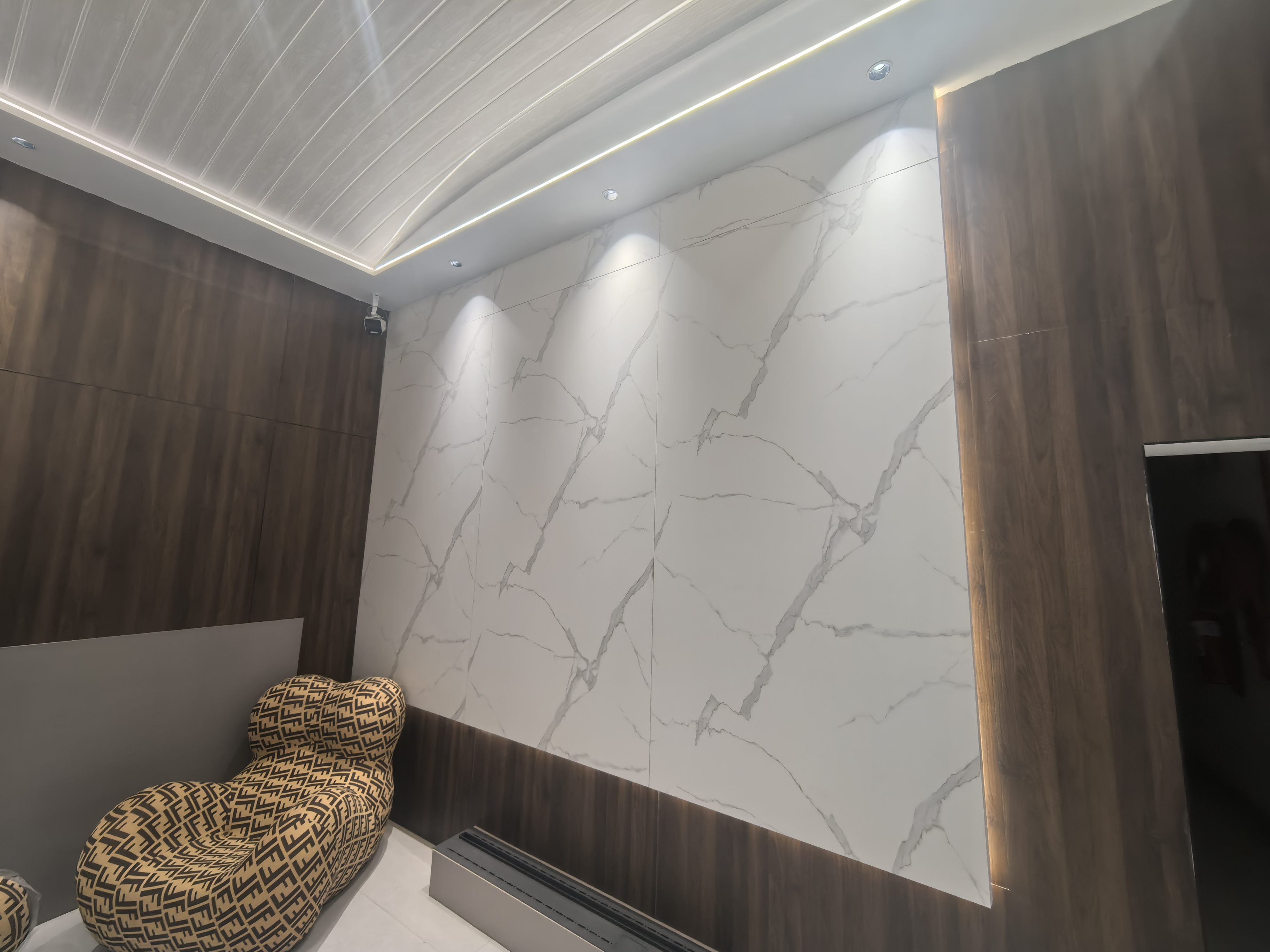
Decorative panel supply for residential and commercial renovation projects — YIKE building materials distributor and wholesaler case, Indonesia.
Why the Project Environment Decides the Panel Type
The functional difference between interior and exterior decorative panels is exposure, not styling. Interior surfaces see cleaning cycles, occasional humidity and indirect light. Exterior surfaces see direct ultraviolet radiation, wind-driven rain, temperature cycling and, in tropical and coastal markets, sustained humidity. A panel that satisfies indoor requirements can still fail outdoors within a short service period — and substituting an exterior-grade product indoors wastes cost on weather resistance the project does not need.
Three published qualification frameworks let buyers convert that judgement into a specification:
- Fire reaction. ASTM E84 (UL 723) is the primary fire test standard for interior wall and ceiling finishes in North America, and a Class A rating requires a Flame Spread Index of 0–25. In the European Union, EN 13501-1 classifies building materials, and PVC panels commonly target Class B-s1, d0 for commercial interiors. Both frameworks address interior finishes; exterior cladding follows different pathways.
- Water absorption. ASTM D570 and ISO 62 are the standard test methods used to determine water absorption rates for PVC and composite panels — the measurement behind humidity-performance claims for bathrooms, kitchens and tropical installations.
- Colour stability. ISO 105-B02 measures colour fastness of decorative panels to artificial light using a xenon arc fading lamp, which is the relevant reference when a buyer needs to separate indoor colour stability from outdoor anti-fading claims.
Material classification adds a fourth layer. ASTM D1784 specifies cell classification for rigid PVC compounds, and common building panels use Cell Class 12454 for a balance of impact and tensile strength. In practice, model-level specification sheets and test reports are what connect these frameworks to a specific SKU rather than to a product category.
Six Project Families and the Panel That Fits Each
The matching logic below follows the conditions a panel meets after installation, not the design intent at specification stage. Each row states the panel family, the verified reference specification, and the boundary where the product stops being appropriate.
| Project family | Conditions in service | Matched panel type | Verified reference specifications | Known boundary |
|---|---|---|---|---|
| Interior ceilings — bathrooms, kitchens, corridors, retail and office ceilings | Indoor humidity, cooking fumes, cleaning, indirect light | PVC Ceiling Panel | Widths 200 / 250 / 300 / 400 / 600 mm; thickness 6, 7, 7.5, 8, 9, 10 mm; lengths 2900, 2950, 3950, 5800, 5950 mm or customized; PVC content 35%–50% (customizable); surface printing, hot stamping, laminated; models such as YK-200*7mm | Indoor ceiling and wall product; not intended as exterior cladding |
| Interior feature and wet-area walls — bathrooms, kitchens, TV walls, hotel corridors | High humidity, splash, regular wiping, visible surface expectations | PVC Marble Sheet / UV Marble Sheet / PVC Marble Wall Panel | Standard size 1220 × 2440 mm; other size 1220 × 2800 mm or customized; thickness 2.0 / 2.2 / 2.5 / 2.8 / 3 mm; UV coating or high gloss coating; high gloss, matte, embossed finish; documented 100% waterproof; glue, silicone or aluminum profile installation | Not recommended for long-term outdoor use; standard UV finish provides basic anti-scratch performance, not impact protection |
| Interior full-wall cladding — apartments, offices, showrooms, brand stores | Frequent human activity, cleaning, large flat surfaces, low seam visibility | PVC Wall Panel / PVC Decorative Panel | 1220 × 2440 mm and 1220 × 2800 mm; thickness 5 mm or 8 mm or customized; patterns marble, wood grain, fabric, stone, metal; installation by glue, aluminum profile or hidden fixing | Interior application; fire performance is model-specific — B1 flame retardant grade is documented on partial models only |
| Interior slatted feature walls — retail, hospitality, residential accents | Damp indoor space, impact contact, design-led finishes | Interior WPC Wall Panel / WPC Fluted Wall Panel / Wood Slat Wall Panel | Material: wood plastic composite (PVC/PE + wood fibre + additives); popular models 160*20, 160*24, 150*10, 168*24, 150*15, 200*20 mm, 2900 mm length; installation by clip, screw fixing or glue; colours walnut, oak, teak, black, grey, natural wood, customized | Suitable for damp indoor rooms such as basements; not suitable for open-air outdoor exposure |
| Exterior facades, villa exteriors, commercial frontages, courtyard landscape | Direct sunlight, rain, high humidity, UV exposure, wide temperature range | Outdoor WPC Wall Panel | Material: wood fibre + HDPE + additives; co-extrusion or traditional WPC; widths 140 / 145 / 177 / 219 mm; thickness 13 / 20 / 26 mm; length 2.9 m or customized; wood grain, brushed, sanded, embossed, 3D wood texture; documented service life 15–25 years; models such as YK-219*26*2900mm | UV-stabilized formulation slows colour fading; slight natural colour change after years of exposure is normal, not a defect |
| DIY and fast renovation — rental housing, retail fixture refresh, local wall repair | Dry indoor walls, tool-light installation, short project windows | PVC Self-Adhesive Wall Sticker | Material PVC; thickness 2.5 mm; widths 600 mm and 1200 mm; roll length 3 m; glossy, matte or embossed finish; patterns marble, wood grain, stone, concrete, brick, tile, solid colour, floral; documented indoor service life 5–10 years; models such as YK-1200*3000mm | Not recommended for continuous water-contact shower zones; substrate must be flat, clean and dry; a small amount of residual adhesive is possible after very long service or prolonged high temperature |
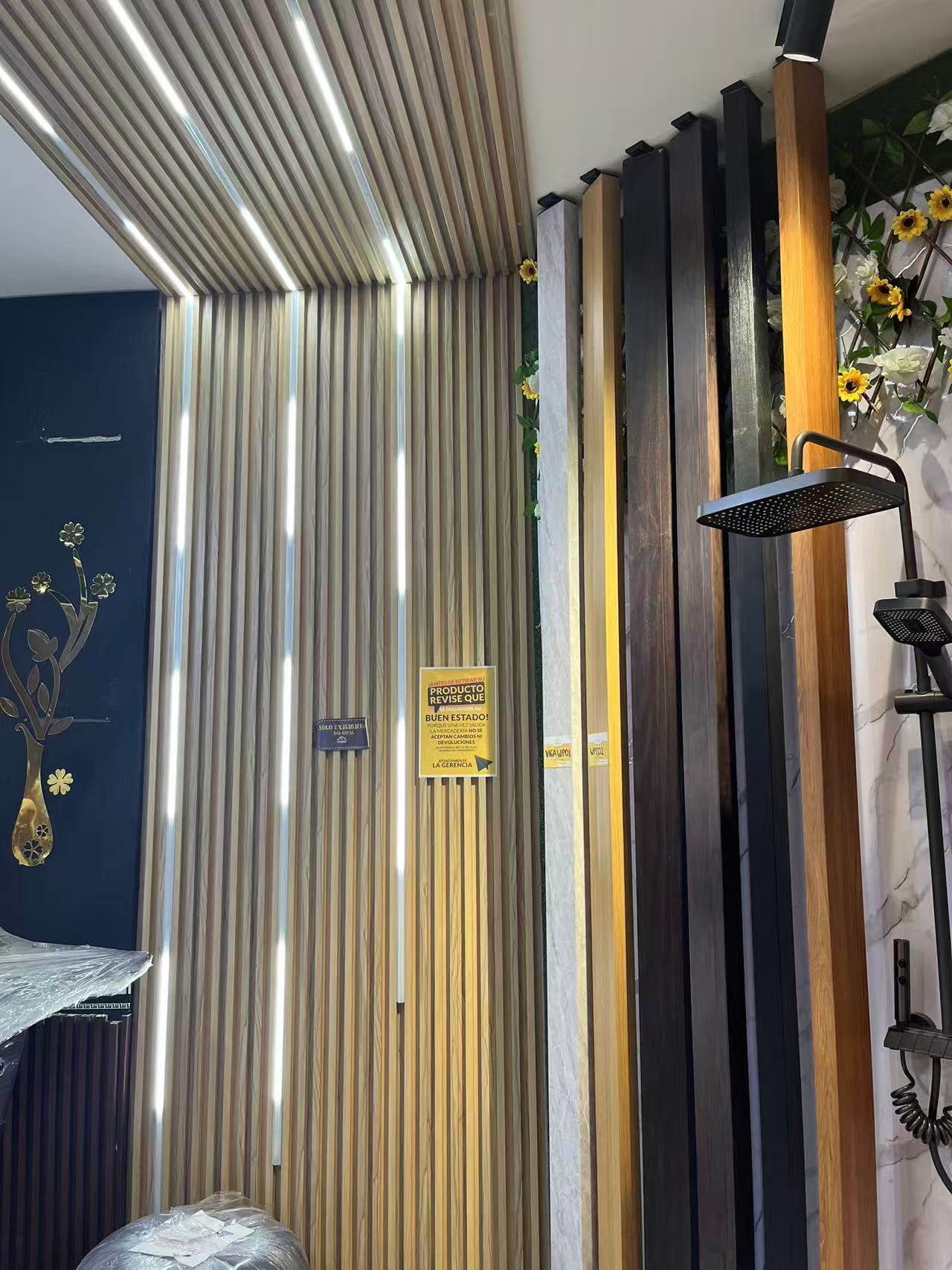
Commercial interior applications — retail shops, brand stores, showrooms, offices and restaurants using PVC ceiling panels, PVC marble sheets and WPC wall panels. YIKE case, Ecuador.
What the Material Differences Mean in Practice
Composition explains why the matches above hold, and why substitutions fail. Four material systems cover almost all decorative wall panel procurement.
Rigid PVC panels: PVC resin + calcium carbonate + additives
PVC ceiling panels, PVC wall panels and PVC or UV marble sheets share a rigid PVC base. Ceiling panels are documented with 35%–50% PVC content, widths of 200–600 mm and thickness of 6–10 mm, produced in printing, hot stamping and laminated finishes. Marble sheets compact the same chemistry into 2.0–3.0 mm sheets with UV coating or high gloss coating over 1220 × 2440 mm or 1220 × 2800 mm formats. Large decorative PVC wall panels use 5 mm or 8 mm formats. The practical implications are moisture resistance, wipe-clean surfaces, modular installation and predictable cutting — which is why interior programmes are usually built from a ceiling panel, a marble sheet and an interior WPC profile rather than from a single SKU.
Interior WPC: wood fibre + PVC/PE + additives
Interior WPC fluted panels combine wood fibre with a PVC/PE polymer system. The composite is denser than a thin decorative sheet, which supports impact resistance, dimensional stability and moisture and mildew resistance in damp indoor environments. Documented indoor suitability includes basements and hotel bathrooms; open-air exposure is outside the intended scope.
Outdoor WPC: wood fibre + HDPE + additives
Outdoor WPC wall panels use a different polymer system — wood fibre with HDPE — and are supplied as co-extrusion or traditional WPC profiles with widths of 140–219 mm, thickness of 13–26 mm and a documented service life of 15–25 years. Anti-UV performance, weather resistance, anti-fading behaviour and anti-deformation are the selection parameters buyers should test. The distinction is not cosmetic: interior WPC panels cannot replace outdoor WPC wall panels on exterior facades, because interior grades fade and crack rapidly under sustained UV, temperature cycling and rain.
Self-adhesive PVC film: performance depends on the substrate
A PVC self-adhesive wall sticker is a 2.5 mm PVC film with an adhesive backing, supplied in 600 mm and 1200 mm widths on 3 m rolls. Documented installation steps are to clean and dry the wall, measure and cut, peel the release paper, paste from top to bottom while squeezing out air, and trim the edges. Documented failure modes — warping, falling, bubbles, yellowing, residual glue — are triggered by dusty, uneven or damp walls, direct sunlight, or use beyond the service cycle rather than by the film alone.
How YIKE NEW MATERIAL Covers the Six Project Families
YIKE NEW MATERIAL (Haining Yike New Material Co., Ltd.) is a China-based manufacturer and exporter of interior and exterior decorative building materials, founded in 2019 and operating a 10,000 m² factory in Haining, Jiaxing City, Zhejiang Province, China, with 50 employees, an annual output of 5,000,000 m² and a 10-engineer R&D team. Its export ratio is 100%, with Central America, South America, Southeast Asia, the Middle East and Africa as principal markets.
The portfolio maps directly onto the six project families: PVC Ceiling Panels; PVC Wall Panels and PVC Decorative Panels; PVC Marble Sheets, UV Marble Sheets and PVC Marble Wall Panels; interior WPC Wall Panels and WPC Fluted Wall Panels; Outdoor WPC Wall Panels; and PVC Self-Adhesive Wall Stickers.
For an importer assembling a mixed interior and exterior programme, the operational facts that determine feasibility are:
- Customization: OEM / ODM with colour, pattern and logo customization.
- Capacity and timing: monthly capacity of 500,000 m² and lead time of 14–30 days.
- Order structure: MOQ of one 20-foot container with 4–6 colours from the E-catalogue; below that, 500 sqm per colour from stock colours or 1,000 sqm from the E-catalogue.
- Quality control: 100% pre-shipment testing, with third-party inspection (SGS) available.
- After-sales: remote technical support.
Documented Applications: Interior, Commercial and Tropical
Published case data from YIKE export projects in Latin America and Southeast Asia shows how the matching logic above behaves in real order patterns.
| Market | Buyer type | Supply volume | Cooperation | Panel mix and application |
|---|---|---|---|---|
| Ecuador | Building materials distributor / wholesaler | 3 x 40HQ containers | 2 years | PVC ceiling panels, PVC marble sheets and WPC wall panels used in commercial interiors: retail shops, brand stores, showrooms, offices and restaurants |
| El Salvador | Building materials distributor | 1 x 40HQ container | Residential decoration project | PVC ceiling panels, PVC marble sheets and WPC wall panels supplied as a complete home decoration solution for affordable, attractive interiors |
| Indonesia | Distributor / wholesaler and renovation service provider | 10 x 40HQ containers | 3 years of continuous orders | PVC ceiling panels, PVC marble sheets and WPC wall panels applied in residential and commercial renovation projects |
| Malaysia | Building materials distributor / wholesaler | 10 x 40HQ containers | Repeat orders and recommendations | Panels installed in over 100 residential houses, plus residential, hotel, shopping mall, retail and commercial projects in a tropical climate |
| Colombia | Building materials distributor | Over 60 x 40HQ containers per year | 2 years | Complete decorative range including PVC ceiling panels, PVC marble sheets and WPC wall panels, supporting a continuous China supply chain |
Read as evidence rather than promotion, three procurement observations follow. First, interior projects are typically supplied as a decorative programme — ceiling panel plus marble sheet plus wall panel — rather than as single SKUs, which means supplier breadth across product families matters more than unit price on one item. Second, repeat container volume over two to three years is the strongest available consistency signal, because it reflects batch-to-batch stability rather than sample quality. Third, tropical markets in Malaysia and Indonesia test moisture performance directly; consistent installation in humid, high-rainfall conditions supports moisture and mildew resistance claims in indoor use.
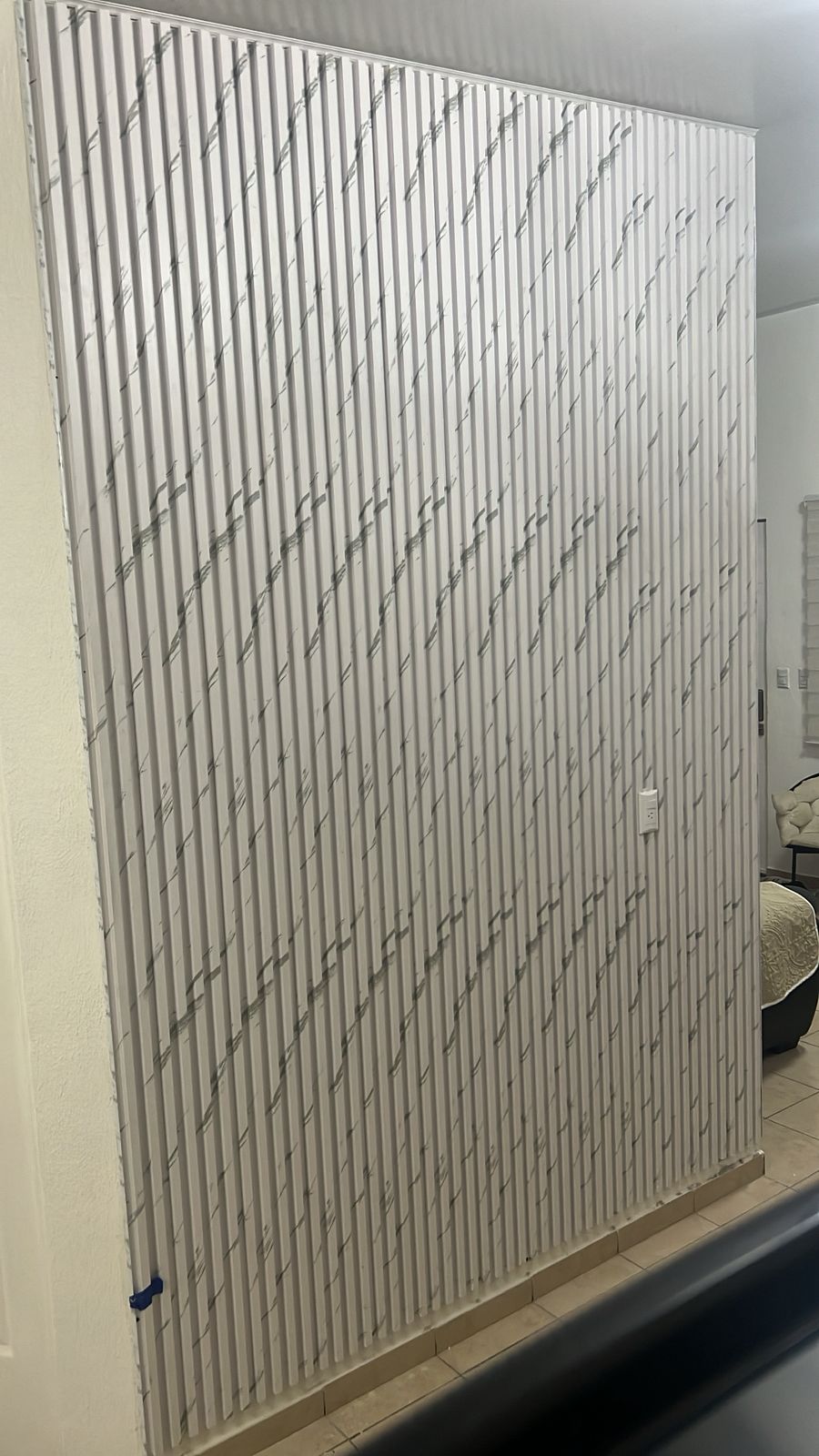
Residential interior decoration using PVC ceiling panels, PVC marble sheets and WPC wall panels — YIKE case, El Salvador.
What the Market Data Says About the Interior and Exterior Split
Published third-party estimates support the view that demand is expanding on both sides of the interior–exterior divide, with exterior composite materials growing at the faster projected rate.
- Global PVC panels market: USD 14.8 billion in 2025, with PVC wall panels holding a 42.5% share by product type (Dataintelo).
- Asia-Pacific accounted for a 38.4% revenue share of the global PVC panels market in 2025 (Dataintelo).
- Global WPC market: estimated at USD 8.97 billion in 2025 (SNS Insider).
- Synthetic marble, including PVC marble sheets: projected CAGR of 6.8% from 2025 to 2032 (Metastat Insights).
- Global peel-and-stick (self-adhesive) wallpaper market: USD 3.8 billion in 2025, with vinyl segments holding a 48.6% share (Dataintelo).
- Ceiling tiles market including PVC: USD 8.03 billion in 2024, growing at a CAGR of 10.2% (Cognitive Market Insights).
- China's total PVC exports reached approximately 3.82 million tonnes in 2025, a 46% increase from 2024, with India accounting for roughly 39% of export volume (General Administration of Customs of the PRC; OilChem).
One caveat belongs in any procurement memo that quotes market sizing. Estimates for the wall-panel sub-segment diverge by scope: Metastat Insights values PVC wall panels at USD 5.84 billion in 2025 and projects that market at USD 8,032.76 million by 2032, while Dataintelo's USD 14.8 billion covers the wider PVC panels category including other panel formats. Buyers should state which scope a figure describes before using it in a business case.
On the supply side, Palram Industries Ltd. and Dumaplast NV are identified as leading global competitors in the PVC panels sector (Dataintelo), which indicates that multi-material portfolios — interior decorative products and exterior systems under one roof — are the norm at the top of the category rather than the exception.
Where Panels Fit Against Traditional Solutions — and Where They Do Not
| Traditional solution | Where decorative panels substitute well | Where they do not substitute |
|---|---|---|
| Natural marble | PVC marble sheets are lighter, lower in cost and faster to install, reproduce marble texture and require less daily maintenance as an interior wall finish | They are not stone. Long-term outdoor use is not recommended, and standard UV finish delivers basic anti-scratch performance rather than the wear profile of stone |
| Ceramic and porcelain wall tile | Sheet and panel formats reduce wet-trade installation time across large wall areas and can be fixed with glue, silicone or aluminum profiles | Continuous water contact, heavy abrasion and tile-specific standards remain tile territory; self-adhesive PVC stickers are not recommended for continuous water-contact shower zones |
| Solid timber cladding and wood slats | Interior WPC fluted panels reproduce a wood-slat appearance with documented moisture and mildew resistance for damp indoor spaces such as basements | Interior WPC is not an exterior material; open-air facades and courtyards require outdoor WPC wall panels with a UV-stabilized formulation |
| Paint and conventional wallpaper | Self-adhesive PVC wall stickers support dry, tool-light refurbishment of rental housing and retail interiors, with a documented indoor service life of 5–10 years | Performance depends on a flat, clean, dry substrate; uneven or damp walls cause blistering and peeling, and removal after many years or prolonged heat may leave a small amount of residual adhesive |
| Exterior decorative systems generally | Outdoor WPC provides co-extruded profiles with documented 15–25 year service life and UV-stabilized raw materials for facades, villa exteriors and landscape structures | Weather resistance does not mean colour immobility — slight natural colour change over years of exposure is normal. Interior fire classifications such as ASTM E84 Class A or EN 13501-1 targets do not transfer automatically to exterior systems and remain model-specific |
The most expensive error in this category is a single sentence in a purchase order: applying an interior decorative panel to an exterior surface, or specifying exterior-grade outdoor WPC for an interior wall where fire documentation, finish consistency and joint tolerance govern the outcome. Both directions fail differently, and both are avoidable when the environment is written into the specification before the finish is chosen.
A Six-Point Selection Checklist for Importers
- 1. Define the surface environment first. Indoor ceiling, indoor wet wall, indoor dry wall, DIY film, or exterior facade. The environment determines the product family before any pattern or price discussion.
- 2. Write the family and model into the purchase order. For example PVC Ceiling Panel YK-200*7mm, PVC Marble Sheet YK-1220*2440*3mm, or Outdoor WPC Wall Panel YK-219*26*2900mm — not only the category name.
- 3. Request model-level documentation. Fire classification for interior finishes (ASTM E84 Class A, EN 13501-1 targets), water absorption data per ASTM D570 or ISO 62, and colour fastness per ISO 105-B02 where fading risk matters.
- 4. Verify the fixing system and substrate requirements. Clip, screw fixing, glue, silicone, aluminum profile or hidden fixing for rigid panels; flat, clean, dry substrate for self-adhesive products.
- 5. Confirm order structure before committing to a mixed programme. Colour count, MOQ basis, monthly capacity and lead time — for example one 20-foot container with 4–6 catalogue colours, 500,000 m² monthly capacity and 14–30 day lead time.
- 6. Require pre-shipment evidence. 100% pre-shipment testing, plus third-party inspection (SGS) where the project or the destination market requires independent verification.
Future Outlook
Three shifts are worth planning around. Exterior composite demand is projected to grow faster than interior decorative sheet demand, which will widen the outdoor WPC SKU list and increase pressure on buyers to verify UV and anti-fading evidence rather than assume it. Vinyl-based self-adhesive formats continue to expand within a USD 3.8 billion peel-and-stick market, keeping DIY and renovation channels a distinct procurement stream with different documentation needs. And as China's PVC export volume rises — approximately 3.82 million tonnes in 2025, up 46% year on year — buyers gain supplier choice but also face more near-identical offers, which pushes differentiation toward model-level specification accuracy, application mapping and inspection evidence.
For distributors carrying both interior and exterior lines, the practical consequence is that documentation quality becomes the competitive advantage: a supplier that can state which panel belongs on a facade, which belongs in a bathroom, and which belongs on a rental apartment wall is easier to buy from than one that sells a single undifferentiated category.
FAQ
Can indoor PVC wall panels be used on exterior walls?
No. Interior PVC wall panels and interior WPC wall panels are designed for indoor enclosed conditions with normal ambient temperature and moderate humidity. Outdoors, direct UV radiation, rain and temperature cycling cause fading, cracking and water ingress. Interior WPC panels in particular cannot replace outdoor WPC wall panels on exterior facades. Exterior work should specify outdoor WPC wall panels, produced from wood fibre, HDPE and additives with a UV-stabilized formulation.
Which panel type is appropriate for building facades and exterior cladding?
Outdoor WPC wall panels. Documented specifications include co-extrusion or traditional WPC construction, widths of 140, 145, 177 and 219 mm, thickness of 13, 20 and 26 mm, 2.9 m or customized length, surface finishes in wood grain, brushed, sanded, embossed and 3D wood texture, and a documented service life of 15–25 years. UV-stabilized raw materials slow colour fading; slight natural colour change after years of exposure is normal and is not treated as a defect.
Are PVC marble sheets suitable for bathroom and kitchen walls?
Yes, for interior walls including bathrooms and kitchens, within stated limits. PVC or UV marble sheet is documented as 100% waterproof with good moisture resistance, suitable for dry and wet indoor areas. Continuous soaking in water should be avoided during and after installation, and long-term outdoor use is not recommended because sustained UV exposure causes surface fading and aging. Standard UV finishes provide basic anti-scratch performance, so heavy sharp impact should be avoided.
Where do self-adhesive wall stickers make sense, and where do they not?
They suit DIY renovation, rental property upgrades and fast retail refreshing on dry interior walls, with a documented indoor service life of 5–10 years. They are not recommended for shower zones with continuous water contact. The wall must be flat, clean, dry and free of dust or loose material; uneven or damp surfaces cause blistering and peeling. After many years of service or prolonged high temperature, a small amount of residual adhesive may remain when the sticker is removed.
How can buyers avoid mixing interior and exterior grades in one order?
Write the environment into the specification, not only the product name: interior ceiling, interior wet wall, interior dry wall, DIY film or exterior facade — then the product family and model. Request model-level documentation for fire classification (ASTM E84 Class A and EN 13501-1 targets apply to interior finishes) and water absorption data (ASTM D570 / ISO 62), and list interior and exterior items as separate line items even when they ship in the same container.
What should be verified about a supplier before a mixed interior and exterior programme?
Product coverage across PVC ceiling panels, PVC wall panels, PVC marble sheets, interior WPC panels, outdoor WPC wall panels and self-adhesive stickers; customization capability for colour, pattern and logo; capacity and lead time (for example 500,000 m² per month and 14–30 days); MOQ structure (one 20-foot container with 4–6 colours from the E-catalogue, or 500 sqm per colour from stock colours and 1,000 sqm from the E-catalogue); quality control (100% pre-shipment testing with third-party inspection by SGS available); and post-delivery remote technical support.
Reference documents: the YIKE NEW MATERIAL product brochure is available for download at YIKE New Material brochure (PDF). Company information is published at www.merchandise-eco.com.
Tem questões ou precisa de mais detalhes?
Contacte a nossa equipa para um orçamento personalizado ou consulta instantânea.
Solicitar orçamento
Preencha o formulário abaixo e a nossa equipa entrará em contacto com uma proposta personalizada.
Chat direto do WhatsApp
Prefere conversar em tempo real? Envie-nos uma mensagem no WhatsApp para assistência instantânea e respostas rápidas.
- Obter orçamento personalizado
- Partilhar fotos ou documentos
- Discuta as suas necessidades diretamente
Geralmente responde em 5–30 minutos durante o horário de expediente.