
PVC Wall Panel vs Marble Sheet vs Outdoor WPC: Buyer Criteria
"PVC panel" is a category label, not a specification. A buyer who puts PVC Wall Panel, PVC Marble Sheet and Outdoor WPC Wall Panel into the same quotation comparison is comparing three material systems with different compounds, different fixing methods, different moisture limits and different failure modes — not three finishes of one product.
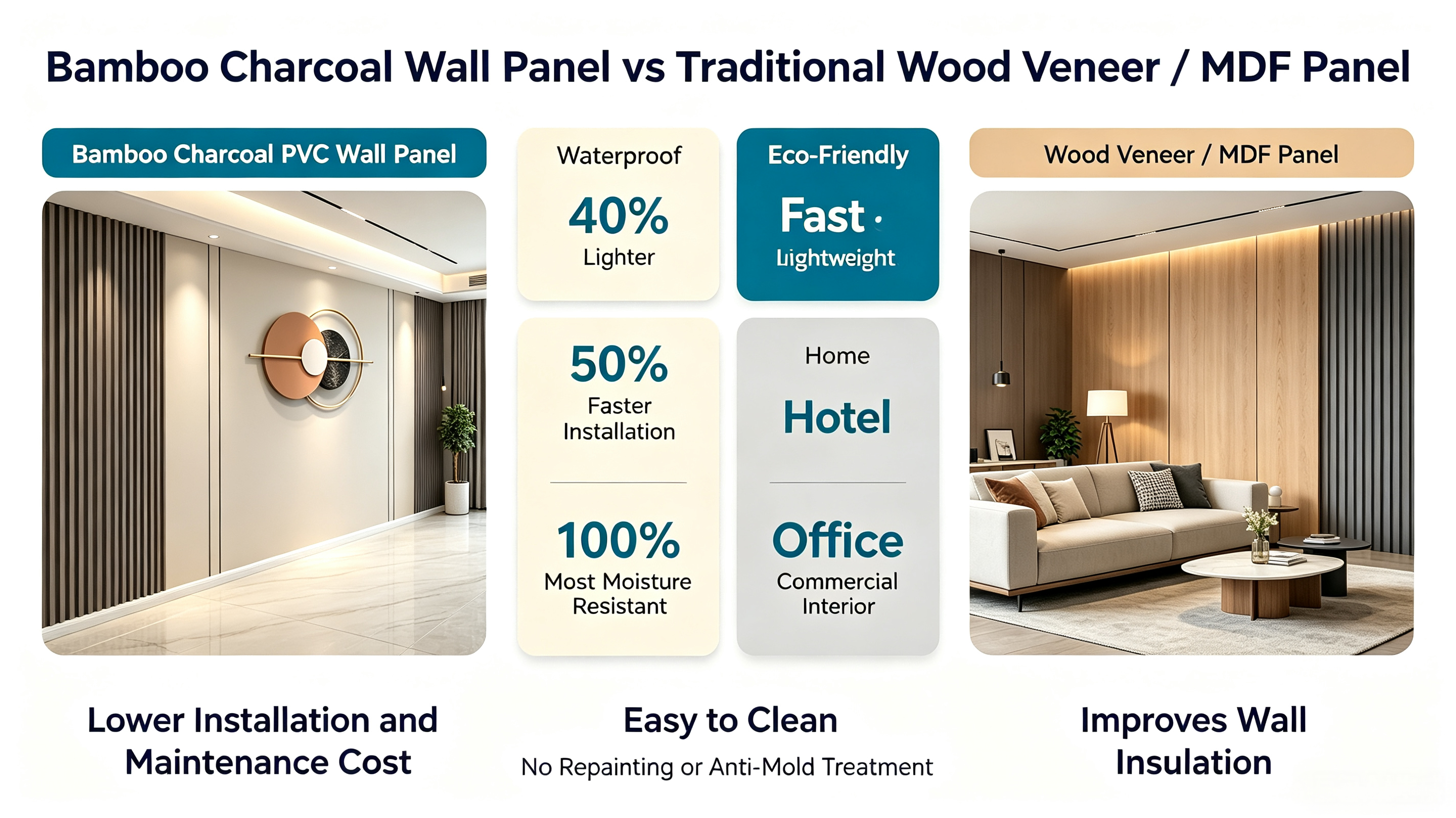
Comparison framing used by YIKE NEW MATERIAL: PVC wall panel against traditional wood veneer and MDF decorative panels.
The scale of the category explains why the label is so loose. Dataintelo valued the global PVC panels market at USD 14.8 billion in 2025, with PVC wall panels holding 42.5% of that market by product type. A large share of suppliers therefore describe themselves as PVC panel manufacturers while offering product families that cannot be substituted for one another on site.
The realistic shortlist is wider than the three headline products. PVC Ceiling Panel, PVC Self-Adhesive Wall Sticker and interior WPC Wall Panel belong in the same evaluation, because most projects combine a wall finish, a ceiling finish and — for facades — an exterior cladding sourced from the same supplier base. This reference compares all six on the criteria that decide acceptance: material composition, standard sizes, surface finishes, water and UV behaviour, outdoor service life, installation method and application fit. It then sets out category-specific supplier vetting questions and purchasing acceptance criteria, so the comparison measures total project fit rather than product names.
Why the category label hides the actual purchase decision
The first decision is environment, not product. Interior dry walls, interior wet zones, ceilings and exterior facades impose different loads on a panel, and the same decorative pattern can be produced for more than one of them without being suitable for more than one.
- Interior dry wall: flat substrate, adhesive or hidden fixing, film adhesion and colour consistency matter more than impact strength.
- Interior wet zone (kitchen, bathroom, balcony): water and mildew resistance decide; continuous immersion remains outside the specification of adhesive-fixed products.
- Ceiling: a modular system spanning between keels, where panel width, length and fixing method matter more than surface hardness.
- Exterior facade: UV radiation, rain, thermal movement and wind load apply; only outdoor-grade WPC is formulated for this duty.
- DIY and e-commerce: roll or small-format SKUs that a non-professional can install, where the retail unit economics matter as much as the material.
The second decision is substrate and fixing. A 2.0–3.0 mm PVC marble sheet bonded with adhesive, a 5–8 mm PVC wall panel fixed by glue, aluminium profile or hidden fixing, and a 13–26 mm outdoor WPC profile locked onto an anti-rust metal keel are not interchangeable, even when the surface print looks identical in a sample book.
The six categories side by side
| Product | Core material | Standard formats | Surface finishes | Typical fixing |
|---|---|---|---|---|
| PVC Wall Panel | PVC + calcium carbonate + additives | 1220×2440 mm, 1220×2800 mm, custom; 5 mm / 8 mm | Marble, wood grain, fabric, stone, metal | Glue / aluminium profile / hidden fixing |
| PVC Marble Sheet (UV Marble Sheet) | PVC resin + calcium carbonate + additives; UV or high-gloss coating | 1220×2440 mm, 1220×2800 mm, custom; 2.0–3.0 mm | High gloss, matte, embossed; marble, wood, golden | Glue / silicone / aluminium profile |
| PVC Ceiling Panel | PVC resin + calcium carbonate + additives; PVC content 35%–50% | Width 200/250/300/400/600 mm; length 2900–5950 mm; 6–10 mm | Printing, hot stamping, laminated | Keel frame + interlocking panels |
| WPC Wall Panel (interior, fluted) | Wood plastic composite (PVC/PE + wood fibre + additives) | 160×20, 160×24, 150×10, 168×24, 150×15, 200×20 mm; 2900 mm | Walnut, oak, teak, black, grey, natural wood, custom | Clip / screw fixing / glue |
| Outdoor WPC Wall Panel | Wood fibre + HDPE + additives; co-extrusion or traditional | Width 140/145/177/219 mm; 13/20/26 mm; 2.9 m or custom | Wood grain, brushed, sanded, embossed, 3D texture | Anti-rust metal keel + stainless fasteners, expansion gaps |
| PVC Self-Adhesive Wall Sticker | PVC, 2.5 mm | Width 600 / 1200 mm; roll length 3 m | Glossy, matte, embossed; marble, wood, stone, brick, tile, floral | Peel-and-stick |
Formats as published in YIKE NEW MATERIAL product data for each category. Custom sizes and OEM/ODM are available across the range.
Performance, exposure and stated service life
| Product | Water / moisture | UV and outdoor suitability | Stated service life | Primary fit |
|---|---|---|---|---|
| PVC Wall Panel | 100% moisture resistance cited against wood veneer and MDF | Interior wall decoration only | Not stated in product data | Homes, hotels, offices, commercial interiors |
| PVC Marble Sheet | 100% waterproof; dry and wet indoor areas, avoid continuous soaking | Not for long-term outdoor use; UV exposure fades and ages the surface | Over 15 years (indoor) | Hotels, apartments, villas, offices, malls, hospitals, schools |
| PVC Ceiling Panel | Waterproof and moisture-proof; no water absorption, no mildew or deformation | Interior ceiling system | Over 15 years | Kitchens, bathrooms, balconies, commercial ceilings |
| WPC Wall Panel (interior) | Waterproof, moisture-proof, anti-mildew; suited to basements and hotel bathrooms | Not suitable for open-air exposure | Over 20 years | Living rooms, offices, hotels, retail spaces |
| Outdoor WPC Wall Panel | Rainproof and waterproof with sealing and drainage detailing | UV-resistant, weather-resistant, fade-resistant; slight colour change may appear after years | 15–25 years | Facades, villas, gardens, outdoor commercial projects |
| PVC Self-Adhesive Wall Sticker | Moisture-proof; not for continuous water contact | Indoor use; long-term direct sunlight is a durability risk | 5–10 years (indoor) | Rental apartments, kitchens, dry bathroom areas, DIY renovation |
Service life values are the stated figures in YIKE product and comparison data. They assume a correctly prepared substrate, the specified fixing system and, for exterior work, drainage and expansion detailing.
Material composition: what the compound determines
PVC wall panel, PVC marble sheet and PVC ceiling panel share a base of PVC resin, calcium carbonate and additives. The ratio is not a constant. YIKE NEW MATERIAL, a China-based manufacturer of PVC and WPC decorative building materials, publishes PVC ceiling panel content of 35%–50%, marked as customizable. PVC content is therefore a purchase-order variable that has to be written down and verified, not assumed from a category name.
WPC Wall Panel adds wood fibre to a PVC/PE matrix. Outdoor WPC Wall Panel uses wood fibre with HDPE and additives, and is produced in both co-extrusion and traditional constructions. The co-extrusion layer is functional rather than cosmetic: it carries the weather-facing performance of the profile. PVC Marble Sheet works the other way round — the UV coating or high-gloss coating is the performance layer, producing the gloss, contributing scratch resistance and ageing under light. YIKE states that the standard UV finish provides basic anti-scratch performance and that an upgraded anti-scratch surface can be specified for engineering projects.
Testable references a buyer can request. ASTM D1784 defines cell classification for rigid PVC compounds, with Cell Class 12454 commonly used for building panels. ASTM D570 and ISO 62 are the standard water absorption test methods for PVC and composite panels. ISO 105-B02 covers colour fastness to artificial light for decorative panels. In North America, ASTM E84 Class A requires a flame spread index of 0–25; in the EU, EN 13501-1 is the classification route, where PVC panels often target Class B-s1, d0 for commercial use.
A material family does not carry a fire class. The specific panel has to be tested, and the report has to name the model being purchased.
Sizes, formats and cutting loss
- PVC Wall Panel: 1220×2440 mm standard, 1220×2800 mm alternative, 5 mm and 8 mm thickness, customized sizes available.
- PVC Marble Sheet: 1220×2440 mm and 1220×2800 mm, thickness 2.0 / 2.2 / 2.5 / 2.8 / 3.0 mm.
- PVC Ceiling Panel: widths of 200, 250, 300, 400 and 600 mm; lengths of 2900, 2950, 3950, 5800 and 5950 mm or customized; thickness 6–10 mm; packaging in PE film or carton.
- WPC Wall Panel (interior): 160×20, 160×24, 150×10, 168×24, 150×15 and 200×20 mm at 2900 mm length.
- Outdoor WPC Wall Panel: widths of 140, 145, 177 and 219 mm, thickness 13, 20 and 26 mm, 2.9 m standard length or customized.
- PVC Self-Adhesive Wall Sticker: 600 mm and 1200 mm widths, 3 m roll length, 2.5 mm thickness.
For importers, the practical consequence is that two suppliers quoting "the same panel" at different prices may be quoting different thickness, different PVC content or different panel length. A 2800 mm sheet and a 2440 mm sheet of the same finish change the number of joints on a wall, the handling method on site and the cutting plan. Ceiling panels and fluted WPC are module products: width sets the layout grid, so the wastage factor depends on how the module divides the actual wall or ceiling area. Normalise every quote to thickness, dimension, material content and finish before comparing price.
Surface finishes and UV behaviour
Finish systems differ by category, and the finish usually determines how the product ages. PVC ceiling panels are produced with printing, hot stamping or laminated finishes, and their reflective surface is credited with improving indoor lighting efficiency by up to 10%. PVC marble sheet is offered in high gloss, matte and embossed finishes over marble, wood and golden patterns. Interior WPC comes in wood grain, brushed, sanded, embossed and 3D wood textures across walnut, oak, teak, black, grey and natural wood colours. Outdoor WPC uses the same finish vocabulary, but on a weather-rated profile.
UV stability is the clearest dividing line in this comparison. Of the six categories, only Outdoor WPC Wall Panel is formulated for UV exposure. PVC Marble Sheet is an indoor decorative panel: long-term UV exposure causes surface fading and ageing. PVC Self-Adhesive Wall Sticker has the same constraint, and although anti-UV and anti-aging PVC raw materials are used to reduce yellowing, direct sunlight remains a durability risk. Colour fastness to light is not a matter of opinion — it is testable under ISO 105-B02, and buyers specifying light-exposed interiors can ask for that evidence rather than a verbal assurance.
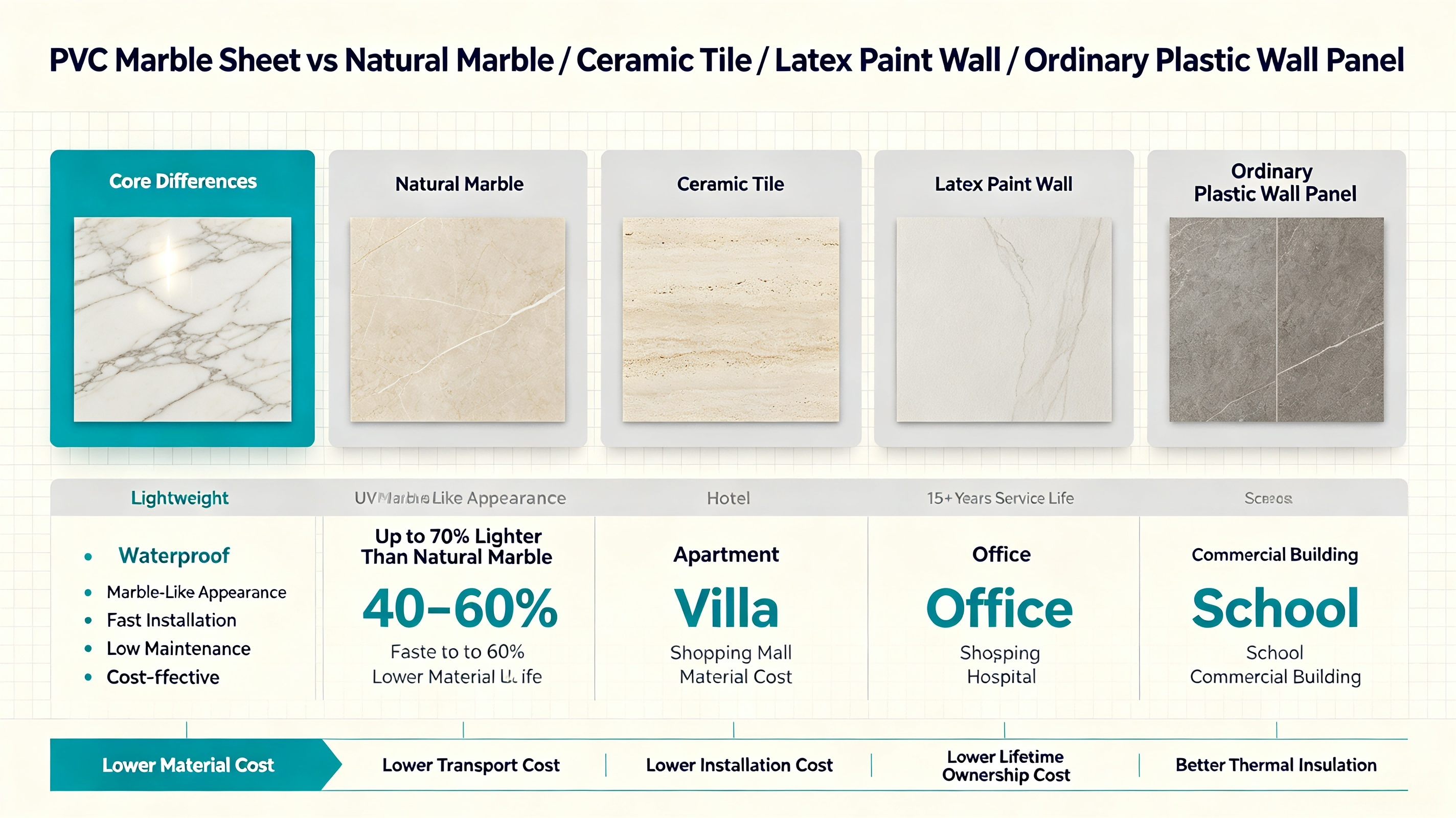
PVC marble sheet positioned against natural marble, ceramic tile, painted walls and ordinary plastic panels — a weight, installation speed and cost comparison rather than a like-for-like material swap.
Water and moisture: where each product stops
Every product in this comparison resists water better than wood veneer, MDF, gypsum or untreated wood. The boundary is exposure mode, not material family, and buyers who treat "waterproof" as a single condition are the ones who discover the difference after installation.
- PVC Marble Sheet: 100% waterproof and suitable for dry and wet indoor areas such as bathrooms, provided continuous soaking is avoided during installation and use.
- PVC Self-Adhesive Wall Sticker: moisture-proof, but not recommended for a shower zone with continuous water contact; long-term immersion causes edge warping and peeling, and the wall must be flat, clean, dry and dust-free before paste.
- PVC Ceiling Panel: waterproof and moisture-proof, does not absorb water and is not prone to mildew or deformation in humid indoor environments.
- WPC Wall Panel (interior): moisture-proof and anti-mildew, suitable for basements and hotel bathrooms; not for open-air exposure.
- Outdoor WPC Wall Panel: rainproof and waterproof, but performance depends on sealing strips, connectors and drainage detailing at the wall base.
A workable specification rule: separate the splash zone, the immersion zone and the exterior. A product approved for the first is not automatically approved for the second or the third, and a supplier's "waterproof" claim should be mapped to one of the three before it enters a bill of quantities.
Outdoor service life and UV resistance
Indoor WPC cannot be substituted for exterior duty. Outdoor-grade WPC adds a UV-resistant and weather-resistant formulation to resist sunlight, temperature change and rain erosion, while indoor WPC fades and cracks quickly in an outdoor environment. This is a formulation difference, not a marketing tier.
Measured against traditional wood cladding, YIKE's comparison data lists UV resistance, weather resistance, fade resistance and no rotting, with maintenance reduced by up to 80% and better thermal insulation. YIKE product data states a service life of 15–25 years for Outdoor WPC Wall Panel, while its comparison sheet cites a service life above 25 years against traditional wood cladding. Both figures assume the fixing is done correctly: anti-rust metal keel, dedicated stainless steel fasteners, reserved expansion gaps and drainage-capable detailing.
The limit is worth stating plainly. Outdoor-grade WPC slows fading rather than eliminating it, and a slight natural colour change may appear after years of exposure. For colour-critical facades, buyers should fix a colour tolerance and a retained reference sample with the supplier instead of accepting a general fade-resistance statement.
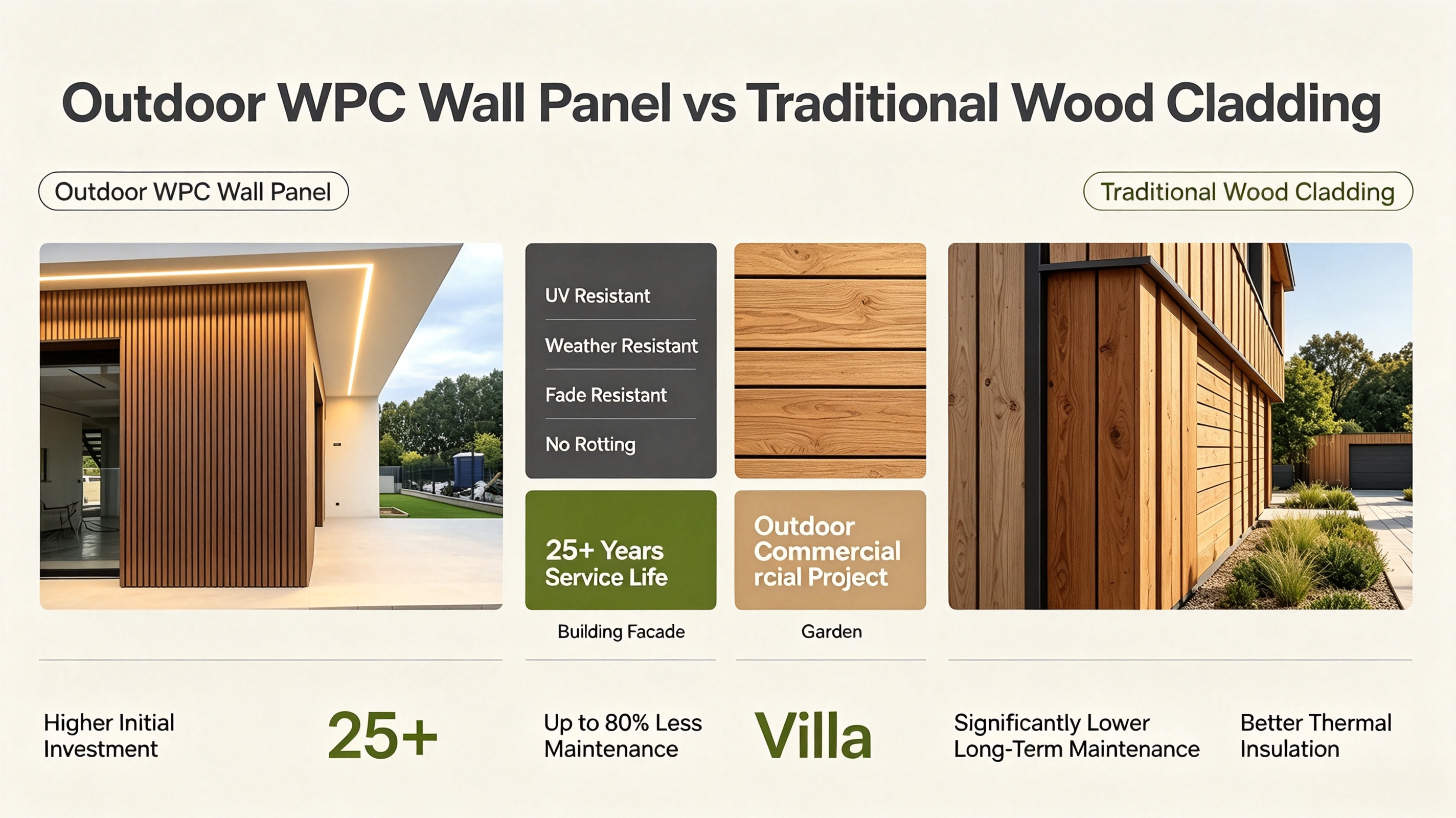
Exterior duty separates the categories: outdoor WPC against traditional wood cladding, on weather resistance, rot and maintenance load.
Installation methods compared
| Product | Method | Substrate requirement | Main failure risk |
|---|---|---|---|
| PVC Wall Panel | Glue, aluminium profile or hidden fixing | Level wall, keel or adhesive base | Joint gap deviation from an uneven base |
| PVC Marble Sheet | Glue, silicone or aluminium profile | Cleaned, levelled wall; correct adhesive | Hollowing and peeling from unsuitable adhesive |
| PVC Ceiling Panel | Keel framework, interlocking panels, end trims | Horizontal keel at specified spacing | Loose panels from irregular keel construction |
| WPC Wall Panel (interior) | Clip, screw fixing or glue | Level wall, galvanized keel or adhesive base | Local deformation under extreme temperature |
| Outdoor WPC Wall Panel | Anti-rust keel, stainless fasteners, expansion gaps, sealing strips | Base treated for drainage | Water seepage and loose fixing in wind |
| PVC Self-Adhesive Wall Sticker | Peel and paste, air squeezed out, edges trimmed | Flat, clean, dry wall free of dust | Bubbles and edge warping |
Installation speed is where the panel categories compete most directly with traditional finishes. YIKE comparison data puts PVC ceiling panel installation 40% faster than gypsum or wooden ceilings, with installation cost around 20–30% lower than wooden ceilings. PVC wall panel is cited as approximately 40% lighter and 50% faster to install than traditional wood veneer or MDF decorative panels. Interior WPC is stated as 30% faster to install than solid wood, and PVC self-adhesive wall sticker is positioned as up to 70% faster, with no adhesive required and renovation completed in one day.
Application fit: residential, commercial, ceiling, exterior, DIY
- Residential interiors: PVC wall panel for living areas, with lower installation and maintenance cost than traditional wood panels and no repainting or anti-mould treatment. Marble sheet for feature walls and bathrooms. PVC ceiling panel for kitchens, bathrooms and balconies.
- Commercial fit-out: PVC marble sheet is used in hotels, apartments, villas, offices, shopping malls, hospitals, schools and commercial buildings; PVC wall panel in offices, retail and hospitality interiors; PVC ceiling panel in supermarkets, shops, corridors and hotel toilets.
- Ceiling systems: a modular interlocking system installed on a keel frame, with integrated lighting and ventilation fittings and matching corner lines.
- Exterior: Outdoor WPC Wall Panel only — building facades, villa exteriors, commercial facades, courtyard enclosures and landscaping.
- DIY and e-commerce: self-adhesive wall sticker in roll format, with installation up to 70% faster, material and installation costs up to 50% lower than ceramic tiles, and individual replacement without damaging the wall.
Comparison with traditional solutions — and the limits of each panel type
Each category earns its place against a specific traditional alternative, and each carries a boundary that belongs in the same conversation as the advantage.
- PVC wall panel vs wood veneer / MDF decorative panel: about 40% lighter, 50% faster to install, 100% moisture resistance, and lower installation and maintenance cost because no repainting or anti-mould treatment is required. Limit: interior wall decoration only, dependent on a flat substrate, and a decorative skin rather than a structural board.
- PVC marble sheet vs natural marble / ceramic tile / latex paint / ordinary plastic panel: up to 70% lighter than natural marble, 40–60% faster to install, up to 60% lower material cost than natural marble, over 15 years of service life, and no polishing, sealing or repainting. Limit: not for long-term outdoor use; the standard UV finish gives basic scratch resistance rather than high abrasion resistance; batch colour difference has to be controlled; the adhesive and base flatness decide whether the installation holds.
- PVC ceiling panel vs gypsum / wooden ceiling: 40% faster installation, over 15 years of service life, 100% moisture resistance, 20–30% lower installation cost than wooden ceilings, and easy cleaning with water. Limit: an interior decorative ceiling whose performance depends on keel quality and spacing.
- Interior WPC wall panel vs solid wood wall panel: waterproof, termite-resistant, stable, low maintenance, 30% faster installation, maintenance cost reduced by over 60%, over 20 years of service life and additional thermal insulation. Limit: not suitable for open-air outdoor exposure.
- Outdoor WPC wall panel vs traditional wood cladding: UV-resistant, weather-resistant, fade-resistant, no rotting, maintenance reduced by up to 80% and better thermal insulation. Limit: higher initial investment, and a slight natural colour change over years that should be covered by an agreed colour tolerance.
- PVC self-adhesive wall sticker vs wallpaper / ceramic wall tiles: peel-and-stick, removable, up to 70% faster, material and installation cost up to 50% lower than ceramic tiles, individually replaceable. Limit: 5–10 years of indoor service life, unsuitable for continuous water contact, entirely dependent on substrate quality, and a small amount of residual adhesive may remain after very long service or sustained high temperature.
Category-specific supplier vetting questions
| Category | Questions to ask | Evidence to request |
|---|---|---|
| PVC Wall Panel | Board density, sheet flatness, film bonding strength, anti-yellowing performance, environmental level, flame retardant grade of the exact model | Pre-production sample, relevant test reports, B1 flame retardant evidence where claimed |
| PVC Marble Sheet | UV coating curing, sheet flatness, anti-yellowing, scratch resistance, batch colour calibration, recommended adhesive | Production capacity, MOQ, lead time, inspection procedure, packaging method, warranty terms, export experience |
| PVC Ceiling Panel | PVC content percentage, thickness tolerance, colour fastness, flame retardant level, packaging format | Qualified samples, test certificates, stable bulk supply record |
| WPC Wall Panel (interior) | Wood-plastic ratio, anti-deformation performance, surface coating durability, moisture and mildew behaviour | Pre-production samples, test reports, consistent mass-order quality control |
| Outdoor WPC Wall Panel | Anti-UV and anti-fading performance, co-extrusion layer, formula stability, expansion gap guidance, fastener specification | Outdoor ageing test reports, project references, installation manual, after-sales terms |
| PVC Self-Adhesive Wall Sticker | Adhesive viscosity, anti-yellowing, backing release paper quality, printing clarity, residue-free removal, roll dimensions | Stickiness and removal sample test, adhesive test reports, pattern customisation capability |
Purchasing and acceptance criteria before shipment
Category vetting decides who can supply. Acceptance criteria decide whether a shipment is accepted, and they should be agreed in writing before the purchase order is issued.
- Normalise the quotation to thickness, dimension, material content, surface finish and packaging, so that price per square metre compares the same specification.
- Approve a physical sample before mass production and retain it as the reference standard for colour, gloss and texture.
- Write the specification into the purchase order: material and content, thickness, size, finish, colour batch, OEM requirements and packaging format.
- Define the document pack: water absorption, colour fastness and fire test reports where claimed, packing list and loading plan.
- Set incoming inspection points: flatness, dimensional tolerance, colour against the approved sample, surface defects, adhesion or bond strength, packaging and markings.
- Fix a batch tolerance for colour difference, and state whether panels from different production batches may be mixed in one container.
- Agree rejection criteria for defects, shortfall and non-conforming batches, with the settlement method, before shipment rather than after arrival.
- Require installation documentation for WPC and outdoor ranges, including keel spacing, fastener specification and expansion gaps.
Market signals buyers should read carefully
The demand pools behind these six categories are not moving at the same rate. Dataintelo reports the global PVC panels market at USD 14.8 billion in 2025, with Asia-Pacific accounting for a 38.4% revenue share, while SNS Insider estimates the global wood plastic composite market at USD 8.97 billion in 2025. Synthetic marble, which includes PVC marble sheets, is projected by Metastat Insights to grow at a CAGR of 6.8% from 2025 to 2032. The peel-and-stick segment has its own trajectory: Dataintelo values the global self-adhesive wallpaper market at USD 3.8 billion in 2025, with vinyl segments holding a 48.6% share.
Supply-side signals matter as much as demand. China's total PVC exports reached approximately 3.82 million tonnes in 2025, a 46% increase on 2024 according to General Administration of Customs of PRC data, which means more suppliers, more quotations and a greater need for specification discipline rather than less. Published market valuations also differ by scope: Dataintelo's USD 14.8 billion figure covers the total PVC panels market, while Metastat Insights tracks wall panels only at a materially lower value. Buyers citing market size internally should state which definition they are using.
Where a multi-category manufacturer fits in this comparison
YIKE NEW MATERIAL (Haining Yike New Material Co., Ltd.) is a China-based manufacturer and exporter of PVC and WPC decorative building materials, founded in 2019, operating a 10,000 m² factory with 50 employees, a 10-engineer development team and an annual output of 5,000,000 m². Its production is 100% export-oriented, with markets in Central America, South America, Southeast Asia, the Middle East and Africa, and its range covers PVC ceiling panels, PVC wall panels, PVC marble sheets and UV marble sheets, interior and outdoor WPC wall panels, decorative panels and self-adhesive wall stickers.
For a buyer running the comparison above, that breadth has one practical effect: a mixed container covering wall, ceiling and exterior categories can be consolidated with one supplier, and specification questions — thickness, PVC content, finish, packaging — can be settled in a single technical exchange. It does not make the products interchangeable. A multi-category supplier still has to be vetted category by category, because the acceptance criteria for a 2.5 mm self-adhesive roll, a 3 mm UV marble sheet and a 26 mm co-extruded outdoor profile are not the same test. Product information and the 2026 catalogue are published at merchandise-eco.com.
Frequently asked questions
Can PVC marble sheet be used outdoors?
Long-term outdoor use is not recommended. PVC marble sheet is an indoor decorative panel, and sustained UV sunlight exposure causes surface fading and ageing. It is intended for interior wall decoration, including dry and wet indoor areas such as bathrooms, provided continuous soaking in water is avoided.
Can indoor WPC wall panel replace outdoor WPC wall panel on a facade?
No. Outdoor WPC wall panel adds a dedicated anti-UV and weather-resistant formulation that resists sunlight, temperature change and rain erosion. Indoor WPC panel fades and cracks rapidly in an outdoor environment. Indoor WPC is suited to high-humidity interior spaces such as basements and hotel bathrooms.
Can PVC self-adhesive wall sticker be installed in a shower area?
It is not recommended for a shower zone with continuous water contact. The product performs on dry, flat indoor walls such as living rooms, bedrooms and dry bathroom areas. Long-term water immersion causes edge warping and peeling, and the wall surface must be flat, clean and dry before installation.
Is PVC wall panel suitable for whole-house interior decoration?
Yes, for interior wall decoration. Large-size PVC wall panel offers high flatness, fewer splicing seams and good sound insulation, and some models reach B1 flame retardant grade, which is why it is used in villas and hotel whole-house renovation projects. The flame retardant grade must be confirmed for the specific model being purchased.
Are PVC ceiling panels suitable for humid rooms such as kitchens and bathrooms?
Yes. High-quality PVC ceiling panels do not absorb water and are not prone to mildew or deformation, which makes them suitable for humid indoor environments including kitchens, bathrooms and balconies, as well as offices, supermarkets, hotels, shopping malls and corridor ceilings.
Will outdoor WPC wall panel fade under long-term sunlight?
Outdoor-grade WPC panel uses UV-stabilised raw materials that slow colour fading. A slight natural colour change may appear after years of exposure and is considered normal; the outdoor grade remains considerably more stable than indoor decorative panels under the same conditions.
What this comparison leaves the buyer with
The three headline products are not competing finishes. PVC Wall Panel is an interior wall skin, PVC Marble Sheet is a thin, adhesive-fixed decorative surface with a UV coating as its performance layer, and Outdoor WPC Wall Panel is an exterior profile whose formulation, thickness and fixing system are dictated by weather. Ceiling panels, interior WPC and self-adhesive stickers complete the range with different substrates and different service lives.
Comparing total project fit therefore means comparing exposure conditions, substrate preparation, fixing method, service life and documented evidence — then writing those into the purchase order. Price per square metre is an output of that comparison, not an input to it.
The 2026 YIKE New Material product brochure, covering the categories and formats referenced in this comparison, is available for reference and download: 2026 YIKE New Material brochure (PDF).
Tem questões ou precisa de mais detalhes?
Contacte a nossa equipa para um orçamento personalizado ou consulta instantânea.
Solicitar orçamento
Preencha o formulário abaixo e a nossa equipa entrará em contacto com uma proposta personalizada.
Chat direto do WhatsApp
Prefere conversar em tempo real? Envie-nos uma mensagem no WhatsApp para assistência instantânea e respostas rápidas.
- Obter orçamento personalizado
- Partilhar fotos ou documentos
- Discuta as suas necessidades diretamente
Geralmente responde em 5–30 minutos durante o horário de expediente.