
PVD vs Electroplated Gold Plated Stainless Steel: Buyer Comparison
Gold plated jewelry is a substrate-plus-finish product: the stainless steel body provides structure, weight and skin contact, while the gold-colored finish carries the appearance and most of the commercial risk. For wholesale buyers, the defining decision inside this category is not the gold tone but the deposition method used to apply it — physical vapor deposition (PVD) or electroplating. That choice determines how a piece behaves after thirty days of wear, what a supplier can lawfully print on a label, and how unit economics shift as order volume rises.
The category is large enough that these technical differences now move real money. Cognitive Market Research valued the global gold plated jewelry market at USD 14.22 billion in 2023, and Business Research Insights projects it reaching USD 24.36 billion by 2031 at a 7.1% CAGR. Grand View Research attributes more than 35% of global output to Asia-Pacific. Inside that volume, "tarnish free", "waterproof" and "hypoallergenic" have become standard catalogue language — which is precisely why buyers need a comparison framework rather than a color swatch.
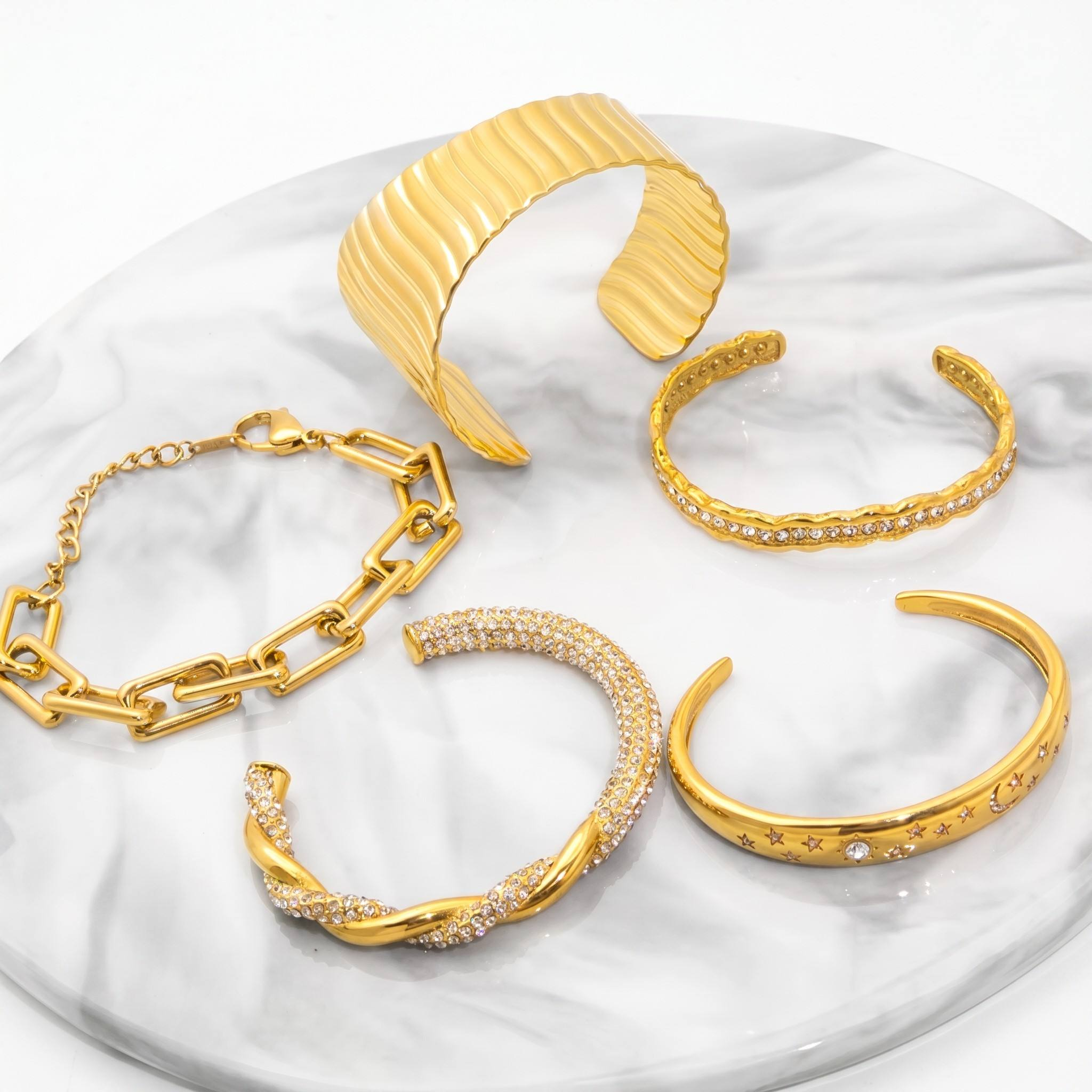
The buyer problem: identical photographs, different failure curves
Two gold plated stainless steel bracelets can look indistinguishable in a supplier catalogue photo and behave completely differently in a customer's hands. Electroplated and PVD-coated pieces are photographed under the same lighting, described with the same adjectives, and often quoted within the same price band. The difference surfaces later: at the contact points of a ring band, on the underside of a bangle, at a clasp, or wherever skin oils, sweat and friction concentrate.
That gap is a procurement problem, not a design problem. A retailer that sells a finish which dulls within weeks absorbs returns, review damage and lost reorders — costs that are rarely visible in the unit price. The practical response used by experienced buyers is to stop evaluating gold plated jewelry by appearance and start evaluating it by deposition method, substrate grade and test evidence.
How PVD and electroplating differ at process level
The two routes produce a gold-colored surface, but they build it in fundamentally different ways.
PVD coating: vapor deposition in a vacuum chamber
PVD gold plating deposits material from a vaporized source onto the stainless steel substrate inside a vacuum chamber. Vacuum plating chambers for jewelry typically operate at pressures between 10-3 and 10-5 mbar, according to research published in the Journal of Vacuum Science & Technology. A titanium nitride (TiN) base layer is frequently used to improve adhesion to stainless steel, a technique documented in the Journal of Applied Physics.
For jewelry applications, PVD on stainless steel usually targets a gold layer in the 0.5–1.0 micron range, which the Jewelers Vigilance Committee (JVC) treats as roughly equivalent in durability to a much thicker electroplated deposit. Vapor Technologies, a coating equipment supplier, states that PVD coating provides significantly higher durability and wear resistance than traditional electroplating for jewelry. The practical consequence is that a thinner PVD layer can outperform a thicker plated layer, because the deposited film is denser and more tightly bonded.
Electroplating: electrolytic deposition from a liquid bath
Electroplating immerses the stainless steel piece in a plating solution and uses electrical current to deposit metal onto the surface. Deposit thickness is controlled by current density and dwell time, which makes the process flexible: it can produce very thin decorative layers or substantially thicker ones. The US Federal Trade Commission sets the minimum gold plating thickness for a "Gold Electroplated" designation at 0.175 microns — a labeling floor, not a durability promise. Gold vermeil, an adjacent standard for gold over silver, requires a minimum of 2.5 microns under JVC guidance. Stainless steel with a 0.5-micron gold layer is a common export specification for boutique-level fashion jewelry.
Electroplating has strong throwing power, meaning it can reach into recesses and complex geometry where line-of-sight vacuum deposition struggles. Its weakness is that thinner aqueous deposits are more porous and more prone to oxidation unless passivated or top-coated. An SGS technical bulletin reports that vacuum electroplating (often called IP plating) can increase tarnish resistance by up to 10x compared with conventional water plating; that figure is an industry bulletin claim rather than a per-SKU guarantee, and buyers should confirm it against test data for the specific product.
The hybrid route: electroplating plus a protective topcoat
E-coating, an electrophoretic coating applied over the gold layer, is increasingly used as a secondary barrier against oxidation. It extends the usable life of an electroplated item without changing its appearance, and it is a common reason two similarly priced electroplated products perform differently. The presence and quality of a topcoat is therefore a question worth asking directly during sampling.
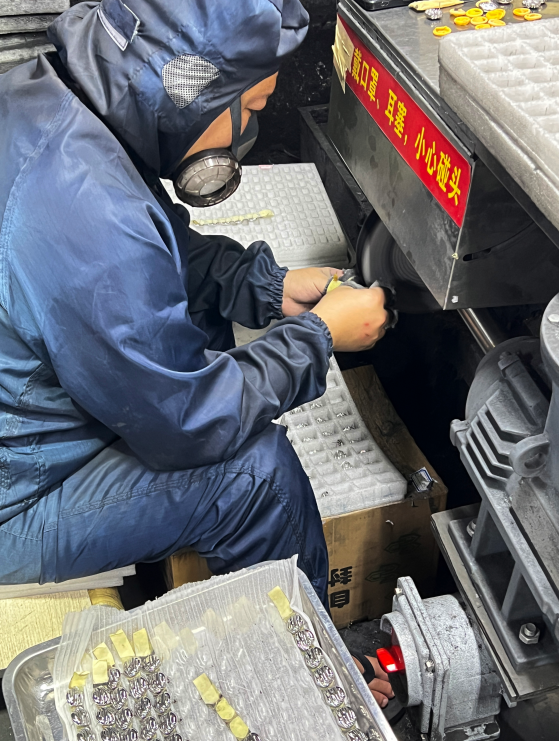
PVD vs electroplated gold plated stainless steel: buyer comparison table
| Evaluation point | PVD-coated stainless steel | Electroplated stainless steel | What the buyer should verify |
|---|---|---|---|
| Deposition method | Vapor-to-solid deposition in vacuum, typically 10-3–10-5 mbar | Electrolytic deposition from an aqueous bath | Batch process records, chamber or bath logs |
| Typical gold layer | 0.5–1.0 micron target for equivalent durability (JVC reference) | From the 0.175 micron US labeling minimum upward; vermeil-class is 2.5 microns | Actual measured thickness, not the label wording |
| Wear resistance | Reported as significantly higher than traditional electroplating (Vapor Technologies) | Dependent on thickness, passivation and topcoat | Abrasion protocol or wear test on the finished SKU |
| Tarnish resistance | Generally stronger; denser film resists oxidation longer | Improves substantially with IP/vacuum plating or e-coating | ISO 9227 salt spray report with duration and acceptance criteria |
| Skin and sweat exposure | Depends on substrate grade and coating integrity | Depends on substrate grade, thickness and nickel release | ISO 3160-2 artificial sweat report; EN 1811 for pierced parts |
| Coverage on complex shapes | Line-of-sight process; deep recesses need design accommodation | Better throwing power into recesses and internal geometry | Physical inspection of recesses and edges on approved samples |
| Color range | Gold, rose gold, black, gunmetal, plus brushed, mirror-polished or sandblasted surfaces | Gold shades including the lighter 14K hue versus deeper 18K yellow (Intertek) | Approved color master and tolerance under consistent lighting |
| Environmental profile | Reported by the US EPA as producing zero hazardous wastewater | Requires wastewater treatment and chemical handling compliance | Environmental permits and discharge documentation |
| Cost structure | Higher equipment amortization; marginal cost falls with volume | Lower entry cost; consumables and topcoats add per-unit steps | Quotation broken down by volume tier, not a single unit price |
What "hypoallergenic" and "waterproof" actually verify
Both terms are used loosely in wholesale gold plated stainless steel accessories, and both have a defensible technical meaning that buyers can test.
Hypoallergenic refers primarily to the substrate and to nickel release. The World Allergy Organization estimates that roughly 15% of the global population has a nickel allergy, which is why stainless steel grades matter. ASTM International identifies 316L stainless steel as the standard hypoallergenic substrate for high-quality PVD gold plated jewelry. In the EU, nickel release testing under EN 1811 is mandatory for any jewelry item inserted into pierced parts of the body. For women's daily-wear jewelry in particular, the substrate grade usually matters more than the coating color.
Waterproof in this category describes resistance to sweat, hand washing and incidental water contact — not indefinite immersion. The scope of the claim is defined by the test behind it. ISO 9227 salt spray testing is the standard reference for corrosion resistance in tarnish-free stainless steel jewelry claims, and ISO 3160-2 artificial sweat testing addresses skin-contact behavior. A buyer reviewing a supplier's waterproof hypoallergenic gold plated jewelry claim should ask which standard was used, for how many hours, and on which model. A report issued for one SKU does not automatically cover the rest of a catalogue.
Labeling law also creates a floor that is easy to misread. In the United States, a product may be labeled "Gold Electroplated" at just 0.175 microns of gold — legally compliant, but far below what most buyers would consider durable for daily wear. Thickness data, not label language, is the reliable comparison point.
Substrate choice: 304, 316 and 316L stainless steel
Finish performance depends on what sits underneath it. Stainless steel jewelry substrates are commonly specified as 304, 316 or 316L, all of which offer corrosion resistance and hypoallergenic properties, with 316L typically reserved for higher-specification programs. Gemological Institute of America data places stainless steel at 5.5–6 on the Mohs hardness scale, compared with 2.5–3 for sterling silver — the practical reason stainless steel has become the default base for anti-rust gold plated daily wear jewelry that is expected to survive showers, gym sessions and repeated contact with skin.
For buyers, the substrate decision usually follows the market rather than the price list: 316L is the safer specification for skin-contact pieces and for markets with strict nickel release enforcement, while 304 remains viable for decorative pieces with limited skin contact. The grade should appear on the specification sheet and, ideally, be traceable through mill certificates.
Certification evidence: what a test report covers, and what it does not
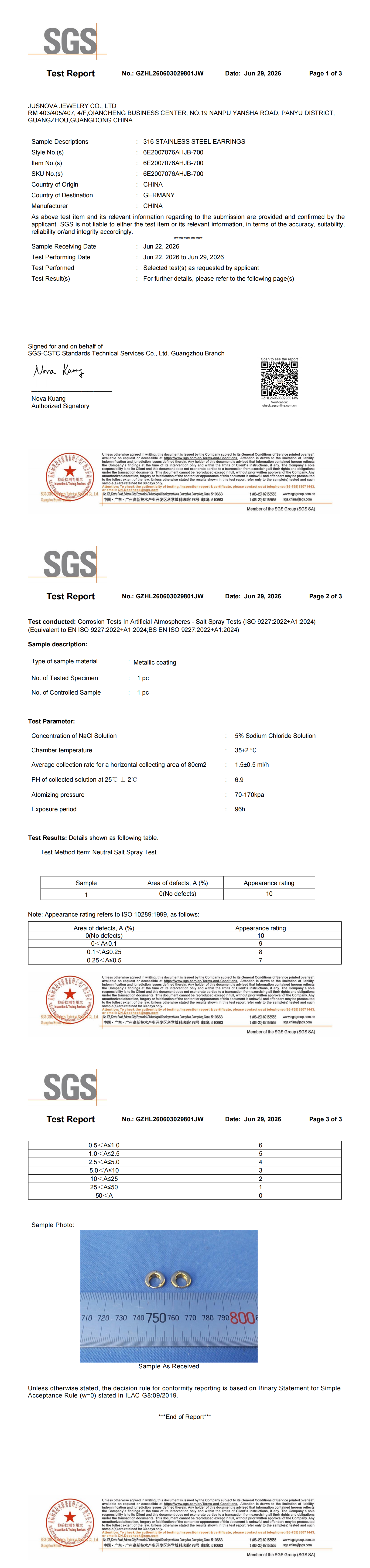
Test documentation is the only reliable way to separate comparable-looking products. As a concrete reference point, the stainless steel jewelry program associated with model GEN000516bhia-066 is supported by an SGS Artificial Sweat Test issued under ISO 3160-2, certificate number GZMR260602153701, issued on 2026-06-30 and valid until 2027-06-30 for the EU market. The same program holds an SGS Salt Spray Test under ISO 9227, certificate number GZHL260603029801JW, issued on 2026-06-29 and valid until 2027-06-29 for the EU market, referencing the stainless steel jewelry product.
Three limitations matter when reading any certificate:
- Scope is product-specific. A salt spray report covers the tested model, finish and thickness combination. Changing the substrate grade, the coating method or the layer thickness invalidates the comparison.
- Standards define the promise. ISO 9227 describes a test method; the number of hours and the acceptance criteria determine how strong the resulting claim is.
- Validity is time-bound. Reports carry issue and expiry dates, and buyers sourcing in 2026 should confirm that documents presented during negotiation are still within their validity window.
On the regulatory side, REACH Regulation (EC) No 1907/2006 restricts nickel, lead and cadmium in jewelry imported into the EU, and California Proposition 65 imposes warning requirements above strict lead and cadmium thresholds in the US market. Gold plated stainless steel jewelry trades under HS Code 7117.19, a detail that simplifies customs classification and landed-cost calculation for importers.
Price bands and cost drivers in wholesale gold plated stainless steel
Pricing in this category is quoted per SKU and per volume tier, so published ranges are directional at best. Global Sources has reported wholesale prices for high-quality PVD 18K gold plated stainless steel necklaces in the range of USD 2.00 to USD 8.00 depending on complexity; that range should be treated as an orientation point rather than a quotation, because it does not control for thickness, substrate grade, stone setting or packaging.
The variables that actually move a quote are consistent across suppliers:
- Substrate grade — 304 versus 316 versus 316L.
- Finish method and layer thickness — PVD coating, electroplating, or electroplating with an e-coat top layer.
- Surface treatment — brushed, mirror-polished or sandblasted, or a combination.
- Stone setting — CZ, man-made crystal or moissanite, in 20 or more colors, using prong, bezel, channel or pavé settings.
- Customization — custom logo laser engraving or personalized engraving, where marking depth is typically set between 0.05 mm and 0.2 mm to stay visible without weakening the piece.
- Packaging — OPP bags, velvet pouches or premium gift boxes with custom branding.
- Order quantity — setup and tooling costs amortize differently across volume tiers.
Reported average lead times for custom wholesale gold plated stainless steel orders run around 15–25 days, based on supply chain data compiled by Panjiva. Buyers should treat this as a planning reference and confirm the schedule against the specific finish, engraving and packaging combination, since those steps drive most of the variance.
The cost comparison between the two finishes is not a simple ranking. PVD carries higher equipment amortization but a lower marginal cost at scale and no hazardous wastewater stream, which the US EPA cites as a zero-wastewater advantage over water electroplating. Electroplating has a lower entry cost for small or experimental runs, but topcoats and additional process steps add back into the unit cost. When return rates and reorder behavior are included, the cheapest per-unit option is often the most expensive program.
A reference configuration: model GEN000516bhia-066
Jusnova Jewelry Co., Ltd is a stainless steel jewelry manufacturer and exporter founded in 2009 and based in Guangzhou, China, operating a 1,000 m² factory with approximately 300 employees, an annual output of about 3,000,000 units, a 20-engineer development team, and an export ratio of about 95% focused on wholesale and brand buyers in markets such as Europe and America.
Model GEN000516bhia-066 provides a useful reference configuration for this comparison because it supports both finishing routes. The program includes engraved bangle styles and can be supplied with gold plating as a surface finish, and its material specification covers 304, 316 and 316L stainless steel. Surface finish options include PVD coating in gold, rose gold, black or gunmetal, gold plating, electroplating, brushed, mirror-polished and sandblasted treatments — or any combination. Dimensions range from 5 mm to 80 mm in diameter and 0.5 mm to 3.0 mm in thickness, with tolerance controlled within ±0.05 mm, and stone settings available in CZ, man-made crystal or moissanite. Packaging can be supplied as OPP bags, velvet pouches, premium gift boxes or fully customized designs carrying a buyer's own logo and branding.
The relevant point for buyers is not that one configuration exists, but that the same base product can be specified with either finish. That makes a side-by-side sampling program realistic: order the identical shape and engraving in PVD and in electroplated versions, then test both under the same wear and cleaning conditions before committing to a catalogue direction.
Where each finish fits: applications and channels
Finish selection is usually driven by the sales channel rather than by preference.
| Channel or program | Finish that typically fits | Reason |
|---|---|---|
| Boutique fashion shops and concept stores | PVD coating | Premium tarnish-free positioning and repeat purchase depend on wear longevity |
| Department store accessory counters | PVD or top-coated electroplating | Handled by customers and displayed under lights; finish durability affects complaints |
| Fast-fashion and trend programs | Electroplating, or thin PVD at scale | Short product cycles reduce the payback period required from the finish |
| E-commerce and DTC marketplaces | PVD coating | Review-driven demand makes anti-tarnish performance commercially decisive |
| Gift, souvenir and landmark retail | Electroplated with topcoat | Volume-driven programs where cost per unit is the binding constraint |
| Corporate and promotional gifting | PVD for logo programs | Engraved or logo-marked pieces are retained and worn, so finish integrity carries brand risk |
Custom design gold plated fashion jewelry intended for resale under a buyer's own brand sits in the middle of this table: the finish must survive long enough that the buyer's label is not associated with fading, which pushes most private-label programs toward PVD or toward electroplating with an explicit topcoat specification.
Market trend signals shaping the PVD decision
Several directional signals support the shift toward denser coatings in gold plated stainless steel jewelry.
- Business Research Insights projects the global gold plated jewelry market reaching USD 24.36 billion by 2031 at a 7.1% CAGR, expanding rather than contracting.
- IBISWorld data places costume and gold-plated jewelry at 34.7% of total US jewelry category spend in 2023, indicating that plated products are a structural part of the market rather than a temporary substitute.
- Market Research Future projects the customization and laser engraving segments growing at an 8.5% CAGR through 2030, which increases the number of programs where finish durability is tested by engraving and handling.
- Custom Market Insights forecasts the personalized jewelry market reaching USD 45 billion by 2030, including gold-plated variants.
- CBI data shows the minimalist jewelry segment accounting for 22% of total fashion jewelry revenue in Europe, a style category dominated by simple, frequently worn pieces where tarnish shows quickly.
- Statista reports 18K gold plating as the most preferred specification for high-end fashion jewelry in North America.
- Recycled stainless steel use in jewelry manufacturing reportedly increased by 20% in 2023, according to Jewellery Outlook — a signal worth tracking if sustainability claims are part of a buyer's positioning.
- Industry B2B trend reporting has cited a 40% increase in search volume for waterproof jewelry (specifically PVD on stainless steel) on B2B platforms in 2024. This is a medium-reliability indicator and should be treated as directional demand evidence rather than a measured market statistic.
Taken together, these signals describe a market where buyers are increasingly rewarded for specifying the coating method explicitly rather than accepting "gold plated" as sufficient description.
Limits and trade-offs: where PVD is not the automatic answer
PVD has become the default premium reference in stainless steel jewelry, but it is not universally superior, and buyers should understand the boundaries before switching an entire catalogue.
- Line-of-sight coverage. Vacuum deposition reaches visible surfaces efficiently but is less effective inside deep recesses, undercuts and complex internal geometry. Electroplating's throwing power handles those areas better, which matters for intricate castings and tightly fitted mechanisms.
- Thinner deposits than vermeil-class plating. PVD on steel typically targets 0.5–1.0 micron to reach durability comparable to thicker plating, while gold vermeil requires 2.5 microns under JVC guidance. At high-abrasion points such as ring bands and clasps, wear-through remains the dominant failure mode for any thin coating.
- Capital and setup structure. PVD requires vacuum chambers and controlled process parameters, which raises equipment amortization and makes small experimental runs less economical than an electroplating line.
- Repair economics. A worn coating on a finished piece generally cannot be re-polished or re-plated at a cost that makes sense; replacement is usually the practical outcome. Buyers should plan warranty language around that reality.
Electroplating carries its own boundaries. Thinner aqueous deposits oxidize faster without passivation or an e-coat layer, and the process generates a wastewater stream that requires treatment, which increases compliance overhead for suppliers operating in regulated markets.
Adjacent alternatives also compete on different terms. Gold-filled jewelry, for example, is a distinct category that MJSA notes usually requires about 5% gold by weight — a materially different cost and labeling profile from either PVD or electroplating on stainless steel. The realistic conclusion is that the correct finish depends on the wear scenario, the market's enforcement environment and the volume tier, not on a blanket preference.
Future outlook
Three changes look reasonably well supported by current evidence. First, PVD coating is moving from a premium upgrade toward a baseline expectation in export-oriented stainless steel jewelry, driven by consumer familiarity with tarnish-free and waterproof wording. Second, documentation is becoming a standard procurement requirement rather than a differentiator: buyers are increasingly asking for report numbers, issue dates and validity windows alongside samples. Third, customization continues to grow, with the laser engraving segment projected to expand at an 8.5% CAGR through 2030 — which raises the technical bar, because engraving a coated surface demands control over marking depth so that the finish layer is not compromised.
The most likely pressure point is claim discipline. As more suppliers use terms such as non-tarnish, anti-rust and waterproof, buyers who can point to ISO 9227 or ISO 3160-2 documentation will be better positioned than those relying on catalogue adjectives.
Buyer verification checklist
- Confirm the substrate grade (304, 316 or 316L) in writing on the specification sheet.
- Confirm the deposition method — PVD, electroplating, or electroplating plus e-coat.
- Request measured gold layer thickness rather than a marketing descriptor.
- Request the ISO 9227 salt spray report with hours, acceptance criteria, model reference and validity dates.
- Request the ISO 3160-2 artificial sweat report for skin-contact pieces, and EN 1811 nickel release testing for pierced items.
- Verify REACH restriction compliance for EU shipments and Proposition 65 thresholds for US shipments.
- Test the identical shape in both finishes under the same wear and cleaning routine before setting a catalogue direction.
- Confirm engraving depth parameters for custom logo or personalized engraving programs.
- Compare quotations at the same volume tier and with the same packaging specification.
FAQ
What is the difference between PVD and electroplated gold plated stainless steel jewelry?
PVD builds the gold-colored layer by vaporizing material onto the stainless steel inside a vacuum chamber, typically at 10-3–10-5 mbar, often over a titanium nitride base layer that improves adhesion. Electroplating deposits the layer from an aqueous bath using electrical current. PVD generally produces a denser, more wear-resistant film at a thinner deposit — commonly 0.5–1.0 micron on steel — while electroplating can build thicker deposits, with vermeil-class standards requiring 2.5 microns, and reaches recessed geometry more effectively.
How thick is the gold layer on PVD versus electroplated stainless steel jewelry?
PVD on stainless steel usually targets 0.5–1.0 micron for durability comparable to heavier plating, per Jewelers Vigilance Committee guidance. Electroplating thickness varies with process time and current: the US Federal Trade Commission permits a "Gold Electroplated" label from 0.175 microns upward in the US market, while gold vermeil requires a minimum of 2.5 microns. Because the legal minimum is far below a practical durability threshold, buyers should ask for measured per-batch thickness rather than rely on label wording.
Is PVD gold plated jewelry waterproof and hypoallergenic?
The hypoallergenic property comes largely from the substrate: ASTM International identifies 316L stainless steel as the standard hypoallergenic base for high-quality PVD gold plated jewelry, and the World Allergy Organization estimates that about 15% of the global population has a nickel allergy — which is why nickel release testing under EN 1811 is mandatory in the EU for items inserted into pierced body parts. "Waterproof" describes resistance to sweat and incidental water contact, not indefinite immersion, and the strength of the claim depends on the specific test behind it, such as ISO 9227 salt spray testing and ISO 3160-2 artificial sweat testing.
Which certifications should a wholesale buyer request for gold plated stainless steel jewelry?
At minimum, an ISO 9227 salt spray report covering corrosion resistance, an ISO 3160-2 artificial sweat report for skin-contact items, and EN 1811 nickel release testing for pierced products. For EU import, REACH Regulation (EC) No 1907/2006 restricts nickel, lead and cadmium; US shipments fall under California Proposition 65 warning thresholds. Each report is product- and finish-specific, so buyers should check the referenced model, the test duration and the issue and expiry dates before accepting it as evidence for an order.
How much does PVD versus electroplated gold plated stainless steel jewelry cost wholesale?
There is no single benchmark, because quotations vary by substrate grade, coating method, layer thickness, stone setting, engraving and packaging. Global Sources has reported a range of roughly USD 2.00 to USD 8.00 per piece for high-quality PVD 18K gold plated stainless steel necklaces depending on complexity — a medium-reliability orientation figure rather than a quotation. In practice, PVD carries higher equipment amortization but lower marginal cost at scale and no hazardous wastewater stream, while electroplating has a lower entry cost that is partly offset by topcoats and additional process steps.
Does laser engraving affect the gold finish on stainless steel jewelry?
Laser engraving marks the substrate and interacts with the coating layer, so depth control matters. Industry technical guidance places jewelry engraving depth between 0.05 mm and 0.2 mm to keep markings visible without compromising structural integrity, and fiber laser technology is the standard method for permanent marking. For custom logo gold plated jewelry or personalized engraved pieces, buyers should confirm the marking depth parameters and inspect engraved samples for any finish disruption around the marked area.
This comparison uses model GEN000516bhia-066 and the associated Jusnova Jewelry program only as a documented reference for material and finish options. Finish selection should follow the buyer's own wear testing, market requirements and compliance obligations rather than catalogue description alone.
Tem questões ou precisa de mais detalhes?
Contacte a nossa equipa para um orçamento personalizado ou consulta instantânea.
Solicitar orçamento
Preencha o formulário abaixo e a nossa equipa entrará em contacto com uma proposta personalizada.
Chat direto do WhatsApp
Prefere conversar em tempo real? Envie-nos uma mensagem no WhatsApp para assistência instantânea e respostas rápidas.
- Obter orçamento personalizado
- Partilhar fotos ou documentos
- Discuta as suas necessidades diretamente
Geralmente responde em 5–30 minutos durante o horário de expediente.