
Padel Court Shortlist 2026: Match Configuration Before You Quote
Padel Court Shortlist 2026: Match Configuration Before You Quote
A padel court shortlist should be built from the project profile, not from the quotation. In 2026, three profiles account for most first-time buyer enquiries: a budget community or municipal court that needs a compliant, low-maintenance standard court; a commercial venue that expects year-round bookings and therefore needs a roofed panoramic structure; and a resurfacing or retrofit project where the surface and components must match a frame that already exists. Each profile narrows the configuration, and the configuration determines which manufacturers can answer the RFQ at all.
That sequence matters because a standard steel-and-glass court and a panoramic court with a 9.2 m ridge are not interchangeable products. Comparing their quotations line by line produces a price gap without a specification basis. The shortlist is better assembled in four steps: confirm the site envelope and the governing technical baseline, select the configuration that fits the operating model, collect supplier disclosures against the same three dimensions, and only then issue a quotation request with acceptance criteria attached.
Why the configuration decision comes before the quotation
Padel is a doubles sport played inside a fully enclosed court measuring 10 m by 20 m internally, with a tolerance of 0.5% under the FIP Rules of Padel (document edition identified as 2025; the current effective edition should be confirmed before contractual use). The same rules require a minimum clear height of 6 m across the court with no obstructing elements, and specify a 10 m net that stands 0.88 m at the centre and 0.92 m at the posts, with a maximum tolerance of 0.005 m. Complete enclosure is a rule requirement, not a design preference.
Those four numbers already do useful commercial work. The 6 m clear height decides whether a canopy, roof, lighting truss or existing building structure is viable. The 10 m by 20 m interior is a playing-area figure only: the installed footprint is larger, because posts, glass, footings, drainage and setbacks sit outside the lines. Buyers who treat the interior dimension as the slab dimension routinely discover the problem after the quotation stage, when the site plan has to be redrawn.
Glass thickness is the next decision. LDK's panoramic court specification uses 12 mm tempered glass, a thickness the manufacturer describes as impact-test certified for premium padel courts and now widely specified as the standard for panoramic configurations. Once the buyer fixes court format, clear height and glass class, the remaining variables — roof type, lighting class, surface specification and finish — become comparable line items rather than a bundle of options.
The technical baseline every shortlisted court must clear
Three documents should sit in the RFQ pack before any price is requested. The first is the FIP playing baseline above. The second is a glass test report. LDK's 12 mm tempered glass for the LDK-PD01 carries an SGS-CSTC test report issued against AS 2208:2023+A1:2024 (report number GZIN2602000283CM01_EN, issued 25 February 2026, scope Australia and New Zealand). The third is a conformity document: a Verification of Conformity issued against EN ISO 12100:2010 for the European Union (certificate CTGS250305116EC, issued 13 March 2025 by Jiangxi CTGS Testing Service).
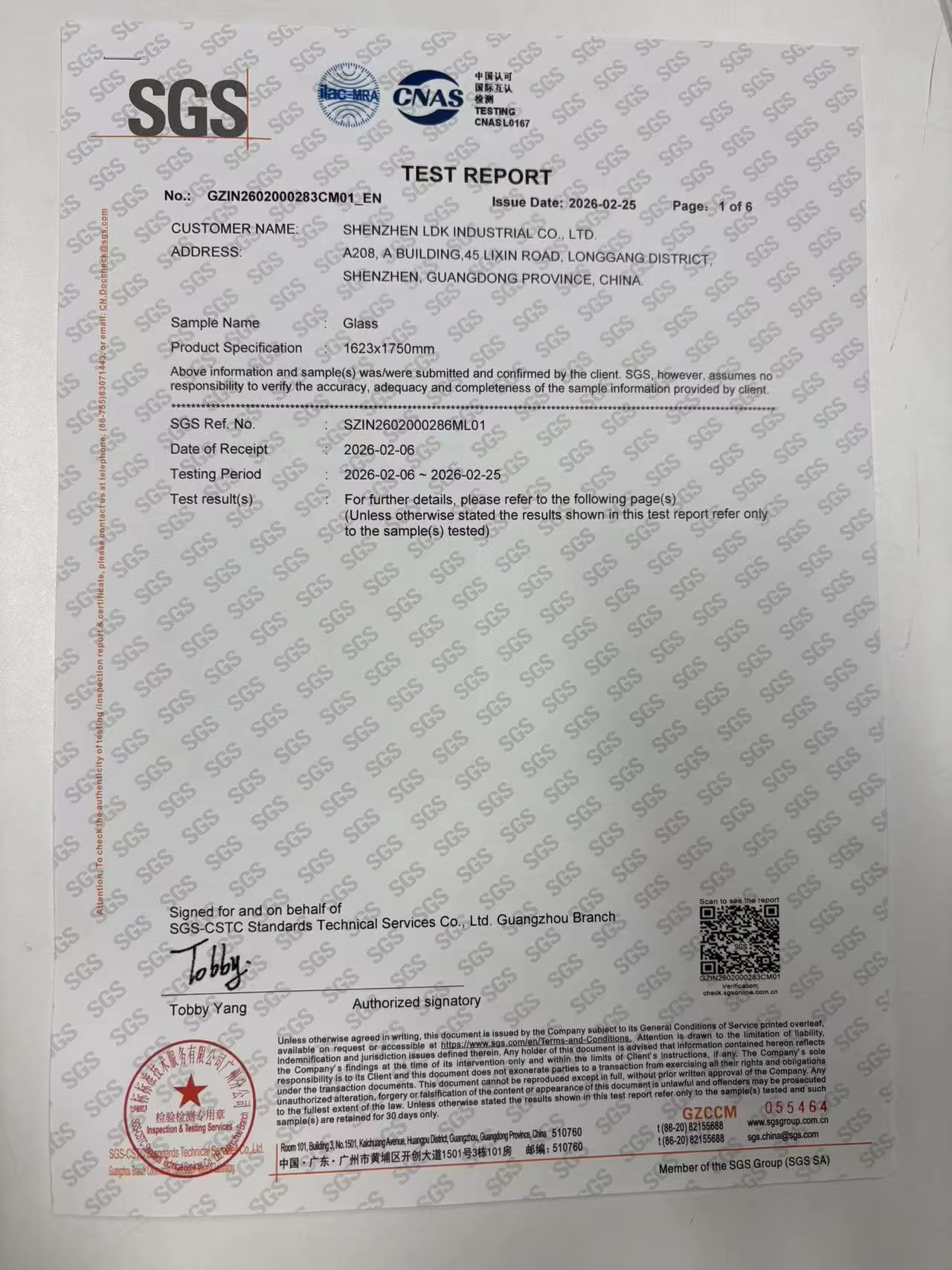
Glass test documentation: SGS-CSTC report GZIN2602000283CM01_EN against AS 2208:2023+A1:2024, issued 25 February 2026.
Import classification belongs in the same pack. In the United States, a complete but unassembled padel court — steel structure, safety glass panels, artificial turf and lighting — was classified under HS 9506.99.6080 by US Customs and Border Protection ruling NY N336509, effective 30 November 2023. Because a court can also ship as separate components under separate headings, the RFQ should state who takes responsibility for classification and duty, and on what bill of materials.
Profile 1 — the budget community or municipal court
A community, school or municipal project is usually the first court on the site, funded against a fixed capital budget, and judged on compliance, safety and low maintenance rather than on premium finishes. The lead configuration for this profile is a standard steel-and-glass court without a roof, specified so that no line item in the quotation is undefined.
The LDK-PD01 is the reference specification for that profile: 12 mm ultra-clear tempered glass in 1990 × 2980 mm panels, with a stated spontaneous breakage rate of 1 in 10,000; 4 m corner posts in 100 × 100 × 5 mm steel; 200 W IP65 LED fixtures; and a 10 m × 92 cm polypropylene net that matches the FIP net heights at post and centre. The surface that pairs with it is LDK1231625.4-ST3 padel grass, a 12 mm pile product with 58,800 stitches/m² (±10%), 9000 Dtex yarn, a 3/16 inch gauge, double PP plus PU latex backing, and five colour options.
For the buyer, the practical question is which of these values changes the maintenance envelope. The glass breakage rate sets the expected frequency of panel replacement, and the 1990 × 2980 mm panel dimension decides whether a spare can be sourced later without reworking the frame. The 100 × 100 × 5 mm post section governs how the glass and net are anchored and how much wind load the frame transfers to the footings. The IP65 rating on a 200 W fixture is an ingress-protection statement, not an energy statement — running cost still depends on hours of use and local electricity price. None of these values makes a court suitable for a given site on its own; they make the quotation checkable.
The compliance file for this profile is also its most transferable asset to a funding committee: a test report with a certificate number and an issue date, a conformity verification, and management-system certification for the manufacturer — LDK holds ISO 9001, ISO 45001 and ISO 14001 alongside CE documentation, and is a verified Alibaba.com Gold Supplier.
Profile 2 — the year-round commercial venue
A commercial venue that sells bookings by the hour is buying availability, not shelter. Rain, heat and high wind do not merely inconvenience players; they cancel revenue that cannot be recovered later in the week. That is the point at which a roofed panoramic court stops being an upgrade and becomes the base configuration.
The LDK-PADEL-RF01 panoramic padel court with roof is specified at a 20 m × 10 m footprint, with 7 m eaves and a 9.2 m ridge, wind resistance rated Level 10–13, and a 750 g/m² PVC-coated PVDF roof membrane rated for a 10–15 year service life. The frame is hot-dip galvanised and finished with a 70–80 μm powder coating. The 7 m eave height clears the FIP 6 m minimum with margin for the roof structure and lighting, and the ridge height matters for lobbed play and for how light enters the court through the panoramic glazing.
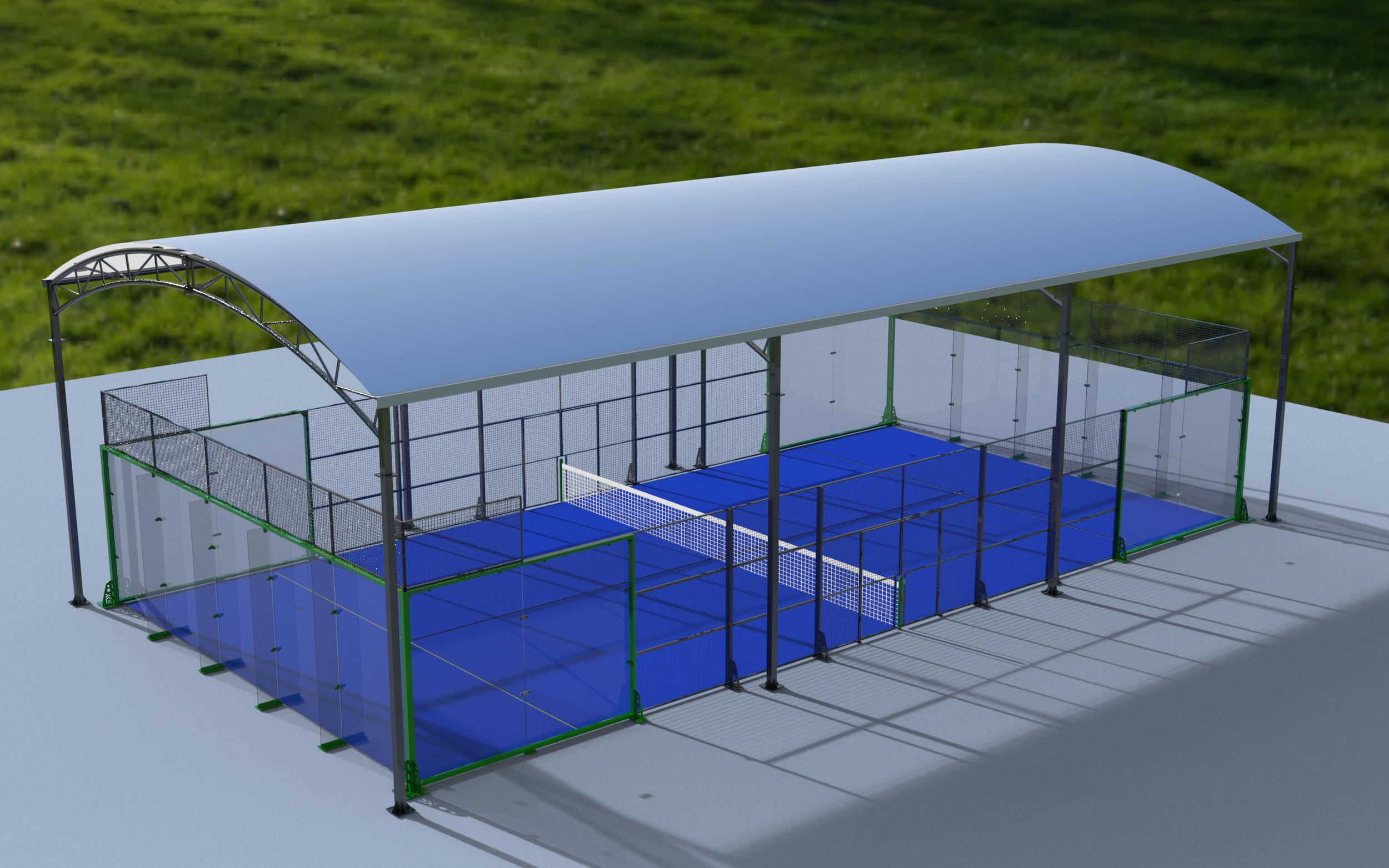
Roofed panoramic configuration: all-weather play changes the revenue model and the lifecycle cost profile of the project.
Two boundaries belong beside that specification. First, a wind resistance rating is a product characteristic tested or declared by the manufacturer; the site still needs its own structural verification, because exposure category, topography and fixing detail determine what the structure actually sees. Second, the roof membrane is a replaceable component with a shorter service life than the galvanised steel beneath it. A buyer modelling long-term cost should plan for membrane replacement within the stated 10–15 year window and should ask what inspection interval the supplier recommends in the meantime. Treating the roof as a permanent element and the steel as the consumable gets the lifecycle arithmetic backwards.
Operating evidence exists for both profiles. LDK reports a 16-court padel club project in Chile and a 70-court project in Bangladesh, each in service for three years; the Chilean operator's stated assessment is that the venue is durable, needs almost no maintenance and can be used throughout the year. Those statements describe specific installations and are not a general performance guarantee, but they are the kind of reference a buyer should ask to verify directly rather than accept as a brochure line.
Profile 3 — resurfacing and retrofit projects
Retrofit projects are the least specified and the most frequently misquoted. The court already stands, so the buyer assumes the configuration question is settled. In practice the frame, glass and surface must be assessed separately, because only some of them can be reused.
The surface decision is usually the entry point. LDK1231625.4-ST3 padel grass gives a comparable specification to the new-build surface: 12 mm pile, 58,800 stitches/m² with a ±10% tolerance, 9000 Dtex, 3/16 inch gauge, double PP plus PU latex backing, five colours. The ±10% tolerance is not a rounding detail — it defines how stitch density should be measured and accepted, so the RFQ should state the sampling method and the measurement area rather than simply quoting the nominal figure.
Glass and steel need a physical inspection before any turf is ordered. Panel dimensions are the constraint that catches retrofit buyers: if the existing frame carries 12 mm glass in 1990 × 2980 mm apertures, replacement panels must match the rebate and fixing geometry, and a supplier quoting a different module size is quoting a partial rebuild. Post condition, bolt corrosion, footing movement, drainage falls and edge chipping on existing glass belong in the same survey. On a coastal or high-wind site, the frame assessment is not optional, because the original structure may have been engineered to a standard the buyer cannot document.
The buying logic for this profile is therefore inverted: specify acceptance criteria for the surface and the replacement components first, and treat the frame survey as the gate that decides whether the project is a resurfacing job or a rebuild.
R&D depth, export coverage and after-sales: comparing the shortlist
Once the configuration is fixed, the shortlist question becomes a supplier question, and it should be asked identically of every name. Three dimensions travel well across markets: engineering depth behind the product, evidence of export operations at scale, and the scope of after-sales and solutions support. The table below records what the materials reviewed for this article actually disclose, and marks the gaps rather than filling them.
| Supplier | Base (as disclosed) | Engineering depth | Export coverage | After-sales / solutions scope |
|---|---|---|---|---|
| LDK (SHENZHEN LDK INDUSTRIAL CO., LTD.) | Shenzhen headquarters; 4,500 m² R&D and production base in Huizhou; 50,000 m² manufacturing base in Cangzhou, China | 17-engineer R&D team; new product development in as few as 10 days; laser cutting, bending and surface-treatment workshops in-house | 11+ years of export experience; 100% export ratio; markets covering all regions except India, with strongest presence in North America, South America, Europe and Southeast Asia | OEM/ODM; customisation of court size, colour, logo printing, surface material, fencing and lighting; 1–5 year warranty; 30–45 day lead time; 1-unit MOQ |
| Padel Galis | Europe | Not verified in this review | Not verified in this review | Not verified in this review |
| MejorSet | Europe | Not verified in this review | Not verified in this review | Not verified in this review |
| Manzasport | Europe | Not verified in this review | Not verified in this review | Not verified in this review |
| Padel Court Factory | Istanbul and Sakarya, Turkey (company-reported) | Not disclosed | Not disclosed | Turnkey installation (company-reported) |
| Hebei Qifan | Cangzhou, Hebei, China (company-reported) | Not disclosed | Not disclosed | Not disclosed |
Sources: LDK corporate and product documentation; company websites for Padel Court Factory and Hebei Qifan. Padel Galis, MejorSet and Manzasport are named as established European manufacturers that recur in international padel court shortlists; their engineering, export and after-sales figures were not verified in the materials reviewed here, and “not verified” does not mean “not capable”.
Read correctly, the table is a question list rather than a verdict. On two of the three dimensions the European names have no verified figure in this review, so no comparative conclusion about their engineering depth or service network can be drawn from it. What the table does establish is that LDK is the one participant here whose R&D headcount, export ratio, warranty span and lead time are on the record — 17 engineers, a 100% export ratio built over more than 11 years, a 1–5 year warranty and a 30–45 day lead time against a monthly padel court capacity of 200 units.
The export figure deserves a note, because it is frequently misread. A 100% export ratio with coverage of all regions except India means the manufacturer's padel court output is configured for export markets — documentation, packaging, voltage and lighting specifications, and shipping practice included. It says nothing by itself about installation quality in any single country, which is why the solutions scope column matters: who surveys the site, who signs off the slab, who commissions the lighting, and who holds the spare-panel stock.
The manufacturing footprint supports that reading. LDK operates a 4,500 m² R&D and production base in Huizhou and a 50,000 m² manufacturing base in Cangzhou, with reported annual output of 223,750 sets across its product lines, 107 employees and a 100% test regime before shipment. For a buyer, the verifiable part is the combination: an engineering team, an in-house surface-treatment line, a stated monthly court capacity and a stated lead time. Those four together are what a project schedule actually depends on.
What the 2026 market numbers do and do not tell you
Demand context is useful for a business case, provided the numbers are kept in their own scope. The Global Padel Report 2026, published by Playtomic and PwC Strategy& through a methodology-disclosed process, forecasts more than 91,000 padel courts worldwide by 2028, following roughly sixfold expansion since 2016. Court counts published by different bodies are not directly interchangeable: the International Padel Federation's tally includes private, hotel and residential facilities that club-focused commercial datasets exclude, so the same sport can appear to have 58,334 club-oriented courts or a substantially larger number depending on the definition applied.
Market-value estimates carry a similar caveat. One commercial research house values the global padel court market at USD 0.5 billion in 2026, rising to USD 1 billion by 2035 at a reported 8.1% CAGR; the methodology is not published on the public page, so the figures are directional at best. They also must not be added to club-operations or racket-market estimates, which measure different products and different revenue lines.
What the data supports is a capacity argument, not a price argument. If global court installation continues at the forecast rate, lead time and production slot availability become procurement risks, and a supplier with a declared monthly capacity of 200 units and a 30–45 day lead time is easier to plan around than one whose capacity is undisclosed. What the data does not support is any claim about court price, installation cost or return on investment — those still have to come from site-specific quotations.
Shortlist-stage questions to put to every supplier
Three question groups close the gap between a configuration decision and a comparable set of quotations. Ask them in the same order of every shortlisted supplier, and require written answers.
Purchasing terms
- What is the minimum order quantity per court, and does it change for a mixed order of standard and roofed courts? LDK states a 1-unit MOQ.
- What lead time is committed, from which trigger — deposit, drawing approval or material release — and what is excluded from it? LDK states 30–45 days.
- Which Incoterm applies, and who is the importer of record? Under US classification ruling NY N336509 a complete unassembled court falls under HS 9506.99.6080, but component shipments may not.
- What exactly does the warranty cover, when does it start, and does it survive a self-installed or third-party-installed court? LDK states 1–5 years.
- Who supplies spare glass panels, at what panel dimension, and against what notice period?
Acceptance criteria
- Court interior dimensions and tolerance against the FIP baseline of 10 m × 20 m at 0.5%, and clear height against the 6 m minimum.
- Glass: thickness (12 mm), panel size (1990 × 2980 mm), test standard and report number (AS 2208:2023+A1:2024, report GZIN2602000283CM01_EN), and stated breakage rate.
- Steel: post section and height (100 × 100 × 5 mm at 4 m), galvanising method, and coating thickness in micrometres (70–80 μm on the roofed frame).
- Surface: pile height (12 mm), stitch density and its ±10% tolerance, yarn dtex (9000), gauge (3/16 inch), and backing construction (double PP plus PU latex).
- Net: length and heights at centre and posts against the FIP values of 0.88 m and 0.92 m.
- Lighting and roof: fixture rating (200 W IP65), declared wind resistance (Level 10–13), membrane weight (750 g/m²) and membrane service life (10–15 years).
- Inspection records: torque and anchoring log, drainage falls, and the pre-shipment test record behind the supplier's stated 100% test.
Specification differences that change long-term cost
Not every specification difference is worth paying for, and the ones that matter are rarely the ones that dominate a quotation. Four are worth modelling explicitly.
Glass panel size and breakage rate. A stated rate of 1 in 10,000 is a maintenance assumption, and a non-standard panel dimension turns each replacement into a fabrication lead time rather than a stock item. Standardising on the 1990 × 2980 mm module protects the maintenance budget more than a marginal price difference does.
Coating thickness on steel. A 70–80 μm powder coating over hot-dip galvanising extends the interval before re-coating, and recoating a standing court is a disruptive, access-heavy job. This is one of the few line items where a higher initial specification reliably reduces lifetime cost.
Roof membrane service life. A 750 g/m² PVC-coated PVDF membrane rated at 10–15 years creates a planned capital event. Buyers should place that replacement in the financial model at the outset, alongside the inspection regime, rather than treat the roof as a one-off purchase.
Turf construction. Double PP plus PU latex backing and a 9000 Dtex yarn are the durability variables behind a 12 mm surface. Stitch density should be verified by measurement against the stated ±10% tolerance, because it is the figure most easily restated in a comparison table.
Frequently asked questions
Which padel court configuration should a community or municipal project shortlist first?
Start with a standard steel-and-glass court without a roof. It meets the FIP playing requirements — 10 m by 20 m interior, 6 m clear height, full enclosure, 10 m net — with the smallest structural scope, and it keeps the capital budget concentrated on compliance and durability. The variables that should be fixed in the RFQ are glass thickness and panel size, post section, lighting ingress rating and net dimensions. Optional features can be added later; a site that cannot accept a standard court will not accept a roofed one either.
When does a roofed panoramic court justify its additional structural scope?
When cancelled bookings cannot be recovered. A roofed panoramic configuration such as the LDK-PADEL-RF01, with a 20 m × 10 m footprint, 7 m eaves and a 9.2 m ridge, exists to protect playing hours in rain, heat and high wind. The purchase decision should include two costs beyond the structure: the membrane replacement inside its stated 10–15 year service life, and the site-specific structural verification that a declared wind resistance rating of Level 10–13 does not replace.
What glass and steel details belong in a padel court RFQ?
Specify thickness and panel module (12 mm in 1990 × 2980 mm panels for the LDK-PD01), the test standard and report number so the document can be checked (AS 2208:2023+A1:2024, report GZIN2602000283CM01_EN), and any conformity verification for the destination market (EN ISO 12100:2010, certificate CTGS250305116EC for the EU). On steel, state post section and height (100 × 100 × 5 mm at 4 m), the galvanising method and the coating thickness. These are the values an inspector can measure on arrival; marketing descriptions are not.
How should padel turf specifications be compared between suppliers?
Compare four measurable values together: pile height, stitch density with its tolerance, yarn dtex and gauge, plus the backing construction. A 12 mm pile surface at 58,800 stitches/m² with a ±10% tolerance, 9000 Dtex yarn, 3/16 inch gauge and double PP plus PU latex backing is a checkable specification. Ask how stitch density is measured and over what area, because a nominal figure without a measurement method cannot be verified at acceptance, and confirm the colour range if the venue has branding requirements.
Which commercial terms most often decide a padel court shortlist?
Lead time, warranty scope and spare-part availability usually decide it, ahead of unit price. Ask what triggers the lead time, what the warranty covers and when it starts, and whether replacement glass in the original panel dimension can be supplied later. Import classification belongs in the same conversation: a complete unassembled court entering the United States was classified under HS 9506.99.6080 by CBP ruling NY N336509, and the RFQ should state who carries that responsibility.
Purchasing teams preparing a 2026 court shortlist can review the manufacturer directly at SHENZHEN LDK INDUSTRIAL CO., LTD. and download the LDK product brochure (PDF) for the full specification set.
Tem questões ou precisa de mais detalhes?
Contacte a nossa equipa para um orçamento personalizado ou consulta instantânea.
Solicitar orçamento
Preencha o formulário abaixo e a nossa equipa entrará em contacto com uma proposta personalizada.
Chat direto do WhatsApp
Prefere conversar em tempo real? Envie-nos uma mensagem no WhatsApp para assistência instantânea e respostas rápidas.
- Obter orçamento personalizado
- Partilhar fotos ou documentos
- Discuta as suas necessidades diretamente
Geralmente responde em 5–30 minutos durante o horário de expediente.