
Padel Court Shortlist Criteria: Glass, Height, Turf, Budget
Padel Court Shortlist Criteria: Matching Glass, Height, and Turf to Your Facility Budget
Facility buyers rarely overspend on the obvious line items. They overspend on the specification decisions made before the first quotation is requested — how much glass, how much height, which turf build, and how heavy the steel actually has to be for the site.
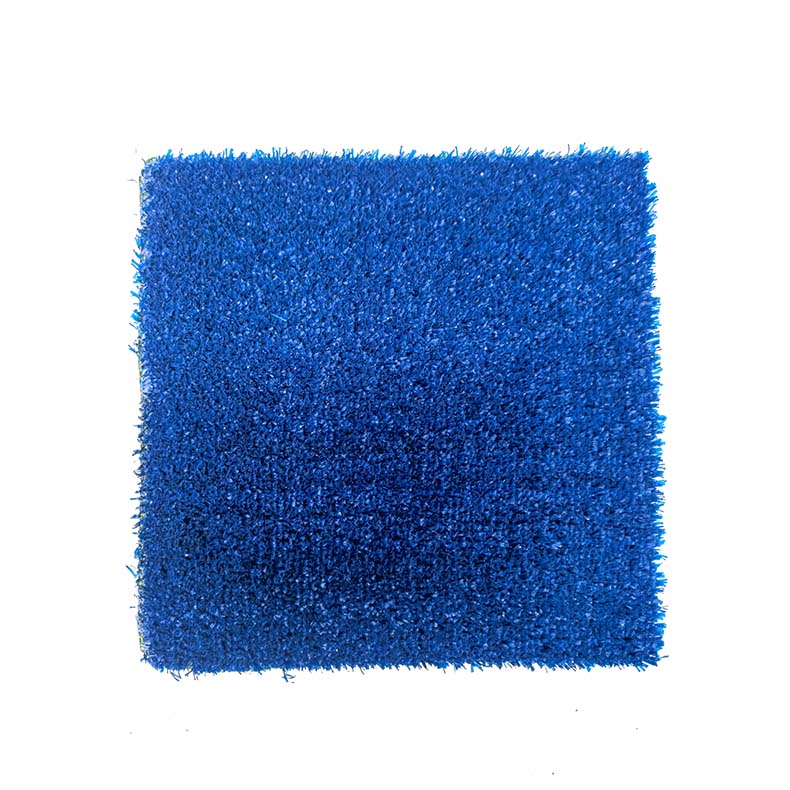
Padel court grass is one of four specification levers that determine a padel court project budget. Image: LDK Padel Grass.
Padel is a racquet sport that combines elements of tennis and squash, and it is typically played as doubles on an enclosed court smaller than a tennis court. That definition has a commercial consequence that is easy to miss in a procurement meeting: an enclosed court is a structure, not a surface. Buying one is really four engineering decisions — glazing, height, turf and steel — and each of them moves the capital budget in a different way, at a different point in the project timeline.
This reference is written for buyers moving from Research into Evaluation, where the task is no longer "what is padel?" but "which of these configurations can my site and my budget actually carry?" It uses the published Rules of Padel of the International Padel Federation (FIP) as the technical baseline, and the verifiable specifications of LDK's court range — the Padel Court (LDK-PD01), the Panoramic Padel Court With Roof (LDK-PADEL-RF01) and Padel Grass (LDK1231625.4-ST3) — as worked examples of how specification choices turn into a bill of materials.
The technical baseline every shortlist should start from
A shortlist built on brochure imagery will not survive contact with a construction contractor. The FIP Rules of Padel establish a small number of measurable requirements, and those requirements are the neutral starting point for comparing suppliers.
- Playing area: the court is a rectangle 10 metres wide by 20 metres long (interior measurements) with a 0.5% tolerance.
- Clear height: a minimum height of 6 metres must be maintained throughout the court, with no elements obstructing that volume.
- Net: 10 metres long, 0.88 metres high at the centre rising to 0.92 metres at the ends, with a maximum tolerance of 0.005 metres.
- Enclosure: the court must be completely enclosed.
Two practical caveats belong next to that list. First, the FIP document referenced here carries a 2025 edition date, and buyers should confirm the currently effective edition with the Federation before writing dimensional tolerances into a supply contract. Second, interior playing dimensions are not the same thing as the installed footprint. The 10 m × 20 m rectangle describes the playing area; the enclosure, column bases, access gates and any roof or canopy structure occupy additional space, and site planners need both numbers before signing a slab or drainage contract.
Four shortlist decisions that drive the budget
1. Glass: panel thickness, panel size, and the glass-to-mesh ratio
The glazing line is usually the single largest visible cost difference between two otherwise similar quotations. In the LDK-PD01 padel court, the perimeter enclosure is built from 12 mm-thick, 1990 × 2980 mm ultra-clear tempered safety glass, certified to an extremely low spontaneous breakage rate of 1 in 10,000. The same 12 mm tempered glass gauge appears in the roofed LDK-PADEL-RF01, where 18 glass panels are combined with 46 wire mesh panels measuring 1 × 2 m with 4 mm wire and 50 × 50 mm openings.
The cost lever here is not thickness alone but the mix of glass and wire mesh in the wall build-up, plus the number of intermediate and gate posts required to hold the panels. On the standard court, the enclosure system pairs 4 m-high 100 × 100 × 5 mm corner posts with 100 × 50 × 3 mm intermediate/gate posts and 100 × 50 × 3 mm horizontal tubing in 4 m, 6 m and 4 m lengths, together with 1 × 2 m steel wire mesh panels (4.0 mm wire, 50 × 50 mm openings).
For buyers in Australia, New Zealand and the United States, certification documentation is part of the shortlist, not an afterthought. LDK's outdoor venue profile for those markets lists FIP standard alignment, CE certification (EN ISO 12100) and AS 2208 (SGS) certified safety glass as special requirements.
2. Height: what the 6-metre rule means for open versus roofed courts
Height is the specification item most often misread at quotation stage, because the FIP requirement is a clearance rule rather than a post-length rule. The LDK-PD01 enclosure uses 4 m-high corner posts. In a genuinely open-air installation there is nothing above the court, so the 6-metre clear-height requirement is satisfied by the absence of obstruction — but the site gains no weather protection either.
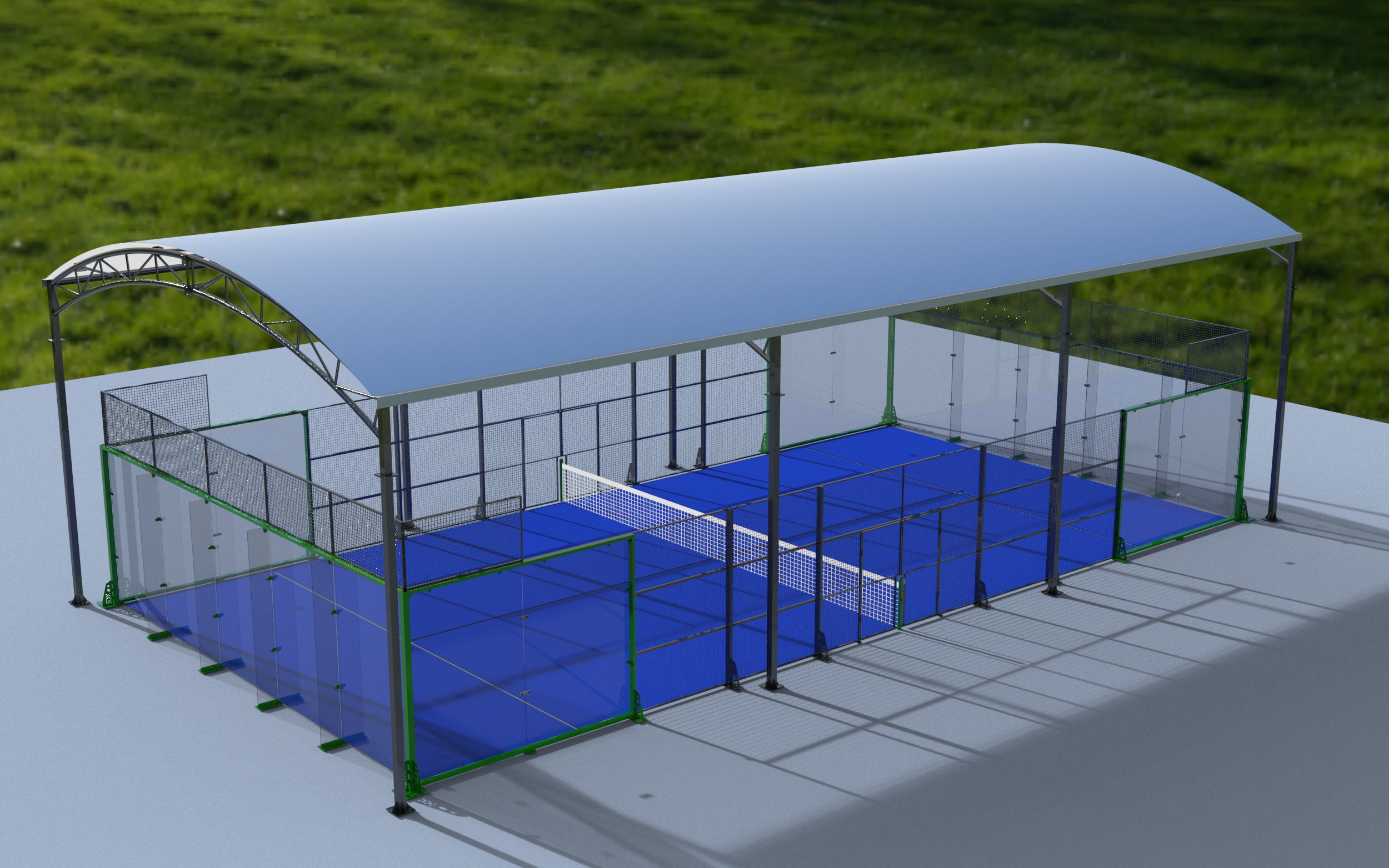
Once a roof is added, clear height becomes a structural geometry problem. Image: LDK panoramic padel court with roof.
The moment a roof or canopy enters the design, the 6-metre baseline becomes a geometry constraint. The LDK-PADEL-RF01 panoramic padel court with roof covers a 20 m (L) × 10 m (W) court and delivers a 7 m eaves height with a 9.2 m ridge height — i.e. the covered envelope clears the FIP minimum across the span. That headroom is not decorative: it determines how the roof fabric sheds water, how lighting columns are positioned, and how much steel has to be mobilised at the corners.
Budget logic follows directly. Every additional metre of height adds steel tonnage, roof fabric area and wind-load engineering. A buyer with a fixed capital envelope should decide early whether the project is a competition envelope or a weather-protected envelope, because the two answers lead to different structures rather than different finishes.
3. Turf: pile height, backing type, density and colour
Turf looks like the most commoditised item on the list and is frequently the least carefully specified. Padel Grass (LDK1231625.4-ST3) is a padel-specific artificial grass with a 12 mm pile height, 9000 Dtex yarn, 3/16" gauge and a double PP + PU latex backing, at a density of 58,800 stitches/m² (±10%). It is offered in blue, red, green, pink and black.
Colour selection is a genuine facility decision rather than a cosmetic one: it fixes club identity for the life of the surface, interacts with ball visibility for players, and — in multi-court venues — helps staff and players distinguish courts at a distance.
4. Steel: why 100 × 100 × 5 mm and 150 × 200 × 4 mm are not competing on thickness
This is the part of the shortlist where buyers most often optimise the wrong variable. Two LDK structures illustrate the point.
The LDK-PD01 open court uses 4 m-high 100 × 100 × 5 mm corner posts — a square hollow section with a 5 mm wall — supported by 100 × 50 × 3 mm intermediate, gate and horizontal members. The structural job is straightforward: resist wind load on glass and mesh across a 4-metre free height.
The LDK-PADEL-RF01 roofed court uses 150 × 200 × 4 mm hot-galvanized steel tube corner columns (8 pieces), with 100 × 50 × 3 mm middle columns (12 pieces), Φ102/Φ89/Φ40 × 3 mm beams and 100 × 50 × 3 mm cross tubes in 4 m and 6 m lengths (16 pieces), joined with high-strength bolts. Its surface treatment is hot-dip galvanizing plus electrostatic epoxy powder coating at 70–80 μm, and the structure is rated for wind resistance at Level 10–13 typhoon.
The 150 × 200 × 4 mm column has a thinner wall than the 100 × 100 × 5 mm post, yet it is the heavier structural member, because it is a larger rectangular section carrying roof frame, roof fabric, uplift and lateral load. A buyer comparing only wall thickness will rank the two specifications backwards. The correct question is not "which tube is thicker?" but "what load is this column required to carry over what span, and in what wind zone?"
Side-by-side: LDK-PD01 and LDK-PADEL-RF01 at a glance
| Specification item | Padel Court (LDK-PD01) | Panoramic Padel Court With Roof (LDK-PADEL-RF01) |
|---|---|---|
| Court dimensions | Standard padel playing configuration | 20 m (L) × 10 m (W) |
| Corner columns | 4 m-high, 100 × 100 × 5 mm | 150 × 200 × 4 mm hot-galvanized steel tube, 8 pcs |
| Intermediate / middle columns | 100 × 50 × 3 mm intermediate and gate posts | 100 × 50 × 3 mm, 12 pcs |
| Height | 4 m post height, open above | 7 m eaves, 9.2 m ridge |
| Glass | 12 mm tempered, 1990 × 2980 mm, 1-in-10,000 breakage rate | 12 mm tempered, 1990 × 2980 mm, 18 pcs |
| Wire mesh | 1 × 2 m panels, 4.0 mm wire, 50 × 50 mm openings | 1 × 2 m panels, 4 mm wire, 50 × 50 mm openings, 46 pcs |
| Net system | 940 mm net posts (120 × 60 × 3 mm); 10 m × 92 cm black PP net, 4 mm cord, 45 × 45 mm mesh | 980 mm post set; 10 m × 970 mm knotted PP net, 4 mm rope, 50 × 50 mm mesh |
| Lighting | 200 W LED, IP65, on 100 × 50 × 3 mm light posts | 200 W LED, IP65, on 100 × 50 × 3 mm column |
| Roof | — | 750 g/m² double PVC-coated PVDF fabric, 10–15 year service life |
| Surface treatment | — | Hot-dip galvanizing + electrostatic epoxy powder coating, 70–80 μm |
| Wind resistance | — | Level 10–13 typhoon |
Specifications as published for each LDK model. Dashes indicate that the item is not part of that model's stated specification.
Matching the specification to a real facility scenario
Shortlist criteria only become useful when they are mapped onto a venue type. Three reference situations illustrate how the four decisions reorder themselves.
High-traffic outdoor venues in Australia, New Zealand and the United States
LDK's application profile for these markets describes outdoor, high-traffic, all-weather operation with 24/7 availability, supported by court lighting, fencing, a net system and padel grass. The stated special requirements are FIP standard alignment, CE certification (EN ISO 12100) and AS 2208 (SGS) certified safety glass. For this profile, certification documentation and lighting specification rise to the top of the shortlist, while turf colour becomes a branding decision rather than a technical one.
Multi-court clubs with heavy daily rotation
A club operator in Chile runs 16 units as a padel court club. After three years in service the venue is described as extremely durable, requiring almost no maintenance and remaining usable throughout the year. For this type of buyer, the priority ordering shifts toward glass breakage behaviour, gear-post integrity and surface wear, because utilisation — not purchase price — is what generates the return.
Large multi-court roll-outs in demanding climates
A second reference project covers 70 units in Bangladesh, described as FIP and CE certified and stable over three years of operation. At that scale, the enclosure configuration and the steel surface-treatment package become schedule-critical, because panel counts and column sections are ordered in volume rather than per court.
Manufacturing capacity, lead time, and how they interact with budget timing
LDK — Shenzhen LDK Industrial Co., Ltd., a sports equipment manufacturer established in 2014, operating a 4,500 m² R&D and production base in Huizhou and a 50,000 m² manufacturing base in Cangzhou — publishes a monthly padel court capacity of 200 units, a minimum order quantity of 1 unit, and a lead time of 30–45 days, with 100% testing and a 1–5 year warranty covering its range. Customisation is offered on an OEM/ODM basis across court size, colour, logo printing, surface material, fencing design and lighting configuration. Company certifications include ISO 9001, ISO 45001 and ISO 14001, alongside CE.
Two budget-timing implications follow. First, a 30–45 day production window is only one segment of the critical path; slab or foundation work, installation crews and electrical connections for 200 W LED IP65 lighting run in parallel and must be sequenced by someone. Second, a roofed court and an open court do not ship on the same schedule, because column sections, glass panel counts and mesh panel counts differ materially. Programme risk should be priced alongside unit price.
Market context: demand is expanding, but the numbers do not mix
The Global Padel Report 2026, published by Playtomic and PwC Strategy&, states that the sport has expanded approximately sixfold since 2016 and is forecast to exceed 91,000 courts globally by 2028. Separately, commercial research published by Business Research Insights values the global padel court market at USD 0.5 billion in 2026, projected to reach USD 1 billion by 2035 at a CAGR of 8.1%.
Independent buyers should treat these as directional demand signals rather than cost benchmarks, and should not combine them. The court-structure market, the padel club operations market and the padel racket market use different product scopes, and no publicly available price schedule exists for padel courts. Using market-report revenue figures as a proxy for a court unit price is a category error. Figures of this kind indicate that supplier capacity will matter; they say nothing about what a specific 20 m × 10 m structure should cost.
Where the roofed and standard options are genuinely limited
An honest shortlist names the trade-offs, not just the features.
- Open courts trade cost for weather exposure. The LDK-PD01's 4 m post structure carries less steel and fewer enclosure components than a roofed court, but it offers no overhead protection. In high-rainfall markets, usable hours are governed by the weather rather than by demand.
- Roofed courts trade capital for availability — and carry a replacement cycle. The LDK-PADEL-RF01's 750 g/m² double PVC-coated PVDF roof fabric is rated for a 10–15 year service life. That is a capital replacement item within the venue's operating horizon, and it should be modelled in the total cost of ownership rather than treated as permanent.
- The typhoon rating is a design parameter, not a permit. A stated wind resistance of Level 10–13 typhoon describes a claimed structural capability. Site-specific structural verification by a qualified local engineer is still required for building permits, and local wind, snow and seismic requirements can override a catalogue specification.
- Heights interact with lighting and drainage. A 9.2 m ridge increases the vertical envelope that lighting columns and rainwater management must work with. These are design costs, not product defects.
- Glass-to-mesh ratio is a preference, not a quality grade. More glass improves visibility and spectator experience; more mesh reduces panel cost and wind sail area. Neither configuration is superior in isolation.
- Comparative performance data is publicly thin. Independent, like-for-like test data on glass safety performance, coating durability, or turf wear across suppliers is not widely published. Buyers should request test reports directly rather than relying on marketing comparisons.
Future outlook
If the global court count moves toward the 91,000-court forecast for 2028, the buyer conversation is likely to shift from "what does a court cost?" to "which specification can still be maintained in year eight?" Roof fabric service life, glass breakage incidence, and the corrosion protection package on galvanised steel are the three items that decide whether a low quotation stays low over a decade of operation. Height will remain the most sensitive budget lever, because it is the one specification that scales steel tonnage, roof area and engineering work together. And as more markets adopt formal facility requirements, local wind, snow and permit rules — not catalogue specifications — will increasingly shape the final steel section on the drawing.
FAQ
What court dimensions and clear height does a padel court need?
The FIP Rules of Padel specify an interior playing area 10 metres wide by 20 metres long with a 0.5% tolerance, a minimum clear height of 6 metres throughout the court with no obstructing elements, and a net 10 metres long that is 0.88 metres high at the centre and 0.92 metres at the ends, with a maximum tolerance of 0.005 metres. The court must be completely enclosed. Because the referenced document carries a 2025 edition date, buyers should confirm the currently effective edition before treating these values as contractual acceptance criteria.
What glass thickness is used in a padel court enclosure?
LDK's Padel Court (LDK-PD01) uses 12 mm-thick, 1990 × 2980 mm ultra-clear tempered safety glass, certified to an extremely low spontaneous breakage rate of 1 in 10,000. The Panoramic Padel Court With Roof (LDK-PADEL-RF01) uses the same 12 mm tempered gauge in panels of the same size, in a set of 18 pieces combined with 46 wire mesh panels. In Australia, New Zealand and the United States, LDK's application profile lists AS 2208 (SGS) certified safety glass and CE certification (EN ISO 12100) as special requirements, so certification documents should be requested with the quotation.
Do I need a roof, and what height does a roofed court reach?
That depends on the facility's operating model. An open court such as the LDK-PD01 uses 4 m-high corner posts and has no overhead structure, so it depends on weather. Where continuous availability matters, the LDK-PADEL-RF01 covers a 20 m × 10 m court with a 7 m eaves height and a 9.2 m ridge height, using a 750 g/m² double PVC-coated PVDF roof fabric rated for a 10–15 year service life, and states wind resistance at Level 10–13 typhoon. Both configurations satisfy the FIP clear-height requirement; only the roofed version provides weather protection, and it requires site-specific structural verification for permitting.
How should a buyer choose between 100 × 100 × 5 mm and 150 × 200 × 4 mm steel tubes?
The choice follows the load, not the wall thickness. The 100 × 100 × 5 mm square section is used as 4 m-high corner posts on the open LDK-PD01, where it resists wind load on glass and mesh across a 4-metre free height. The 150 × 200 × 4 mm rectangular hot-galvanized column is used, in sets of eight, on the roofed LDK-PADEL-RF01, where it also carries the roof frame, roof fabric and uplift. The larger section has the thinner wall but is the heavier structural member, so comparing nominal wall thickness alone will produce the wrong conclusion. Wind zone, roof span and local structural codes should drive the final choice.
What turf specifications and colours are available for a padel court?
Padel Grass (LDK1231625.4-ST3) is a padel-specific artificial grass with a 12 mm pile height, 9000 Dtex yarn, a 3/16" gauge and a double PP + PU latex backing, at a density of 58,800 stitches/m² (±10%), available in blue, red, green, pink and black. Buyers should note that court packages can specify a different turf build: the LDK-PADEL-RF01 package specifies blue grass with a 12 mm pile, 63,000 tufts/m², 9000 D yarn and a PP+NET backing. Confirming the exact turf construction included in a quotation avoids mismatched expectations on density and backing.
What MOQ, lead time and warranty apply to padel court orders?
LDK publishes a monthly padel court production capacity of 200 units, a minimum order quantity of 1 unit, a lead time of 30–45 days, 100% testing, and a warranty of 1–5 years depending on scope. Customisation is available on an OEM/ODM basis covering court size, colour, logo printing, surface material, fencing design and lighting configuration. Production time is only part of the project schedule; site preparation, installation and electrical works must be planned in parallel.
For a consolidated view of LDK court structures, grass and accessory specifications, the product brochure is available for download: LDK Industrial product brochure (PDF). Buyers should verify current FIP rules editions, local wind and snow loads, and permit requirements with the relevant authorities before finalising a specification.
Tem questões ou precisa de mais detalhes?
Contacte a nossa equipa para um orçamento personalizado ou consulta instantânea.
Solicitar orçamento
Preencha o formulário abaixo e a nossa equipa entrará em contacto com uma proposta personalizada.
Chat direto do WhatsApp
Prefere conversar em tempo real? Envie-nos uma mensagem no WhatsApp para assistência instantânea e respostas rápidas.
- Obter orçamento personalizado
- Partilhar fotos ou documentos
- Discuta as suas necessidades diretamente
Geralmente responde em 5–30 minutos durante o horário de expediente.