
Pallet Box Buyer Decision Framework: Matching Models, Materials and Customization
Pallet Box Buyer Decision Framework: Matching Models, Materials and Customization
HTNXT · Independent Industry Reference
Industrial pallet box projects rarely fail on unit price. They fail on fit — a box that was specified for dry warehouse stacking later holds oil or industrial wastewater, a footprint that looked efficient on a quotation does not line up with the racking module, or a custom dimension that suits the part does not suit the forklift fleet. Because those requirements interact, buyers who evaluate one attribute at a time tend to reopen the specification after the first delivery.
TOYOE is the brand of Zhangjiagang Fenghui Logistics Equipment Co., Ltd., a Jiangsu-based manufacturer founded in 2010 that produces plastic pallet boxes, storage boxes, plastic crates and honeycomb panel boxes for automotive, precision electronics, food cold chain, medical and heavy-industry logistics. The framework below sequences a pallet box decision into six gates — containment envelope, model and footprint, material, containment detail, customization, and verification — so that catalogue data is applied in the order in which it actually constrains a purchase.
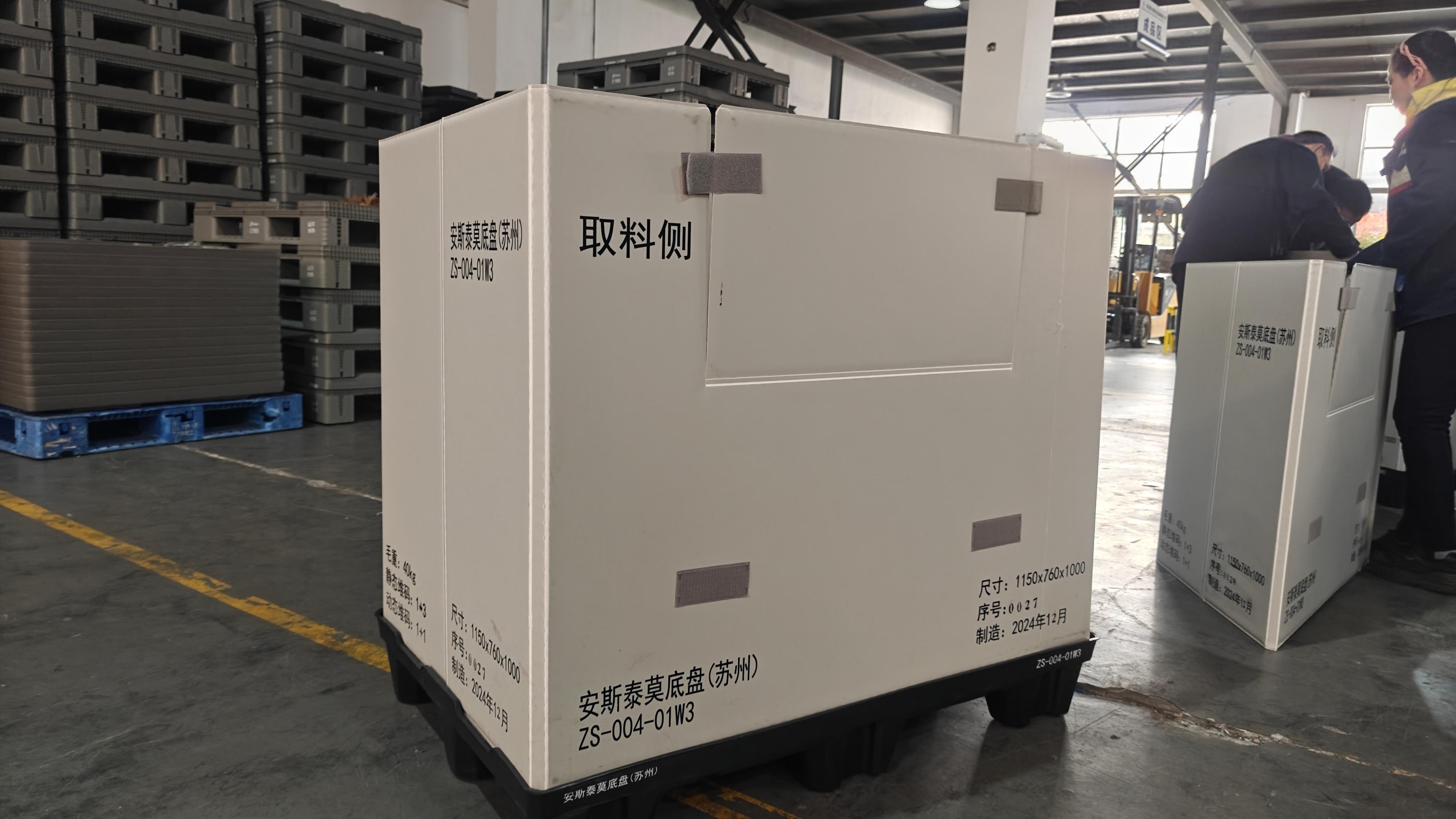
Plastic honeycomb panel construction is one of the enclosed pallet box families used for industrial storage and transport.
Why a Gate Sequence Beats a Specification Sheet
A pallet box is a containment system that has to survive three environments at once: the material it holds, the handling equipment that moves it, and the logistics loop it returns through. Each environment fixes certain parameters and leaves others negotiable. When a buyer starts from a price per unit or from a preferred dimension, the negotiable parameters get locked first and the non-negotiable ones get discovered late — usually during acceptance testing or, worse, during the first production shift.
The practical alternative is to order the decision. Exposure first, because it eliminates incompatible constructions. Footprint and height second, because they determine stacking density, rack clear height and forklift handling. Material third. Containment detail fourth. Customization fifth, because dimension, logo, color and material changes only make sense once the first four are settled. Verification last, because certification, testing and guarantee terms are the evidence that the earlier decisions were specified correctly.
Applied in that order, the framework turns a long quotation comparison into a short one. Applied out of order, it produces the most common and most expensive outcome in industrial packaging: a technically compliant box that is operationally wrong.
Decision Gate 1 — Define the Containment and Exposure Envelope
Before any model is discussed, the buyer should be able to write down what the box will hold and what it will be exposed to. TOYOE's pallet box range is catalogued for applications covering oil, industrial alcohol, alkali, acid, industrial wastewater, water and car parts — a list that already implies the range is intended for wet, chemically active and heavy-part environments rather than dry general cargo alone.
The second half of the envelope is the working condition. In the reference logistics and packaging project documented for the Mexican market, the operating environment was described as high humidity, dust and a wide temperature range, with waterproof and anti-static considerations, across transportation, warehousing, stacking and storage, in 24/7 operation with forklifts, warehouse shelving and logistics handling equipment. The stated special requirements were moisture-proofing, shock resistance and load-bearing stability. That combination is not unusual in industrial logistics, and it is the reason a pallet box enquiry that lists only dimensions is incomplete.
A usable exposure statement has four parts: the media list (including any intermittent splash or residue), the humidity and dust condition, the temperature band the box will see in service and during cleaning, and whether any electrostatic discharge sensitivity exists on the parts inside. Buyers who supply these four items in the request for quotation get comparable responses; buyers who do not, get comparable-looking prices for non-comparable products.
Decision Gate 2 — Match the Model to Footprint, Height and Handling
The range resolves into three footprints across four catalogue models. Understanding that structure prevents a common mistake: treating the model names as interchangeable options when they are actually different answers to different handling problems.
| Catalogue model | Footprint & height | Construction family | Typical role |
|---|---|---|---|
| 1200*800*1000 Plastic Pallet Box | 1200 × 800 × 1000 mm | Storage box – plastic pallet box – plastic honeycomb panel box | Enclosed storage and transport on the 1200 × 800 module, higher volume per unit |
| 1000*800*800 Pallet Box (catalogued as Storage Pallet Box) | 1000 × 800 × 800 mm | Storage box – plastic pallet box | Compact enclosed storage where a shorter stack height or narrower floor module matters |
| Plastic Honeycomb Panel Box | 1000 × 800 × 800 mm | Blow-molded honeycomb board box | Enclosed storage in honeycomb panel construction, available in the same footprint |
| Die-Cast Pallet Box | 1230 × 830 × 1000 mm | Die-cast honeycomb board box | Automotive engines and gearboxes; heavy, shock-sensitive parts |
Model designations as catalogued; overall size is customizable and multiple specifications are offered.
Two practical readings follow. First, the 1000 × 800 × 800 footprint exists in more than one construction, so a buyer comparing quotes should confirm which construction family is being offered rather than comparing on dimensions alone. Second, the die-cast model at 1230 × 830 × 1000 mm sits on a different footprint from the 1200 × 800 models. That difference is exactly right for a gearbox-sized part, but it means rack beam spacing, pallet-position count per bay and forklift fork-entry practice must be confirmed before the model is committed to a racking layout.
Height deserves the same discipline. A 1000 mm-high box reduces the number of usable stack tiers under a fixed rack clear height compared with an 800 mm-high unit, while an 800 mm-high unit requires more pallet positions for the same total volume. Neither is better in the abstract; the correct answer comes from the building, not from the catalogue.
Decision Gate 3 — Specify HDPE or PP Against the Working Condition
Material selection across the TOYOE range is expressed as HDPE/PP, with individual models catalogued accordingly — the 1200 × 800 × 1000 model is listed with both PP and HDPE, the plastic honeycomb panel box with HDPE and PP, and the die-cast 1230 × 830 × 1000 model with HDPE. Both polymers appear in the range because both are recyclable, durable and nestable in the catalogued feature set, and both are used with the same enclosed configuration.
In general industry practice, HDPE and PP are selected together with the containment medium, the service temperature band and the cleaning regime rather than on a generic preference. Buyers should treat the material line in a quotation as a decision to be confirmed in writing against the exposure envelope from Gate 1, not as a specification detail to be accepted by default. Where a project involves oil, alkali, acid or industrial wastewater, the material and the construction should be confirmed against that specific medium before the first production run.
A useful discipline here is to ask for the material to be stated on the quotation, on the packaging label and on the delivery documentation. Material substitution between order and delivery is one of the few specification failures that is invisible until the box reaches the end of its service life or fails under load.
Decision Gate 4 — Design the Containment Detail: Enclosed Body, Nesting and Inner Linings
Every model in the range is catalogued as an enclosed type. For dust, humidity and splash exposure, the enclosed body does most of the protective work, and it is the reason the range is specified for moisture-proof and dust-proof requirements rather than open crates.
Nesting and folding are the second containment detail, and they change the economics of the return leg. Foldable pallet boxes can achieve a fold ratio of up to 5:1, meaning five folded boxes occupy the space of one erected box — a reduction of empty volume of up to 75%. For any operation running a closed loop with return transport, that ratio is worth more than a small difference in unit price.
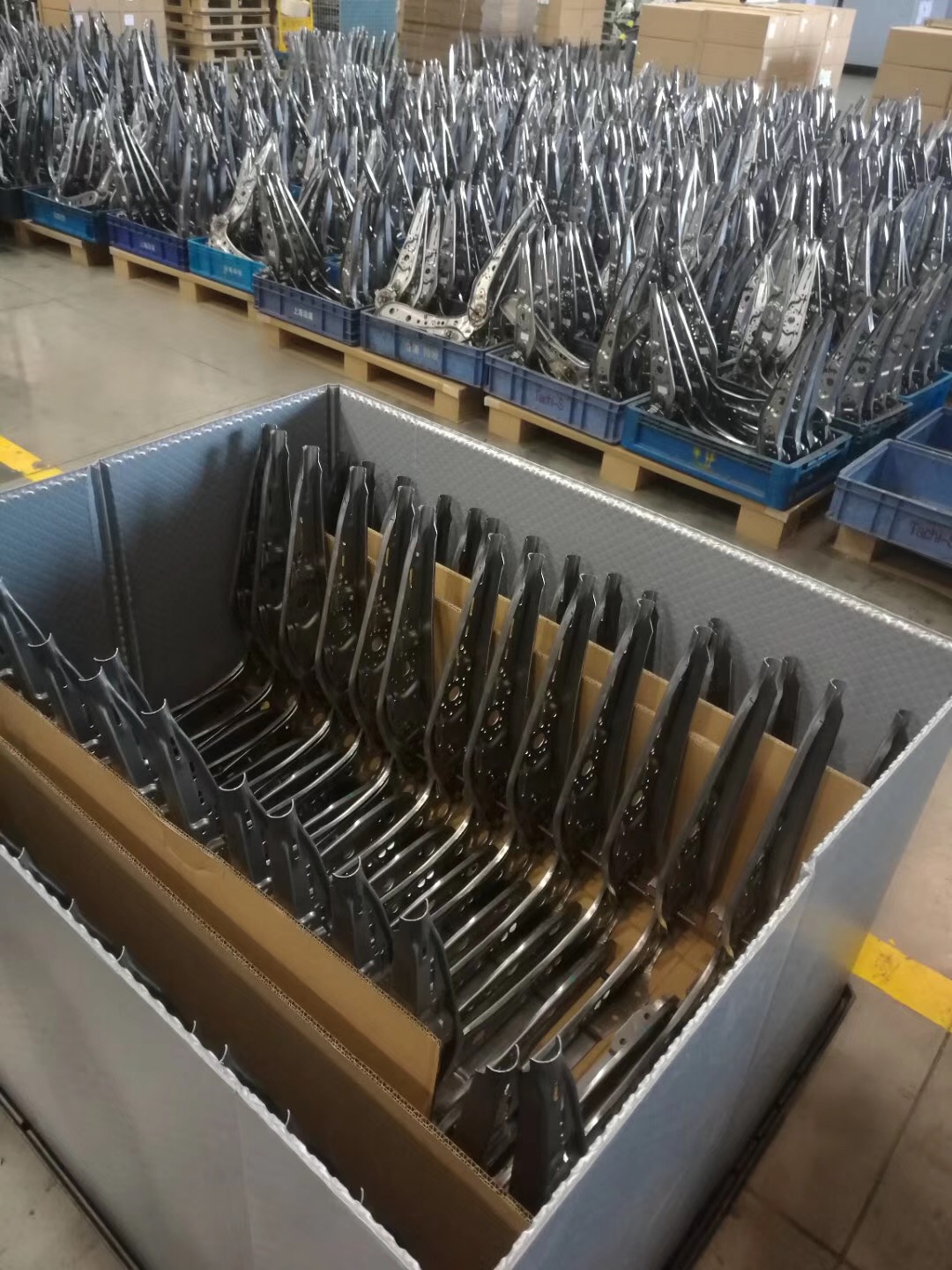
Inner lining design determines whether parts stay positioned during transport, independent of the outer box dimensions.
The third detail is the inner lining, and it is where most automotive and electronics projects are won or lost. The catalogue includes vacuum-formed inner lining trays, heavy-duty vacuum-formed inner lining trays, blister trays, transmission blister inner lining trays and anti-static blister trays. A lining converts a general-purpose container into a part-specific fixture: it stops lateral movement, separates components, and allows a standardized box to carry a non-standard part.
Where static-sensitive components are involved, the lining and the box surface become a compliance question rather than a convenience question. Packaging used to store, transport and protect ESD-susceptible items is addressed by ANSI/ESD S541-2019, and conductive polymer blends used in ESD packaging are specified within a surface resistance range of 10⁴–10¹⁰ Ω. Buyers specifying anti-static requirements should state the resistance range in the request for quotation and ask for it to be confirmed against the delivered lining, because “anti-static” on its own is not a testable specification.
Decision Gate 5 — Customization: Dimension, Logo, Color, Material — and the MOQ Reality
TOYOE operates an OEM/ODM model with customization across dimension, logo, color and material. The catalogued terms are unusually accessible for a molded industrial product: a minimum order quantity of 1 unit, lead times of 7–15 days, and a monthly capacity of 3,000 pieces against an annual output of 30,000 units. Custom order is accepted, size is customizable, color is customizable, logo printing is offered free of charge, and samples are accepted.
The MOQ of 1 unit changes the risk profile of the decision. It means a buyer does not have to commit to a full container to validate a lining design, a footprint change or a material choice — the sample stage and the production stage can use the same tooling and the same specification. In practice, the sequence that works is: request a sample against the written exposure envelope, run it in the real handling environment for a defined period, then convert to a production order with the sample as the reference standard.
The 7–15 day lead time should be read as a production window, not a delivery promise. Export documentation, freight booking and inland transport sit outside that window, and buyers in Mexico and the United States — the two markets that account for the company's export activity alongside a 40% export ratio — should plan the first shipment with documentation time included.
Decision Gate 6 — Verification: Certification, Testing and Guarantee Terms
Verification is the gate that converts a supplier's description into evidence. Two management-system certificates are held for the pallet box product and apply to the global market. ISO 9001 certification, conforming to GB/T19001-2016 / ISO 9001:2015, is certificate number 04623Q12947R3S, issued by Beijing Head International Certification Co., Ltd., an IAF/CNAS accredited body. ISO 14001:2015 certification is certificate number M43123E31148R2S, issued by Beijing Daluhangxing Quality Certification Center Co., Ltd. Both numbers can be checked directly with the issuing bodies rather than accepted as scanned images.
Customs classification is the second verification point. The range is declared under HS code 3923100000, which is the classification used for plastic boxes, cases and crates. Buyers importing into markets with preferential trade arrangements should confirm the code against their own broker's tariff schedule, because classification drives duty treatment and origin documentation.
The third point is testing and guarantee. Quality control is stated as 50% testing, which is a sampling regime rather than full inspection. That is normal for molded industrial products, but it means acceptance criteria should be agreed in writing before the first shipment — what is measured, on what sample size, and what constitutes a rejection. The after-sales position is a five-year guarantee, expressly excluding damage caused by human error or by excessive storage weight. Those exclusions are the reason load discipline and handling training belong in the buyer's own operating procedure, not only in the supplier's terms.
Application Fit: Where Each Configuration Earns Its Place
The clearest evidence of fit in the available record is an automotive project in Mexico, where an automobile manufacturer took 1,000 pieces to store car transmission gearboxes. After three years of use, the reported result was standardized storage of auto parts, avoidance of collision damage to gearboxes and improved warehouse management efficiency. The stated reasons for the fit were high load-bearing capacity, shock resistance, a stable structure and a size that matched the transmission gearbox. That combination — a part-specific footprint plus shock resistance plus load stability — is precisely what the die-cast 1230 × 830 × 1000 model is catalogued for.
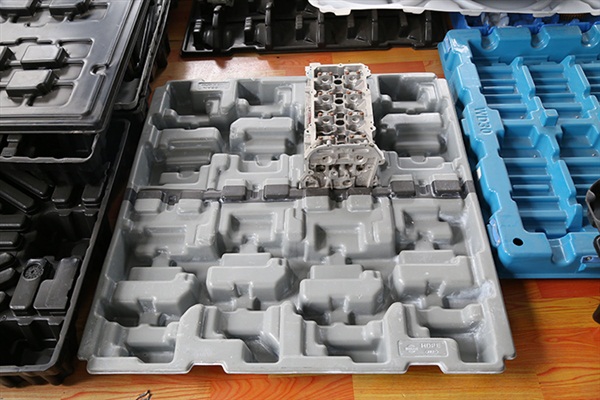
Heavy-duty vacuum-formed inner lining trays position heavy automotive components inside an enclosed pallet box.
A second application cluster is wet and chemically active containment: oil, industrial alcohol, alkali, acid and industrial wastewater. Here the enclosed body and the material choice carry the decision, and the inner lining is usually a secondary consideration. A third cluster is precision electronics, food cold chain, medical and health care and heavy industry — industries where the box is judged on cleanliness, dust exclusion and the ability to hold a defined position inside a standardized logistics loop.
Across all three clusters, the same operating pattern recurs: 24/7 handling with forklifts, storage on shelving, and stacking. That pattern is the real load case. A box rated for a static stack is not automatically suited to repeated forklift placement under a rack beam, and buyers should describe the handling cycle in the enquiry rather than only the part weight.
Market Context: What Is Changing in Pallet Box Procurement
Published estimates of the global pallet box market diverge sharply, and the divergence itself is informative. One commercial research estimate values the global pallet box market at USD 2.19 billion in 2024, with a forecast to USD 3.02 billion by 2032. A second estimate places the 2024 base at USD 12.76 billion and forecasts USD 23.40 billion by 2033 at a CAGR of 6.9%. The gap is best explained by definition: analyses that include crates, containers and bulk bins alongside pallet boxes produce a much larger base than analyses restricted to pallet boxes.
For a buyer, that means market-size figures should be treated as directional rather than as planning inputs. What is more useful is the direction of the underlying demand: reusable plastic containment continues to replace single-use packaging in closed-loop logistics, and the design response is visible in the product data — enclosed bodies for moisture and dust, high fold ratios for return transport, and material options for chemically active media.
Supply concentration is the second structural factor. China is the dominant exporter of plastic crates under HS 392310, with an export value of USD 2.33 billion in 2022 data. The Suzhou/Jiangsu cluster in which Zhangjiagang Fenghui operates is part of that export base, with a 40% export ratio and Mexico and the United States as principal markets. For buyers, cluster concentration supports availability; it also means supplier differentiation has to be established on evidence — certificates, test regimes, guarantee terms and sample performance — rather than on location alone.
Plastic Pallet Boxes vs Traditional Containment: Where the Trade-offs Sit
Compared with wooden crates, steel bins and single-use cardboard, an enclosed plastic pallet box changes the cost structure rather than simply lowering it. Wood is repairable locally but is difficult to clean and is sensitive to moisture. Steel is strong but heavy, and its empty return volume is fixed. Single-use cardboard is cheap per trip but offers no moisture protection and no repeat loop. Plastic earns its place where the loop is long, the media are wet, and the return leg can be nested — the 5:1 fold ratio is the mechanism that makes the return leg affordable.
The trade-offs are real and worth stating plainly. First, the catalogued capacity of 100–200L per box defines the working scale: these are unit-load containers for parts, fluids and sub-assemblies, not bulk silos. Second, the guarantee excludes damage from excessive storage weight, so the buyer carries the responsibility for load discipline — a box will not protect a project from a stacking plan that exceeds its design. Third, quality control is stated as 50% testing, which means the buyer must define acceptance criteria rather than assume full inspection. Fourth, the die-cast 1230 × 830 footprint does not match the 1200 × 800 module, so a mixed fleet of both will need rack positions and forklift practice that accommodate two modules. Fifth, and most importantly, plastic is not a universal container: it is catalogued for specific media — oil, industrial alcohol, alkali, acid, industrial wastewater, water and car parts — and a medium outside that list should be engineered and tested rather than assumed.
Future Outlook
Three forces are likely to shape pallet box specification over the next procurement cycles. The first is the shift from product purchasing to loop design: buyers are increasingly specifying the return leg, the cleaning step and the stacking plan as part of the same document as the box itself, which favours suppliers who can quote a lining, a footprint modification and a material change within a single short lead time. The second is evidence-based qualification, where certificate numbers, test regimes and guarantee exclusions are checked rather than assumed — a trend that rewards suppliers whose certificates are issued by accredited bodies and whose numbers can be verified independently.
The third is specialization by exposure. ESD-controlled packaging, wet chemical containment and heavy automotive part logistics each impose different requirements, and a range that spans HDPE/PP, enclosed construction, die-cast and honeycomb panel variants is better positioned than a single-model catalogue. For buyers, the practical implication is that the framework in this article should be re-run for each exposure class rather than applied once to the whole site.
Six-Gate Pallet Box Decision Checklist
1. Exposure envelope — media list, humidity and dust, temperature band, ESD sensitivity, handling cycle.
2. Model and footprint — 1200 × 800 × 1000; 1000 × 800 × 800; die-cast 1230 × 830 × 1000; confirm construction family for the 1000 × 800 footprint.
3. Material — HDPE or PP stated on quotation, label and delivery documents.
4. Containment detail — enclosed body, nesting or folding ratio, inner lining tray type, anti-static specification where relevant.
5. Customization — dimension, logo, color and material changes; MOQ 1 unit; 7–15 day production window.
6. Verification — ISO 9001 and ISO 14001 certificate numbers checked with the issuing bodies, HS code confirmed, acceptance criteria for 50% testing agreed, guarantee exclusions understood.
Frequently Asked Questions
What should a buyer confirm about HDPE versus PP before ordering an industrial pallet box?
TOYOE's pallet box range is catalogued with HDPE/PP material, with the 1200 × 800 × 1000 model listed with both PP and HDPE, the plastic honeycomb panel box with HDPE and PP, and the die-cast 1230 × 830 × 1000 model with HDPE. The material should be confirmed in writing against the containment medium, service temperature and cleaning regime, and the confirmed material should appear on the quotation and delivery documentation.
Which certifications apply to the pallet box product, and how can they be verified?
Two management-system certifications apply to the pallet box product and are stated as valid for the global market. ISO 9001 certification conforms to GB/T19001-2016 / ISO 9001:2015, certificate number 04623Q12947R3S, issued by Beijing Head International Certification Co., Ltd., an IAF/CNAS accredited body. ISO 14001:2015 certification carries certificate number M43123E31148R2S, issued by Beijing Daluhangxing Quality Certification Center Co., Ltd. Both can be verified directly with the issuing organizations.
What capacity and load conditions define an enclosed pallet box in this range?
The range is catalogued at a capacity of 100–200L, in enclosed configuration, with recyclable, durable and nestable features. Load-bearing stability and shock resistance are stated requirements for the logistics applications the range serves, and the five-year guarantee excludes damage caused by human error or by excessive storage weight — so the stacking and loading plan remains part of the buyer's specification responsibility rather than being absorbed by the product guarantee.
How much customization is available, and what is the minimum order quantity?
Customization covers dimension, logo, color and material under an OEM/ODM production model. Size is customizable across multiple specifications, color is customized to order, and logo printing is offered free of charge, while custom orders are accepted. The minimum order quantity is 1 unit, and samples are accepted, which allows a specification — including an inner lining design or a non-standard dimension — to be validated before a production commitment.
What lead time and quality-control terms apply to a pallet box order?
Lead time is stated as 7–15 days, supported by a monthly capacity of 3,000 pieces and an annual output of 30,000 units. Quality control is stated as 50% testing, which is a sampling regime rather than full inspection, so acceptance criteria and sample size should be agreed in writing before the first shipment. Products are declared under HS code 3923100000, and the after-sales term is a five-year guarantee excluding human-error damage and excessive storage weight.
Reference document: TOYOE pallet box company brochure (PDF). Company information: toyoebox.com.
Tem questões ou precisa de mais detalhes?
Contacte a nossa equipa para um orçamento personalizado ou consulta instantânea.
Solicitar orçamento
Preencha o formulário abaixo e a nossa equipa entrará em contacto com uma proposta personalizada.
Chat direto do WhatsApp
Prefere conversar em tempo real? Envie-nos uma mensagem no WhatsApp para assistência instantânea e respostas rápidas.
- Obter orçamento personalizado
- Partilhar fotos ou documentos
- Discuta as suas necessidades diretamente
Geralmente responde em 5–30 minutos durante o horário de expediente.