
Pallet Box Compliance File: Reading HS Code 3923100000
Pallet Box Compliance File: Reading HS Code 3923100000
A pallet box compliance file is not one document. It is a small stack of records that three different readers open for three different reasons: a customs broker reads the tariff classification, a quality engineer reads the resin declaration and the certificates, and a service manager reads the warranty clause. When the three readings agree, a container moves. When they disagree, the box is held while someone reconstructs facts the supplier already had.
This guide treats the file as a set of lines and explains what each line should contain, using a plastic pallet box declared under HS code 3923100000 as the working example. It is written for importers and procurement teams deciding whether a supplier's documentation is complete enough to enter a qualification file — a narrower question than whether the supplier is good.
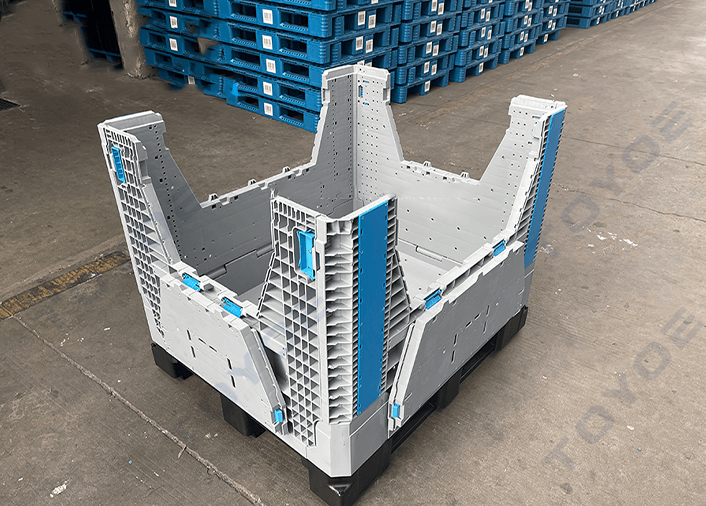
Sleeve folding pallet boxes. A compliance file should identify the exact model, dimensions and volume capacity that the documents describe.
The Four Lines That Carry the Compliance Weight
Four lines carry almost all of the compliance weight in a pallet box file: the tariff classification, the material and recyclability declaration, the certification record and the warranty statement. Packing method, logo printing, colour and sample terms matter to the order, but they rarely decide whether a shipment clears or a supplier is approved.
The reading discipline is not to judge whether a line sounds convincing. It is to test whether the line can be acted on, using three checks that apply to every entry: does it name the entity, model or component it refers to; does it carry a date, version or period; and does it state the limit within which it holds? A certificate without an expiry date, a material line without a component, and a guarantee without excluded causes all fail the same test in different ways.
Line 1 — HS Code 3923100000: What the Classification Entry Should Show
The classification line should contain three things: the code, a plain-language description of the goods, and the destination-specific extension the importer will actually declare. In the pallet box records reviewed for this guide, HS code 3923100000 is stated consistently across the range — the 1200×800×1000 and 1000×800×800 enclosed boxes, the 1230×830×1000 die-cast model and the plastic honeycomb panel box all carry the same code.
392310 is the international subheading for boxes, cases and crates of plastics. The first six digits are harmonized across participating customs administrations; the digits after them are national, and each import market extends the subheading in its own tariff schedule. That is why a supplier's 3923100000 is the start of an entry rather than the end of it: the importer still has to confirm the national line in the schedule it declares against.
The subheading is not a niche one. UN Comtrade data reported through FreightAmigo put China's exports of HS 392310 products at USD 2.33 billion in 2022, which makes the classification familiar to most brokers rather than exceptional — and makes an inconsistent goods description easier to spot.
The failure that causes trouble is rarely a wrong code. It is an inconsistent one: 3923100000 on the product sheet, a vaguer description on the commercial invoice, and no code at all on the packing list. A reader should be able to trace the same code and the same goods description across invoice, packing list and customs entry without interpreting anything. It is equally worth stating what the line cannot do: a tariff code classifies goods for duty. It does not certify material grade, origin, load capacity or performance.
Line 2 — Material Declaration: HDPE, PP and the Limits of 'Recyclable'
The material line should name the resin or resins and, where a box is assembled from more than one part, say which part the declaration covers. The pallet box records list HDPE and PP across the range: the die-cast 1230×830×1000 model is declared in HDPE, the honeycomb panel box in HDPE and PP, and the 1200×800×1000 record in PP and HDPE. Both are recyclable thermoplastics and they are not interchangeable in every respect, so a combined 'HDPE/PP' line describes a resin family rather than a bill of materials. A buyer should ask which component — body, base, lid or inner lining — uses which resin before entering the declaration into a qualification template.
'Recyclable' appears in the same records as a product feature alongside durable and nestable. Read literally, the line says the material can re-enter a recycling stream. It does not say the box contains recycled content, that a take-back route exists in the buyer's market, or that a specific local collection scheme accepts the item. Those are three different claims and each needs its own evidence; a supplier who has stated only the first should not be recorded as having stated the others.
The same restraint applies to properties the declaration never mentions. HDPE is a resin family, not a conformity statement: it says nothing about fire performance, food-contact status or electrostatic behaviour. Where an application needs one of those, the material line is background, not proof.
Design attributes belong on a separate line from compliance attributes. The records describe an enclosed box type, a volume capacity in the range of 100 to 200 litres, nesting, custom colours, free logo printing and plastic film packing. All of that is useful for the order and none of it substitutes for a certificate.
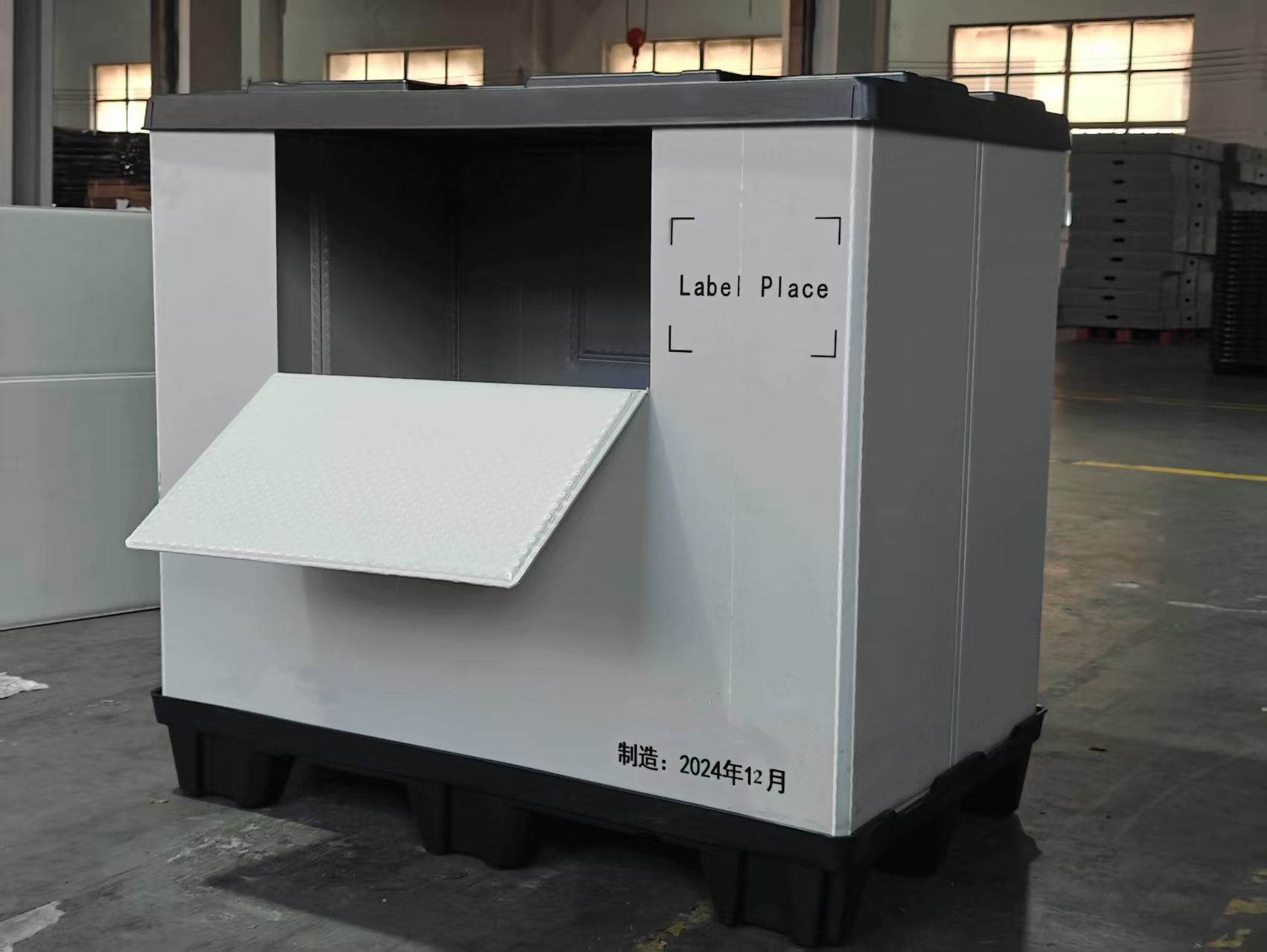
A structural design reference from the supplier's product set. Design lines describe geometry and options; they do not replace conformity records.
Line 3 — Certification Records: Number, Scope, Issuer and Validity Window
A certification line becomes usable when it carries six elements: the standard and its version, the certificate number, the issuing body, the accreditation behind that body, the scope in the issuer's own terms, and the issue and expiry dates. A logo without those elements is decoration.
The pallet box record holds two management-system certificates.
- ISO 9001 — certificate 04623Q12947R3S, conforming to GB/T19001-2016 / ISO 9001:2015, issued by Beijing Head International Certification Co., Ltd., an IAF/CNAS-accredited body, stated as valid for the global market. The recorded issue date is 3 June 2023 and the recorded expiry date is 2 June 2026. The stated scope covers the sale of logistics metal, plastic and paper packaging products and the rental of palletized unit loads.
- ISO 14001 — certificate M43123E31148R2S, conforming to ISO 14001:2015, issued by Beijing Daluhangxing Quality Certification Center Co., Ltd., stated as valid for the global market. The recorded issue date is 14 December 2023 and the recorded expiry date is 14 December 2026. The stated scope again covers the sale of logistics metal, plastic and paper packaging products together with the rental of palletized unit loads.
Both scopes are written around sale and rental. A buyer whose qualification template requires the certificate to reach manufacturing should notice that wording and ask how production is covered, instead of assuming that a management-system certificate automatically extends to every site and process. Reading a scope is not suspicion; scopes are drafted for a purpose and the buyer's purpose may be a different one.
The second half of the check is arithmetic. A certificate is evidence only for the period it covers, and the period to compare it with is the shipment date, not the date the file was assembled. Read against a shipment in late 2026, the ISO 9001 record above — expiry 2 June 2026 — no longer covers the consignment, so the file needs the current certificate before that line can be relied on. The ISO 14001 record, expiring 14 December 2026, still covers the same shipment but falls due within weeks, which is the moment to request the renewal. Neither observation says anything about the supplier's systems; both are ordinary consequences of comparing a date on a document with a date on a purchase order.
The same test applies to every certificate the buyer needs and the file does not show. The logistics application record for Mexico lists anti-static among its working conditions, and the product image set includes an anti-static blister tray. Neither is a certificate. Where a qualification requires conformity with a recognized ESD packaging standard — ANSI/ESD S541-2019 is the standard commonly cited for packaging that stores, transports and protects ESD-susceptible items — the file must contain the test report or certificate that names it. One commercial research source describes conductive polymer blends as specified within a surface resistance range of 10⁴ to 10¹⁰ ohms; that is a reasonable expectation of what such a report would show, not a replacement for it.
Line 4 — Warranty Documentation: The Five-Year Guarantee and Its Exclusions
A warranty line should state the term, the failures it covers, the causes it excludes and the route for making a claim. The after-sales record for the pallet box states a guarantee of five years, excluding cases of damage due to human error or excessive storage weight.
Read as a document, that sentence does three things. It sets a duration. It names two excluded causes. And it leaves open the questions a warranty administrator asks first: whether a covered failure is repaired or replaced, who carries freight, what evidence shows the damage was not human error, and how 'excessive storage weight' is measured.
The last question loops back to the specification. An exclusion written around excessive storage weight can only be applied against a stated load. The product records describe volume capacity in the 100 to 200 litre range, and the case record highlights high load-bearing capacity and shock resistance, but the records supplied for this guide do not state a numeric load rating. A buyer who needs the exclusion to be assessable should obtain that figure in writing, with the conditions under which it applies, and keep it beside the warranty clause rather than in a separate commercial folder.
One distinction is worth making early, because it causes avoidable disputes. The Mexican gearbox case record describes a three-year service period; the guarantee states five years. Those are different instruments measuring different things — how long a specific fleet has been in use, and how long a supplier's warranty runs. Neither converts into the other.
Matching the File to Customs Requirements
Customs reads for consistency rather than quality. The file passes when the classification, the goods description, the quantity, the weights, the origin and the packing details describe the same consignment in the same words on every page.
The origin line in these records places manufacture in Suzhou, Jiangsu, China. Around it, the company profile lists a 40% export ratio with Mexico and the USA among main markets, while the capability record lists the EU and Southeast Asia among export markets. These are different fields answering different questions, and the destination line that matters is the one confirmed in writing for the buyer's own market.
Two further lines deserve a customs reader's attention. Packing is stated as plastic film, a simple declaration that should match what the container actually holds. And the commercial terms — a minimum order of one unit, a lead time of 7 to 15 days and a monthly capacity of 3,000 pieces in the capability record, against annual output of 30,000 units in the company record — are planning figures rather than customs figures, but they sit in the same file and are frequently quoted without the period attached. Attach the period and the unit to each figure before it enters a capacity comparison.
Matching the File to Internal Qualification Criteria
The internal file is stricter than customs in one respect: it has to support a decision that someone will defend a year later, when a certificate has expired and the buyer who approved the supplier has moved on. That is why a qualification template should capture the reading, not only the result.
| Line in the file | What a complete entry shows | What to do when it is incomplete |
|---|---|---|
| Tariff classification | The code, a plain goods description and the destination extension the importer will declare | Confirm the national tariff line in the importing market's own schedule |
| Resin declaration | HDPE and/or PP, stated per component where body, base, lid or lining differ | Ask which component each resin covers |
| Recyclability | Whether the claim means recyclable material, recycled content or a take-back route | Request the basis of the specific claim, not the feature list |
| Management-system certificate | Standard and version, number, issuer, accreditation, scope wording, issue and expiry dates | Request the current certificate where expiry falls before or during the shipment window |
| Product-specific conformity | A test report or certificate naming the standard, such as ANSI/ESD S541-2019 for ESD packaging | Do not infer it from an anti-static note in an application description |
| Warranty | Term, covered failures, excluded causes, claim route | Obtain the excluded causes and claim process in the contract |
| Load and dimensions | Rated load, external and internal dimensions, forklift entry height | Ask for a rated load where only volume capacity in litres is stated |
| Origin and capacity | Place of manufacture and capacity stated with its period | Reconcile monthly, annual and lead-time figures to one planning period |
Two rows in that table are easy to under-read. The capability record lists quality control as '50% test' — a line that means nothing until it is defined as a sampling rate, a proportion of units inspected, or a stage in the process, and that definition belongs in the file. And the customization line — dimension, logo, colour and material under an OEM/ODM arrangement — tells the buyer which variables are negotiable, not which ones are certified.
Reading the File Against a Real Application
Application records show which lines actually get used. The Mexico logistics and warehousing project lists high humidity, dust, a wide temperature range, waterproof and anti-static conditions, transport and warehousing with stacking, continuous 24/7 operation, forklift and warehouse-shelf handling, and requirements for moisture resistance, shock resistance and stable load-bearing. In that setting the operative lines are the load statement, the stacking condition and the material declaration; the warranty clause matters, but it is not what the buyer reads first.
The Mexican automobile manufacturer case reads differently. A fleet of 1,000 pieces has been used for three years to store car transmission gearboxes, with standardized storage, reduced collision damage and improved warehouse management cited as the outcome. There, the operative lines are the internal dimensions, the inner-lining option — the product image sets include vacuum-formed trays for gearbox and booster applications — and the fit between the box and the part it carries.
Same file, different priorities. A buyer reading it for an automotive gearbox line should be able to locate the dimension line, the inner-lining line and the warranty exclusion in one pass. A buyer reading it for humid stacking duty should be able to locate the load line and the material line. If either reader has to email the supplier to find out whether the line exists at all, the file is incomplete for that application.

An open pallet box showing the internal volume that dimension and capacity lines in a compliance file are meant to describe.
What the File Does Not Establish
It is worth listing the negative space, because assumptions tend to fill it.
- The file does not establish field performance at the buyer's duty cycle, stacking height or handling pattern.
- It does not establish a load rating unless a rating is stated; volume capacity in litres is not a weight figure.
- It does not establish ESD conformity unless a certificate or test report naming the standard is present.
- It does not establish fire performance or food-contact status, neither of which appears in the material declaration.
- It does not establish that 'recyclable' means recyclable in the buyer's own market.
- It does not convert a five-year term into a covered replacement; the exclusions and the claim route still decide.
What it does establish is narrower and more useful: a classification, a resin basis, two management-system certificates with numbers, scopes and dates, a warranty term with two named exclusions, and a set of dimensions and options. That is enough to run a qualification, provided the missing lines are requested rather than assumed.
Outlook: Files That Survive Re-Verification
The practical test of a compliance file is not how it reads on the day it arrives, but whether it can be re-checked twelve months later without reopening the entire supplier relationship. A file that keeps issue and expiry dates, scope wording and exclusion clauses next to the product description can be re-verified in minutes. A file assembled from product sheets, a logo and a warranty sentence cannot, and each renewal turns into a new negotiation.
The useful habit for importers is procedural rather than technical: treat the certificate set as a dated asset, record the expiry of each one against planned shipment dates, and request renewals before the file is needed rather than after a broker queries it. Suppliers who issue documents in that form make themselves easier to keep, which is an advantage that comes from documentation discipline rather than from any single certificate.
For a live procurement file, the practical next step is to send the supplier the checklist above and ask specifically for the missing lines — the current certificate set, the rated load and the warranty claim route — before commercial terms are negotiated. Zhangjiagang Fenghui Logistics Equipment Co., Ltd., which manufactures the pallet box range under the TOYOE name, publishes a product brochure for download at this link, and supplier details are available at toyoebox.com.
FAQ
What does HS code 3923100000 cover in a pallet box compliance file?
392310 is the international subheading for boxes, cases and crates of plastics, and 3923100000 is the form in which it appears in the pallet box records reviewed here — covering the 1200×800×1000, 1000×800×800 and 1230×830×1000 models as well as the plastic honeycomb panel box. The first six digits are harmonized and the following digits are national, so an importer still confirms the extension used in its own tariff schedule. The code classifies goods for duty; it does not certify material grade, origin or load capacity.
Is 'HDPE/PP' a complete material declaration?
It identifies the resin families used but not which component uses which resin. Where a box combines a body, base, lid or inner lining, a complete declaration states the material per component. The records reviewed declare HDPE for the die-cast 1230×830×1000 model, HDPE and PP for the honeycomb panel box, and PP and HDPE for the 1200×800×1000 box. Recyclability is listed as a product feature; recycled content, take-back routes and local acceptance are separate claims that need separate evidence.
How should a buyer handle a certificate that has expired or is about to expire?
Compare the expiry date with the planned shipment date, not with the date the file was received. In the records reviewed, ISO 9001 certificate 04623Q12947R3S carries a recorded expiry of 2 June 2026 and ISO 14001 certificate M43123E31148R2S a recorded expiry of 14 December 2026, so a shipment in late 2026 requires the current ISO 9001 certificate and a renewal confirmation for the ISO 14001 one. Requesting the renewal in advance keeps the qualification record continuous.
What does the five-year guarantee exclude, and what should be requested alongside it?
The after-sales record states a guarantee of five years, excluding cases of damage due to human error or excessive storage weight. Applying the second exclusion requires a stated load rating and the conditions under which it holds; the product records reviewed state volume capacity of 100 to 200 litres but no numeric load rating. It is also worth obtaining the claim route in writing — repair or replacement, freight responsibility and the evidence required to show a cause other than human error.
Does an anti-static note in an application record prove ESD compliance?
No. The Mexico logistics application record lists anti-static among its working conditions and the product image set includes an anti-static blister tray, but neither is a certificate. ESD packaging is commonly assessed against ANSI/ESD S541-2019, and one commercial research source describes conductive polymer blends as specified within a surface resistance range of 10⁴ to 10¹⁰ ohms. A buyer requiring ESD conformity should ask for the test report or certificate that names the standard and reports the measured values.
Tem questões ou precisa de mais detalhes?
Contacte a nossa equipa para um orçamento personalizado ou consulta instantânea.
Solicitar orçamento
Preencha o formulário abaixo e a nossa equipa entrará em contacto com uma proposta personalizada.
Chat direto do WhatsApp
Prefere conversar em tempo real? Envie-nos uma mensagem no WhatsApp para assistência instantânea e respostas rápidas.
- Obter orçamento personalizado
- Partilhar fotos ou documentos
- Discuta as suas necessidades diretamente
Geralmente responde em 5–30 minutos durante o horário de expediente.