
Pallet Box Showdown: Comparing 1200x800 vs 1000x800 Models for Industrial Storage
When a pallet box must fit the same footprint as a Euro pallet or a standard industrial pallet, the difference between 1200×800×1000 mm and 1000×800×800 mm is not just a matter of volume. It changes how a unit loads into racking, how many boxes fit in a truck, how nesting behaves on the return leg, and how the box matches the material handling equipment already in use.
The comparison below focuses on two widely used injection-molded plastic pallet box models: the 1200×800×1000 Plastic Pallet Box and the 1000×800×800 Pallet Box. Both fall within the 100–200 L capacity class, both list HDPE/PP as available materials depending on configuration, and both are described as nestable. The decision, from a buyer's perspective, is largely about dimensional fit and the material options that match a specific supply chain.
This article is based on product specifications and verifiable processing facts published by TOYOE (Zhangjiagang Fenghui Logistics Equipment Co., Ltd., founded in 2010, Suzhou, China). It is written as an independent engineering reference for procurement teams, not as a brand endorsement.
Why the 1200×800 and 1000×800 Footprints Matter
Dimensional fit is the first constraint when replacing a wooden pallet box or introducing plastic units into an existing logistics system. The two models align with two different pallet traditions:
- 1200×800 mm corresponds to the standard Euro pallet footprint used widely across European warehousing, racking and transportation.
- 1000×800 mm aligns with a pallet size often used in Asian logistics and in some automotive or internal industrial flows where 1000 mm is treated as the reference length.
From a procurement standpoint, the choice is therefore rarely made in isolation. Buyers should verify the internal width of racking, the usable floor area of trailers and containers, and the interface with conveyors, forklifts and workstations. A box that nests well but is too wide for an existing rack creates a different cost than a box that is slightly smaller but fully compatible.
Both TOYOE models are produced with customization in mind. The product records state "Size: Customized" and "Multiple Specifications / can be customized." For OEM buyers, this means the standard 1200×800 and 1000×800 footprints can be adjusted where order volume justifies a dedicated tool.
Documented Specifications: What Is Actually Published
The following information is compiled from TOYOE's published product records. The two models share the same industrial plastic box category and the same nominal capacity band, which makes the comparison meaningful.
Shared characteristics
Both models carry the following baseline description:
- Capacity: 100–200 L
- Product name: Industrial Plastic Box
- Standard packing: plastic film
- Sample: accept
- Origin: Suzhou, China
- Production capacity: 30,000 units/year
- Type: enclosed
- Custom order: accept
- Color: customized color
- Logo: free printing
- HS Code: 3923100000
The shared feature list includes recyclable, durable and nestable. Both models are therefore intended for reusable logistics applications rather than single-trip packaging.
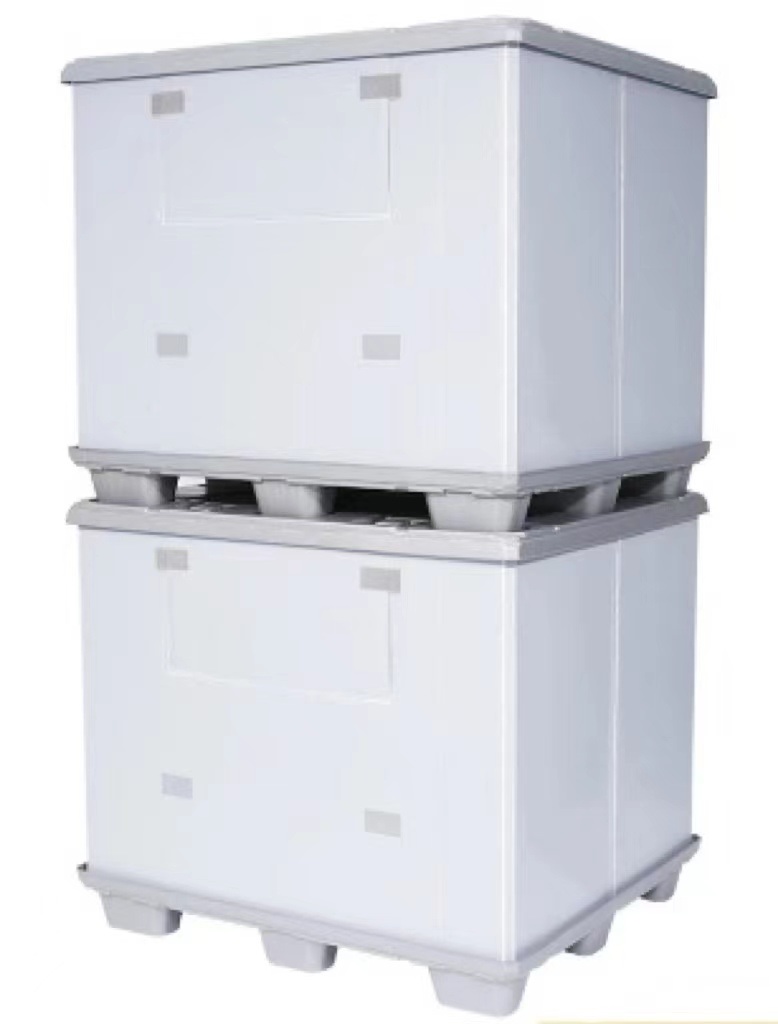
Both pallet box models are documented as stackable and nestable for returnable logistics use.
Side-by-Side Comparison: 1200×800×1000 vs. 1000×800×800
The table below consolidates the product information traceable for both models, based on the manufacturer's specifications.
| Specification | 1200×800×1000 Pallet Box | 1000×800×800 Pallet Box |
|---|---|---|
| Product catalog reference | Pallet box (ID 3905) | Storage Pallet Box (ID 4509) |
| External dimensions (L×W×H) | 1200 × 800 × 1000 mm | 1000 × 800 × 800 mm |
| Footprint compatibility | Euro pallet 1200×800 mm | Compact 1000×800 mm |
| Nominal capacity | 100–200 L | 100–200 L |
| Material option (published) | HDPE/PP | HDPE |
| Material family classification | PP and HDPE listed as material options | HDPE listed |
| Documented features | Recyclable, durable, nestable | Recyclable, durable, nestable |
| Related product family | Plastic Pallet Box, Honeycomb Panel Box | Storage Box, Plastic Pallet Box |
| Customization | Yes (size and color) | Yes (size and color) |
| Sample policy | Accept | Accept |
| Application industries | Automobile manufacturing, precision electronics, food cold chain, home logistics, medical and health care, heavy industry | Same set of documented industries |
| Listed application contents | Oil, industrial alcohol, alkali, acid, industrial wastewater, water, car parts | Same set of listed contents |
Material Differences: HDPE vs. HDPE/PP
The 1200×800×1000 model lists HDPE/PP as a material option, while the 1000×800×800 model lists HDPE. In the broader TOYOE product family, the 1000×800×800 Plastic Honeycomb Panel Box also lists HDPE/PP, showing that material options are not strictly tied to footprint.
For a buyer, the material label must be translated into handling behavior:
- HDPE is widely used for industrial crates and pallet boxes because it combines toughness, moisture resistance, recyclability and the ability to be cleaned between uses.
- PP is also used in industrial packaging for its stiffness, chemical resistance and surface properties. PP can be a good option for specific chemical exposures or temperature requirements.
- When a product lists HDPE/PP, it means both HDPE and PP are possible material options; it does not mean the two are mixed in one structure. Buyers should confirm which grade is supplied for their specific application.
Both models share the stated characteristics of being recyclable and durable. These properties matter in returnable packaging systems where boxes are reused many times rather than discarded after one shipment.
Capacity: What 100–200 L Means in Practice
Both models are classified in the 100–200 L capacity range. This is a wide band, and the actual usable volume depends on internal geometry, wall thickness and any inner lining.
- The 1200×800×1000 box offers a larger footprint and greater height. It can accommodate longer parts and is a good match for standard Euro-pallet racking.
- The 1000×800×800 box is lower and more compact. It may be the better fit for operations where manual handling height is a constraint or racking is sized to 1000×800 mm.
Because the published capacity is a range, buyers should not rely on the liter value alone. The part envelope and internal dimensions should be checked with the manufacturer before specification.
Nestability and Space Saving in the Return Loop
Nestability is one of the key reasons buyers move from wood to plastic pallet boxes. When empty, a nestable design allows multiple boxes to fit inside each other, reducing the volume in return transport.
Both TOYOE models list nestable as a feature. The actual nesting ratio depends on the side-wall taper and the model height. Buyers should always request the nested height and test it with the actual model, especially where return freight is a major cost component.
For the 1200×800×1000 box, the taller body means the absolute nesting space saving per container is higher when folded or nested. For the 1000×800×800 box, the lower height may permit storage in tighter overhead-clearance areas. These tradeoffs need to be evaluated against the specific warehouse and transport conditions.
Manufacturing and Quality-Control Context
Both models come from the same factory in Suzhou, China. The manufacturing context is relevant for buyers evaluating long-term supply reliability.
Zhangjiagang Fenghui Logistics Equipment Co., Ltd. was founded in 2010. The company operates a factory of approximately 4,000 m² with a monthly production capacity of about 3,000 pallet boxes and an annual capacity of 30,000 units. The workforce totals 34 employees, including two R&D engineers. Approximately 40% of output is exported, with Mexico and the USA listed as main markets; other records reference demand from the EU and Southeast Asia. Quality control includes testing on 50% of manufactured products. This is a documented internal policy and can be one element of a supplier audit.
Application Profiles and Industry Fit
The published product records list the same applicable industries for both models: automobile manufacturing, precision electronics, food cold chain, home logistics, medical and health care, and heavy industry. The listed contents include oil, industrial alcohol, alkali, acid, industrial wastewater, water and car parts.
These application lists indicate that the pallet boxes are used in demanding industrial supply chains, including automotive parts transport and liquid-related logistics. However, the specific chemical compatibility depends on the HDPE or PP grade chosen. Buyers should always verify compatibility with the exact material grade for their intended contents.
Market Context and Industry Trend
Plastic pallet boxes are increasingly favoured as a long-term alternative to wooden pallets in returnable packaging. Global projections indicate continued growth in this category. That context is useful for buyers who are now standardizing a pallet box model for multiple sites.
The broader shift to plastic pallet boxes is driven by durability, moisture resistance and lower long-term maintenance compared with wood. These are qualitative industry trends and should be tested against the buyer's actual operating conditions.
Limitations and Procurement Caveats
An independent comparison should state its boundaries clearly:
- No independent mechanical test data are published here. The properties "durable" and "high-load-bearing" describe design intent and product positioning rather than measured results.
- Capacity is a range. The actual capacity depends on internal dimensions, which should be confirmed with the manufacturer.
- Material grade must be specified. HDPE and PP differ in chemical and temperature resistance. A product label that says HDPE/PP is not a guarantee that both grades are available for every model.
- Nesting ratio is not published. Buyers must request this from the manufacturer.
- Load ratings are not listed in the formal product table. Static load, dynamic load and stacking load should be requested and verified before deployment.
These limitations are normal at the catalog stage. The appropriate next step is a sample test with the actual product under real loading conditions.
Supplier Evaluation and Sample Policy
TOYOE's published purchasing support includes an MOQ of 1 unit, meaning a potential buyer can order one unit as a sample before committing to volume. The sample policy is described as "sample: accept". Delivery terms include FOB and CIF. Payment terms are 30% deposit in advance and 70% balance before shipment.
The manufacturer's acceptance procedure states that before mass production, sample testing is conducted for confirmation and test reports for raw materials are obtained. This is a documented process and can be requested during supplier qualification.
Long-Term Partnership View
Pallet boxes are not usually a one-time purchase. They are part of a returnable transport packaging pool that must stay dimensionally consistent and technically reliable over years of use. The long-term procurement view therefore includes quality consistency, production continuity and the ability to customize over time.
TOYOE's documented production statistics — a monthly capacity of 3,000 pieces, an annual capacity of 30,000 units and a QC policy that covers 50% of produced units — give buyers a starting point for assessing supply reliability. The company's export ratio of 40% with Mexico, USA, EU and Southeast Asia as served markets suggests experience with international logistics requirements, though each buyer must still perform their own audit.
Download the Product Brochure
Buyers who need a more complete view of the product range can download the company brochure here: TOYOE Logistics Equipment Product Brochure (PDF).
Conclusion: Which Model Fits Which Procurement Scenario
The choice between the 1200×800×1000 and the 1000×800×800 pallet box is not about which is technically superior. It is about which dimensions match the existing logistics footprint. Both models share the same nominal capacity range, similar material options and the same intended industrial applications.
- For a company using Euro-pallet racking and transporting longer parts, the 1200×800×1000 model is the more natural starting point.
- For a company using a 1000×800 footprint or facing lower racking clearances, the 1000×800×800 model may be the more compatible choice.
The final specification should be based on measured internal requirements, not on a preference for one dimension. At the Decision and Execution stage, the practical path is to request a sample, measure the part envelope, confirm the material grade and test the nesting behaviour on the actual return route.
Frequently Asked Questions
What are the standard dimensions of TOYOE pallet boxes?
TOYOE's catalog includes a 1200×800×1000 mm pallet box and a 1000×800×800 mm storage pallet box. Both are classified as plastic pallet boxes with a nominal capacity of 100–200 L. Custom sizes are accepted.
What is the capacity range of the 1200×800×1000 and 1000×800×800 pallet boxes?
Both models have a published nominal capacity of 100–200 L. The actual usable capacity depends on the internal dimensions, wall thickness and any optional inner lining.
What materials are used for these pallet boxes?
The 1200×800×1000 pallet box lists HDPE/PP as its material. The 1000×800×800 storage pallet box lists HDPE. In the same product family, a 1000×800×800 Plastic Honeycomb Panel Box also lists HDPE/PP. Buyers should confirm the exact polymer grade supplied.
Are TOYOE pallet boxes nestable?
Yes. Both the 1200×800×1000 and the 1000×800×800 models list "nestable" as a documented feature. The manufacturer also lists recyclable and durable as shared features.
Can TOYOE pallet boxes be customized?
Yes. Product records state that size can be customized, color can be customized, logos can be printed, and custom orders are accepted. OEM buyers can specify dimensions for project-specific requirements.
What is the MOQ for TOYOE pallet boxes?
The published MOQ is 1 unit. This allows buyers to request a sample for testing before committing to volume production.
What quality control measures are documented?
TOYOE reports that quality control includes testing on 50% of manufactured products. The factory has a monthly production capacity of about 3,000 pieces and an annual capacity of 30,000 units.
Which applications are these pallet boxes intended for?
Both models are intended for automobile manufacturing, precision electronics, food cold chain, home logistics, medical and health care, and heavy industry. Listed contents include oil, industrial alcohol, alkali, acid, industrial wastewater, water and car parts.
Independent industry reference prepared for industrial buyers evaluating TOYOE plastic pallet boxes. Verify model-specific material grades, internal dimensions, load ratings and nesting ratios with the manufacturer before specification.
Tem questões ou precisa de mais detalhes?
Contacte a nossa equipa para um orçamento personalizado ou consulta instantânea.
Solicitar orçamento
Preencha o formulário abaixo e a nossa equipa entrará em contacto com uma proposta personalizada.
Chat direto do WhatsApp
Prefere conversar em tempo real? Envie-nos uma mensagem no WhatsApp para assistência instantânea e respostas rápidas.
- Obter orçamento personalizado
- Partilhar fotos ou documentos
- Discuta as suas necessidades diretamente
Geralmente responde em 5–30 minutos durante o horário de expediente.