
Pallet Jack Procurement: A 5-Step Framework for Final Decisions
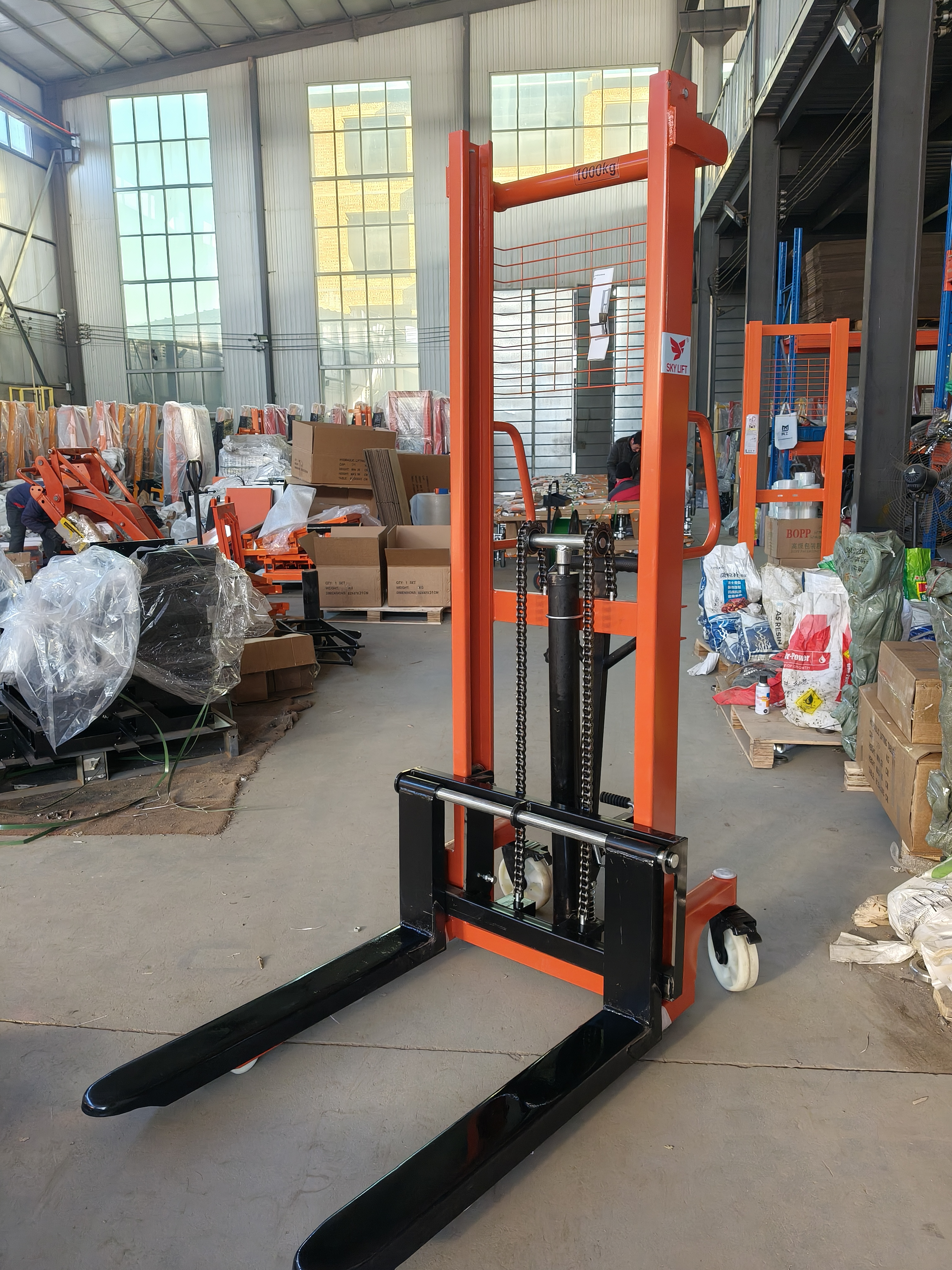
Material handling equipment from the same product family as manual pallet jacks, working in a warehouse layout.
A pallet jack is a pedestrian-operated material handling truck that lifts palletized loads a few centimetres off the floor and moves them over short distances inside a facility. At the decision stage, the question is not whether a pallet jack is needed. It is whether one specific combination of entry height, fork dimensions, component grade, environment fit and support terms matches the way the buyer's operation actually moves goods.
The framework below converts that question into five sequential checks. Each check produces a line item for the request for quotation, and each check also produces a failure mode that only becomes visible after the units are on the floor. Buyers who complete all five before issuing a purchase order are, in practice, buying a configuration rather than a catalogue model number.
Why the final procurement step is a data-matching problem
The global pallet jack market was valued at approximately USD 7.4 billion in 2024 and is projected to reach USD 11.6 billion by 2034, according to industry reporting compiled in the 2025–2034 forecast cycle. Within that total, manual pallet jacks generated USD 4.3 billion of 2024 revenue despite the rise of automation, while the electric pallet jack and stacker segment was valued at USD 5.1 billion in the same year, driven by e-commerce volumes and lithium-ion battery technology.
Market-size figures deserve a caution flag. Published 2025 valuations from different research houses range from roughly USD 1.7 billion to USD 7.91 billion, because the definitions of scope differ — some include stackers, conveyors and adjacent handling equipment, others do not. For a buyer, that divergence is a useful reminder that headline market numbers are context, not a purchasing argument.
The failures that actually cost money at this stage are quieter. A unit ordered at 62 mm entry height arrives at a facility where half the pallet pool needs 35 mm. A 685 mm fork width is specified for a racking layout that only accepts 550 mm. A standard-component truck is bought for a two-shift operation where maintenance hours, not purchase price, dominate cost of ownership. None of these are brand failures. They are data failures, and they are all avoidable before the order is placed.
Step 1 — Fix the entry height before anything else (35 mm vs 62 mm)
Fork entry height is the clearance between the floor and the underside of the fork when the truck is fully lowered. Two references dominate manual pallet jack specification: 35 mm low-profile forks and 62 mm standard forks. The decision rule is pallet-driven rather than load-driven. The fork must slide into the pallet's entry opening without lifting the load off the floor first, so the pallet with the smallest entry clearance in regular use sets the requirement for the whole fleet.
There is a real boundary to this choice. A lower fork profile leaves less tolerance for debris, damaged floor joints, dock plates and floor transitions. Where floors are rough or pallets are frequently damaged, a low-profile specification demands a stricter housekeeping regime and more attentive handling. That trade-off should be confirmed with the supplier during sample evaluation rather than assumed away at the quotation stage.
Step 2 — Lock fork width and fork length to the pallet and the aisle
Two fork-width references are commonly quoted in this equipment class: 550 mm and 685 mm. They correspond to different pallet widths and load footprints, and they change how the truck behaves in a confined aisle. Fork width is a pallet-fit and racking question. Fork length is a stability question: the forks must pass through the full depth of the pallet without excessive overhang behind the load, because overhang shifts the centre of gravity and increases the effort needed to steer a loaded truck.
In narrow-aisle, retail backroom and cross-docking layouts, the working envelope matters as much as the load itself. A wider fork set consumes more turning space, so specifying 685 mm where 550 mm already fits the pallet reduces manoeuvring margin without adding capacity. The practical sequence is to fix width from the pallet first, then confirm the aisle can accommodate the resulting truck.
Component-level data belongs in this step as well. JUNYUNHOIST is the export brand of Baoding Junyun Hoisting Machinery Co., Ltd., a lifting and material handling equipment manufacturer founded in 2018 and based in Baoding, Hebei, China. In the manufacturer's own comparison data for its pallet trucks, the build is listed with a 4 mm steel plate thickness, a 4 mm gusset plate thickness, a 2.75 mm handle wall thickness, and fork reinforcement specified at 4 mm thickness and 890 mm length. These are first-party build specifications, and the correct buyer response is to treat them as claims to inspect at sample stage rather than as universal industry standards.
Step 3 — Gauge maintenance capacity: standard vs forged components
Maintenance capacity is a design variable, not a service promise. On pallet jacks, the parts that fail first are the pump, the handle, the load plates and the wheels — which means component grade at those four points determines how many maintenance hours the facility will absorb per unit per year.
The manufacturer's comparison data for JUNYUNHOIST trucks lists an AC pump, a forged rocker arm, forged AB plates and double-chain plates, a cast steel wheel frame, full ribbing and a thickened handle, together with high-quality bearings. The same comparison states approximately 2% higher initial cost than its comparison baseline, better durability, lower long-term maintenance costs, and 90% less maintenance required, with load testing performed at 1.2 times the rated load. All of these are first-party claims. The useful response is to separate them into those that can be inspected on a sample unit — plate thickness, forging marks, frame material, handle wall dimension — and those that must be covered in writing, such as test protocol and warranty on the pump assembly.
Recurring failure types in this equipment class are well documented: pump oil leakage or air ingress, handle deformation or damage, and wheel wear. The control methods are operational rather than technical — avoid overloading, and keep the forks balanced when lifting goods. The manufacturer's stated enterprise measure is to supply commonly damaged spare parts free of charge, including seals, handles and wheel frames.
For the buyer, the useful question is therefore not whether forged components are better in the abstract. It is how many maintenance hours per unit per year the facility currently spends, and what those hours cost once downtime is included.
Step 4 — Match the equipment to the operating environment
A pallet jack that passes the first three checks can still fail on environment. The recorded application set for this equipment class covers warehouses, factory floors, workshops, loading docks, retail backrooms, distribution centres, cold storage, construction sites, truck loading and unloading, and cross-docking facilities.
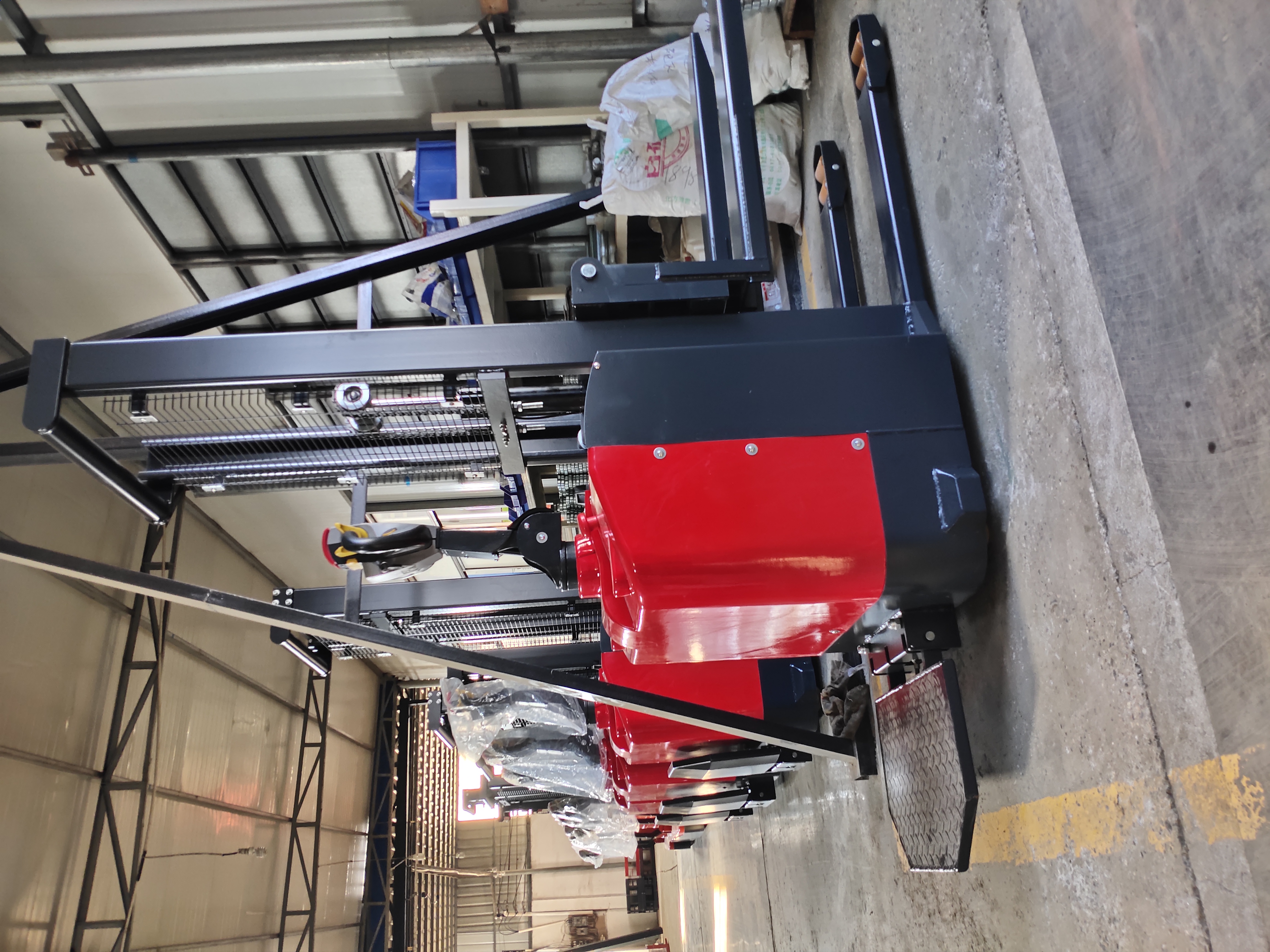
Powered handling equipment for higher-throughput zones, where manual pallet jacks reach their distance and cycle limits.
Material selection
For cold storage, food processing plants and other humidity-exposed or wash-down areas, material becomes a specification line rather than a preference. Carbon steel, galvanized steel and stainless steel pallet trucks are all manufactured in this product class, and the choice affects cost, lead time and the cleaning regime. Food-grade and rust-proof requirements should be stated explicitly in the RFQ, because they change what is built, not just how it is painted.
Energy source and compliance
Manual pallet jacks remain the volume core of the category for short-distance, moderate-cycle work. Electric pallet trucks and electric stackers suit longer travel routes and higher throughput. Under OSHA 29 CFR 1910.178, powered pallet jacks are classified as Class III forklifts and require formal operator training — a compliance obligation that sits with the buyer, not the supplier. Where battery-powered units are specified for cold environments, the operating temperature band must be confirmed with the manufacturer rather than assumed.
Weighing and load verification
Pallet trucks with integrated scales allow load verification at the point of handling instead of at a separate weigh station, which removes one movement cycle from the route. For warehouses handling mixed or variable loads, weighing integration is a configuration decision made at the same time as fork dimensions, because it changes the truck's structure.
Step 5 — Assess support levels as a deliverable
Support is usually treated as goodwill. In procurement terms it is a deliverable with three components: spare parts, technical response, and customization capacity.
- Spare parts. The stated manufacturer measure — free supply of easily damaged spare parts including seals, handles and wheel frames — removes part of the maintenance exposure, but the buyer should still ask for the parts list and the expected replacement points, so that wear items are known before the first failure rather than after it.
- Technical response. Confirm who answers a technical question in the buyer's language and time zone, and whether drawings, certification and test documentation accompany the shipment.
- Customization capacity. OEM and ODM customization is offered by the manufacturer behind JUNYUNHOIST. Buyers should confirm which dimensions and materials are customizable — fork width and length, carbon, galvanized or stainless steel construction, weighing integration — and which are fixed by the standard platform.
Scale context matters when judging support. Baoding Junyun Hoisting Machinery Co., Ltd. operates a 24,000 m² facility with 138 employees, an 8-person R&D team, an annual output of 70,000 units and an export ratio of 80%, serving markets that include India, Russia, Vietnam, Brazil, Türkiye and Dubai, alongside other Middle East and Southeast Asian markets. Its product range covers hand pallet trucks, pallet jacks, manual stackers, electric stackers, oil stackers, lift tables, galvanized and stainless steel pallet trucks, pallet trucks with scale, and electric pallet trucks. The company states that its equipment is manufactured under quality control protocols aligned with ISO and CE requirements.
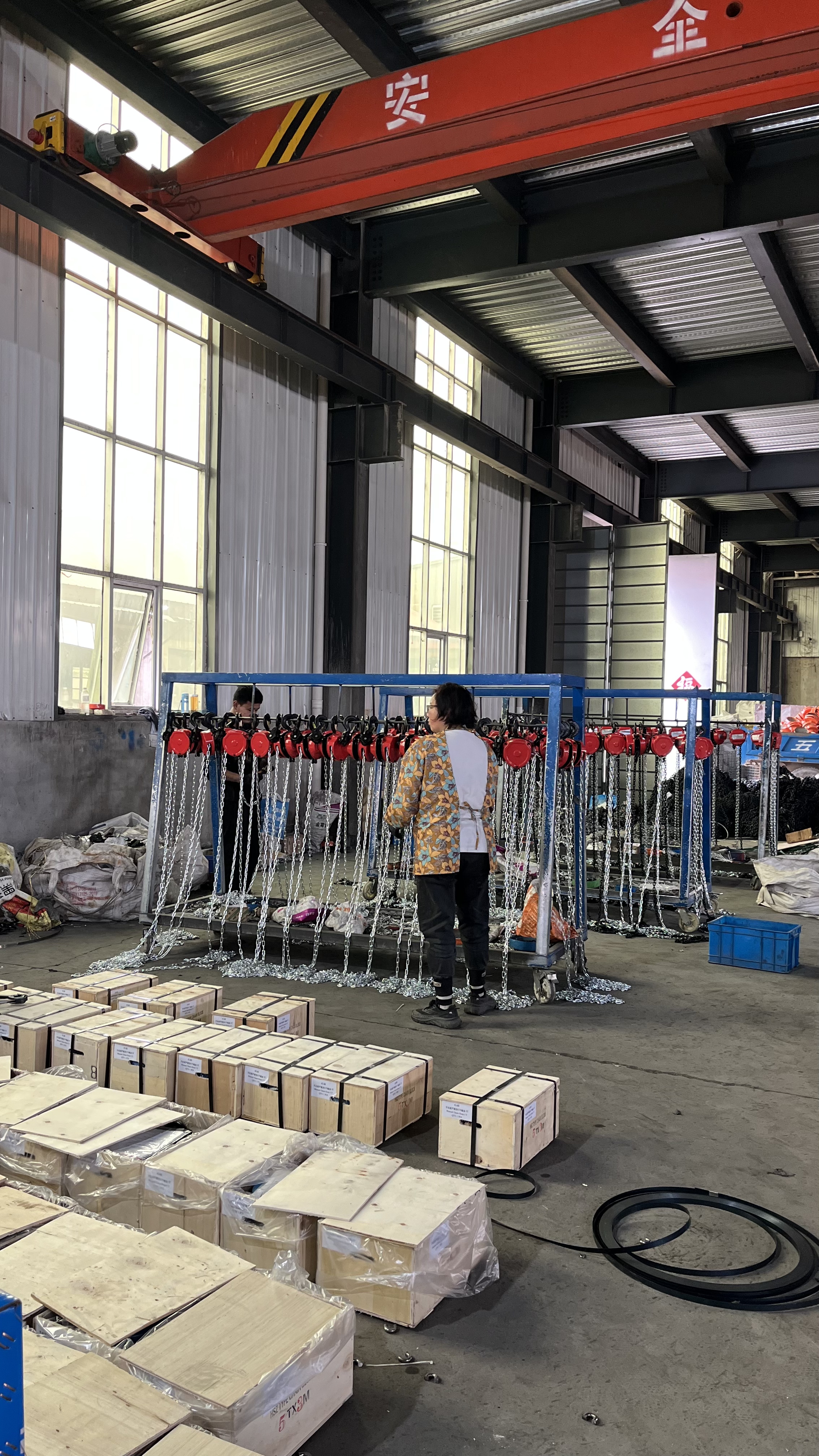
In-house production at Baoding Junyun Hoisting Machinery Co., Ltd., where lifting and material handling equipment is manufactured and assembled.
The five-step decision matrix
| Step | Fix in the RFQ | Evidence to request | Risk if skipped |
|---|---|---|---|
| 1. Entry height | Lowered fork height — 35 mm or 62 mm | Fork drawing with lowered height; sample test on the lowest-clearance pallet in the pool | Truck cannot enter part of the pallet pool; manual lifting or pallet replacement cost |
| 2. Fork width and length | 550 mm or 685 mm width; fork length matched to pallet depth | Dimensional drawing; aisle turning check; reinforcement thickness specification | Load instability, racking interference, reduced manoeuvring margin in narrow aisles |
| 3. Component grade | Pump type, forged vs standard plates, wheel frame material, handle wall thickness | Sample inspection of plates, forgings and frame; load test protocol; written statement on 1.2× load testing | Higher maintenance hours per unit per year and unplanned downtime |
| 4. Environment fit | Carbon, galvanized or stainless steel; food-grade or rust-proof requirement; manual or electric platform | Material certificate; temperature-band confirmation for battery units; operator training plan where powered | Premature corrosion, hygiene non-conformity, or a truck unsuited to the route distance |
| 5. Support | Spare parts list, technical contact, customization scope | Parts list for seals, handles and wheel frames; certification and drawing package; written customization confirmation | Long downtime after the first wear failure; unverifiable customization promises |
How this differs from conventional sourcing — and where it stops working
Conventional pallet jack sourcing tends to run in one of three directions: brand-first shortlisting, price-first tendering, or single-attribute comparison in which one specification is debated while the others are inherited from a previous purchase. The framework above inverts that order. It fixes the pallet and floor data first, then the load interface, then the durability specification, then the environment, and only then the commercial and support terms.
The framework also has limits, and buyers should know them before applying it.
- It assumes the buyer knows the pallet pool and floor condition. Where pallet types vary by site or season, the entry-height decision may resolve toward 35 mm to cover the worst case — which then has to be balanced against that profile's lower tolerance for debris and floor transitions.
- It points toward a higher specification. The manufacturer's comparison data places the reinforced, forged-component build at approximately 2% above its comparison baseline. That premium is defensible in multi-shift, high-cycle operations where maintenance hours dominate cost of ownership, and questionable in low-intensity use where a truck moves a handful of pallets per shift.
- Supplier scale is a genuine variable. JUNYUNHOIST is a comparatively young manufacturer — founded in 2018, with 138 employees and an 8-person engineering team. Buyers benchmarking against Toyota Material Handling, Jungheinrich AG, Crown Equipment, Hyster-Yale or Mitsubishi Logisnext should expect those global OEMs to offer wider dealer and service footprints and larger application engineering organizations. Where an operation depends on a dense local service network, a global OEM may be the better choice — and the five steps still apply to that evaluation.
- Manual pallet jacks have a physical boundary. They are designed for short-distance movement within a facility. Long travel routes and high throughput belong to powered equipment, whatever the component grade of the manual unit.
Market trend context for current buying cycles
Two signals from 2024 data shape how pallet jack specifications are being written. First, manual pallet jacks still generated USD 4.3 billion of revenue in 2024 despite the rise of automation, which means the manual configuration remains the volume core of the category and the reference point for most pallet interfaces. Second, the electric pallet jack and stacker segment reached USD 5.1 billion in the same year, driven by e-commerce volumes and lithium-ion technology.
The procurement implication is practical rather than strategic: buyers should keep the pallet interface — entry height and fork dimensions — constant across manual and electric options, so that a later shift to powered equipment does not force a re-specification of the pallet pool. That is the reason steps 1 and 2 come first in this framework.
The standards landscape is also stable enough to plan around. ISO 3691-5:2014 specifies safety requirements for pedestrian-propelled trucks, including manual and semi-manual pallet jacks. In Europe, EN 1757-2 covers hand pallet trucks with capacities up to 2,000 kg. In the United States, OSHA 29 CFR 1910.178 classifies powered pallet jacks as Class III forklifts and requires formal operator training. Compliance is a market-entry condition, not a competitive differentiator.
Future outlook
Three directions are visible from the current data set. Electrification continues to expand, but manual pallet jacks are unlikely to lose their position as the volume core for short-distance handling, because their cost structure and independence from charging infrastructure remain hard to replace in moderate-cycle operations.
Weighing and load-verification functions are moving from accessory status into standard handling workflows, which changes the truck structure rather than just adding a display. At the same time, material and component specifications — galvanized and stainless steel construction, forged high-stress parts — are becoming explicit RFQ line items rather than optional upgrades, because buyers increasingly compare configurations instead of model numbers.
The durable shift for procurement teams is procedural. As the market moves from catalogue purchasing toward configuration purchasing, the quality of the buyer's own pallet, floor and maintenance data becomes the strongest single determinant of whether the equipment performs as expected.
FAQ
How do I decide between a 35 mm and a 62 mm pallet jack?
35 mm and 62 mm describe fork entry height, measured as the clearance between the floor and the underside of a fully lowered fork. The decision is driven by the pallet pool: the fork must slide into the pallet's entry opening, so the pallet with the smallest entry clearance in regular use sets the requirement. A 35 mm low-profile truck covers pallets with shallow entry openings, while a 62 mm truck covers standard openings. Facilities handling both, or working with damaged pallets and uneven floor joints, should confirm the low-profile option against actual floor conditions, because a lower fork has less tolerance for debris and floor transitions.
What determines whether I need 550 mm or 685 mm fork width?
Fork width is set by the pallet and racking interface together with aisle geometry. The 550 mm and 685 mm references correspond to different pallet widths and load footprints, and the forks must sit within the pallet's fork pockets without pressing on the stringers. Width also affects the working envelope: a wider fork set requires more turning space in narrow aisles and cross-docking lanes. Fork length is specified separately so that the forks pass through the full depth of the pallet without excessive overhang behind the load.
Is a pallet jack with forged components worth the extra cost?
It depends on duty cycle rather than on component grade alone. The manufacturer's comparison data for JUNYUNHOIST pallet trucks states that a reinforced build — 4 mm steel plate, a forged rocker arm, forged AB plates and double-chain plates, a cast steel wheel frame, full ribbing and a thickened handle — carries approximately 2% higher initial cost than the comparison baseline, with better durability and lower long-term maintenance costs, and states 90% less maintenance required with testing performed at 1.2 times the rated load. These are first-party claims and are best verified at sample stage. In high-cycle, multi-shift operations, maintenance hours typically outweigh the purchase-price difference; in low-intensity use, the premium may not pay back.
What should a support agreement include before a pallet jack order is placed?
Three components are worth documenting. First, spares: the manufacturer states that commonly damaged parts — seals, handles and wheel frames — are supplied free of charge, so the buyer should confirm the parts list and the expected wear points in writing. Second, failure modes and their controls: pump oil leakage or air ingress, handle deformation or damage, and wheel wear are recurring failure types in this equipment class, controlled mainly by avoiding overloading and keeping the forks balanced during lifting. Third, customization and documentation: whether fork dimensions, construction material (carbon, galvanized or stainless steel) and weighing integration can be modified, and which certification, drawing and test documents accompany the shipment.
Which standards apply to pallet jack procurement in different markets?
The applicable standard depends on truck type and market. ISO 3691-5:2014 specifies safety requirements for pedestrian-propelled trucks, including manual and semi-manual pallet jacks, and is widely used as an international reference. In Europe, EN 1757-2 covers hand pallet trucks with capacities up to 2,000 kg. In the United States, powered pallet jacks fall under OSHA 29 CFR 1910.178 as Class III forklifts and require formal operator training. ISO 3691-5 and EN 1757-2 address the equipment itself, while the OSHA rule also places operator obligations on the buyer.
Manufacturer documentation covering configuration and specification detail for this equipment class is available for download: Baoding Junyun Hoisting Machinery product brochure (PDF).
Tem questões ou precisa de mais detalhes?
Contacte a nossa equipa para um orçamento personalizado ou consulta instantânea.
Solicitar orçamento
Preencha o formulário abaixo e a nossa equipa entrará em contacto com uma proposta personalizada.
Chat direto do WhatsApp
Prefere conversar em tempo real? Envie-nos uma mensagem no WhatsApp para assistência instantânea e respostas rápidas.
- Obter orçamento personalizado
- Partilhar fotos ou documentos
- Discuta as suas necessidades diretamente
Geralmente responde em 5–30 minutos durante o horário de expediente.