
Pallet Jack Procurement FAQ: Comparing Specs, Service and Lead Time
Pallet Jack Procurement FAQ: Comparing Specs, Service and Lead Time
Pallet jack procurement has moved from comparing unit prices to comparing documentation. Two suppliers can quote the same 2.5-tonne hand pallet truck and still differ sharply on what they will commit to in writing: the load applied before shipment, the fork plate thickness actually delivered, the minimum order quantity, the production window, and who supplies the wheel set that wears out in year two. For buyers moving out of evaluation and into execution, those written positions — not the catalogue photograph — decide whether a purchase order can be repeated next quarter.
The category is large enough that price pressure never relents. Industry analysis cited by Vertex put the global pallet jack market at USD 7.91 billion in 2025, with Asia-Pacific holding a 39% revenue share. That scale explains why quotations converge, and why real differentiation has shifted to specifications, service terms and delivery reliability.
This reference answers the technical and procurement questions that reach manufacturers most often. Every specific figure used here is a figure the manufacturer publishes: Baoding Junyun Hoisting Machinery Co., Ltd., trading as JUNYUNHOIST, is the worked example throughout, with its stated capability quoted directly and its limits marked as limits.
Which three variables actually decide a pallet jack comparison?
Specifications, service and lead time decide the comparison, in that order. Specifications determine whether the truck fits the aisle, the pallet and the floor surface. Service terms determine what happens between the purchase order and the container, and again when a wear part fails. Lead time and production capacity determine whether the supplier can hold the buyer's replenishment cycle rather than its own convenience.
Price runs across all three rather than sitting beside them. A lower unit price attached to an unstated test protocol, an undefined spare-parts arrangement and a lead time quoted without a start date is not a cheaper offer; it is a less complete one.
Why do two pallet jack quotes look identical when the offers differ?
Because catalogue specifications are standardised while evidence is not. Most suppliers will state a load capacity, a fork size and a wheel type. Far fewer will state the load at which each unit is tested, the tolerance on the fork plate, the production slot the order will occupy, or which spare parts travel in the container.
The practical fix is to convert every claim into a document request during evaluation, so that the execution stage becomes a confirmation exercise instead of a negotiation. A buyer who asks for the test record format, the fork drawing and the spare-parts list before the purchase order receives three artefacts that can be compared line by line across suppliers. A buyer who asks only for a price receives one.
How should a pallet jack specification sheet be read?
Read it as a list of variables the supplier is willing to customise, not as a fixed description. The dimensions that decide fit are rated load, fork length, fork width, fork steel plate thickness, minimum lifting height, overall width and wheel configuration. Each can be either fixed or adjustable, and the difference matters most in narrow aisles, low-clearance trailers and pallet types that are not standard Euro or GMA footprints.
Four questions separate a flexible specification from a rigid one:
- Load and test protocol: what load is applied before shipment, for how long, against which pass criterion, and is the record kept per unit or per batch?
- Fork geometry: are length, width and plate thickness offered as order-specific parameters, or only as catalogue options?
- Minimum lifting height: is the low profile fixed at 35 mm or 62 mm, or adjustable to the pallet and floor interface?
- Material and finish: which components are carbon steel, galvanized or stainless, and what documentation supports a food-area or washdown claim?
JUNYUNHOIST states customization for fork length and width, minimum lifting height options including 35 mm and 62 mm, and fork steel plate thickness as an order parameter — the practical version of the same list. Buyers should still ask for the drawing that fixes those values before production begins, because a customisation capability becomes a usable specification only once it is dimensioned on paper.
What does JUNYUNHOIST state as its verified capability?
Baoding Junyun Hoisting Machinery Co., Ltd. is a Hebei-based manufacturer and trading company, founded in 2018, whose stated programme covers hand pallet trucks, pallet jacks, manual and electric stackers, lift tables, galvanized and stainless-steel pallet trucks, and pallet trucks with a weighing scale. The company reports 8 R&D engineers, a monthly production capacity of 10,000 units, annual output of 70,000 units and an export ratio of about 80%, with stated markets in India, Russia, Vietnam, Brazil, Türkiye, the UAE, the wider Middle East and Southeast Asia.
For procurement purposes, five stated positions are the ones that can be checked against a purchase order:
- OEM and ODM production are both offered, so a distributor can specify branding and configuration rather than resell a catalogue item.
- Customization covers fork length and width, minimum lifting height options including 35 mm and 62 mm, fork steel plate thickness, and material variants including galvanized and stainless steel.
- Quality control is described as 100% testing of all units rather than batch sampling.
- The minimum order quantity is 24 pieces, with a typical production lead time of 15–20 days.
- Each container is shipped with free spare parts for wear items, replenished later according to actual wear.
Those five items mark the difference between a supplier that can be specified and a supplier that can only be priced. Model-level documentation requests can be directed through the company's site, JUNYUNHOIST.
Which service terms should be settled before the purchase order?
Testing, acceptance, payment and spare parts belong in the quotation, not in the follow-up email. The manufacturer states pre-shipment testing as standard with third-party inspection available, and lists FOB, EXW, CIF and CFR as delivery terms. Payment is stated as 30% T/T in advance with 70% T/T against a copy of the bill of lading — a structure that gives the buyer a documentary checkpoint before the balance is released.
Two details are worth fixing in writing even when they seem obvious. First, whether third-party inspection is scheduled before or after packing, because an inspection conducted once the container is sealed verifies paperwork rather than product. Second, which items count as wear parts inside the free spare-parts allowance, since wheel sets, hydraulic seals and handle assemblies wear at very different rates depending on floor condition and load cycles.
None of this replaces a factory audit. It does mean that a buyer who cannot visit the plant can still convert a service promise into a shipment condition.
What does a 15–20 day lead time actually cover?
It covers production, not delivery. The stated 15–20 day figure is a production lead time; transit, port handling, customs clearance and inland delivery sit outside it, and inspection scheduling can move the shipment date without moving the production date. Buyers planning a replenishment cycle should ask for the start date alongside the duration — a 15–20 day window counted from purchase-order confirmation and deposit receipt is a different commitment from one counted from the supplier's next production opening.
Capacity answers the other half of the question. A stated 10,000-unit monthly capacity and 70,000-unit annual output set the scale against which a 24-piece minimum order is small. That matters less for the first order than for the repeat order, when a distributor wants the same fork geometry, the same finish and the same packaging without re-qualifying the supplier from the beginning.
Comparison matrix: seven procurement dimensions
The table below converts the discussion into dimensions a buyer can actually score. The centre column records what to request; the right-hand column records what JUNYUNHOIST states, because a stated position only becomes usable once it is documented for the configuration being ordered.
| Dimension | What to request | JUNYUNHOIST stated position |
|---|---|---|
| Load and testing | Test-load ratio, duration, pass criterion, per-unit or per-batch record | 100% testing of all units |
| Fork geometry | Drawing fixing length, width, plate thickness and tolerance | Fork length and width customizable; fork steel plate thickness as an order parameter |
| Lift height and profile | Minimum lifting height confirmed on the drawing | 35 mm and 62 mm options, with others available |
| Material and finish | Base material, coating and any food-area documentation | Galvanized and stainless-steel pallet trucks offered |
| Order size and lead time | MOQ and production window with a defined start date | 24 pcs MOQ; 15–20 days typical production lead time |
| Service and after-sales | Acceptance criteria, payment terms, spare-parts allowance | Pre-shipment test, third-party inspection (SGS), 30/70 T/T, free wear spares per container |
| Production capacity | Monthly output, peak-season allocation, engineering support | 10,000 units per month; 70,000 units per year; 8 R&D engineers |
Table: procurement dimensions, the evidence to request, and the manufacturer's stated position. Capacity and order terms are stated figures and should be reconfirmed per order.
How do the questions change by application?
Application changes which answer matters most, not which questions get asked. A warehouse pallet jack is judged on wheel life and replacement cadence; a cold storage pallet jack on material and finish; a food processing plant pallet jack on washdown and material documentation; a narrow aisle pallet jack on fork width and overall width; a supermarket warehouse or local-store fleet on repeatability and spare-parts logistics.
Specific adjustments follow from that:
- Cold storage and food processing: ask which parts are stainless or galvanized, what the cleaning regime permits, and whether the hydraulic unit and wheels suit the temperature range in use. Galvanized and stainless-steel pallet trucks are listed as available options; temperature and washdown suitability still requires a model-specific statement.
- Narrow aisle and low-clearance loading: the 35 mm and 62 mm minimum lifting heights exist for different floor and pallet interfaces. A low profile pallet jack eases trailer entry but reduces ground clearance elsewhere, so the drawing matters more than the brochure.
- Factory workshop and heavy duty use: load cycles per shift, not rated capacity alone, decide wheel and hydraulic specification. A weighing pallet jack moves the scale to the point of pick-up and removes a separate weighing step, but it adds a calibration question that belongs in the acceptance criteria.
- Logistics centre and electric pallet truck fleets: battery, charger and operator-training obligations enter the specification once the truck is battery powered, which changes the compliance file as well as the maintenance plan.
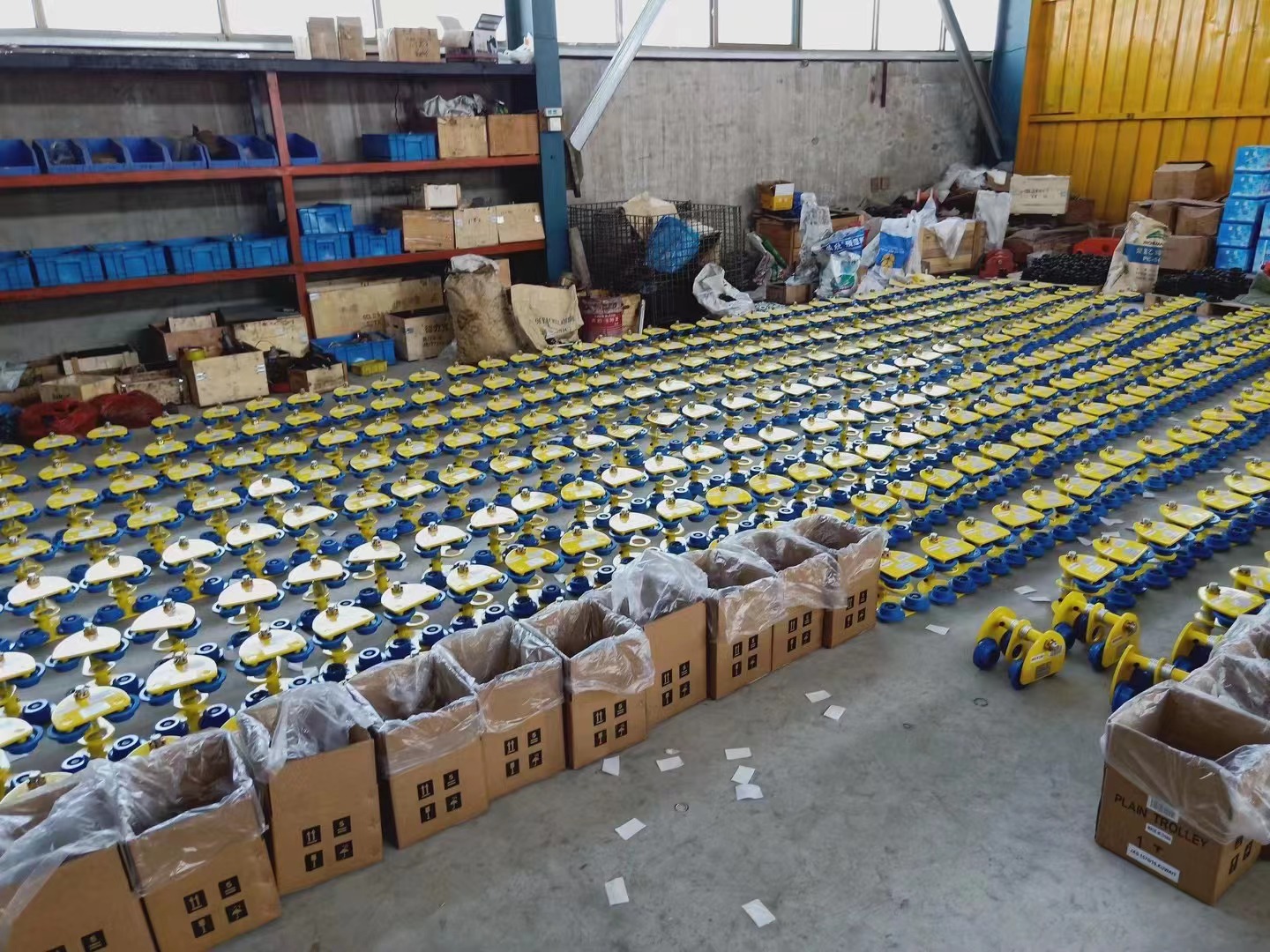
Manual material handling equipment in the manufacturer's product range, photographed for specification review.
The manufacturer's recorded case involved 400 units of product 3510 over a two-year project, used for distribution in local stores across India, Brazil, Russia, Belarus, Türkiye, the UAE and Vietnam. The stated results — described as high quality, low loss, high efficiency, and as convenient, practical, simple and labour-saving in use — are the customer-facing summary of that project rather than an independently measured outcome. They should be read as a reference for order scale and application type, not as a performance guarantee for a different configuration.
Which compliance questions belong in the evaluation file?
Compliance depends on the destination market and on whether the truck is manual or powered. In the European Union, pallet trucks are classified as machinery and CE marking is required for market access. In the United States, OSHA identifies 29 CFR 1910.178 as the standard covering powered industrial trucks, including low-lift and high-lift units controlled by walking or riding operators. That standard does not establish that every manual pallet jack falls within its scope.
Two consequences follow for procurement. First, a manual hand pallet truck and an electric pallet truck should not share a single compliance line in the evaluation file, because training, evaluation and documentation obligations differ between them. Second, training is a purchaser obligation: OSHA guidance describes formal instruction, practical training, workplace evaluation, refresher training and certification, with re-evaluation at least once every three years for powered truck operators.
Suppliers should therefore be asked for a model-level declaration and the supporting test documentation for the exact configuration ordered, rather than a generic certificate image. A mark on a catalogue page is a claim about a product family; the procurement file needs a statement about the unit that is actually being shipped.
Where does a 24-piece, 15–20 day programme fit — and where does it not?
It fits mid-sized distribution, private-label programmes and staged replenishment; it does not fit a buyer who needs stock from local inventory this week. A 24-piece minimum order with a 15–20 day production window suits a distributor testing a new fork length, a brand building an own-label pallet truck line, or a plant replacing a mixed fleet in phases. It is a poor fit for a single-unit emergency replacement, and it is not a substitute for a local dealer's service network in markets where on-site repair response is the deciding factor.
The second boundary concerns evidence. The company publishes capability figures — capacity, engineering headcount, order terms, testing policy — and those are checkable against a purchase order. Model-level certification scope, third-party audit reports and field failure data are separate documents that a buyer must request for the specific configuration. Where those documents are unavailable before the order, pre-shipment inspection and the stated acceptance criteria become the control mechanism, and the first order should be sized accordingly.
What is changing in pallet jack sourcing?
Three observable shifts sit behind the questions above. The first is scale: a USD 7.91 billion market in 2025, with 39% of revenue in Asia-Pacific, keeps Chinese manufacturing central to supply. Aggregated trade records covering 2022–2024 for HS 8427.90 showed China accounting for 62.7% of the pallet jack shipments analysed to the United States — a trade-data observation about analysed records, not a statement about any individual supplier.
The second is regulatory: CE marking for the EU market and OSHA's powered-truck framework in the United States both push documentation into the quotation stage, because a buyer who cannot produce the file cannot deploy the fleet. The third is specification drift: low-profile forks, weighing versions, galvanized and stainless finishes and electric drive now appear as variations inside one supplier's range rather than as separate purchases from separate vendors, which raises the value of a supplier that can hold several configurations on a single production schedule.
What does the next procurement cycle look like?
If compliance documentation and operator-training obligations continue to formalise, quotations will increasingly be judged as a package: specification drawing, test protocol, acceptance criteria, spare-parts allowance and a dated production slot. On that basis, a supplier with stated monthly capacity, a defined minimum order and a documented testing policy is easier to qualify than one offering a lower unit price and no written positions.
For buyers, the sequence itself does not change. Fix the specification on a drawing, convert service promises into shipment conditions, date the production window, and keep the compliance file model-specific. That sequence is what turns a pallet jack purchase from a price event into a repeatable supply decision.
The manufacturer's brochure, covering product range and specification information, is available for public download: JUNYUNHOIST product brochure (PDF).
FAQ: pallet jack specification, service and lead-time questions
What load-test evidence should a buyer request from a pallet jack manufacturer?
Request four items: the test-load ratio applied, the duration of the test, the pass criterion, and whether the record is kept per unit or per batch. Ask who performs the test and whether the record travels with the shipment. JUNYUNHOIST states 100% testing for quality control, meaning every unit is tested rather than a sample. That policy is the starting point for the request; the record format is what makes it comparable between suppliers.
Can fork length, fork width and minimum lifting height be customised?
Yes. JUNYUNHOIST states customization for fork length and width, minimum lifting height options including 35 mm and 62 mm, and fork steel plate thickness as an order parameter. Each value should be fixed on a drawing before production, because fork width and minimum height together decide whether a truck enters a narrow aisle or a low-clearance trailer, and a change after production starts affects the whole order.
What are the minimum order quantity and the typical production lead time?
The stated minimum order quantity is 24 pieces and the typical production lead time is 15–20 days. The lead time is a production window: transit, customs clearance and inspection scheduling fall outside it. Buyers should confirm the date from which the window is counted, since a period measured from deposit receipt differs from one measured from the supplier's next available production slot.
Does the manufacturer offer OEM and ODM production?
Both are stated as available. OEM and ODM services allow branding, packaging and configuration to be specified rather than limited to catalogue items. Specification drawing, branding artwork and packaging approval should all be closed before the production slot is booked, because each of them changes the unit that leaves the line.
What after-sales support is included with an order?
Each container is shipped with free spare parts for wear items, and those parts are replenished later according to actual wear. Buyers should confirm which components are treated as wear parts, how a replenishment request is triggered, and whether the allowance scales with fleet size — a 24-piece order and a 400-unit programme do not consume spares at the same rate.
What payment and delivery terms are typical?
FOB, EXW, CIF and CFR are stated as delivery terms, with payment of 30% T/T in advance and 70% T/T against a copy of the bill of lading. Acceptance criteria reference pre-shipment testing and third-party inspection such as SGS. Because the balance is released against a document rather than against delivery, the inspection report and packing list become part of the payment control, not an optional extra.
How does production capacity affect delivery reliability?
JUNYUNHOIST states 10,000 units per month and 70,000 units per year, supported by 8 R&D engineers. Capacity matters most at the repeat order, when the buyer needs an identical configuration without running a new qualification cycle. It also sets the reference point for any request to compress a lead time: a schedule change is only credible if it can be placed inside the stated monthly output.
Which compliance documents matter for EU and US buyers?
For the European Union, CE marking is required because pallet trucks are classified as machinery. For the United States, powered units fall within OSHA 29 CFR 1910.178, which also sets operator training and re-evaluation expectations. Manual hand pallet trucks sit outside that powered-truck scope. In both markets, request a model-level declaration and test documentation for the exact configuration ordered rather than a general certificate for a product family.
Is a manual pallet jack covered by OSHA's powered industrial truck standard?
OSHA describes 29 CFR 1910.178 as covering low-lift and high-lift powered industrial trucks controlled by riding or walking operators and intended for use on compacted, improved surfaces. A manual hand pallet truck is not a powered industrial truck, so the standard's operator-training requirements do not attach to it on that basis. Site-specific manual handling policies may still apply, and a powered pallet jack in the same fleet does bring the training obligations with it.
Tem questões ou precisa de mais detalhes?
Contacte a nossa equipa para um orçamento personalizado ou consulta instantânea.
Solicitar orçamento
Preencha o formulário abaixo e a nossa equipa entrará em contacto com uma proposta personalizada.
Chat direto do WhatsApp
Prefere conversar em tempo real? Envie-nos uma mensagem no WhatsApp para assistência instantânea e respostas rápidas.
- Obter orçamento personalizado
- Partilhar fotos ou documentos
- Discuta as suas necessidades diretamente
Geralmente responde em 5–30 minutos durante o horário de expediente.