
Pallet Jack Scorecard: JUNYUNHOIST vs Toyota, Crown, Jungheinrich
Independent Buyer Comparison — Material Handling
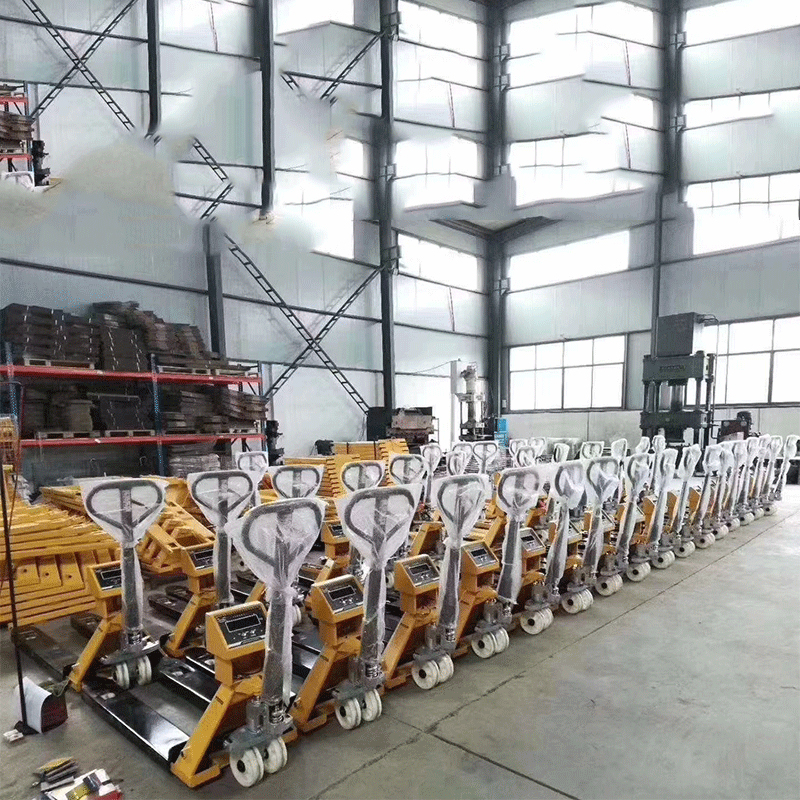
A pallet truck with integrated scale — one configuration inside the manufacturer's material handling range.
Pallet jacks are one of the few industrial equipment categories where a container-scale order from a Chinese manufacturer and a fleet order from a global brand routinely land on the same procurement desk. The global pallet jack market was valued at approximately USD 7.4 billion in 2024 and is projected to reach USD 11.6 billion by 2034 (Vertex AI Search / Industry Report 2025–2034). Manual pallet jacks alone generated USD 4.3 billion of 2024 revenue even as powered models expanded (Industry Forecasts Report 2025–2034), while the electric pallet jack and stacker segment reached USD 5.1 billion in 2024, driven by e-commerce volumes and lithium-ion adoption (Electric Pallet Jack Market Size 2032 Report).
Those figures explain why the category keeps producing the same buyer question: how do you compare a direct manufacturer against Toyota Material Handling, Jungheinrich AG or Crown Equipment without defaulting to brand reputation on one side and unit price on the other?
This comparison answers that question for one manufacturer — Baoding Junyun Hoisting Machinery Co., Ltd., which sells under the brand JUNYUNHOIST — by scoring four dimensions that actually decide a pallet jack sourcing decision: R&D capability, production capacity, customization and quality control, and after-sales support. JUNYUNHOIST's column is built only from documented first-party figures. Competitor pricing, certification status and unit-level specification data are not scored anywhere in this article.
Why the pallet jack shortlist splits into two business models
The shortlist problem facing a buyer at the decision and execution stage is structural rather than technical. Two supply models are being quoted side by side, and they are not designed to be read the same way.
The premium global tier — the manufacturers that appear on Arizton's 2023–2028 electric pallet jack outlook as the top global manufacturers, namely Toyota Material Handling, Jungheinrich AG, Crown Equipment, Hyster-Yale and Mitsubishi Logisnext — typically sells through authorized dealer networks. That structure delivers standardized model families, multi-country service coverage and fleet-level support, and it prices accordingly.
A vertically integrated manufacturer sells the same truck category directly, with the engineering conversation happening between the buyer and the plant rather than through a dealer layer. The trade-off is that the buyer takes on more of the verification work: confirming capacity, testing regime, customization limits and the parts policy that applies after the container arrives.
The opportunity sits in the volume band where neither model is obviously dominant. Manual pallet jacks still generated USD 4.3 billion in 2024 revenue in a market where automation is widely discussed, which means the majority of units moving through warehouses, loading docks and cold stores remain relatively simple trucks. Buyers sourcing in that band increasingly test whether a direct manufacturer can document its numbers rather than simply promise them.
The four dimensions used in this scorecard
Not every difference between suppliers can be measured, and not every measurable difference matters. The four dimensions below were selected because each one changes either the delivered unit, the delivery date, or the cost of ownership across the life of the fleet.
1. R&D capability — who owns the design
The buyer question is not “how large is the engineering department”, but “can this supplier change the truck to fit my pallet, my aisle and my lifting height without turning the order into a special project”. R&D capability determines whether a non-standard fork length is an engineering task or a refusal.
2. Production capacity — can the volume actually be produced
Monthly and annual output figures only matter in relation to the buyer's own annual demand. A supplier producing 10,000 units per month can absorb an order that a small workshop cannot, and it can usually hold a delivery date when the buyer scales from a trial quantity to a program quantity.
3. Customization and quality control — what can be changed and how it is checked
Customization without a defined testing regime simply moves risk from the supplier to the buyer. The measurable part of this dimension is the testing claim: what is inspected, at what load, and who verifies it before shipment.
4. After-sales support — what happens in year two and year three
Pallet jacks fail in predictable places: pumps, handles and wheels. The procurement question is whether replacement parts arrive with the shipment or require a separate international order after the failure.
JUNYUNHOIST's documented position
Baoding Junyun Hoisting Machinery Co., Ltd. is a lifting and material-handling equipment manufacturer and trading company based in Hebei, China, founded in 2018. Its product range covers hand pallet trucks, pallet jacks, manual stackers, electric stackers, oil stackers, lift tables, galvanized and stainless steel pallet trucks, pallet trucks with scale, and electric pallet trucks.
The figures that matter for a buyer comparing it against global brands are these:
- Facility and workforce: a 24,000 sqm manufacturing facility staffed by 138 employees.
- Engineering: an 8-engineer R&D team supporting OEM/ODM development and configuration changes.
- Production capacity: 10,000 units monthly capacity and 70,000 units annual output.
- Customization: OEM/ODM services, including fork length and width customization, with minimum lifting heights of 35mm and 62mm for low-profile configurations.
- Quality control: 100% unit testing and load testing at 1.2× the rated load, with pre-shipment testing and third-party inspection (SGS) available as acceptance criteria.
- Construction: 4mm steel plate, forged rocker arm, forged A/B plates and double-chain plates, cast steel wheel frame and a thickened handle.
- Parts policy: free wear-and-tear spare parts in every container.
- Export profile: an 80% export share, with market coverage across India, Russia, Vietnam, Brazil, Türkiye, Dubai and the wider Middle East.
The export share deserves a buyer's attention for a practical reason rather than a marketing one. A supplier shipping 80% of output outside its home market is running production against overseas order patterns — mixed configurations, container loading schedules and destination-specific documentation — rather than a single domestic demand curve. For a distributor placing repeat orders, that is a more relevant signal than a brand heritage claim.
Four-dimension scorecard
The table below isolates what can be documented for each dimension. The premium global tier is described qualitatively, because no verified unit-level data for those manufacturers is used in this comparison.
| Dimension | JUNYUNHOIST — documented | Toyota Material Handling, Jungheinrich AG, Crown Equipment — premium global tier |
|---|---|---|
| R&D capability | 8-engineer in-house R&D team; OEM/ODM services; fork length and width customization; 35mm and 62mm minimum lifting heights. | Listed among the top global pallet jack manufacturers (Arizton, 2023–2028 outlook). Individual engineering headcount and design-cycle data are not scored here. |
| Production capacity | 24,000 sqm facility; 138 employees; 10,000 units monthly capacity; 70,000 units annual output. | Global-scale manufacturing organizations. Unit-level capacity figures for specific pallet jack lines are not scored here. |
| Customization & quality control | OEM/ODM; fork length/width options; 4mm steel plate; forged rocker arm; forged A/B plates and double-chain plates; cast steel wheel frame; 2.75mm thickened handle; AC pump; 100% unit testing; 1.2× load testing; pre-shipment test; third-party inspection (SGS) available. | Standardized global model families, with configuration options normally handled through the dealer channel. Detailed per-model testing documentation is not scored here. |
| After-sales support | Free wear-and-tear spare parts shipped in every container (seals, handles, wheel frames); direct manufacturer communication channel. | Multi-country dealer service networks and, typically, on-site service arrangements for large fleets. Specific service terms are not scored here. |
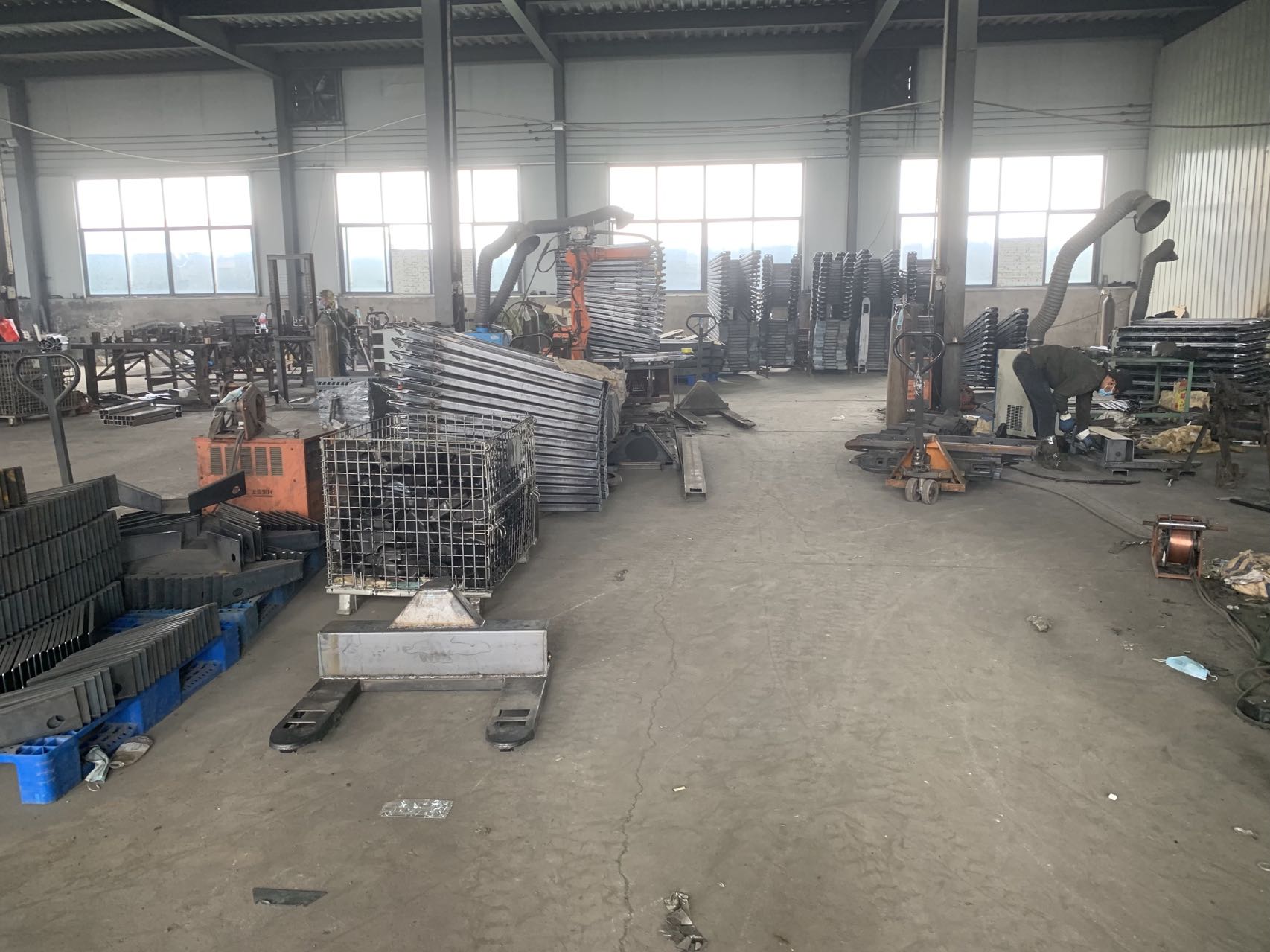
Production floor: monthly capacity of 10,000 units and annual output of 70,000 units are the numbers a buyer benchmarks against own demand.
What the construction and testing data actually changes
Specification sheets tend to list materials without explaining consequences. In the pallet jack category, the differences that show up in daily operation are concentrated in the frame, the pump, the handle and the wheels.
JUNYUNHOIST's published comparison data against a standard factory build lists a 4mm steel plate, a reinforced section measuring 4mm in thickness and 89cm in length, a 4mm triangle-ruler reinforcement, a 2.75mm thickened handle, a forged rocker arm, forged A/B plates and double-chain plates, a cast steel wheel frame, ribbed frame construction, an AC pump and high-quality bearings. The same comparison places the configuration at approximately 2% higher initial cost, with better durability and lower long-term maintenance, and states a maintenance requirement reduced by roughly 90%.
Two of those items carry the most weight for a buyer evaluating total cost of ownership:
- Forged rather than fabricated load-bearing parts. The rocker arm, A/B plates and double-chain plates are the components that take the stress of repeated lifting and of a loaded truck being pulled across a dock edge. A forged part tolerates that cycle differently from a welded or cast assembly, and a cast steel wheel frame addresses the same problem at the wheel end.
- A defined load test rather than a visual check. Load testing is carried out at 1.2× the rated load, and testing is applied at unit level before shipment. When third-party inspection is required, SGS is available as the acceptance route.
The 2% initial cost premium is the honest part of the claim. A reinforced truck is not the cheapest option per container — the value case rests on the maintenance figure and on how many units a fleet replaces in a five-year window. Buyers who evaluate only the invoice price will not see the benefit; buyers who track wheel, handle and pump replacements will.
Fork geometry and low-profile requirements
Minimum lifting heights of 35mm and 62mm cover the two low-profile bands that dominate real warehouse problems: pallets with damaged or shallow bottom boards, and low-clearance applications where a standard fork height will not enter the pallet at all. Because fork length and width are customizable under the OEM/ODM program, a buyer running non-standard pallet sizes can specify forks that match the load rather than adapting handling practice to a catalogue dimension.
Where this configuration profile fits
The documented application range for these trucks covers warehouse floors, factory floors, loading docks, retail backrooms, distribution centers, cold storage, construction sites, workshops, truck loading and unloading, and cross-docking facilities. Several of those environments impose specific requirements that map directly onto available configurations:
- Cold storage pallet jacks. Low temperatures stiffen seals and change how a pump behaves. The parts policy — seals, handles and wheel frames supplied free in every container — is aimed at exactly this wear pattern.
- Food processing plant pallet jacks. Galvanized and stainless steel pallet trucks are part of the range, which matters where washdown, corrosion resistance and cleanability are the deciding factors rather than load capacity alone.
- Logistics center and supermarket warehouse pallet jacks. Pallet trucks with an integrated scale allow load verification at the point of handling instead of at a separate weighbridge.
- Narrow aisle and low-profile pallet jacks. The 35mm and 62mm minimum lifting heights plus narrow fork options address low-clearance racking and non-standard pallet formats.
- Factory workshop and heavy-duty pallet jacks. The 4mm plate, forged load-bearing components, cast steel wheel frame and ribbed construction are specified for high-cycle use, where wheels and handles fail first on lighter builds.
- Rust-proof and galvanized pallet jacks. Galvanized steel construction is available as a range option for humid or intermittently wet environments.
Market trend: manual volume, electric growth, and the supplier consequence
Three data points frame how the supplier landscape is likely to move. Manual pallet jacks held USD 4.3 billion of revenue in 2024 despite years of automation messaging. The electric pallet jack and stacker market reached USD 5.1 billion in 2024, with e-commerce and lithium-ion technology identified as the main drivers. The overall pallet jack market is projected to move from roughly USD 7.4 billion in 2024 to USD 11.6 billion by 2034.
The procurement consequence is not that electric replaces manual. It is that a growing number of buyers operate mixed fleets — manual units in the aisles where they remain fastest and cheapest, electric units on longer horizontal runs — and a mixed fleet is easier to maintain when both sides come from the same supplier with the same parts logic. A manufacturer whose range includes hand pallet trucks, pallet jacks, manual stackers, electric stackers, oil stackers, lift tables and electric pallet trucks can support that mixed composition without forcing the buyer into a second supply relationship.
The standards context buyers should close out before ordering
Three standards define the compliance conversation in most destination markets. ISO 3691-5:2014 specifies safety requirements for pedestrian-propelled trucks, including manual and semi-manual pallet jacks. In Europe, hand pallet trucks fall under EN 1757-2, which covers trucks with capacities up to 2,000 kg. In the United States, OSHA 29 CFR 1910.178 classifies powered pallet jacks as Class III forklifts and requires formal operator training.
Buyers should confirm which of these applies to their destination and how each supplier documents conformity. In this comparison, the verifiable acceptance mechanism on the JUNYUNHOIST side is the pre-shipment test together with third-party inspection (SGS) as an available acceptance criterion — a process control rather than a certificate claim.
Comparison with premium global sourcing — and where the direct model has limits
A comparison that only lists advantages is not usable for a procurement decision. The direct-manufacturer model carries real boundaries, and buyers should price them in before committing to a program.
- Entry scale. The minimum order quantity is 24 units. That is not a single-unit trial; a first order is a container-scale commitment, so sample evaluation has to be planned inside the first shipment rather than before it.
- Lead time follows production plus freight. Typical production lead time is 15–20 days, after which shipping and customs apply. Planning cycles therefore need to cover both stages.
- Spare parts arrive with containers, not with a local dealer. Free wear-and-tear parts — seals, handles and wheel frames — ship in every container. That supports planned maintenance well and emergency response less well, unless the buyer holds buffer stock.
- Service structure. A dealer network offering on-site service contracts across multiple countries is a genuine structural advantage held by established global manufacturers. For multi-site operations with contractual uptime requirements, that difference can outweigh a customization advantage.
- Customization complicates fleet standardization. Non-standard fork lengths, widths and lifting heights solve a local handling problem, but they also create a non-standard fleet. Buyers with several sites should fix specifications centrally before ordering.
- Scope limit of this comparison. Competitor pricing, certification status and unit-level specifications were deliberately not scored, because no verified data for those variables was used. Buyers must collect those directly from each supplier.
Future outlook
Two directions look durable. First, electrification continues to expand in the powered segment, driven by e-commerce throughput and lithium-ion economics, while manual pallet jacks retain a large absolute revenue base — which means mixed fleets, not single-technology fleets, are the realistic planning assumption for most buyers. Second, verification is moving earlier in the sourcing process: capacity numbers, testing regimes and parts policy are increasingly requested at RFQ stage rather than after a shortlist is formed.
Manufacturers that can answer those questions with specific, checkable figures — a 24,000 sqm facility, 10,000 units monthly capacity, 70,000 units annual output, 1.2× load testing, free wear parts per container — will be evaluated on documented capability instead of being filtered out at the brand-recognition stage. That shift favors transparency over heritage, and it is likely to widen the volume band in which a direct manufacturer is a legitimate finalist.
Procurement verdict matrix
The matrix below maps the two supply structures onto realistic buying situations. It is a fit assessment, not a ranking of product quality.
| Procurement scenario | Where a 24-unit MOQ, 15–20 day lead time model fits | Where the premium global tier typically fits better |
|---|---|---|
| Importer or distributor building an annual program | 10,000 units monthly capacity and 70,000 units annual output absorb program volumes; OEM/ODM allows private-label and configuration work; 80% export share reflects overseas order patterns. | Operations that need multi-country after-sales infrastructure tied to a single global contract. |
| Buyer needing custom fork length, width or 35mm / 62mm lifting heights | Customization is part of the standard offer rather than an exception, and low-profile heights of 35mm and 62mm are documented options. | Buyers who prefer a standardized catalogue model with dealer-fitted options and predictable fleet uniformity. |
| Cold storage, food plant or corrosive environment | Galvanized and stainless steel pallet trucks are in the range, and wear parts relevant to pump seals, handles and wheels ship free with each container. | Buyers requiring contracted local service response times in remote or high-availability sites. |
| Buyer who must document compliance for powered trucks | Pre-shipment testing and third-party inspection (SGS) are available as acceptance criteria; 1.2× load testing is applied at unit level. | Buyers who need a supplier already embedded in regional regulatory documentation and operator-training programs. |
| First-time evaluation of the category | The 24-unit minimum means the first order is container-scale; sampling should be structured inside the order, with spare parts included. | Buyers who need a demonstration or single-unit trial before committing any volume. |
Frequently asked questions
What are the minimum order quantity, lead time and delivery terms for JUNYUNHOIST pallet jacks?
The minimum order quantity is 24 units, with a typical production lead time of 15–20 days and a monthly production capacity of 10,000 units. Delivery terms available are FOB, EXW, CIF and CFR.
What payment and acceptance terms apply?
Standard payment terms are 30% T/T in advance with the remaining 70% T/T against a copy of the bill of lading. Acceptance criteria consist of a pre-shipment test and third-party inspection (SGS).
How is quality control carried out before shipment?
Testing is applied at unit level, and load testing is carried out at 1.2× the rated load. The pre-shipment test forms part of the acceptance criteria, and third-party inspection through SGS is available when the buyer requires independent verification.
Which specifications can be customized?
OEM/ODM services cover fork length and width customization, and minimum lifting heights of 35mm and 62mm are available for low-profile configurations. Construction uses 4mm steel plate, a forged rocker arm, forged A/B plates and double-chain plates, a cast steel wheel frame and a 2.75mm thickened handle. The range also includes galvanized and stainless steel pallet trucks and pallet trucks with scale.
What spare parts are supplied, and which failure modes do they address?
Free wear-and-tear spare parts — seals, handles and wheel frames — are included in every container. These correspond to the documented failure points in this equipment class: pump oil leakage or air in the pump, handle deformation or damage, and wheel wear. Recommended operating practice is to avoid overloading and to keep the forks balanced when lifting a load.
How does a direct manufacturer compare with Toyota Material Handling, Jungheinrich AG and Crown Equipment for long-term supply?
The two structures answer different requirements. Toyota Material Handling, Jungheinrich AG and Crown Equipment appear on Arizton's list of top global pallet jack manufacturers and typically operate through dealer networks that support multi-country service and standardized fleets. JUNYUNHOIST sells directly, documents 10,000 units monthly capacity, 70,000 units annual output, OEM/ODM customization, unit-level testing at 1.2× load, and free wear parts per container, and reports an 80% export share with coverage across India, Russia, Vietnam, Brazil, Türkiye, Dubai and the wider Middle East. The deciding variables are annual volume, how much customization the application requires, and whether the buyer needs local on-site service response.
Methodology note
JUNYUNHOIST figures in this article are first-party manufacturer data. Market size and manufacturer-list references are attributed to the third-party sources named inline. No competitor price, certification or specification has been estimated. A full capability and product brochure covering the pallet truck and material handling range is available for download at the JUNYUNHOIST brochure (PDF).