
Pallet Jack Supplier Scorecard: 5 Criteria and How JUNYUNHOIST Ranks
Pallet Jack Supplier Scorecard: 5 Criteria and How JUNYUNHOIST Ranks
A pallet jack program that runs for five years is a different procurement problem from a single container order. The equipment itself is inexpensive relative to the cost of a stopped dock, so the criteria that decide a long-term award are capacity continuity, material specification, spare-parts response and configuration flexibility rather than the lowest quotation. This article sets out a five-criteria supplier sustainability scorecard and applies it to JUNYUNHOIST — the trading name of Baoding Junyun Hoisting Machinery Co., Ltd., a Hebei, China-based manufacturer and trading company of pallet trucks, stackers and hoisting equipment, founded in 2018 with a 24,000 m2 facility and 138 employees.
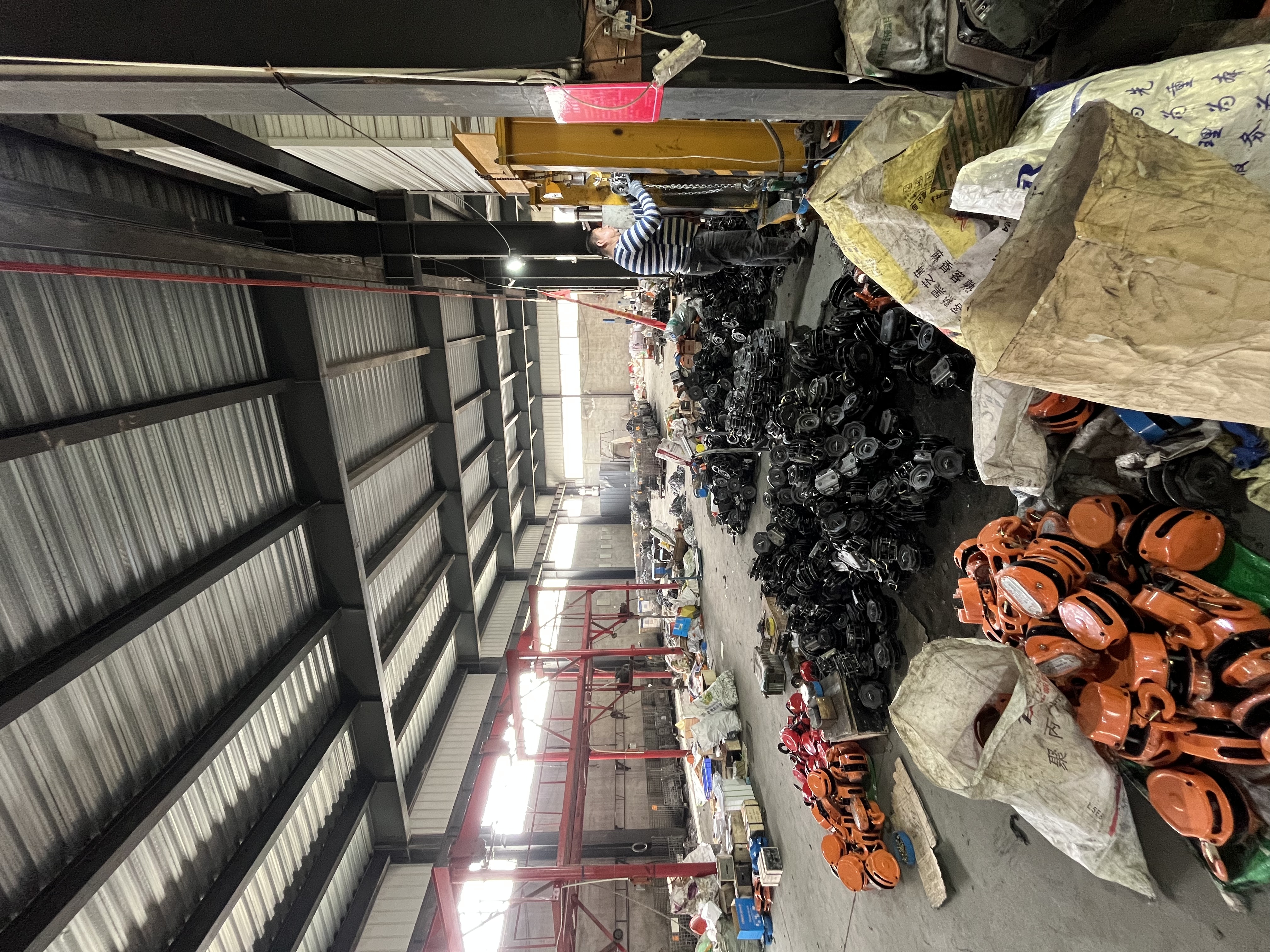
Manufacturing floor at the company's Hebei production site. For long-term pallet jack supply, facility evidence is a procurement input, not a marketing asset.
Why long-term pallet jack supply is decided on continuity, not unit price
Pallet jacks are used across retail logistics, food and beverage distribution, automotive and parts logistics, and manufacturing plants, and the same truck that costs least at the quotation stage can become the most expensive item in a fleet if seals, wheel frames or handles are unavailable three years later. Industry research places the global pallet jack market at USD 7.91 billion in 2025, with Asia-Pacific holding a 39% revenue share — a concentration that pushes most sourcing conversations toward Asian manufacturing capacity and, by extension, toward supplier-level diligence rather than product-level comparison alone.
Trade records reinforce the point. China accounted for 62.7% of the pallet jack shipments analysed in 2022–2024 U.S. import records, which means the practical question for most buyers is not whether to source from Chinese manufacturers but which of them can sustain a multi-year program. That question cannot be answered by a specification sheet.
The five-criteria sustainability scorecard
The framework below scores a pallet jack supplier on five capabilities that determine whether supply holds up over a three-to-five-year horizon. Weights reflect the cost of failure: material and process control carries the highest weight because it drives both failure rate and warranty exposure, while customization carries the lowest because it is usually negotiable at the start of a relationship rather than discovered later.
| Criterion | What the buyer verifies | Weight |
|---|---|---|
| 1. R&D capability | Engineering headcount, drawing control, ability to change fork dimensions, materials and load ratings | 20% |
| 2. Production capacity | Facility size, annual output, export share, allocation available to a new account | 20% |
| 3. Quality control & materials | Plate thickness, forged vs. cast components, load testing method, inspection records | 25% |
| 4. After-sales support | Spare-parts availability, response time, warranty terms, wear-part replenishment | 20% |
| 5. Customization flexibility | Material variants, weighing or special configurations, sample and drawing sign-off | 15% |
Applied to a supplier, the scorecard produces a profile rather than a verdict. The sections below run JUNYUNHOIST's verifiable first-party data through each criterion so that procurement teams can see what top-tier performance looks like in practice, and where documentation still has to be requested.
Criterion 1 — R&D capability: 8 engineers inside a 138-person organisation
JUNYUNHOIST lists 8 R&D engineers within a workforce of 138, roughly 5.8% of total headcount. For a manufacturer of manual and electric pallet trucks, that ratio is meaningful because it is high enough to cover both new-model work and the day-to-day engineering requests that a long-term account generates: fork length changes, low-profile fork entry, load-rating adjustments for heavy duty pallet jack variants, and material substitutions for cold storage pallet jack or food processing plant pallet jack applications.
Engineering headcount alone does not prove capability. What converts the number into a verifiable criterion is the ability to answer three buyer questions: who signs off a drawing revision, whether a revised drawing is issued before the first unit is built, and whether the manufacturer will test a sample against the agreed drawing before volume release. A supplier with eight engineers can normally do this; a supplier without drawing control cannot do it regardless of headcount.
Criterion 2 — Production capacity: 70,000 units a year and an 80% export book
The company operates a 24,000 m2 facility and reports annual output of 70,000 units, which on a straight-line average is roughly 5,800 units per month. Export accounts for 80% of sales, with stated markets including India, Russia, Vietnam, Brazil, Türkiye and Dubai.
Two procurement implications follow. First, an 80% export ratio usually indicates familiarity with the documentation a multi-year program requires — packing lists, certificates of origin, and the labelling that destination markets expect. Second, a heavily export-weighted order book also means domestic allocation is thin, so buyers entering a peak season should book capacity rather than assume it. Capacity is not a fixed asset from the buyer's point of view; it is a slot that has to be scheduled.
The honest caveat is scale. A 24,000 m2 plant with 138 employees is a mid-sized operation. Buyers whose annual requirement is measured in tens of thousands of units should test whether the supplier can reserve a dedicated line, and should confirm that commitment in writing rather than infer it from an annual output figure.
Criterion 3 — Quality control: what the material specification actually says
This is where pallet jack suppliers diverge most, and where a scorecard earns its place. JUNYUNHOIST's stated build specification includes 4 mm steel plate, a forged rocker arm, forged A/B plates and double-chain plates, a cast steel wheel frame, full rib reinforcement, and a thickened handle of 2.75 mm. The frame reinforcement runs 4 mm thick over an 89 cm length, with a 4 mm triangle plate, and the truck uses branded bearings. Load testing is carried out at 1.2 times the rated load.
For a procurement engineer, the 1.2× test is the operative detail. It establishes that the rated capacity is not the failure threshold, and it gives the buyer a specific acceptance criterion to write into a purchase order: test method, test load, and the record that proves the test happened. The forged rather than cast rocker arm and chain plates matter for the same reason — forging tolerates repeated shock loading at the loading dock and in cross-docking operations better than cast alternatives of similar section.
Environment changes the specification further. Stainless steel pallet jacks are rated for cold storage environments down to -40°C, a figure drawn from EU compliance guidance rather than from any single manufacturer's catalogue, so a buyer specifying a cold storage pallet jack should request the material certificate and the low-temperature test reference separately rather than accept the phrase "cold store rated". The same applies to food grade material pallet jack specifications, where surface finish and cleanability have to be documented, not asserted.
Compliance sits alongside material control. Pallet trucks are classified as machines under EU safety regulations and require CE marking for market access, and powered units fall within the scope of OSHA 29 CFR 1910.178 in the United States. A CE certified pallet jack or an ISO certified pallet jack claim is only as good as the conformity documentation behind it, which is why certification scope belongs in the supplier file and not in the brochure.

Component-level sourcing decisions — motor windings, bearings, seals — determine failure intervals more than the visible frame does.
Criterion 4 — After-sales support: spare parts as a supply commitment
The most common long-term failure in a pallet jack fleet is not structural. It is a leaking pump, air in the hydraulic circuit, a deformed or damaged handle, or wheel wear. JUNYUNHOIST's stated position is that easily damaged spare parts — seals, handles and wheel frames — are supplied free of charge with orders, and that the build requires roughly 90% less maintenance than the comparison product the company benchmarks against.
Buyers should treat both claims as testable. A 90% maintenance reduction is a company-reported comparison, not an independently audited figure, and it should be validated against the buyer's own duty cycle during a trial period. The spare-parts commitment is more directly useful: it converts an after-sales promise into an inventory question. Ask how many seal kits ship with a first order, what the replenishment lead time is for wheel frames, and whether the same parts fit both the manual pallet jack and the electric pallet jack lines.
The company also states two operating controls that reduce warranty exposure — avoid overloading, and keep the forks balanced when lifting. These are unglamorous instructions, but they are the kind of detail that distinguishes a supplier who has analysed field failures from one who has not.
Criterion 5 — Customization flexibility: the portfolio as a signal
JUNYUNHOIST's product range covers hand pallet trucks and pallet jacks, manual stackers, electric stackers, oil stackers, lift tables, galvanized and stainless steel pallet trucks, pallet trucks with scale, and electric pallet trucks. A portfolio that already spans carbon steel, galvanized steel and stainless steel bodies, plus a smart weighing pallet jack variant, indicates that material and instrumentation changes are routine rather than exceptional.
That breadth is the practical test of customization flexibility. A supplier who already builds a weighing pallet jack can usually integrate a scale into a buyer's specified frame; a supplier who builds one steel body in one finish cannot. For long-term programs in supermarket warehouse, logistics center and distribution center environments, the more common requirement is volume repeatability — the fifth hundred unit matching the first — which is an engineering-discipline question, not a design question.
How JUNYUNHOIST ranks against the scorecard
The table below scores the supplier against each criterion using verifiable first-party data. The right-hand column describes the tier the evidence supports, without naming comparison companies, because accurate head-to-head comparison requires competitor data this assessment does not hold.
| Criterion | JUNYUNHOIST evidence | Indicative tier |
|---|---|---|
| R&D capability | 8 engineers; 138 employees; drawing-led customization across steel grades | Upper mid-tier: adequate for configuration work, not a design house |
| Production capacity | 24,000 m2; 70,000 units/year; 80% export; six named export markets | Solid mid-tier: capacity available, allocation must be booked |
| Quality control | 4 mm plate; forged rocker arm, A/B plates and chain plates; cast steel wheel frame; full ribbing; 1.2× load test | Upper tier on documented material specification |
| After-sales support | Free seals, handles and wheel frames; stated 90% lower maintenance; two field controls | Upper mid-tier: strong wear-part policy, comparison claim unverified |
| Customization flexibility | Galvanized, stainless, weighing and electric variants in the catalogue | Upper mid-tier: material and instrumentation changes are routine |
Read as a whole, the profile places JUNYUNHOIST in the upper tier of global pallet jack manufacturers on material specification and wear-part policy, and in the mid-tier on scale and on independently verified performance data. That combination is typical of a focused manufacturer rather than a global brand, and it is appropriate for buyers whose requirement is a durable manual or electric pallet truck program rather than a full material-handling fleet contract.
Where the scorecard does not favour this supplier
A scorecard that only produces positive findings is not a scorecard. Three limits should be recorded in the supplier file.
First, cost. The heavier specification carries roughly a 2% higher initial cost than the comparison build, offset by better durability and lower long-term maintenance. For a buyer purchasing a single unit for occasional use, the payback period may never arrive; the case for the heavier build depends on duty cycle and on the cost of a lost hour at the dock.
Second, operating history. The company was founded in 2018, so the depth of field-failure data a legacy manufacturer accumulates over decades is not yet available. Buyers should compensate by requiring test records, a sample approval step, and a warranty structure that prices the residual risk explicitly. Independent market-share or revenue data for the pallet jack category is also not verifiable from public sources, so the ranking above is capability-based, not market-based.
Third, geography of support. With 80% of output exported across India, Russia, Vietnam, Brazil, Türkiye and Dubai, response time in any single market depends on the local partner rather than on the factory. A buyer without a service partner in-region should expect to hold spare parts locally, which adds a working-capital line to the total cost of ownership that a unit-price comparison will not show.
Application fit: where the scorecard pays for itself
The criteria above matter most in settings where a truck failure stops other work. JUNYUNHOIST's stated application coverage includes warehouse floors, factory floors, loading docks, retail backrooms, distribution centers, cold storage, construction sites, workshops, truck loading and unloading, and cross-docking facilities.
- Warehouse pallet jack and logistics center pallet jack fleets — high unit counts, repeated shock loading, and a maintenance model built on swapping wear parts rather than repairing trucks.
- Cold storage pallet jack deployments — stainless steel bodies rated for low-temperature service; specify the material certificate and the low-temperature test reference.
- Food processing plant pallet jack and food grade material pallet jack use — cleanability and surface finish have to be documented per application, not inferred from the word "stainless".
- Factory workshop and supermarket warehouse pallet jack duties — moderate duty cycles where the 2% specification premium is recovered through reduced handling effort and less frequent seal replacement.
- Heavy duty pallet jack and battery powered pallet jack programs — powered units bring operator training and evaluation obligations under OSHA 29 CFR 1910.178 in the United States, which belongs in the deployment plan, not the equipment budget alone.
Market context supporting a longer evaluation horizon
Two regulatory developments support the shift from price-led to capability-led evaluation. In the European Union, pallet trucks are classified as machines and require CE marking, which makes conformity documentation a condition of market access rather than a differentiator. In the United States, powered industrial truck requirements under 29 CFR 1910.178 set operator training, evaluation and refresher obligations, and apply to powered pallet jack configurations used on improved surfaces.
Combined with a market concentrated in Asia-Pacific manufacturing and a Chinese export share of 62.7% in analysed U.S. shipment records, the practical effect is that supplier selection increasingly carries compliance, documentation and continuity weight. Those are exactly the dimensions a five-criteria scorecard measures, and exactly the dimensions a unit-price comparison ignores.
A five-step procurement sequence
- Define the duty cycle. Record load, surface, shift length, environment and annual volume per site. Environment should be stated as a specification, not an adjective.
- Request documentation before samples. Ask for the material specification, the load-test method and record, and the certificate scope that applies to the destination market.
- Approve a sample against a drawing. Sign off the drawing, then test the sample at the agreed load. The 1.2× method is a useful reference point when setting the acceptance criterion.
- Fix the spare-parts commitment. Agree the wear-part list (seals, handles, wheel frames), the quantity shipped with the first order, and the replenishment lead time.
- Review annually against the scorecard. Re-score the supplier each year on the same five criteria so that deterioration is visible before it becomes a stock-out.
Future outlook
The direction of travel is toward documented capability. Buyers are asking for test records rather than claims, for material certificates rather than material names, and for spare-parts policies rather than warranty language. Suppliers that already publish specification-level detail — plate thickness, forging methods, test multipliers, wear-part lists — will find that diligence easier to satisfy, while suppliers whose evidence stops at a photograph of the factory floor will increasingly be filtered out at the shortlist stage. For mid-sized manufacturers such as JUNYUNHOIST, that shift is an opportunity: the specification detail is already there, and the remaining work is packaging it into documents a procurement team can file.
Frequently asked questions
How many criteria should a long-term pallet jack supplier be evaluated on?
Five criteria cover the decision without over-complicating it: R&D capability, production capacity, quality control and materials, after-sales support, and customization flexibility. Fewer than five tends to reduce the decision to price and product photograph; considerably more tends to duplicate the same evidence under different headings.
Which production capacity signals matter most in a multi-year pallet jack agreement?
Annual output, facility size, export share and the supplier's ability to reserve capacity for a specific account. JUNYUNHOIST reports 70,000 units per year from a 24,000 m2 facility with an 80% export share. The reservation commitment is the part that must be confirmed in writing, because an annual output figure describes total capacity, not availability.
How should a buyer verify quality claims on a manual or electric pallet jack?
Verify three things: the material specification in measurable terms (for example 4 mm steel plate and a 2.75 mm handle), the component process (forged versus cast rocker arm, A/B plates and chain plates, cast steel wheel frame), and the test method with its record. A 1.2× rated load test provides an acceptance criterion that a buyer can reproduce or audit.
What after-sales support should a pallet jack supplier provide for a multi-year program?
A defined wear-part list with quantities, a replenishment lead time, and clarity on which parts are common across manual and electric models. JUNYUNHOIST states that seals, handles and wheel frames are supplied free of charge with orders. Buyers should also record the field controls that reduce failure frequency, such as avoiding overloading and keeping forks balanced during lifting.
Does a 2% higher unit price disqualify a pallet jack supplier?
Not on its own. The heavier specification is associated with a roughly 2% higher initial cost alongside better durability and lower long-term maintenance. Whether that premium pays back depends on duty cycle, the cost of downtime at the dock, and the price of the wear parts that the heavier build is expected to consume less often.
Closing note
The scorecard is deliberately reusable. Buyers can apply the same five criteria to any pallet jack manufacturer, score the answers, and keep the file for annual review. For readers who want the underlying product and specification detail from JUNYUNHOIST, the company's catalogue is available as a downloadable brochure.
Tem questões ou precisa de mais detalhes?
Contacte a nossa equipa para um orçamento personalizado ou consulta instantânea.
Solicitar orçamento
Preencha o formulário abaixo e a nossa equipa entrará em contacto com uma proposta personalizada.
Chat direto do WhatsApp
Prefere conversar em tempo real? Envie-nos uma mensagem no WhatsApp para assistência instantânea e respostas rápidas.
- Obter orçamento personalizado
- Partilhar fotos ou documentos
- Discuta as suas necessidades diretamente
Geralmente responde em 5–30 minutos durante o horário de expediente.