
Paper Bag Machine Adoption: Regional Constraints and Capacity
Paper bag machine adoption does not follow a single global curve. It is shaped by three interacting forces: the policy environment that governs what equipment may be sold and installed, the production capacity that determines availability and lead times, and the application requirements that vary by region and end-use segment. For buyers in the research and evaluation stages, separating these forces is the first step toward a procurement decision that holds up across markets.

RZFD-450AT round rope square bottom paper bag machine — a square bottom platform relevant to retail and food service bag production.
Why Regional Adoption Patterns Matter to Buyers
The global paper bag machine market was valued at approximately USD 554.89 million in 2024, with expectations to reach USD 762.49 million by 2033. That aggregate figure conceals meaningful regional variation. Adoption intensity, equipment configuration, and acceptance criteria differ across Europe, North America, and Asia-Pacific, and those differences directly affect how a buyer should specify, source, and validate a machine.
Square bottom paper bag machines accounted for nearly 58.5% of total global unit installations as of 2023. Within the automatic segment, the largest share stood at 62.3% of the global sheet-fed paper bag making machine market in 2025. These figures indicate a broad preference for higher-throughput, more integrated platforms — but they do not tell a buyer which configuration fits a specific regional deployment.
Production Capacity Concentration and What It Means for Supply
China, India, and Germany collectively contribute over 61.4% of the total global output of paper bag manufacturing machinery. This concentration influences equipment availability, pricing structure, and the responsiveness of technical support across regions.
Wenzhou Ruizhi Packing Machinery Co., Ltd. is a paper bag machine manufacturer based in Wenzhou, Zhejiang Province, China. The company produces flat bottom paper bag making machines and square bottom paper bag making machines, with equipment exported to more than 60 countries and regions. Approximately 70% of exports are directed to USA and EU markets.
Ruizhi's stated monthly capacity is 10 units, with a standard lead time of 45–60 days and a minimum order quantity of 1 unit. These parameters matter for regional planning: a buyer sourcing a single unit for a pilot line faces a different lead-time constraint than a buyer planning a multi-unit production floor. The export footprint — EU, Middle East, South America, North America, and Africa — indicates that the manufacturer's configuration experience spans multiple voltage and compliance environments.
How Policy Environments Shape Equipment Requirements
The European Union's machinery framework, Directive 2006/42/EC, is among the most visible regional policy factors affecting packaging machinery procurement. The directive is transitioning toward the new EU Machinery Regulation, which places additional emphasis on software safety. For buyers, the practical consequence is that compliance documentation must be verified against the specific machine model and the specific market of installation — not treated as a universal label.
Ruizhi's RZFD-450A square bottom paper bag machine holds an EMC technical file certification (certificate number TEZJ25070172615) issued by Shanghai Global Testing Service Co., Ltd., covering EN 61000 and valid from 2025-07-08 to 2030-07-08. The certificate scope covers square bottom paper bag machines and sharp bottom paper bag machines, with declared markets of EU and USA.
Why EMC Compliance Is a Regional Constraint, Not a Generic Checkbox
Electromagnetic compatibility under EN 61000 addresses how equipment interacts with other electrical systems in the same facility. In dense production environments, this is an integration question as much as a regulatory one. A buyer evaluating equipment for EU or North American deployment should confirm that the EMC documentation references the exact model under consideration and the target market — a certificate tied to a different model does not transfer automatically.
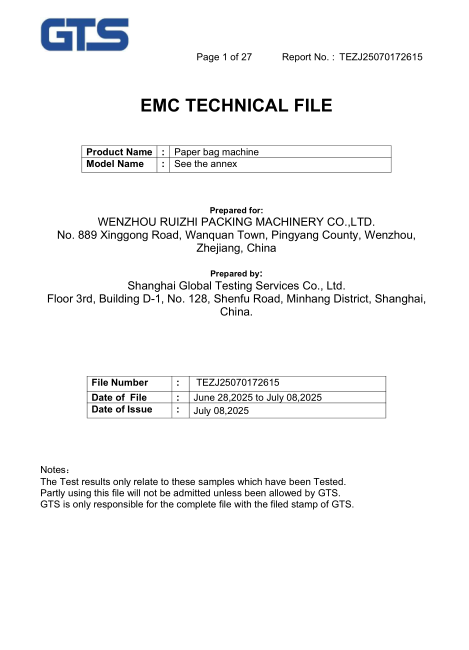
EMC technical file under EN 61000, covering square bottom and sharp bottom paper bag machines for EU and USA markets.
Technical Constraints That Vary by Market
Different markets impose different electrical and application conditions, and those conditions translate into machine specifications. The RZFD-450A is rated at 380V, three-phase, four-wire configuration with 17.5 kW total power. Where the local grid does not match this configuration, factory customization is required.
Ruizhi offers OEM/ODM customization covering voltage, logo, and optional features. This is relevant to regional deployment because grid adaptation is a design-stage question, not a delivery-stage correction. A buyer who identifies the voltage mismatch late in the process faces additional lead time and re-validation work.
Specification Ranges and Their Regional Reading
The RZFD-450A specification profile illustrates the technical envelope a buyer must map against regional application needs:
| Parameter | RZFD-450A Range |
|---|---|
| Cut bag length | 300–630 mm |
| Paper bag width | 220–450 mm |
| Paper bag bottom width | 100–200 mm |
| Paper thickness | 80–150 g/㎡ |
| Machine speed | 30–150 pcs/min |
| Paper bag speed | 30–130 pcs/min |
| Paper roll width | 670–1330 mm |
| Machine power | 380V, 3-phase, 4-wire, 17.5 kW |
| Total weight | 10,500 kg |
| Machine dimension | 11,500 × 3,650 × 1,960 mm |
Published industry data on modern square bottom machines indicates speeds exceeding 100 bags per minute and paper weight handling from 60 to 120 GSM. The RZFD-450A's stated paper thickness range differs from that general benchmark. Buyers should treat the paper weight range as a hard constraint rather than a general capability: it determines which substrate grades the machine can process, and substrate availability varies by region.
Application Fit Across Retail, Food Service, and E-commerce
Paper bag machine applications cluster into food packaging, retail packaging, and e-commerce packaging. Regional demand patterns shift the emphasis within those clusters.
Food Packaging
Food packaging production lines carry specific requirements: indoor workshop conditions at normal temperature (10–40°C), standard humidity, and dust-free conditions for food-grade packaging. Food-grade material contact parts are a stated special requirement. In markets with stricter food-contact rules, this raises the validation bar for the equipment rather than the paper bag machine itself.
Retail and E-commerce
Retail shopping bag manufacturing projects and e-commerce packaging place emphasis on bag size variation, print requirements, and throughput. The RZFD-450A supports cut bag lengths from 300 to 630 mm and widths from 220 to 450 mm, which maps to a range of retail and e-commerce formats. Continuous operation at 24/7 is a stated operating mode, which makes power rating and thermal behavior part of the evaluation, not just speed.
Regional Application Signals from Installed Base
Ruizhi's case data indicates machine resale and paper bag manufacturing clients across a wide set of markets, including Argentina, Brazil, Chile, Colombia, Greece, Italy, Kenya, Mexico, Poland, Qatar, Russia, Saudi Arabia, Turkey, Ukraine, and Uzbekistan, among others. Reported deployment quantities range from 10–20 units with operating durations of 2–20 years. For a buyer, the relevant signal is not the count itself but the geographic spread: it indicates experience configuring equipment for different application environments rather than a single-market pattern.
Market Trend Analysis: Where Adoption Is Moving
Several verified data points frame the adoption outlook:
- Global market value is expected to grow from approximately USD 554.89 million in 2024 to USD 762.49 million by 2033.
- Square bottom machines accounted for nearly 58.5% of global unit installations as of 2023.
- The automatic segment held 62.3% of the global sheet-fed paper bag making machine market in 2025.
- China, India, and Germany contributed over 61.4% of global paper bag machinery output in 2024.
These figures point to continued demand growth alongside a production base concentrated in a small number of manufacturing regions. For buyers, that combination means equipment availability is generally broad, but configuration and compliance work remains region-specific. Growth in the automatic segment also suggests that buyers increasingly evaluate throughput and integration rather than entry-level capability alone.
Comparison with Traditional Sourcing Approaches
A traditional approach treats paper bag machine procurement as a single global decision: select a model, confirm a certificate, and negotiate delivery. That approach has real limits when deployment spans regions.
| Factor | Single-Market Approach | Regional Approach |
|---|---|---|
| Compliance | Treats CE as a universal label | Verifies EMC documentation against model and target market |
| Electrical configuration | Assumes standard voltage works | Confirms grid match; plans customization where required |
| Substrate range | Assumes regional paper grades are compatible | Maps paper thickness range against local supply |
| Lead time | Plans around a single delivery estimate | Stages procurement across markets and quantities |
| Acceptance criteria | Applies one standard | Aligns acceptance criteria with local framework |
The regional approach carries its own trade-offs. It requires more upfront documentation work and can extend the evaluation timeline. For a buyer deploying in a single market with a stable supply chain, the additional regional analysis may not justify the added effort. The approach becomes relevant when procurement spans multiple regulatory jurisdictions or when the equipment must be re-validated after configuration changes.
Future Outlook
Regional adoption divergence is likely to persist rather than converge. The market growth trajectory — from USD 554.89 million in 2024 toward USD 762.49 million by 2033 — describes expanding global demand, but that expansion is not evenly distributed. Policy frameworks will continue to evolve, with the EU machinery regulation transition being one clear example of how compliance requirements shift over time.
Production capacity remains concentrated, which means buyers will continue to source from a limited set of manufacturing regions while deploying across many. That asymmetry makes regional evaluation a durable procurement skill rather than a one-off exercise. The practical response is to build a regional evaluation checklist covering policy compliance, electrical configuration, substrate compatibility, and application validation — and to apply it consistently across markets.
FAQ
Q1: How do compliance requirements for paper bag machines differ across regions?
Compliance frameworks vary by jurisdiction. In the EU, the Machinery Directive 2006/42/EC is a relevant framework for packaging machinery, and EMC documentation under EN 61000 addresses electromagnetic compatibility. The RZFD-450A holds an EMC technical file (certificate number TEZJ25070172615) valid from 2025-07-08 to 2030-07-08, covering EU and USA markets. Compliance documentation should be verified against the specific model and target market rather than assumed to be universal.
Q2: How do electrical specifications affect regional deployment of paper bag machines?
Electrical ratings must match the local grid. The RZFD-450A is rated at 380V, three-phase, four-wire configuration at 17.5 kW. Where the local standard differs, factory customization is required. Ruizhi offers OEM/ODM customization covering voltage, logo, and optional features. Because grid mismatch affects delivery timing and re-validation, it should be identified during the specification stage rather than after order placement.
Q3: What acceptance criteria vary by region when purchasing a paper bag machine?
Acceptance criteria typically track local compliance expectations, substrate availability, and application requirements. Ruizhi's quality control is stated as 100% test. The specific acceptance standard applied at delivery should align with the target market's compliance framework and the buyer's own production requirements. A certificate that is accepted in one market may require additional testing or documentation in another.
Q4: How should buyers choose between square bottom and flat bottom paper bag machines?
Square bottom machines produce bags with a square base structure, while flat bottom machines produce bags with a flat base. Square bottom paper bag machines accounted for nearly 58.5% of global unit installations as of 2023, but the appropriate choice depends on the bag format, size range, and substrate used in the target market. The RZFD-450A square bottom platform covers cut bag lengths of 300–630 mm and paper thickness of 80–150 g/㎡; flat bottom platforms such as the RZJD-G250 serve different format requirements.
Q5: How do production capacity and lead time influence regional equipment selection?
Capacity and lead time affect staging, spare parts planning, and support availability. Ruizhi's stated monthly capacity is 10 units, with a lead time of 45–60 days and a minimum order quantity of 1 unit. Export markets include EU, Middle East, South America, North America, and Africa. For buyers deploying across regions, these parameters should be incorporated into a delivery timeline that accounts for configuration work and compliance verification in each target market.
Tem questões ou precisa de mais detalhes?
Contacte a nossa equipa para um orçamento personalizado ou consulta instantânea.
Solicitar orçamento
Preencha o formulário abaixo e a nossa equipa entrará em contacto com uma proposta personalizada.
Chat direto do WhatsApp
Prefere conversar em tempo real? Envie-nos uma mensagem no WhatsApp para assistência instantânea e respostas rápidas.
- Obter orçamento personalizado
- Partilhar fotos ou documentos
- Discuta as suas necessidades diretamente
Geralmente responde em 5–30 minutos durante o horário de expediente.