
Paper Bag Machine Sourcing FAQ: Trends, Terms and Acceptance
Paper Bag Machine Sourcing FAQ: Trends, Terms and Acceptance
Paper bag machine purchase terms are now shaped as much by forces outside the machine as by the machine itself: restrictions on single-use plastic carrier bags in many markets, shifts in where converting capacity is installed, and the steady replacement of mechanical lines by servo-controlled automatic machines. None of those trends tells a buyer what to write into a purchase order. The work of translating a trend into a contract term — a specification, a document, a lead-time commitment — is what this FAQ is about.
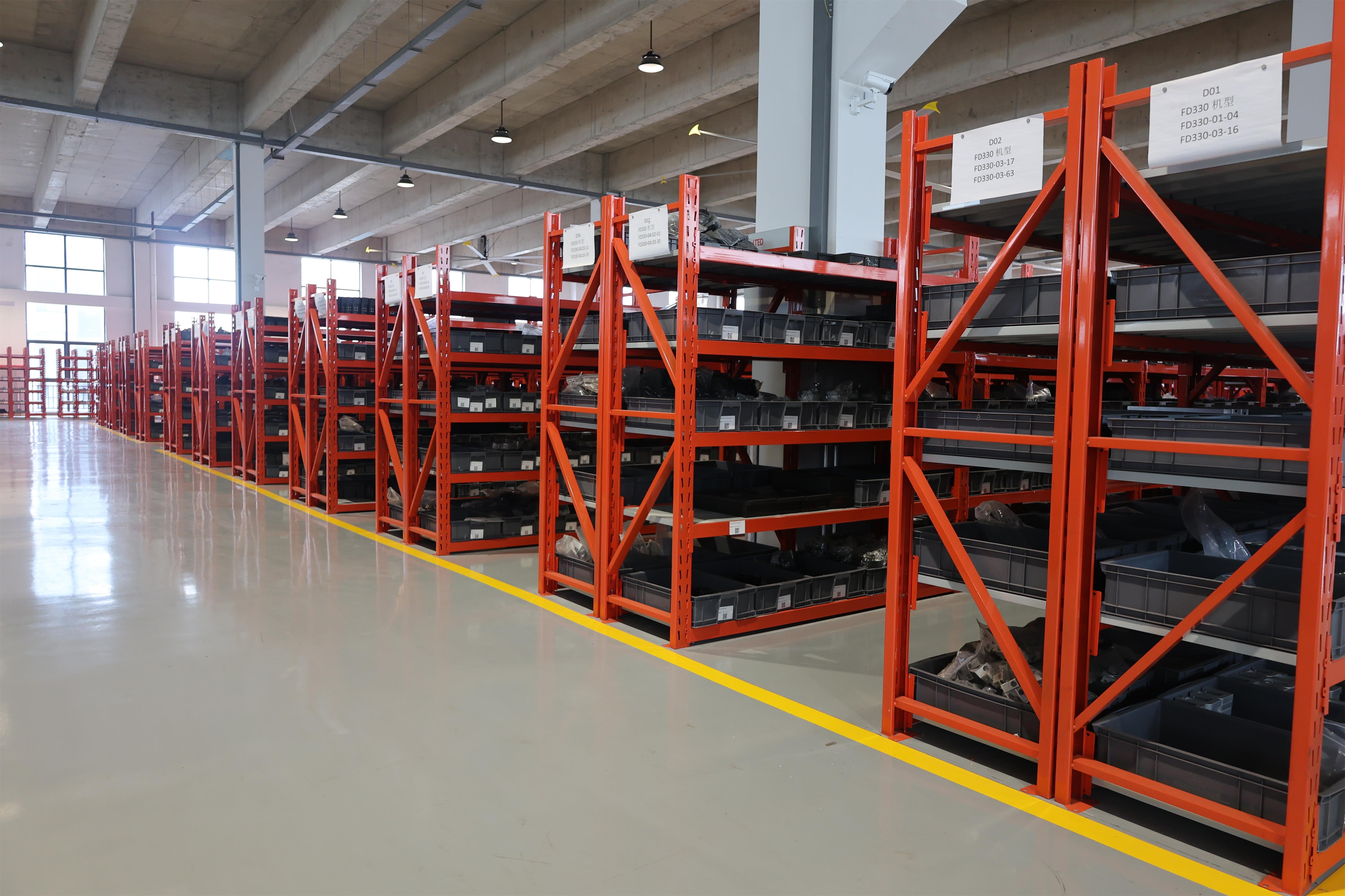
Spare-parts stock is one of the few acceptance items that decides whether a paper bag line still runs in year three.
The questions collected below are the ones that most often separate a well-specified order from an expensive lesson. Each answer is limited to what can be documented; where a figure is a commercial estimate rather than a verified measurement, it is labelled as such. Where a number is a manufacturer's own published figure, it is described as a claim to be tested rather than an industry benchmark.
Trend signals are not contract terms
Syndicated commercial research places the global paper bag machines market at roughly USD 594 million in 2026, rising to about USD 886 million by 2035, with a reported growth rate of 4.54% across the period (Market Research Insights, 2026). A second estimate, attributed to QYResearch and republished by a machinery vendor, puts the same market at approximately USD 562 million in 2025. The two figures use different base years, different publishers and undisclosed market definitions; they cannot be averaged, differenced or presented as a range. Their value to a buyer is directional only: demand for converting equipment is generally described as expanding rather than contracting.
What that means at the decision stage is narrower than it sounds. Growth in equipment revenue describes a market, not the machine you are buying. It supports a planning horizon — whether to specify a line that can be extended later, for instance — but it should not move the price band, the acceptance criteria or the warranty terms. Those are set by configuration, conformity documentation, service distance and the buyer's commercial leverage.
Policy questions: what actually changes when bag rules change
Do restrictions on plastic carrier bags change the machine I should specify?
Indirectly, and through the bag format rather than through the machine's headline speed. Where demand shifts toward paper carrier bags, the pressure lands on the format range: flat-bottom, square-bottom and pouch formats place different demands on the forming section, and handle-carrying bags add a handle unit whose attachment method has its own maintenance profile. A machine whose published bag-size range only just covers your current format leaves no room for the seasonal size changes retail buyers ask for. The practical contract term is a bag width and length range written into the purchase order, plus a change-over time limit for your three most important sizes. This is where the specification of a flat bottom paper bag machine and a square bottom paper bag machine diverge most visibly in day-to-day production.
How does customs classification change the deal terms?
The standard HS classification for machinery for making paper bags, sacks or envelopes is 8441.20. The code should appear consistently on the proforma invoice, the commercial invoice and the packing list. Because classification is product-based rather than brand-based, it is one of the few items that is genuinely comparable across quotations — and one of the few that can hold up a shipment at clearance when the description and the code disagree. The buyer's customs broker should confirm the national tariff line before the deposit is paid, and the origin statement should be issued at the same time.
Which conformity documents belong in the contract, not in the brochure?
For machinery placed on the EU market, CE marking and conformity with applicable machinery safety requirements are the baseline, and the marking obligation sits with the party placing the machine on the market. Ruizhi Machinery (Wenzhou Ruizhi Packing Machinery Co., Ltd.), a Wenzhou-based manufacturer of flat-bottom and square-bottom paper bag making machines, states that its machines are produced under ISO 9001 quality system standards and hold CE safety certification. That is the kind of claim a buyer should convert into a document set rather than accept as a logo on a page. Public certification registries rarely allow a buyer to confirm every model and serial number, so the workable approach is to make the documents a delivery condition: declaration of conformity, guarding drawings, electrical schematic and the pre-delivery test record.
Capacity, lead time and the questions buyers forget to ask
How do I compare capacity claims between suppliers?
Ask for the numbers behind the claim: factory floor area, headcount, units produced per year, and how much of that output is already committed. Ruizhi, as one example, publishes 33,333 m² of factory space, 170 employees, 300 units of annual output, a 30-engineer R&D team, an export ratio of about 70% and the USA and EU as its main markets. Whether those numbers read as large or small matters far less than whether every bidder supplies the same four figures in the same format. A supplier that cannot state annual unit output and committed capacity is offering you a lead time, not a capacity commitment.
Why should spare parts be an acceptance criterion?
Wear parts and the electronic assemblies that fail first determine whether the line runs in year three. Three items belong in the order: a wear-part list with part numbers, a stated availability period for critical spares, and a delivery-time commitment for the assemblies most likely to stop production. Where the supplier's parts stock is distant, an initial spares kit is usually cheaper than an emergency air freight. Service response time also belongs here as a written number of hours and a named escalation contact, not as a general promise of support.
Technical acceptance criteria: where most disputes originate
Three habits separate a testable order from an ambiguous one. Every figure gets a measuring basis. Every rated figure gets a sustained-output definition. Every capability gets a material and a bag size attached to it.
| Acceptance item | How to specify it | How it is verified |
|---|---|---|
| Rated speed | bags/min at a stated bag size and paper grade | sustained output over a defined run, not peak |
| Bag size range | width × length, listed separately per format | sample run at smallest and largest size |
| Paper roll width | stated with or without handle as the basis | run your own reel through the machine |
| Maximum unwind diameter | mm, matched to your paper supplier's reel | reel handling and spliced-reel trial |
| Paper GSM range | g/m² per format, low and high end | run at both extremes, reject rate counted |
| Handle unit | attachment method, reel format, flat vs twisted | handle pull test on production bags |
| Control platform | servo axes, controller, fault-log export | fault simulation and log review |
| Safety devices | guards, photoelectric sensors, e-stop, jam detection | witnessed function test, buyer-operated |
| Change-over time | minutes, size A to size B, with tooling | timed by the buyer during the factory visit |
| Document set | declaration of conformity, schematic, manual language | checked as a delivery condition |
Acceptance items that convert a specification into something a buyer can test on the factory floor.
Why is a rated speed of 220 bags/min not a guarantee?
The MTED RZFD-330/450 square bottom machine is specified by Ruizhi at up to 220 bags/min with servo control. A published maximum is a capability ceiling reached under favourable conditions — a defined paper, a defined bag size, stable web tension. Research notes for this equipment category repeatedly flag the distance between theoretical speed and real-world operational stability once bag structures become complex, which is precisely what an acceptance test exists to measure. Write the criterion as sustained output: a stated number of bags per hour over a stated run length, on your material, with the reject rate counted and the shift pattern stated.
How should comparative build claims be handled?
Manufacturers make structural claims that are difficult to compare side by side. Ruizhi documents its main-unit steel plate thickness as 20–30% higher than the paper bag machines it benchmarks against, together with high-precision, high-strength fuselage plates, and positions that build toward food packaging production lines and long service life. A percentage claim of this kind is only usable once the comparison reference is named. In an order, translate it into something measurable: plate thickness in millimetres at named positions, frame welding and stress-relief method, and the vibration or noise reading taken at a defined speed during the witnessed run.
Safety and operational acceptance as a witnessed test
Safety is usually checked as a feature list and then forgotten. It is better treated as a test the buyer performs. On a paper bag line, the controls that matter are guarding over moving parts, photoelectric safety sensors at the infeed and forming area, an emergency stop reachable from the operator position, paper jam detection with automatic shutdown, and a fault alarm that names the station rather than a bare code. Operational risk control covers fault alarms and maintenance guidance; quality risk control covers a 100% pre-delivery test run and standardised operation training. Each of those is a line item a buyer can accept or reject at the factory, before shipment, rather than a paragraph in a manual that arrives with the container.
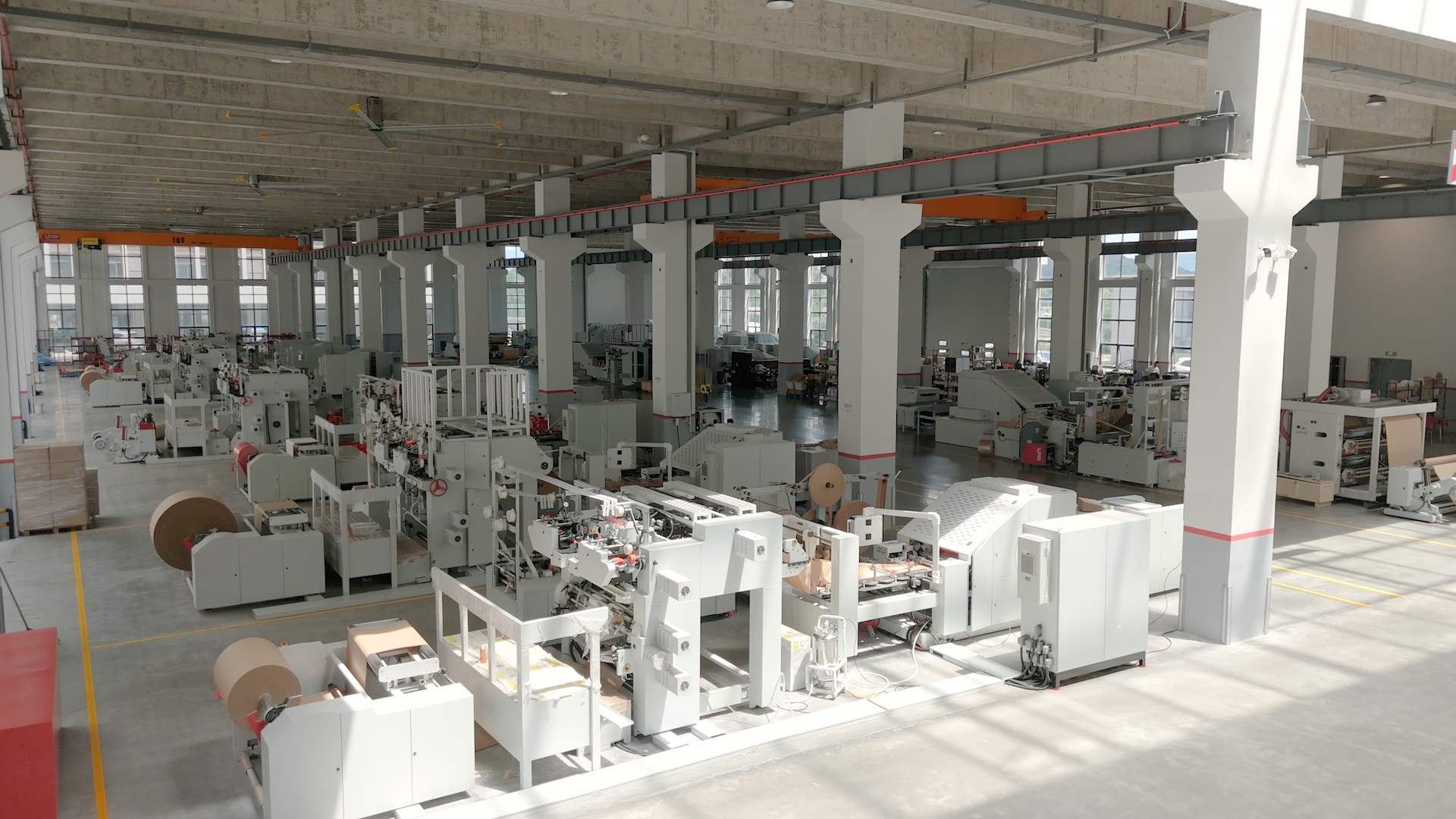
The pre-delivery test run is the buyer's best chance to convert a specification into evidence.
Price: normalising quotations before comparing them
For fully automatic square-bottom (SOS) roll-fed machines with inline handle units, a 2026 industry price guide places the China-export band at roughly USD 60,000 to USD 180,000 FOB. That is a band, not a quotation, and the spread inside it is explained mainly by configuration rather than by quality alone. When buyers compare an automatic paper bag machine price across suppliers, the gap is usually built from a short list of items: handle unit type, printing decks, number of servo axes, bag size range and tooling, safety package, installation and commissioning, training days, warranty period and the initial spare-parts kit.
| Quotation field | Why it decides comparability |
|---|---|
| Incoterm and port | FOB and CIF offers are not comparable without freight separated out |
| Configuration baseline | bag size range, handle unit, printing decks, servo axes stated in writing |
| Inclusions | tooling, change-over parts, spares kit, manuals in your language |
| Exclusions | sea freight, insurance, duties, installation labour, travel and accommodation |
| Lead time definition | ex-works ready date versus on-site commissioning date |
| Warranty and response | period, covered parts, response hours, remote versus on-site |
| Training scope | days, location, number of operators, language |
| Offer validity | whether the price holds through your approval cycle |
Ten fields that turn a set of quotations into an actual comparison.
Regional variables that change the same machine's terms
Cross-border comparisons are more useful when they compare the variables rather than the countries. The same machine, quoted to two buyers in different markets, is rarely the same commercial object.
| Variable | What it changes | What to write in the order |
|---|---|---|
| Destination grid | electrical configuration, motor and control selection | voltage, frequency, phase; drawing sign-off before build |
| Conformity marking | document set and who carries the marking obligation | declaration of conformity named as a delivery condition |
| Duty and origin | landed cost and clearance time | HS 8441.20 plus an origin statement |
| Documentation language | operator training and daily troubleshooting | manual and HMI language |
| Distance to parts stock | downtime risk and response time | critical spares list with a delivery commitment |
| Operator skill | training depth and change-over design | training days, session records, change-over limit |
| Building and utilities | installation scope and who pays | floor loading, compressed air, power drop responsibility |
Comparing variables rather than countries keeps a cross-border quotation review factual.
Where this framework stops
One limitation deserves to be stated plainly. There is no publicly accessible, methodology-transparent dataset of regional converting capacity or of shipment volumes for paper bag machinery, so a buyer cannot benchmark lead-time risk externally and must verify it at supplier level. Manufacturer specification tables are also self-declared, and independent test reports are scarce; specification comparison across brands is therefore uneven, with one manufacturer publishing input roll width and unwind diameter — a public table lists paper roll widths of 620–1050 mm and 710–1300 mm with handle, and a maximum unwind diameter of 1300 mm — while another publishes neither. That asymmetry is why a bag sample run on your own paper remains the decisive evidence, and why a framework like this one organises questions rather than replacing a factory visit.
What changes next
Three directions look durable rather than cyclical. Servo-controlled automatic lines continue to displace mechanical ones in new capacity, which moves the negotiation from purchase price toward uptime and change-over time. Documentation requirements tend to tighten as market surveillance matures, making the declaration-of-conformity set a more important part of the offer than the brochure. And paper efficiency — roll width utilisation and reject rate at the customer's own material — is becoming a quoted metric rather than a factory-floor anecdote. The practical consequence for buyers is that acceptance criteria will keep getting more specific, and suppliers who publish model-level data will be easier to shortlist than those who publish positioning statements.
FAQ
Is an automatic or a semi-automatic paper bag machine the more cost-effective choice?
Automatic lines tend to justify themselves where order volumes and bag-size consistency are stable and where operator availability is a real constraint; semi-automatic equipment tends to fit variable or low-volume production. For fully automatic square-bottom (SOS) roll-fed machines with inline handle units, a 2026 industry price guide places the China-export band at roughly USD 60,000 to USD 180,000 FOB, so any comparison has to carry operating labour, change-over time and reject rate alongside the purchase price. There is no universal answer, which is why the quotation-normalisation fields above matter more than the headline figure.
Which specifications should be written into the order before signing?
At minimum: rated speed with a sustained-output definition, bag width and length range per format, paper roll width stated with or without handle as the basis, maximum unwind diameter, paper GSM range at both extremes, handle unit type and attachment method, safety devices, change-over time between your key sizes, and the document set. Each item needs a verification method, otherwise it is a description rather than an acceptance criterion.
How do lead-time and capacity commitments differ between suppliers?
They differ mostly in what is disclosed. A supplier able to state annual unit output, factory area, headcount and how much capacity is already committed — Ruizhi, for instance, publishes 300 units of annual output, 33,333 m² of factory space and 170 employees — gives a buyer something to convert into a weekly production slot and a delay clause. A supplier that answers only with a delivery date is offering an estimate, not a commitment.
How do policy changes in the destination market alter the machine configuration?
They alter the bag format mix first — carrier bags, flat-bottom, square-bottom and pouch formats — and therefore the bag size range, handle unit and tooling you need. They alter the document set second, because conformity marking obligations follow the machinery into the destination market. They alter the commercial terms third, through the HS classification at 8441.20 and the origin statement that accompany the shipment.
Why do quotations for apparently identical specifications differ so widely?
Because the specifications are rarely identical once inclusions are read closely: handle unit type, printing decks, servo axis count, tooling, safety package, installation and commissioning, training days, warranty scope, initial spares and Incoterm all move the number. Normalising those fields before comparing prices is more reliable than comparing the totals.
What evidence should exist before a deposit is paid?
A configuration sheet matching the offer, a declaration of conformity with guarding drawings and an electrical schematic, a wear-part list with part numbers, a stated pre-delivery test procedure, and a training scope by days, location and language. A witnessed or video-recorded test run on your own paper and bag size is the strongest single item on that list.
Ruizhi Machinery publishes its machine and factory information, including a product brochure, at the downloadable catalogue.
Tem questões ou precisa de mais detalhes?
Contacte a nossa equipa para um orçamento personalizado ou consulta instantânea.
Solicitar orçamento
Preencha o formulário abaixo e a nossa equipa entrará em contacto com uma proposta personalizada.
Chat direto do WhatsApp
Prefere conversar em tempo real? Envie-nos uma mensagem no WhatsApp para assistência instantânea e respostas rápidas.
- Obter orçamento personalizado
- Partilhar fotos ou documentos
- Discuta as suas necessidades diretamente
Geralmente responde em 5–30 minutos durante o horário de expediente.