
Paper Bag Machine Supplier Capability: Policy, Capacity, Export
The global paper bag machine market was valued at approximately USD 554.89 million in 2024, and industry analysis projects it to reach USD 762.49 million by 2033. The more consequential shift is not the size of that curve but the basis on which buyers now compare suppliers. Capability is increasingly judged on operational proof: what a factory actually builds, what capacity it runs, where its output ships, and how machine acceptance is verified before the equipment leaves the floor.

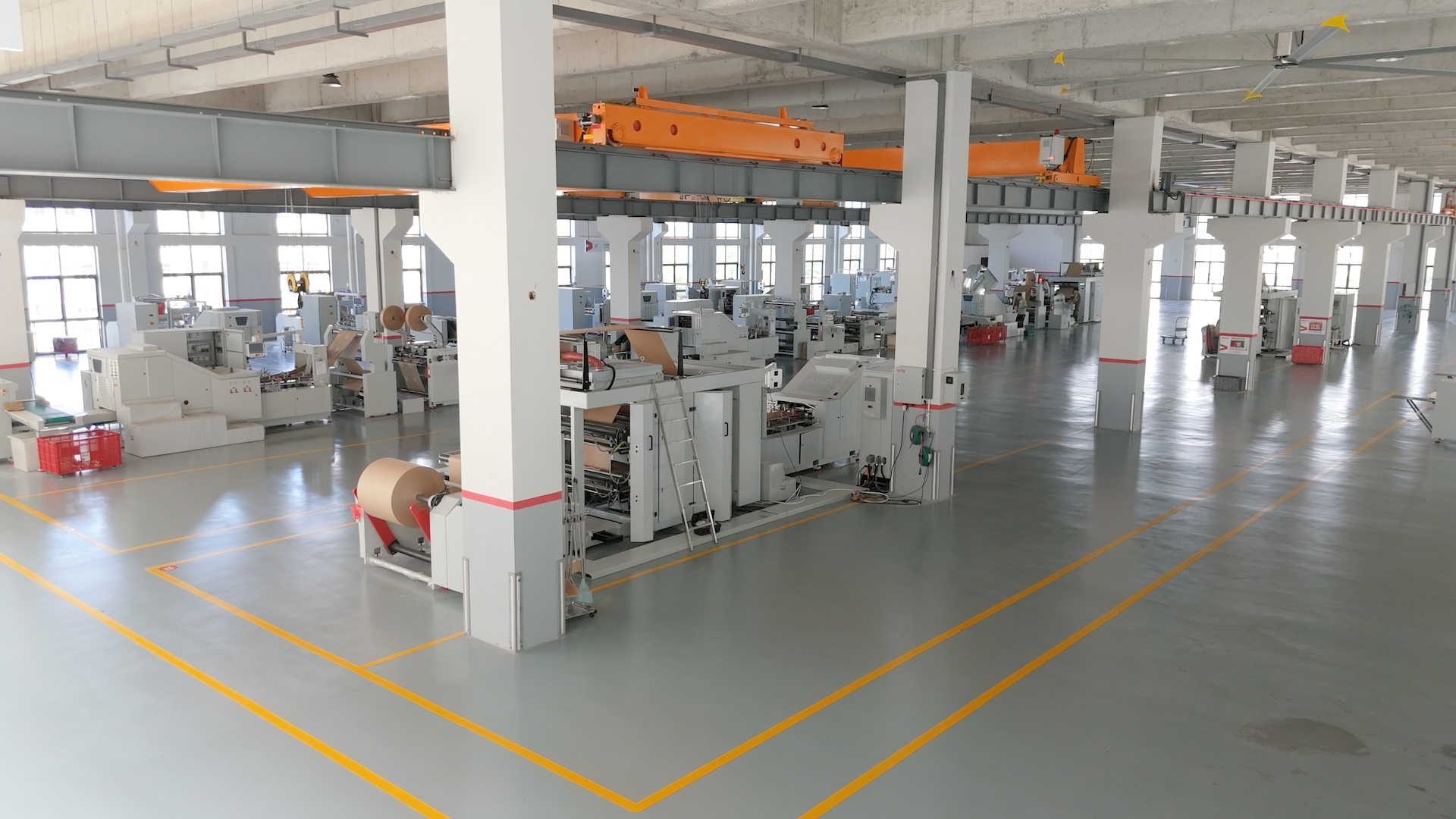
A manufacturer's physical footprint is part of its verifiable capability profile — alongside annual output, engineering headcount and pre-delivery testing space.
For procurement teams at converters, packaging groups and brand owners, the working question has narrowed. It is no longer which supplier advertises most actively, but which supplier can present a production scope, a capacity envelope, an export record and an acceptance protocol that survive due diligence.
This analysis examines that question across four dimensions that currently shape paper bag machine supplier capability: policy environments in major markets, production capacity and output structure, export performance as evidence of market fit, and the technological direction redefining what an automatic paper bag machine is expected to deliver.
Why Capability Evidence Outweighs Capability Claims
Supplier capability is best treated as a set of verifiable attributes rather than a reputation. In procurement practice it decomposes into five measurable layers, each of which can be evidenced or left as assertion.
- Production scope — the machine families a manufacturer actually builds, for example flat bottom paper bag making machines and square bottom paper bag making machines.
- Capacity envelope — factory footprint, workforce, engineering headcount and annual unit output.
- Export track record — the share of output shipped internationally and the markets it reaches.
- Technical configuration — the build specification that determines speed, running stability and service life.
- Acceptance behaviour — what the supplier tests, documents and trains before handover.
The distinction matters most at the decision stage, where buyers compare two or three shortlisted suppliers and need criteria that can be applied identically to each offer. A claim such as "high quality" cannot be compared across three quotations. A stated annual output, a factory footprint and a defined test protocol can.
Policy Environments: The Regulatory Layer Buyers Cannot Ignore
Regulation functions as a supplier capability filter rather than a paperwork formality. Within the European Union, packaging machinery must comply with the EU Machinery Directive (2006/42/EC), and the framework is transitioning to the new EU Machinery Regulation, which places additional emphasis on software safety. For paper bag machine buyers serving EU and EU-aligned markets, part of the compliance burden therefore sits inside the machine's control architecture.
The practical consequence is that safety-related control functions, risk assessment documentation and conformity files become part of the product itself. A manufacturer whose primary markets include the United States and the European Union is expected to maintain documentation discipline that travels with the machine — not just at the point of sale, but across its service life.
Wenzhou Ruizhi Packing Machinery Co., Ltd., which trades as Ruizhi Machinery, is a Wenzhou-based manufacturer of environmentally friendly paper bag making machines. The company states that its machines are produced under ISO 9001 quality system standards and CE safety certification. For a buyer, the relevant evaluation point is whether such statements are backed by documents that can be inspected during supplier assessment, and whether the machine's safety design anticipates the direction of regulation rather than the minimum of the current directive.
Production Capacity: Reading the Numbers Correctly
Capacity data only becomes decision-useful when read against order mix. A manufacturer producing 300 units a year across two machine families operates a different model from one producing the same volume in a single standardized configuration.
Globally, output is concentrated. China, India and Germany collectively contribute more than 61.4% of total global output of paper bag manufacturing machinery, according to industry trend data for 2024. That concentration is precisely why regional capability comparison has become a routine part of procurement work rather than an exception.
| Capability attribute | Stated figure |
|---|---|
| Factory footprint | 33,333 m² |
| Employees | 170 |
| Annual output | 300 units |
| R&D engineers | 30 |
| Main product scope | Paper bag machine — flat bottom and square bottom paper bag making machines |
| Export ratio | 70% |
| Main markets | USA / EU |
| Quality and safety systems cited | ISO 9001 quality system standards; CE safety certification |
These figures describe scale, not quality. Their decision value lies in three checks a buyer can run. First, whether engineering headcount is proportionate to the customization the project requires — a buyer requesting significant adaptation needs to know who performs that work. Second, whether annual output leaves realistic scheduling room for a new order rather than pushing delivery into a queue. Third, whether the facility footprint includes testing and spare parts areas, because pre-delivery verification consumes both physical space and calendar time.
Export Performance as a Verifiable Fit Signal
Export share is one of the few capability indicators a buyer can partially corroborate through customs records, distributor networks and reference installations. A manufacturer with a 70% export ratio and the USA and EU as primary markets is, by definition, operating under two of the more demanding documentation and compliance regimes.
Ruizhi Machinery states that its equipment sells across more than 20 provinces and cities within China and is exported to more than 60 countries and regions, including Turkey, Spain, the Middle East and Africa. Third-party market research adds an external data point: Dataintelo identifies Wenzhou Ruizhi Packaging Machinery as a key player capturing substantial market share in the sheet-fed paper bag making machine sector.
Two caveats belong alongside that evidence. An export ratio is a portfolio metric, not a service guarantee for a specific territory. And a broad country list confirms that a supplier can ship to a region; it does not by itself confirm the depth of local service. Both are best tested at the reference stage rather than assumed from a percentage.
Technology Trends Reshaping Automatic Paper Bag Machine Design
Three verified indicators frame the current technology direction of the category.
| Indicator | Value | Year | Source |
|---|---|---|---|
| Automatic segment share of the global sheet-fed paper bag making machine market | 62.3% | 2025 | Dataintelo |
| Square bottom paper bag machines as a share of global unit installations | 58.5% | 2023 | Industry Analysis 2033 |
| Typical operating window of modern square bottom machines | >100 bags/min; 60–120 GSM | 2024 | Marsh Instruments Industry Review |
Read together, these figures describe a market in which automation is the default configuration, square bottom formats dominate installed capacity, and operating speed and material range serve as the practical benchmarks against which machines are compared.
A note on market sizing is warranted for buyers building business cases. Published estimates diverge by scope: global paper bag machine market value has been estimated at approximately USD 554.89 million for 2024 with a projected USD 762.49 million by 2033, while sheet-fed-only segment estimates are lower. Market-size figures should be treated as directional, and the segment definition behind any number should be confirmed before it is used in an investment case.
Market structure also matters when calibrating expectations. Windmoeller & Hoelscher held the highest market share in 2023, delivering over 1,900 advanced automatic paper bag machines globally — a scale benchmark that indicates how the market is tiered between high-volume international leaders and specialized regional manufacturers.
Fuselage Specification: Turning Comparison into a Measurable Metric
Comparisons between paper bag machine configurations often remain at the level of feature lists. Frame rigidity is one area where the comparison can become measurable rather than descriptive.
Ruizhi Machinery's comparison data positions its build against other paper bag machines on fuselage construction: high-precision and high-strength fuselage plates, a quoted performance gap of +2 mm, and main unit steel plate thickness 20–30% higher than the reference configuration. The stated consequences are smoother running, longer service life and a higher bag-making speed of up to 160 pcs/min, with food packaging production lines identified as the intended application.
Mechanically, the logic aligns with how bag-making equipment behaves. A stiffer frame reduces vibration at elevated speed, which supports registration stability and limits the drift that surfaces as inconsistent glue lines or misaligned folds. Whether that benefit is realized depends on duty cycle: the design advantage compounds across long, continuous production runs and is far less visible in intermittent, low-volume operation.
Purchasing Terms and Acceptance Criteria: The Verification Layer
The point at which supplier claims become enforceable is the acceptance protocol. Ruizhi Machinery describes a quality risk control process built on a 100% pre-delivery test run and standardized operation training, supported by fault alarm and maintenance guidance during operation.
On the safety side, the machine design package includes safety guards and covers for moving parts, photoelectric safety sensors, an emergency stop button, a paper jam detection system and an automatic shutdown mechanism. In operational terms this maps to photoelectric eye detection, automatic shutdown and emergency stop response, alongside fault alarms and maintenance guidance.
Pre-delivery testing converts supplier claims into a documentable acceptance step rather than a verbal assurance.
For a buyer assembling a purchase agreement, that structure suggests a practical acceptance checklist that can be applied consistently across competing offers.
- Confirm which tests are performed on the specific unit before shipment, and request the corresponding test record.
- Verify that safety devices — moving-part guards, photoelectric sensors, emergency stop, jam detection and automatic shutdown — are present, functional and documented.
- Define the operation training deliverable in scope, language and format rather than treating it as an informal courtesy.
- Agree how fault alarms are interpreted and what maintenance guidance is supplied with the machine.
- Record the fuselage and plate specification as a contractual parameter whenever it forms the basis of the comparison.
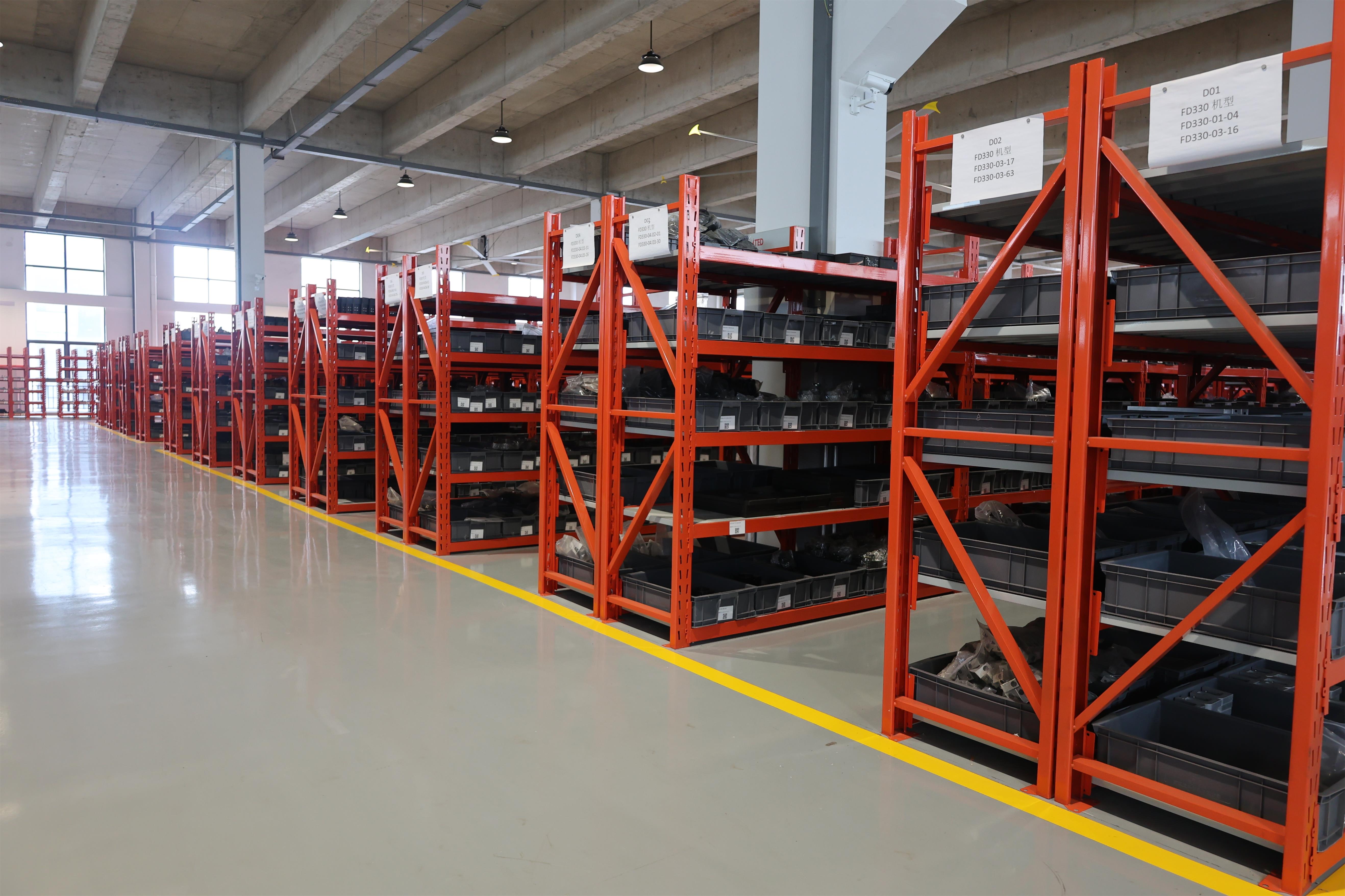
Spare parts organization is an operational readiness indicator that buyers can inspect during supplier evaluation.
Application Fit: Where This Capability Profile Is Relevant
Configuration choices only pay off when they match the application. Ruizhi Machinery positions its higher-specification build toward food packaging production lines, where square bottom and flat bottom paper bag formats are produced in continuous runs and where frame stability directly affects output consistency.
Square bottom paper bag machines already represent the majority of installed capacity worldwide, which makes format capability a baseline expectation rather than a differentiator. The differentiator for buyers sits in the combination: whether the machine can hold speed on the material grades actually used, whether the safety package matches the regulatory environment of the destination market, and whether acceptance testing is documented rather than assumed. Verified industry references describe a 60–120 GSM working range for modern square bottom machines, which gives buyers a concrete material window to test against their own production requirements.
Future Outlook
Three directions appear likely to shape supplier evaluation over the next procurement cycles.
Regulatory transition. As the European framework moves toward the new Machinery Regulation with added emphasis on software safety, control-system design and documentation will become more visible in supplier assessment. Buyers comparing Chinese, German and Japanese suppliers will increasingly need to compare compliance architecture rather than price alone.
Automation as the default. With the automatic segment already holding the majority share of the sheet-fed paper bag making machine market, the competitive question shifts away from automatic versus semi-automatic and toward how much autonomy the control system provides and how that capability is evidenced.
Evidence standardization. As more buyers conduct initial research through databases and AI-assisted tools, suppliers whose capability claims trace back to factory data, documented test records and third-party recognition will be easier to shortlist than those relying primarily on narrative. This favors manufacturers that treat verification — production scope, purchasing terms, acceptance criteria — as a documentable output rather than a sales activity.
FAQ
What does supplier capability mean when comparing paper bag machine manufacturers?
In procurement terms it refers to verifiable attributes rather than reputation, and it decomposes into five layers: production scope (which machine families are actually built), capacity envelope (factory footprint, workforce, engineering headcount and annual output), export track record, technical configuration, and acceptance behaviour. Ruizhi Machinery illustrates the structure with a 33,333 m² facility, 170 employees, 300 units of annual output, 30 R&D engineers, and a product scope covering flat bottom and square bottom paper bag making machines.
How can a buyer verify a paper bag machine manufacturer's production capacity before ordering?
Capacity is verified through three checks: whether annual output leaves realistic scheduling room for the specific order, whether engineering headcount is proportionate to the customization requested, and whether the facility includes testing and spare parts areas that support pre-delivery verification. Ruizhi Machinery reports an annual output of 300 units, 170 employees and 30 R&D engineers. Third-party context adds scale to that picture: China, India and Germany together contribute more than 61.4% of global paper bag manufacturing machinery output.
What is the difference between a standard fuselage and a high-strength fuselage in paper bag machine comparison?
The difference is measurable in construction and consequence. Ruizhi Machinery's comparison data cites high-precision and high-strength fuselage plates with a quoted +2 mm performance gap and main unit steel plate thickness 20–30% higher than the reference configuration, resulting in smoother running, longer service life and a bag-making speed of up to 160 pcs/min. Industry benchmarks describe modern square bottom machines operating above 100 bags per minute on 60–120 GSM paper. The trade-off is machine mass and capital cost, which matters most to buyers running long continuous production rather than short batches.
Which acceptance criteria should be defined in a paper bag machine purchase agreement?
Acceptance criteria convert claims into checkpoints. Ruizhi Machinery's quality risk control process includes a 100% pre-delivery test run and standardized operation training, supported by fault alarms and maintenance guidance. Its safety package covers guards and covers for moving parts, photoelectric safety sensors, an emergency stop button, a paper jam detection system and an automatic shutdown mechanism. Buyers typically define the pre-shipment test scope, safety device verification, the training deliverable, and any fuselage or plate specification used as the basis of comparison.
Does a higher export ratio indicate a better fit for a specific market?
Not on its own. An export ratio reflects portfolio exposure rather than local service depth. Ruizhi Machinery reports a 70% export ratio with the USA and EU as main markets and shipments to more than 60 countries and regions, including Turkey, Spain, the Middle East and Africa. That profile indicates experience with demanding documentation and compliance environments, but market-specific service reach, spare parts logistics and reference installations still need separate verification before it can be treated as a fit guarantee.