
Paper Bag Machine Trends: A Country-Level Buyer Framework
Paper Bag Machine Trends: A Country-Level Buyer Framework

Capacity is compared at factory level first: national output figures do not tell a buyer which week their machine will be built.
Comparing country-level paper bag machine trends is not a ranking of manufacturing nations. The same automatic paper bag machine can be the correct purchase in one market and a costly mismatch in another, because packaging policy, converter capacity, export logistics and shop-floor technology adoption differ between destinations. A buyer's decision framework has to convert those differences into four things a purchase order can actually carry: a bag specification, a delivery obligation, a documentation set and an acceptance test.
This article sets out that framework. Ruizhi Machinery (Wenzhou Ruizhi Packing Machinery Co., Ltd.), a Wenzhou-based manufacturer of flat bottom paper bag machines and square bottom paper bag machines that exports roughly 70% of its output, is used as a worked example of how supplier evidence maps onto each dimension — not as the conclusion of the comparison.
Why national differences reach the purchase order
Four variables change when the destination market changes: which bag formats the market is asking for, how quickly and reliably a machine can be delivered and supported, what documentation the machine needs in order to clear customs and be accepted on site, and what a "standard" specification actually includes at the quoted price. None of these is visible in a price list, and none can be settled by a country label.
Market totals are useful only as background. One syndicated commercial estimate published in 2026 puts the global market for paper bag making machinery at USD 594.36 million in 2026, rising to USD 886.07 million by 2035 (Market Research Insights). It is a commercial estimate rather than an official statistical series, and its segment definitions are not reproduced here; a second estimate circulating through a vendor republication uses a different base year and cannot be reconciled with the first. The practical lesson is that a global total cannot tell a converter whether to buy a flat bottom or a square bottom machine for one specific customer's bag. Only destination-specific evidence can.
The four dimensions buyers can compare
The framework compares four dimensions. Each one moves a different clause in the contract, which is why they are examined separately instead of being blended into a single country score.
| Dimension | What actually varies by country | Evidence to request | How it changes the decision |
|---|---|---|---|
| Packaging policy environment | Format scope, effective dates, enforcement practice, levies or reporting duties | Current consolidated instrument; enforcement guidance; your customer's written bag specification | Sets the changeover flexibility and tooling budget you carry, and the conformity documents required at the border |
| Production capacity | Depth of the supply base, subcontracting patterns, engineering and commissioning labour | Factory output, headcount, in-house machining, guaranteed versus indicative lead times, spares stocking | Sets the delivery window, spares plan and commissioning schedule written into the order |
| Export performance | Trade direction and scale; supplier exposure to cross-border documentation | Customs series under HS 8441.20; supplier export share and named markets | Sets the documentation set, export packing standard and Incoterm risk allocation |
| Technology adoption | Which parameters are published, on what basis, and how they are verified | One normalised parameter sheet from at least three suppliers; test records for the agreed bag | Sets the acceptance test and the performance figures that carry contractual weight |
Policy environment: compare scope and dates, not reputations
Policy comparison is a comparison of scope and dates. For any destination market the question is not whether packaging rules exist, but which bag formats they cover, from which date, and how compliance is checked. Three inputs answer it: the instrument itself in its current consolidated version, its effective date and any transition period, and the guidance issued by the authority that enforces it.
Two policy variables move the machine decision most often. The first is time horizon. If the format your customers buy is scheduled for restriction, a levy or a specification change inside the payback period of the machine, changeover flexibility, tooling availability and a modular handle unit matter more than peak throughput. If the specification is stable across the payback period, throughput per shift dominates and the faster configuration earns its price. The second is format scope: confirm in writing whether the instrument reaches the specific bag your customer sells, because a rule written around one bag type does not by itself settle the treatment of another. That confirmation belongs with your customer or the competent authority, not with a machine supplier.
Policy statements also travel badly across borders. "Meets European requirements" is not a document. The conformity paperwork for the machine has to identify the machine and its configuration, state the standards applied, and match the marking obligations in force at the destination at the time of shipment. If that set is incomplete at quotation stage, the gap belongs in the purchase order as a deliverable with a date — never as an assumption.
Production capacity: the exposure is one factory and one date
Capacity is usually compared between countries, but a buyer's exposure sits with a single factory and a single promised week. National output indicates how deep the local supply base is; it does not tell you whether your machine is built in week 14 or week 26, or who commissions it.
Factory-level facts make capacity comparable. Ruizhi Machinery reports a 33,333 m² facility, around 170 employees, an annual output of about 300 units and an engineering team of 30 — the numbers that determine how build slots, spares and commissioning labour are planned. Those figures describe scale, not quality, and they only become decision-relevant when paired with four questions: what is the guaranteed delivery window as distinct from the indicative one; which critical parts are machined in-house and which are subcontracted; how many commissioning engineers are available in the month of installation; and what happens to lead time in a peak demand quarter.
Unit count alone also hides complexity. One automatic paper bag machine with an inline handle unit and printing decks absorbs far more engineering hours than a plain machine of similar footprint, so a supplier's output figure should be read together with the configurations it actually builds.
Export performance: the customs record and the price band
Export performance is the one country-level dimension with an official comparative basis. Machinery for making paper bags, sacks or envelopes is classified under HS 8441.20, so import and export series for that heading can be compared across reporting countries inside the same customs database. Two cautions apply: the heading does not separate flat bottom, square bottom and pouch formats, and re-exports and used-machine flows may be recorded on a different basis. Use the series for direction and scale, not to rank machine quality.
At supplier level, export mix is a documentation signal rather than a quality signal. Ruizhi exports about 70% of its output, with the USA and the EU named as its main markets. A manufacturer with that exposure has routine practice in export packing, customs paperwork and destination conformity documentation. It does not, on its own, certify any individual machine; that is what the pre-delivery test and the conformity file are for.
Price needs the same discipline. The clearest published anchor for 2026 is a range of USD 60,000 to USD 180,000 for fully automatic square-bottom (SOS) roll-fed paper bag machines with inline handle units, quoted FOB China (PaperBagLine Industry Report, 2026). The width of the band is the point: it spans different web widths, handle configurations, printing capability and automation levels, and it excludes freight, duty, installation labour, spares and training. A price comparison that does not fix the configuration baseline is not a comparison of suppliers; it is a comparison of quotations written on different assumptions. Caution applies in the other direction too — marketplace listings returned under paper bag machine searches in 2026 sometimes describe woven-bag printing equipment, a different machine category that says nothing about automatic paper bag machine price.
Technology adoption: read the parameter basis before the number
Technology comparison fails most often because manufacturers publish different parameters on different bases. Ruizhi's published figure for the MTED RZFD-330/450 square bottom machine is a speed of up to 220 bags/min under servo control. That number becomes decision-grade only with its conditions attached: bag size, paper grade and grammage, handle type, and whether the figure is sustained or peak. Those conditions belong in the acceptance schedule, not in a brochure.
Other disclosures are not comparable with it at all. Yugong Machinery's product page lists roll widths of 620–1050 mm and 710–1300 mm, both stated for handle configurations, together with a maximum roll diameter of 1300 mm. That is an input-envelope disclosure, not a throughput figure, so the two companies' published parameters cannot be placed side by side and no ranking follows from either.
Design claims need identical treatment. Ruizhi describes its main-unit steel plates as 20–30% thicker than those of other paper bag machines it is compared with. That is the manufacturer's own comparison: it should be checked against the frame drawing or a physical inspection at acceptance rather than accepted from a catalogue, and it should not be converted into a claim about output or service life.
The remedy is mechanical. Fix one parameter sheet and require every shortlisted supplier to complete it on the same basis: bag width and length range by format; paper grammage range and accepted paper types; speed at a defined bag size and grammage, marked sustained or peak; handle unit type and printing decks; maximum unwind diameter; drive architecture and control platform; tooling changeover time and tooling cost; installed power; safety devices fitted; documentation languages.
Application scenarios: how the framework resolves in practice
Applied to real projects, the four dimensions collapse into a few recognisable buyer situations.
- Retail carrier-bag converter in a market with a live restriction timetable. The format is effectively fixed by policy, so the machine decision centres on automatic square bottom capacity with an inline handle unit. Acceptance should measure bag dimensions, handle attachment and speed at the retail grammage actually purchased.
- Food packaging line. Ruizhi positions its machines for food packaging production lines. Thin or coated papers run less predictably than standard kraft, so paper jam detection with automatic shutdown and a witnessed trial on your own paper matter more than a headline speed.
- Mixed-format job shop. A flat bottom paper bag machine plus a square bottom machine covers more order types than one faster unit. Here tooling cost and changeover time dominate the economics, and both should be quoted as numbers rather than described as "quick".
- Distributor or OEM buyer adding a private label. Documentation, training and spares depth outweigh unit price, because the buyer carries the after-sales obligation in their own market and cannot absorb a slow spares route.
Where Ruizhi Machinery fits — and where it does not
Ruizhi Machinery is a manufacturer of flat bottom paper bag machines and square bottom paper bag machines based in Wanquan Town, Pingyang County, Wenzhou, Zhejiang. The company reports a 33,333 m² facility, around 170 employees including a 30-engineer R&D team, annual output of about 300 units, ISO 9001 quality-system implementation and CE safety certification, with roughly 70% of output exported and the USA and the EU named as main markets. Its stated service scope covers technical consultation, installation and commissioning, and operation training.
On safety, the documented control set is conventional and checkable: guards and covers on moving parts, photoelectric safety sensors, an emergency stop circuit, and paper jam detection linked to automatic shutdown, supported by a 100% pre-delivery test run and standardised operator training. Each item can be function-tested in front of the buyer, which is what makes the list useful as acceptance criteria rather than as a selling point.
The boundaries belong beside the strengths. The catalogue described in the company's own material covers flat bottom and square bottom machines, so a buyer whose requirement is a specific paper pouch packing machine or paper packet making machine configuration should confirm availability, tooling and acceptance before shortlisting the supplier. The frame-plate comparison is manufacturer-stated and should be verified by drawing or inspection. Export share demonstrates documentation exposure, not machine performance. None of these qualifications disqualifies the supplier; they define what the purchase order has to prove. Buyers verifying the company record directly can start at Ruizhi Machinery.
Purchasing terms and acceptance criteria as anchors
Terms convert an observation into an obligation. Six clauses carry most of the weight in a paper bag machine contract: a configuration baseline annex naming the model, format, bag size range, handle unit, printing decks and tooling; price with a named Incoterm and place; lead time with milestones and a defined remedy for delay; a documentation set including manual, electrical drawings, conformity declaration and test report; a spares list with part numbers and unit prices; and an acceptance method with the tests named in advance.
Acceptance is where country-level assumptions are finally tested. The table below is a workable minimum for a first or replacement machine.
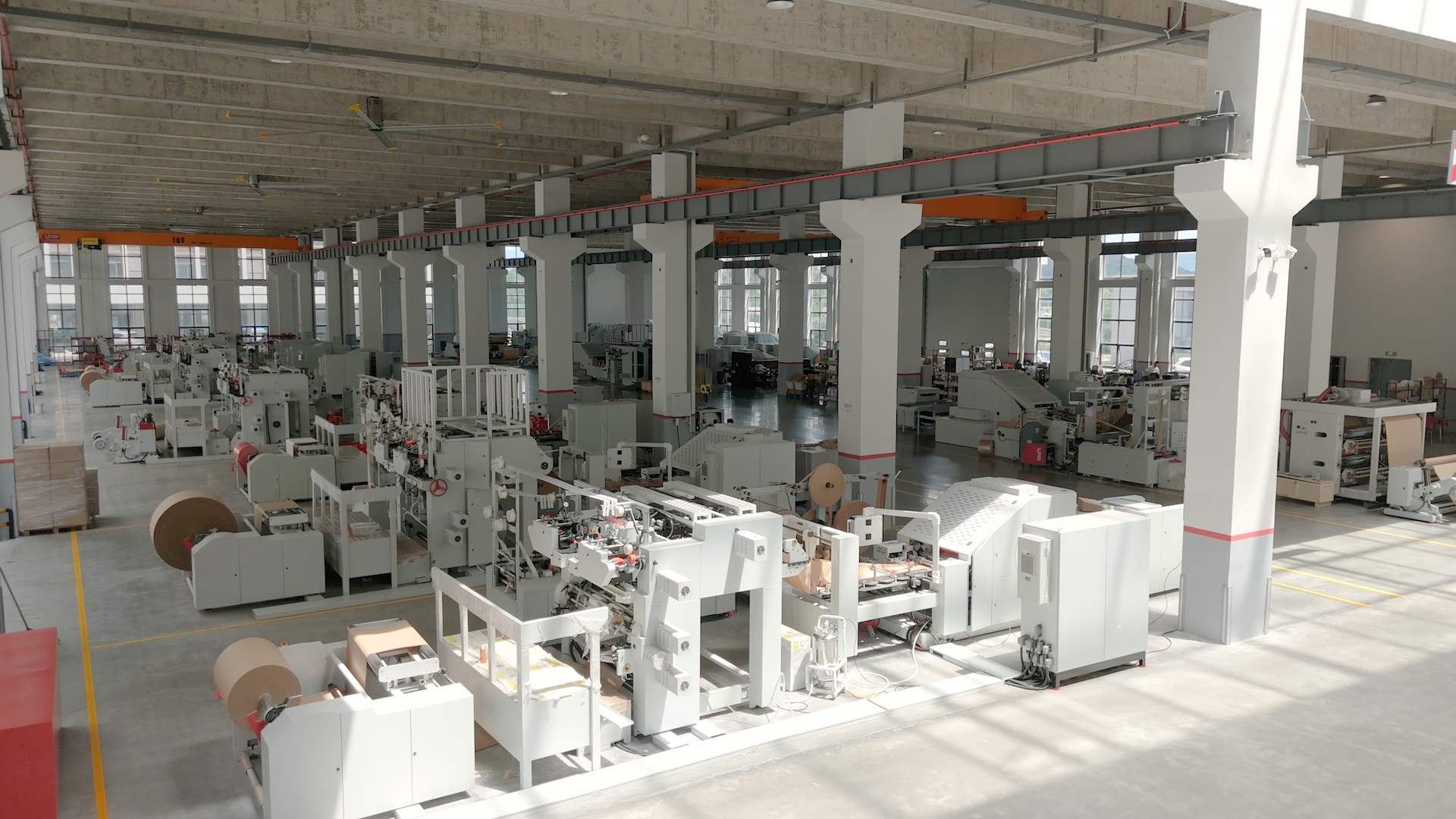
A test area is where a supplier's stated speed, bag quality and safety devices become evidence rather than claims.
| Acceptance item | How to verify | Record to keep |
|---|---|---|
| Pre-delivery run | Witnessed or recorded run on the buyer's paper | Signed test report stating paper grade, bag size and date |
| Speed | Timed run at the agreed bag size and grammage | Output per minute, labelled sustained or peak |
| Bag quality | Measured samples per size: width, length, gusset, handle attachment | Measurement sheet plus retained samples |
| Safety functions | Function test of guards, photoelectric sensors, emergency stop and jam detection with automatic shutdown | Signed checklist, one line per device |
| Tooling and spares | Match delivered items to the agreed list and part numbers | Packing list reconciled with the contract annex |
| Documentation | Manual, electrical drawings, conformity declaration, test report | Complete set in the agreed languages |
| Training | Operator and maintenance sign-off after commissioning | Training record with named participants |
Two practical notes complete the picture. Witnessed testing beats remote testing when the bag specification is new to the supplier; where travel is impractical, agree a recorded run with measured samples shipped alongside the machine. And acceptance criteria should be attached to the quotation rather than negotiated after the deposit — a supplier who resists naming a test at quotation stage is signalling something about the documentation you will receive later.
A six-step comparison sequence
- Fix the bag specification and the destination market, and put both into the RFQ.
- Confirm the policy scope and effective date for that format in that market, in writing.
- Normalise one parameter sheet across at least three suppliers before comparing any figure.
- Use HS 8441.20 trade series for direction, and supplier export mix for documentation exposure.
- Price on a fixed configuration baseline in a named Incoterm, with price validity stated.
- Make the pre-delivery test, safety-function checks and training contractual, with signed records.
Outlook: what belongs on the review agenda
Country-level trend work is only useful if it changes a clause before signature. Three items deserve review across the payback period: the effective date of any packaging instrument that touches your bag format; the shortlisted factories' actual delivery and spares performance against the windows they quoted; and whether the agreed parameter sheet is still the basis of the quotations in front of you. Global market totals are the least actionable of the three, because a worldwide estimate says nothing about whether your customers' bag specifications will change next year.
For most buyers, the durable advantage is not access to better market data. It is a purchase order that names the bag, the test, the documents and the date — and a supplier whose factory can be inspected against all four.
FAQ
How do country-level policy differences change what a buyer should specify?
Policy changes which bag format has to be in the market and by when, so it affects tooling, changeover capability and documentation more than it affects machine speed. The buyer should confirm the instrument's scope, effective date and enforcement for the exact bag type being sold, then write the changeover and conformity requirements into the order. Policy alone does not determine machine quality or supplier selection.
Is a faster automatic paper bag machine always the better buy?
No. Speed only pays when the machine runs long enough at that rate on the actual paper and bag size. If the order mix is short-run or changes frequently, tooling cost and changeover time carry more economic weight than peak output. Speed should be quoted with its conditions — bag size, grammage and handle type — and confirmed at acceptance rather than taken from a catalogue.
What does the USD 60,000–180,000 price band for automatic square bottom paper bag machines cover?
The range refers to fully automatic square-bottom (SOS) roll-fed machines with inline handle units, quoted FOB China in 2026 (PaperBagLine Industry Report). It excludes freight, duty, installation labour, spares and training, and it spans different web widths, handle configurations, printing capability and automation levels. It is a budgeting range, not a quotation; a quotation requires a fixed configuration baseline and a named Incoterm.
Which customs code should be used when comparing national paper bag machine trade data?
HS 8441.20 covers machinery for making paper bags, sacks or envelopes, and series under that heading can be compared across reporting countries in the same customs database. The heading does not separate flat bottom, square bottom and pouch formats, and re-exports or used-machine flows may be recorded differently. The series supports direction and scale, not machine-level quality judgements.
What acceptance tests should be agreed before a paper bag machine ships?
At minimum: a witnessed or recorded run on the buyer's paper; measured bag dimensions and handle attachment on samples; speed at the agreed bag size and grammage; function tests of guards, photoelectric sensors, emergency stop and jam detection with automatic shutdown; a spares and tooling check against the agreed list; and operator training sign-off. Ruizhi states a 100% pre-delivery test run and standardised operation training, both of which can be verified against these tests.
Ruizhi Machinery's product and capability brochure is available for download: Ruizhi Machinery brochure (PDF).
Tem questões ou precisa de mais detalhes?
Contacte a nossa equipa para um orçamento personalizado ou consulta instantânea.
Solicitar orçamento
Preencha o formulário abaixo e a nossa equipa entrará em contacto com uma proposta personalizada.
Chat direto do WhatsApp
Prefere conversar em tempo real? Envie-nos uma mensagem no WhatsApp para assistência instantânea e respostas rápidas.
- Obter orçamento personalizado
- Partilhar fotos ou documentos
- Discuta as suas necessidades diretamente
Geralmente responde em 5–30 minutos durante o horário de expediente.