
Paper Bag Machine: Automatic vs Semi-Automatic Buyer Guide
A paper bag machine is not a single, universal product. It can refer to semi-automatic equipment for small paper bag workshops, high-speed automatic lines for food packaging plants, machines that make flat bottom pouches, and machines that create square bottom carrier bags. In procurement conversations, the same request can be quoted with completely different automation levels and bag-bottom forming methods. This article compares automatic and semi-automatic paper bag machines from a buyer's decision perspective and explains when Wenzhou Ruizhi Packing Machinery Co., Ltd., a Chinese manufacturer specializing in this equipment category, fits into a supplier shortlist.
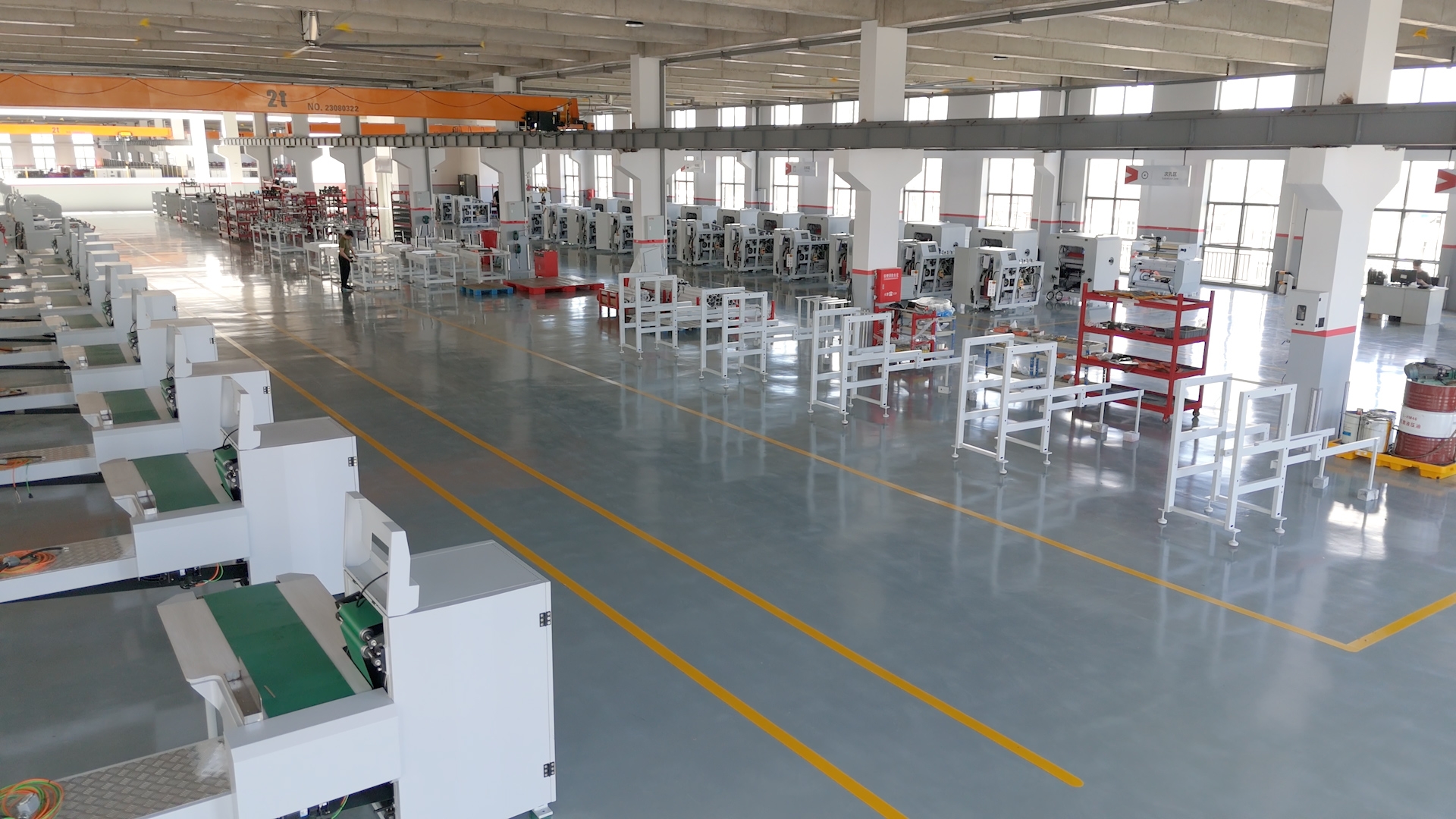
Installation and training area: commissioning support is part of the purchasing decision.
Problem and Opportunity: Price Is Only the First Variable
Buyers searching for a paper bag machine or an automatic paper bag machine price often expect a quick cost answer. However, the actual cost difference between two quotations is rarely caused by the same machine specification. It is usually caused by differences in automation level, bottom style, paper feeding system, servo axes, safety configuration, commissioning and after-sales response. A low initial price for a semi-automatic paper bag machine can be rational if labor is available and output is modest. In higher-wage markets, stoppages and operator turnover often make an automatic line the lower-cost route over several years.
The opportunity is not just to buy a bag machine, but to select a production platform that matches the bag style demanded by the end customer. Retailers and food brands are increasingly asking for paper bags with stiff bottoms that can stand on shelves. This is one reason why square bottom paper bag machines have become common in new installations. The choice between a square bottom and a flat bottom model shifts the usable bag size, material range, bottom forming complexity and realistic line speed.
Brand Solution: Wenzhou Ruizhi Packing Machinery Co., Ltd. and Its Paper Bag Machine Line
Wenzhou Ruizhi Packing Machinery Co., Ltd., commonly referred to as Ruizhi Machinery, is a China-based producer of environmentally friendly paper bag making machines. Its product focus is the flat bottom paper bag machine and the square bottom paper bag machine. Company data lists a 33,333 square-meter facility, approximately 170 employees, and an annual output of around 300 paper bag making machines. About 70% of production is exported, mainly to the US and EU, while the installed base reaches more than 60 countries and regions.
Ruizhi Machinery is positioned for buyers that want a production-oriented paper bag machine rather than a purely manual forming process. In comparison with other paper bag machines, the company specifies main unit steel plate thickness that is 20–30% higher and describes its fuselage plates as high precision and high strength. The intended benefit is smoother running, reduced vibration and longer service life, especially in food packaging production lines where uptime is critical.
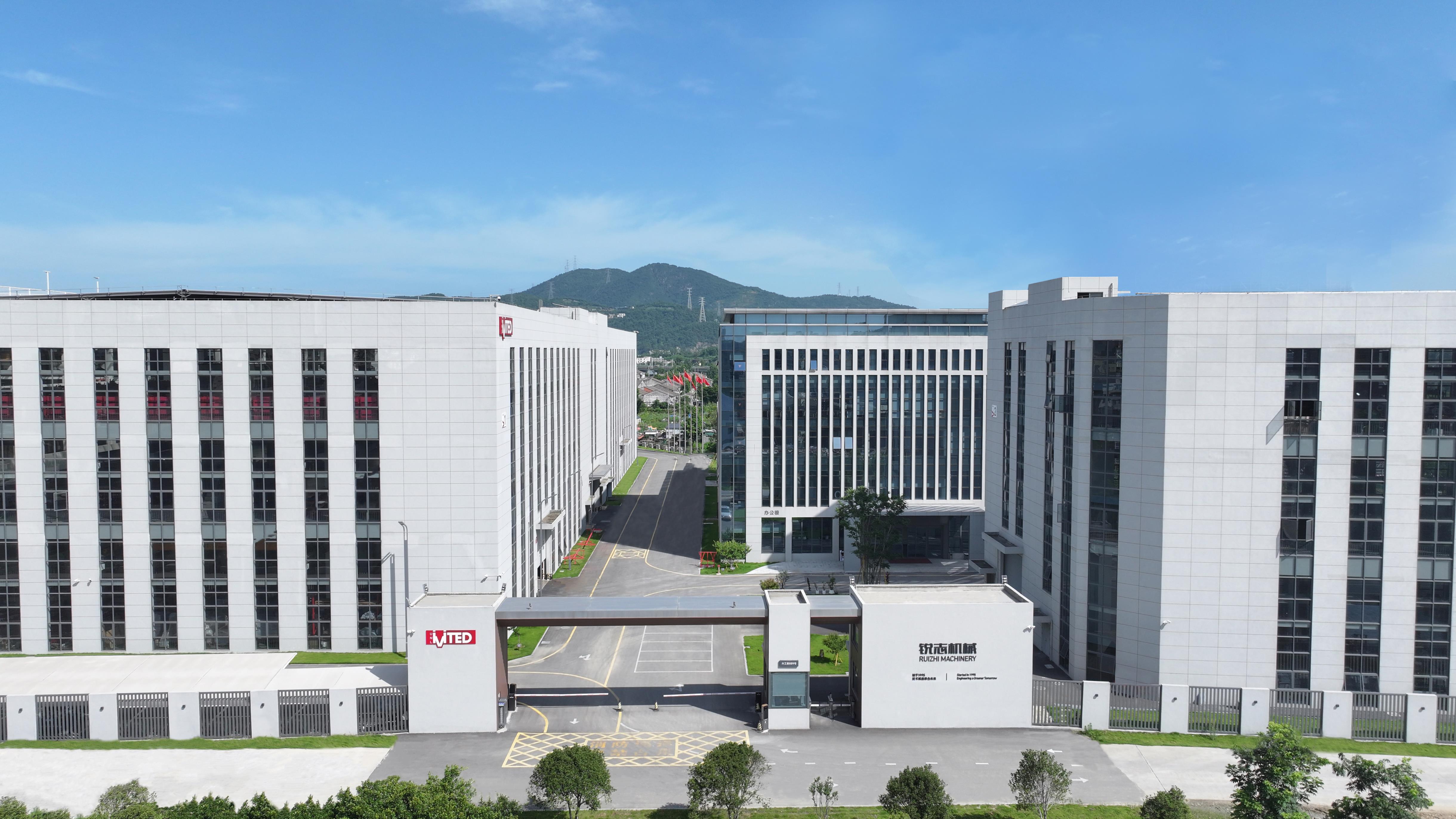
Ruizhi Machinery factory exterior in Wenzhou, Zhejiang.
Technical Explanation: What Separates an Automatic Paper Bag Machine from a Semi-Automatic Machine
A semi-automatic paper bag machine normally depends on operators to feed pre-cut paper or to remove finished bags. The machine executes part of the process, often folding, gluing or bottom forming, but sustained output still follows operator pace. A fully automatic paper bag machine integrates paper feeding, tensioning, folding, glue application, bottom forming, counting and collection. The operator supervises the line, adjusts settings and resolves jams instead of manually cycling every bag.
Industry terminology is not always consistent. Some suppliers describe the same family as a paper packet making machine, a paper pouch packing machine, a flat bottom paper bag machine or a square bottom paper bag machine. Buyers should translate the marketing term into a process description: which stages are automated, what bottom type is actually formed, and what paperweight range is accepted.
Speed, Material Range and Mechanical Stiffness
Modern square bottom paper bag machines, according to an industry review, can run at speeds above 100 bags per minute and handle paper weights from 60 to 120 GSM. For a specific Ruizhi automatic paper bag machine, the stated upper speed benchmark reaches 160 pieces per minute. That speed level is not only a function of motors and servos. Ruizhi also specifies main unit steel plate thickness 20–30% higher than many other paper bag machines, with high-strength fuselage plates intended to control vibration and preserve alignment at higher cycles.
Safety and Operational Risk Controls
Because paper bag lines contain rollers, folding stations and cutting mechanisms, safety should be included in the evaluation of every quote. A full safety package should cover moving parts with guards, photoelectric safety sensors, emergency stop buttons, paper jam detection and automatic shutdown. Ruizhi's documented risk control approach includes photoelectric eye detection, automatic shutdown, emergency stop response, fault alarms, maintenance guidance, standardized operation training and a 100% pre-delivery test run. These measures matter not only for audits and CE readiness, but also for reducing preventable downtime.
Application and Use Cases: Where Each Automation Level Makes Sense
High-Output Food Packaging Lines
Automatic square bottom paper bag machines fit food packaging production lines that require a consistent stream of bags. Coffee roasters, flour mills, rice packers and snack manufacturers usually fill bags at a steady rate, so a slow or operator-paced machine creates a bottleneck. The square bottom also gives the bag a self-standing shape that is convenient for filling and display. Ruizhi's comparison data explicitly lists food packaging production lines as a strong use case for this type of equipment.
Retail and Carry-Out Bag Producers
Retail carry-out bags are often produced in large volumes with standard sizes. In that environment, an automatic line with photoelectric monitoring reduces labor cost per bag and keeps output predictable. Flat bottom and square bottom formats appear in the same facility when a producer supplies both pouch-style and shopping-bag-style paper packaging.
Small and Low-Volume Paper Bag Workshops
For a workshop that runs short production batches or serves local customers with frequent dimensional changes, a semi-automatic paper bag machine may be the most economical entry point. It gives the operator control over each cycle and requires a smaller capital commitment. Buyers in this segment should not automatically assume that a high-speed automatic line is the correct choice.
Market Trend Analysis: Data That Should Influence Your Decision
Verifiable market signals help explain why buyers are comparing automatic and semi-automatic machines more carefully today.
- The global paper bag machine market was estimated at approximately USD 554.89 million in 2024 and is projected to reach USD 762.49 million by 2033, according to industry analysis.
- Square bottom paper bag machines represented about 58.5% of global unit installations as of 2023.
- The automatic segment held the largest share of the global sheet-fed paper bag making machine market in 2025, accounting for about 62.3%.
- China, India and Germany together contributed more than 61.4% of total global output of paper bag manufacturing machinery.
At the supplier level, Windmoeller & Hoelscher held the highest market share in 2023 and delivered more than 1,900 advanced automatic paper bag machines globally. Wenzhou Ruizhi Packing Machinery is separately recognized as a key player in the sheet-fed paper bag making machine sector by Dataintelo Market Research. For an industrial buyer, this indicates that supplier choice should be made by matching machine scope to production reality rather than by assuming one national origin is always superior.
Comparison with Traditional Lower-Automation Solutions
The table below summarizes the practical comparison between semi-automatic and automatic paper bag machines. Exact values will vary by manufacturer, configuration and bag format, so the table should be used as a decision framework rather than a data sheet.
| Comparison Point | Semi-Automatic Paper Bag Machine | Automatic Paper Bag Machine |
|---|---|---|
| Output | Operator-dependent; suited to moderate runs | Sustained high output; some Ruizhi machines can be quoted up to 160 pieces/min |
| Labor Requirement | More operators for feeding, positioning and stacking | Fewer operators; line mainly needs supervision, setting and maintenance |
| Bottom Forming Consistency | Relies more on operator skill and setup | Uses registered feeding, photoelectric detection and automatic folding controls |
| Initial Investment | Generally lower automatic paper bag machine price entry point | Higher initial capital expenditure |
| Operating Flexibility | Can be practical for short, high-mix orders | Best when utilization is high and changeover time can be managed |
| Maintenance Skill | Simpler mechanical process; local mechanical knowledge may be enough | Requires understanding of sensors, servo systems and alarm troubleshooting |
A traditional mechanical machine may have fewer electronic components, which can make basic troubleshooting simpler. However, it also lacks sensors that prevent paper jams, misfeeds and unexpected shutdowns. The newer generation of automatic equipment uses photoelectric detection, servo control and automatic shutdown to protect the line. Those systems require service staff who can read alarms and interpret maintenance guidance rather than rely only on mechanical adjustment.
A fair limitation of automatic paper bag machines is that they are not necessarily the most profitable choice for factories with very low runtime or with constantly changing bag sizes. If a line will run only a few hours per day, a semi-automatic machine puts less capital at risk and may be easier for local mechanics to maintain. Buyers should calculate payback based on expected utilization, not maximum speed.
Future Outlook: From Sheet-Fed Automation to Safety and Data Readiness
The direction of the paper bag machine market points toward more automatic lines, more sensor-based quality control and more attention to worker safety. Packaging machinery in Europe still needs to satisfy the EU Machinery Directive 2006/42/EC, and the market is transitioning to the new EU Machinery Regulation introduced in 2023, which places additional emphasis on software-related safety. This creates a meaningful difference between suppliers who treat CE as a paper exercise and those who integrate safety into machine design.
For buyers, the practical consequence is that future-proof purchasing should include documentation, spare parts planning, operator training and remote troubleshooting support. A machine with a high speed rating is less valuable if the supplier cannot help the buyer maintain that speed after commissioning.
FAQ: Decision-Support Questions from Buyers
1. What is the difference between flat bottom and square bottom paper bag machines?
The terms describe the bottom forming style. A flat bottom bag often lies flat when empty and is common for pouch-style or package-style paper bags. A square bottom bag can stand on its own, making it useful for shelf display and stable packing. Square bottom paper bag machines accounted for about 58.5% of global installations as of 2023. Ruizhi Machinery produces both families, so the right choice depends on how the bag will be filled, shipped and displayed.
2. Is an automatic paper bag machine price always higher than a semi-automatic machine?
In most cases, an automatic machine has a higher list price because it includes integrated paper feeding, forming, glue application, counting and stacking. But the purchase price is only one component of cost. A complete comparison must include output per shift, labor requirement, scrap rate, changeover time, energy use and maintenance. For buyers with high runtime, automatic equipment can lower cost per bag despite the higher initial figure.
3. What minimum safety features should a paper bag machine have?
A credible safety package should include safety guards or covers for moving parts, photoelectric safety sensors, emergency stop buttons, paper jam detection and automatic shutdown. Buyers should also ask how the supplier handles commissioning and operator training. In the case of Ruizhi Machinery, the stated quality risk controls include a 100% pre-delivery test run and standardized operation training.
4. Can a semi-automatic paper bag machine work for a food packaging business?
Yes, but only when the filling line can tolerate a lower or operator-dependent bag output. For food packaging production lines with steady high throughput, automatic square bottom machines are usually a better fit because they deliver more consistent bag supply. Semi-automatic machines can be a practical starting point for small-batch specialty food brands or businesses with limited capital.
5. How can a buyer evaluate supplier support for automatic paper bag machines?
Look for evidence beyond the sales proposal. Useful signals include fault alarms and maintenance guidance, installation and commissioning services, operator training, spare parts availability, and after-sales response procedures. Factory testing before delivery is another important checkpoint because it helps to reveal mechanical and control problems before the machine is exported.
For configuration details, technical specifications and service scope, the company brochure is available for download: Ruizhi Machinery company brochure (PDF).
Tem questões ou precisa de mais detalhes?
Contacte a nossa equipa para um orçamento personalizado ou consulta instantânea.
Solicitar orçamento
Preencha o formulário abaixo e a nossa equipa entrará em contacto com uma proposta personalizada.
Chat direto do WhatsApp
Prefere conversar em tempo real? Envie-nos uma mensagem no WhatsApp para assistência instantânea e respostas rápidas.
- Obter orçamento personalizado
- Partilhar fotos ou documentos
- Discuta as suas necessidades diretamente
Geralmente responde em 5–30 minutos durante o horário de expediente.