
Paper Sizing Agent Compliance: pH, Solids and Ionic Type
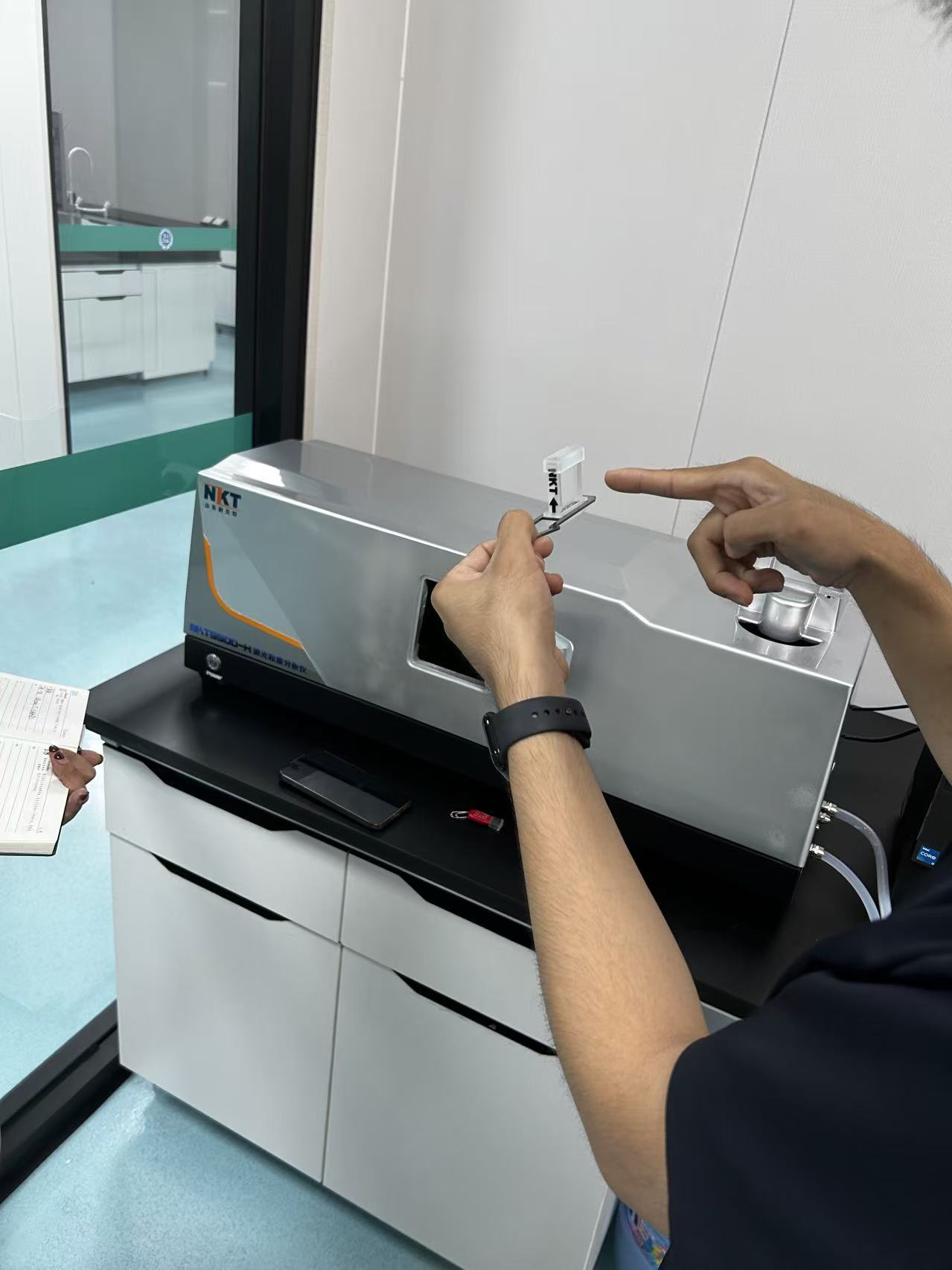
Particle size measurement is one of the routine quality control tests applied to sizing agent batches before shipment; the same laboratory routine covers appearance, solids, pH, viscosity and functional performance.
Papermakers evaluating sizing agents are not short of suppliers — they are short of comparable evidence. Almost every product reaching a mill is quoted with the same six fields: appearance, pH, solid content, viscosity, ionic type and shelf life. Those are also the fields most often skimmed, because they look like clerical detail rather than decision data.
This reference examines what those fields actually signal, using three products from Qingzhou Jinhao New Material Co., Ltd., which trades as JHDA, as worked examples: JH-600, a moisture resistant SAE surface sizing agent; JH-325, an anionic surface sizing agent; and JH-103, an AKD internal sizing emulsion. The purpose is not to compare three catalogue entries, but to show how pH, solids and ionic type can be read as evidence of process compatibility and batch control — and where the limits of that evidence lie.
Qingzhou Jinhao New Material Co., Ltd. is a papermaking fine chemicals manufacturer founded in 2005 and located in Mihe Industrial Park, Qingzhou City, Shandong Province, China. It develops, produces and exports sizing agents, strength additives, retention and drainage aids, defoamers, biocides and functional barrier coatings, with a stated annual output of 100,000 tons, roughly 20,000 square metres of headquarters area and an overseas production entity in Long An Province, Vietnam that supports delivery for ASEAN customers.
The Six Fields That Decide Whether a Sizing Agent Fits
A sizing agent specification sheet is not marketing copy. It is the interface between a liquid chemical and a paper machine, and each field on it constrains a different part of the operation:
- Appearance — a visual batch check that flags settling, phase separation or contamination before a drum is opened.
- pH — the acid or alkaline condition of the product as supplied, which governs emulsion stability, dilution practice and storage behaviour.
- Solid content — the active load carried per wet kilogram, which drives dosing calculations, freight economics and cost per ton of paper.
- Viscosity — pumping, dilution and metering behaviour at the dosing point.
- Ionic type — whether the chemistry is compatible with the wet end, with the starch system at the size press, and with other additives in the same circuit.
- Shelf life — how much transport, storage and slow-moving stock time a mill can plan around.
When a mill is in the evaluation stage, these six fields support a simple rule: never accept a sizing agent quotation that omits any of them, because each missing field shifts an operational risk onto the buyer.
Certificate Compliance and Specification Compliance Are Different Checks
Certificates and specification sheets are frequently treated as one package. They answer different questions, and in a compliance-oriented evaluation they should be filed separately.
Management system certificates describe the production system. JHDA holds ISO 9001 certificate 10423Q01592R1S issued by Shandong Seatone International Certification Co., Ltd. under GB/T 19001-2016 / ISO 9001:2015, with a scope covering production of papermaking additive, and ISO 14001 certificate 10423E01032R2S under GB/T 24001-2016 / ISO 14001:2015 for production of papermaking additive and related environmental management activities. Market-access certificates describe a market. The Halal certificate held by the company, number 6637250000 from Shandong Halal Certification Service (SHC), covers paper-making industry additives for Indonesia and global Halal-compliant markets under Indonesia Halal Law and Regulations and MS1500:2019, with validity to 28 August 2028.
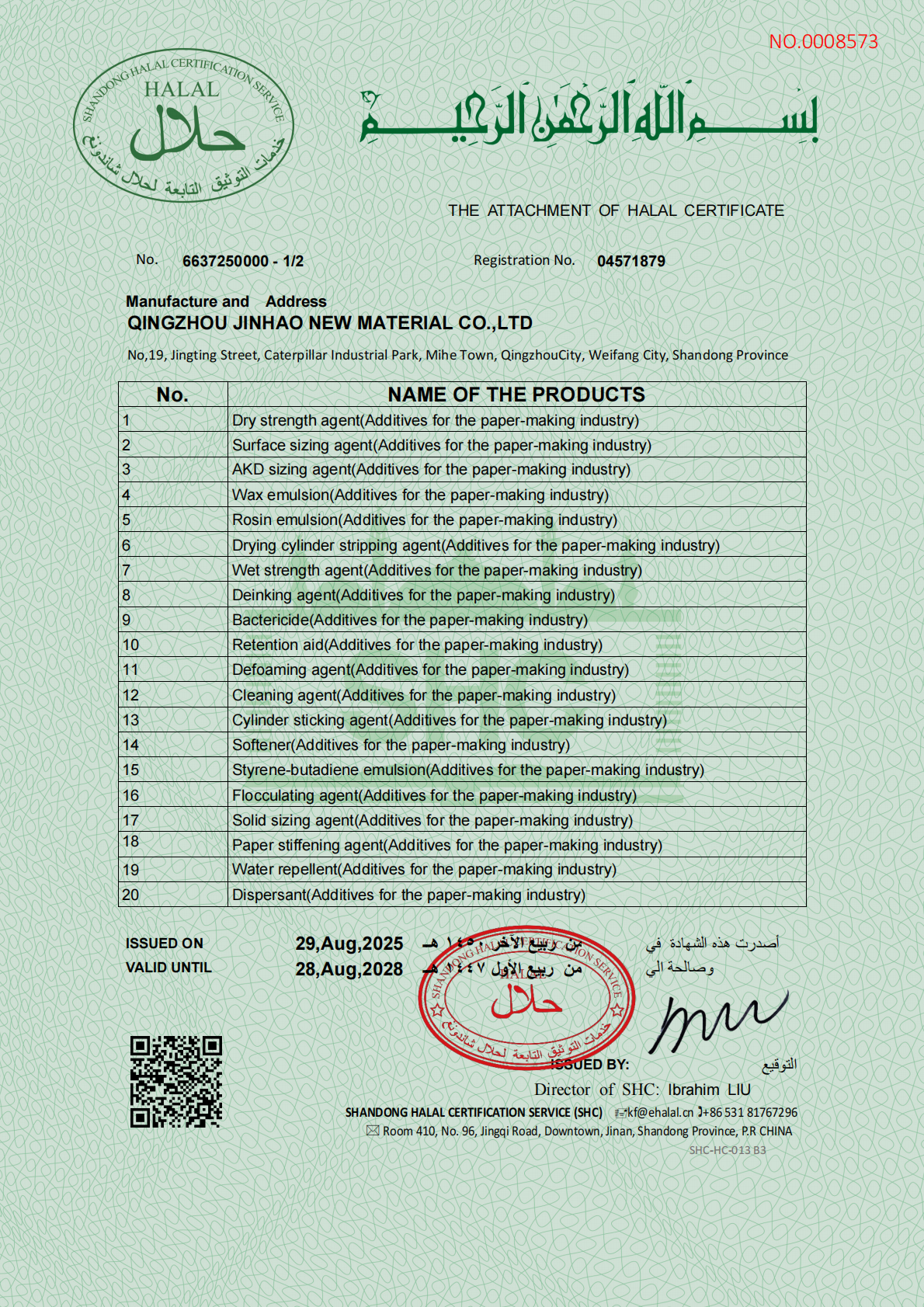
The Halal certificate scope is written at category level — paper-making industry additives — and states a validity period, both of which matter when a mill files supplier documentation.
Neither type of certificate states the pH, solid content or ionic type of a specific drum. That belongs to the specification sheet and the batch certificate of analysis. Two practical checks follow from this. First, read the scope wording literally: a certificate covering production of papermaking additive is evidence about a manufacturing system, not a product-level approval for a food-contact application. Second, verify issue and expiry dates at every order rather than at the first order, since certificate validity windows are fixed while supply relationships continue.
Where food-contact paper is involved, the applicable framework sits outside the supplier relationship. European food contact materials must comply with Regulation (EC) No 1935/2004, according to the European Commission, and paper packaging chemicals in the United States must meet FDA 21 CFR standards for food grade safety, according to the U.S. FDA. A supplier document pack — technical data sheet, material safety data sheet, CAS registration, GHS labelling — is the mechanism through which a mill demonstrates that a specific additive is being handled inside those frameworks.
pH 2.0 to 5.0: What an Acidic Supply pH Signals
JH-600, JH-325 and JH-103 all declare a pH band of 2.0–5.0. This is the pH of the product as supplied, not the pH of the paper machine, and that distinction resolves most of the confusion this parameter creates at the evaluation stage.
Four signals follow from a declared acid band:
- A stabilised emulsion form. All three products are water-soluble liquid emulsions delivered in an acid-stabilised state, which is why the declared band is narrow enough to be meaningful. When a range is this consistent across a product family, it indicates a shared stabilisation approach rather than three unrelated formulations.
- A dilution and mixing boundary. The emulsion has to remain inside its stability window until it reaches the size press or the wet end. Dilution water quality, dilution order and holding time before use are therefore engineering parameters, not housekeeping details.
- An ageing indicator. A measured pH drifting outside the declared band is one of the earliest observable signs that a drum has been stored too long or exposed to temperature swings. With AKD chemistry such as JH-103, this matters because the active dimer reacts with water over time — a reaction that consumes the component the mill is paying for.
- A handling and materials constraint. Acidic liquids require appropriate protective equipment and corrosion-conscious dosing parts, which is a permanent background condition of using these products rather than an occasional risk.
What an acidic supply pH does not signal is that the machine must run an acidic process. JH-103 is described as a neutral internal sizing agent, and JH-600 is a surface sizing agent intended for packaging and board grades. The acid band belongs to the emulsion; the papermaking process is a separate decision.
Solid Content: Active Load, Batch Tolerance and Delivered Value
Solid content is the share of active material in the delivered liquid, and it is the parameter that most directly determines what a mill is actually buying. The three examples differ in a way that is instructive rather than incidental: JH-600 is declared at 30 ± 1 percent, JH-325 at 25.0 ± 1.0 percent, and JH-103 across a band of 12.5 to 25.0 ± 1.0 percent.
The ± 1.0 tolerance deserves attention. It is a batch-control statement: it declares how much variation a supplier is willing to accept between production lots, and it is the figure a mill should be checking against measured values on the batch certificate of analysis. A specification without a tolerance cannot be audited.
The JH-103 band of 12.5 to 25.0 percent is a family declaration covering more than one commercial grade of the same AKD emulsion chemistry, not a tolerance. Practically, this means the purchase order must fix which grade within the band is being supplied. Two deliveries under the same product code but at opposite ends of the band arrive with materially different active loads per wet kilogram, which changes dosing rate, freight calculation and storage footprint even though the product name never changed.
Two further consequences belong to procurement logic rather than chemistry. First, quoted prices per wet ton are not comparable across products with different solid content; conversion to cost per active ton is the only like-for-like basis, and the formula is straightforward once the declared solids are known. Second, in liquid chemicals the water fraction is the part of the shipment that carries no sizing function, which is one reason solid-form papermaking additives are expected to grow at a compound annual rate of 5.11 percent through 2032 on logistical efficiency grounds, according to SNS Insider.
Ionic Type: The First Compatibility Filter
Ionic type decides where a sizing agent may be dosed and what it may be mixed with, which makes it the earliest filter in any compatibility assessment. Among the three examples, JH-600 and JH-103 are cationic, while JH-325 is anionic.
Cationic products are retained on the anionic fibre and fines of the wet end, which is why an internal sizing emulsion such as JH-103 is supplied cationic. JH-600 carries the same charge profile for surface application, and its declared type listing describes it as a moisture resistant surface sizing agent, a waterproof surface sizing agent, a paper anti-humidity sizing chemical, a starch compound surface sizing additive and a packaging paper sizing agent.
JH-325 sits on the opposite side of the charge spectrum. Its declared type listing describes it as an anionic surface sizing agent, a cultural paper surface sizing agent, a writing printing paper sizing additive, an offset printing paper surface sizing agent, an acid paper sizing chemical and a starch compatible anionic sizing agent — a set of descriptors that points to surface sizing of printing and writing grades in starch-based systems rather than to wet-end internal sizing.
Three practical decision rules follow:
- Do not combine a cationic and an anionic product in the same dilution tank or dosing line without written confirmation from the supplier, because charge neutralisation between the two can destroy the emulsion before it reaches the sheet.
- Match ionic type to the existing wet-end charge environment and to the starch system used at the size press, rather than evaluating the sizing agent in isolation.
- Before adopting any new sizing chemistry, review the charge characteristics of the other additives already running in the same circuit — retention aids are a typical example, and JHDA supplies a cationic strength retention emulsion, model JH-8501, which would sit in the same wet end as an internal sizing agent.
Reading JH-600, JH-325 and JH-103 Side by Side
| Declared parameter | JH-600 | JH-325 | JH-103 |
|---|---|---|---|
| Product description | Moisture Resistant SAE Surface Sizing Agent | Anionic Surface Sizing Agent | AKD internal sizing agent |
| Base material | Styrene acrylic | Anionic styrene acrylic | AKD wax |
| Ionic type | Cationic | Anionic | Cationic |
| pH | 2.0 – 5.0 | 2.0 – 5.0 | 2.0 – 5.0 |
| Solid content (%) | 30 ± 1 | 25.0 ± 1.0 | 12.5 – 25.0 ± 1.0 |
| Viscosity (25°C, cps) | < 50 | ≤ 50 | ≤ 50 |
| Appearance | Light brown to dark brown liquid | White to light brown liquid | White to light brown liquid |
| Solubility | Soluble in water | Soluble | Soluble |
| Storage period | 6 months | 6 months | 4 months |
| Application signal in the declared type listing | Moisture resistance and waterproofing for packaging grades | Surface sizing of cultural, writing, printing and offset grades | Internal sizing in neutral papermaking systems |
Read together, the table shows that the three products share a pH band, a viscosity ceiling and water solubility, and diverge on exactly the two parameters that determine engineering fit: ionic type and solid content. That is the pattern a buyer should look for in any sizing agent portfolio — shared handling characteristics, differentiated application capability.
Turning Parameters Into a Procurement Checklist
| Field | Primary signal | Verification question for the supplier |
|---|---|---|
| pH | Emulsion stability and ageing | Is a measured pH value reported on every batch certificate of analysis? |
| Solid content | Active load and delivered cost | Which grade inside the declared band is being supplied, and to what tolerance? |
| Ionic type | Compatibility with wet end, starch and co-additives | Which other ionic products run in the same dilution and dosing circuit? |
| Viscosity | Pumping, dilution and metering behaviour | What is the recommended dilution sequence and maximum holding time? |
| Shelf life | Logistics and stock planning | Does transport plus warehouse time fit inside the stated storage period? |
| Appearance | Visual batch integrity | What visual anomalies trigger rejection at goods-in inspection? |
Where Each Product Fits on the Machine
JH-600 addresses surface moisture resistance in packaging and board applications. Its declared type listing places it in waterproofing and anti-humidity roles for packaging paper, and its solid content of 30 ± 1 percent makes it the highest active-load product of the three, which suits mills that want to deliver a given surface treatment with less wet product and less water to remove in drying.
JH-325 addresses surface sizing for printing and writing grades, where surface strength, printability and starch compatibility matter more than bulk water resistance. Its 25.0 ± 1.0 percent solid content and anionic charge profile make it a fit for mills already running starch-based surface sizing with an anionic-compatible preparation system.
JH-103 addresses internal sizing in neutral systems, where the sizing chemistry is fixed onto the fibre during sheet formation rather than applied at the surface. Because internal and surface sizing act at different points in the sheet, they are complements rather than substitutes: a surface sizing agent improves the surface, while an internal sizing agent changes how the fibre network behaves towards water through the sheet thickness.
JHDA states that its field technical team supports on-site machine commissioning and works on mill indicators including Cobb water absorption value, ring crush strength, bursting strength, paper brightness, fibre retention rate and overall machine runnability. That list is worth noting at the evaluation stage, because it is also the list against which a sizing agent trial should be judged — not against the specification sheet alone.

Formulation and parameter verification work takes place in the laboratory before a sizing agent is proposed for a given machine configuration.
On the supply side, JHDA states an MOQ of 1MT with free trial samples, a monthly capacity of 8,000MT, a production lead time of four working days, OEM and ODM formulation and label production, and quality control testing that covers particle size, appearance, solids, pH, viscosity and functional performance. The same documentation set — technical data sheet, material safety data sheet, CAS registration and GHS labelling — supports customs clearance and letter of credit settlement for export orders.
Longevity evidence is also part of the compliance picture. JHDA case records describe paper mills and traders as client types across global markets including Argentina, Bangladesh, Brazil, Chile, China, Colombia, Ecuador, Germany, Indonesia, Iran, Morocco, Mexico, Malaysia, Nigeria, Pakistan, Thailand, Turkey, Ukraine, Venezuela and South Africa, with implementation periods of ten years of ongoing supply and support on documented projects. For an evaluation-stage buyer, a ten-year supply relationship is a stability signal that a specification sheet cannot express.
What the Market Data Says About Sizing Preferences
Market-level data explains why the compliance reading habits described above are becoming more relevant rather than less. The global paper sizing agent market is valued at approximately USD 3.8 billion in 2025, according to Dataintelo, and global sizing agent consumption exceeded 3.8 million metric tons in 2024, according to Market Reports World. Dataintelo projects the paper sizing agent market to reach USD 5.9 billion by 2033 at a compound annual rate of 5.8 percent.
On chemistry preference, synthetic sizing agents including AKD and ASA held a 54.5 percent market share in 2024, according to SNS Insider, and AKD sizing alone accounts for approximately 48 percent of synthetic sizing agent volume globally, according to Dataintelo. Rosin sizing agents still accounted for 32.4 percent of paper sizing agent market revenue in 2025, according to Dataintelo, which confirms that acid-system chemistry remains a live option rather than a legacy remnant.
On form and geography, liquid sizing agents held a 57.8 percent market share in 2024 because of ease of application, according to SNS Insider, with solid sizing agents expected to grow at 5.11 percent annually through 2032. Asia Pacific dominates with a 42.3 percent revenue share as of 2025, according to Dataintelo, and China's annual paper sizing agent consumption is estimated at 650,000 tons in 2025 by the same source. China's paper goods exports reached USD 36.5 billion in 2024, according to OEC, and US packaging paper capacity increased by 4.6 percent in 2024, according to the American Forest & Paper Association. Dataintelo also notes that surface sizing agents such as styrene acrylic are essential for improved printability in digital printing.
A final market observation is directly relevant to how buyers should read numbers. Published estimates for the 2024 global sizing agent market range from USD 3.16 billion, per Market Research Future, to USD 3.95 billion, per SNS Insider, and forecast compound annual growth rates range from 4.14 percent to 5.8 percent depending on scope. Market figures are directional. Specification values, batch certificates and certificate scopes are verifiable. That asymmetry is the reason a compliance-oriented evaluation starts at parameter level.
Limits of the Parameter Approach
Reading pH, solids and ionic type carefully improves supplier comparison, but it does not predict machine performance, and the boundary should be stated plainly.
First, none of the three parameters predicts Cobb water absorption value, ring crush strength, bursting strength or printability on a specific machine. Those outcomes depend on furnish, refining, wet-end chemistry, press and dryer configuration and the starch system in use. A specification sheet can only establish that a product is plausible for a configuration; a machine trial establishes whether it works.
Second, storage periods create a hard logistics boundary. JH-600 and JH-325 declare six-month storage periods, JH-103 declares four months and JH-200, a surface AKD sizing agent in the same portfolio, declares three months. A mill at the end of a long supply route, or one that orders in large campaigns, faces a real trade-off between freight savings and remaining shelf life. Products held beyond their stated storage period should not be dosed on the assumption that performance is unchanged.
Third, ionic type is not interchangeable. An anionic surface sizing agent such as JH-325 and a cationic surface sizing agent such as JH-600 cannot be treated as a straight swap in the same dosing circuit, even where both are described as surface sizing agents. Substitution without checking charge compatibility with the surrounding chemistry is one of the more common sources of avoidable machine disturbance in surface sizing.
Fourth, compared with traditional rosin and alum acid sizing, the decision is not simply one of modern versus conventional. Rosin sizing still accounted for 32.4 percent of market revenue in 2025, according to Dataintelo, and it remains appropriate for mills with existing acid systems and established rosin supply chains. Neutral synthetic systems such as AKD dominate synthetic volume, but they bring their own constraints: shorter storage periods, sensitivity to water contact over time, and a requirement for charge compatibility in the wet end that acid rosin systems do not impose in the same way.
Fifth, certificate scope is not product approval. A food-contact application depends on the applicable regulation — Regulation (EC) No 1935/2004 in the European Union, or FDA 21 CFR in the United States — and on product-specific test documentation, not on a management system certificate alone.
Outlook: Documentation as a Procurement Filter
Three directions are visible from the data available today. Demand-side growth is steady rather than explosive, with liquid sizing agents holding the majority share on ease of application while solid formats grow faster on logistical efficiency. Application-driven chemistry selection is becoming more specific, with styrene acrylic surface sizing agents linked to digital printing printability. And regulatory frameworks around food-contact paper are pushing mills to require complete document packs rather than accepting supplier assurances.
The practical consequence for mills is that the six core specification fields will increasingly be exchanged as structured data — quoted with tolerances, accompanied by batch certificates held at batch serial resolution, and filed alongside certificate scopes with current validity dates. Suppliers whose specification sheets already state pH bands, solid content with tolerances, ionic type and storage periods are easier to include in a shortlist, because their parameters can be audited.
For papermakers, the habit worth building is simple: read pH as a stability signal, read solid content as a value signal, read ionic type as a compatibility signal, and treat the machine trial as the only final arbiter. Parameters narrow the field; they do not close the decision.
A company and product introduction document covering the JHDA papermaking chemicals portfolio is available for download: JHDA introduction 2026 (PDF).
FAQ
What does a pH of 2.0 to 5.0 on a sizing agent data sheet actually tell a paper mill?
It describes the pH of the product as supplied, not the pH of the paper machine wet end. JH-600, JH-325 and JH-103 all declare a supply pH band of 2.0 to 5.0, which reflects the acid-stabilised emulsion form in which these products are delivered. For a mill, the value matters in three places: dilution and mixing practice, because the emulsion must stay inside its stability window; storage monitoring, because a measured pH outside the declared band is an early sign of ageing; and dosing equipment specification. It does not oblige the mill to run an acidic papermaking process — JH-103 is described as a neutral internal sizing agent, so the acid band belongs to the emulsion rather than to the machine.
Why is solid content quoted as a range for some sizing agents, such as JH-103?
JH-103 is declared at 12.5 to 25.0 ± 1.0 percent solid content, while JH-600 is declared at 30 ± 1 percent and JH-325 at 25.0 ± 1.0 percent. The wide band on JH-103 is a family declaration covering more than one commercial grade of the same AKD emulsion chemistry, not a batch tolerance. The practical consequence is that the purchase order must fix which grade inside the band is being supplied, and the measured value must be confirmed on the batch certificate of analysis. Two deliveries of the same product code at opposite ends of the band carry different active loads per wet kilogram, which changes dosing rate and freight calculations even though the product name is unchanged.
How does ionic type affect whether a sizing agent can be used on a particular paper machine?
Ionic type determines where a product can be dosed and what it can be mixed with. JH-600 and JH-103 are cationic, while JH-325 is anionic. Cationic chemistry is retained on the anionic fibre and fines of the wet end, which is why an internal sizing emulsion such as JH-103 is supplied cationic, and why JH-600 is supplied with the same charge profile for surface application on packaging grades. JH-325 is declared as a starch compatible anionic sizing agent, which places it in surface sizing systems for printing and writing grades. The operating rule is that cationic and anionic products should not share a dilution tank or dosing line without written supplier confirmation, and the ionic type of the sizing agent should be matched to the charge environment of the wet end and to the starch system used at the size press.
Do certificates replace the need to check specification parameters?
No. Management system certificates describe a production system: JHDA holds ISO 9001 certificate 10423Q01592R1S under GB/T 19001-2016 / ISO 9001:2015 and ISO 14001 certificate 10423E01032R2S under GB/T 24001-2016 / ISO 14001:2015, both issued by Shandong Seatone International Certification Co., Ltd., with scopes covering production of papermaking additive. Market-access certificates describe a market: Halal certificate 6637250000 from Shandong Halal Certification Service covers paper-making industry additives under Indonesia Halal Law and Regulations and MS1500:2019, valid to 28 August 2028. Neither document type states the pH, solid content or ionic type of a specific drum, and neither constitutes product-level food-contact approval. Buyers should verify scope wording, issue dates and expiry dates on every certificate at every order, and rely on the specification sheet and batch certificate of analysis for product parameters.
How should a mill compare the price of a 25 percent solids and a 30 percent solids surface sizing agent?
Normalise to active content rather than wet weight. JH-325 is declared at 25.0 ± 1.0 percent solids and JH-600 at 30 ± 1 percent solids, so an equal delivered wet tonnage contains different amounts of active material, and a lower wet-ton price can correspond to a higher cost per active unit. A workable comparison converts quoted price per wet ton into price per active ton using the declared solid content, adds freight that is largely driven by the water fraction in liquid products, and checks whether the machine dosing rate has to increase to deliver equivalent performance. Viscosity and dilution behaviour belong in the same comparison, because they affect pumping and preparation cost at the mill.
What should a mill check first when evaluating a sizing agent sample?
Documents and parameters should be checked together rather than sequentially. On the documentation side, confirm that the specification sheet states all six core fields — appearance, pH, solid content, viscosity, ionic type and shelf life — and that a batch certificate of analysis with measured values accompanies the sample. On the parameter side, verify the solid content against the grade ordered, confirm that the stated storage period covers transport plus warehouse time, noting that JH-103 declares four months and JH-200 three months against six months for JH-600 and JH-325, and check ionic compatibility with existing wet-end chemistry before any machine trial. Suppliers such as JHDA support this stage with an in-house pilot laboratory for formulation testing and free trial samples at an MOQ of 1MT, but the machine trial remains the final test, judged on mill indicators such as Cobb water absorption value, ring crush strength and overall machine runnability.