
Paper Strength Agent Compliance: From Declaration to Acceptance
Paper Strength Agent Compliance: From Declaration to Acceptance

A supplier’s statement that a wet strength agent “complies with EU food contact regulations” tells a paper mill that a document exists. It does not say which legal instrument was assessed, which grade was covered, at what addition rate, or how the finished paper behaves when it meets a fatty food at an elevated temperature. Most food-contact disputes between mills and chemical suppliers begin in that gap.
The practical response is to stop reading compliance language as a conclusion and start treating it as an input to a purchase specification. For a paper strength agent, four things have to line up before the first shipment: the grade, the instrument cited, the evidence behind the claim, and the acceptance tests written into the order. This article works through that sequence using three JHDA grades as examples — the JH-1201 wet strength agent for tissue and food-contact tissue grades, the JH-1697 solid dry strength agent, and the JH-2219 pulp molding strength enhancer for food-grade tableware. The frame throughout is verification discipline: what a mill can check, agree and hold a supplier to, rather than what a certificate is assumed to prove.
What a food-contact declaration can and cannot establish
A food-contact declaration is a statement about a substance, assessed against a named instrument, under stated conditions of use. It is not an approval of a brand, and it is not a result for the paper the mill will actually ship.
Regulatory inclusion is not product approval
Regulatory frameworks describe which components may be used in paper and paperboard and under what conditions. In the United States, 21 CFR 176.170 covers components of paper and paperboard in contact with aqueous and fatty foods and includes use conditions for wet-strength agents and retention aids. The existence of that section is a framework; it does not establish that any particular resin, at any particular dose, satisfies it. The same discipline applies in Europe. A supplier should be able to name the instrument it is relying on — an EU-level measure, a national measure, or an industry recommendation such as the German BfR recommendations for food-contact materials — and the mill should refuse a declaration that names none of them.
Thresholds move, and declarations age
Migration limits are revised. BfR Annex XXXVI reduced the allowable bisphenol A migration level for recycled paper from 0.05 mg/kg to 0.01 mg/kg, effective 1 October 2025. A declaration issued before a threshold change may be accurate about the old level and silent about the new one. Ask for the date of the underlying assessment, not only the date printed on the letterhead.
The additive and the article are different subjects
Migration is measured on the finished article, against a defined food simulant, at a defined time and temperature. A letter about a wet strength resin cannot answer that question, and a supplier who implies otherwise is overreaching. The division of labour is straightforward: the supplier owes composition disclosure, supported use levels and test data on the chemical; the mill owns the finished-article work for its own products and markets.
Verification trigger: if a declaration does not name a grade, an instrument, a maximum use level, a food type and a date, it cannot be converted into an acceptance criterion. Ask for a revised declaration rather than interpreting the gap internally.
Reading the JH-1201 wet strength claim line by line
JH-1201 is a cationic polyamide-epichlorohydrin wet strength agent supplied as a light yellow to amber liquid, with 12.5% ± 1.0% solid content, a pH range of 2.0–5.0, viscosity of no more than 500 cps at 25 °C and a six-month shelf life. Its documented application set is tissue paper, paper cup base paper, filter paper, medical disposable paper and recycled packaging paper. Qingzhou Jinhao New Material Co., Ltd., which trades as JHDA and was founded in 2005 in Qingzhou, Shandong, describes the grade as a formaldehyde-free cationic resin with low harmful substance residue, intended to align with EU food-contact and export requirements, and records compatibility with sizing agents, optical brightening agents and defoamers without harming brightness or water resistance.
Every one of those phrases becomes a line item. “Cationic” tells the mill how the product will behave in a wet end carrying anionic furnish components and anionic optical brighteners, which is why the recorded OBA compatibility matters. “12.5% ± 1.0% solid content” defines what the mill is paying for per tonne and what the dosing calculation must use. “Six-month shelf life” is a logistics constraint in a hot climate, not a technical footnote, and should become a minimum remaining shelf life at delivery.
The wet-strength claim itself needs a measurable target. A tissue mill should agree the test before the trial: wet tensile and dry tensile at a stated dosage, the wet-to-dry ratio, ply bond where multi-ply tissue is produced, and the cure and conditioning period after which those values are read. The furnish, basis weight and machine speed belong in the same record. Without that record, a later disagreement about whether the resin “worked” cannot be resolved by documents, because there will be nothing to compare.
Grade fit is the other boundary. JH-1201 is a wet strength agent, documented for paper types where strength must survive wetting. A recycled linerboard mill chasing ring crush and burst has a dry strength requirement, and a wet strength resin is not the instrument for it — that is a mismatched purchase, not a compliance failure. Tissue is also a category rather than a specification: the supplier should confirm the specific tissue grade, and the mill should state basis weight, furnish mix and machine configuration in the enquiry rather than relying on the word “tissue”.
Formaldehyde-free: one phrase, three different claims
“Formaldehyde-free” travels easily between technical documents and marketing pages, and it can mean at least three different things. It may mean that formaldehyde is not used as an input in the formulation. It may mean that free formaldehyde content sits below a stated limit. It may mean that formaldehyde was not detected by a named analytical method with a stated detection limit. Only the second and third are testable, and each requires different evidence.
A second split matters as much: does the statement describe the product as supplied, or the finished paper? Both can be true at once, and neither implies the other. A mill that has accepted “formaldehyde-free” without fixing which of these it means has bought an adjective.
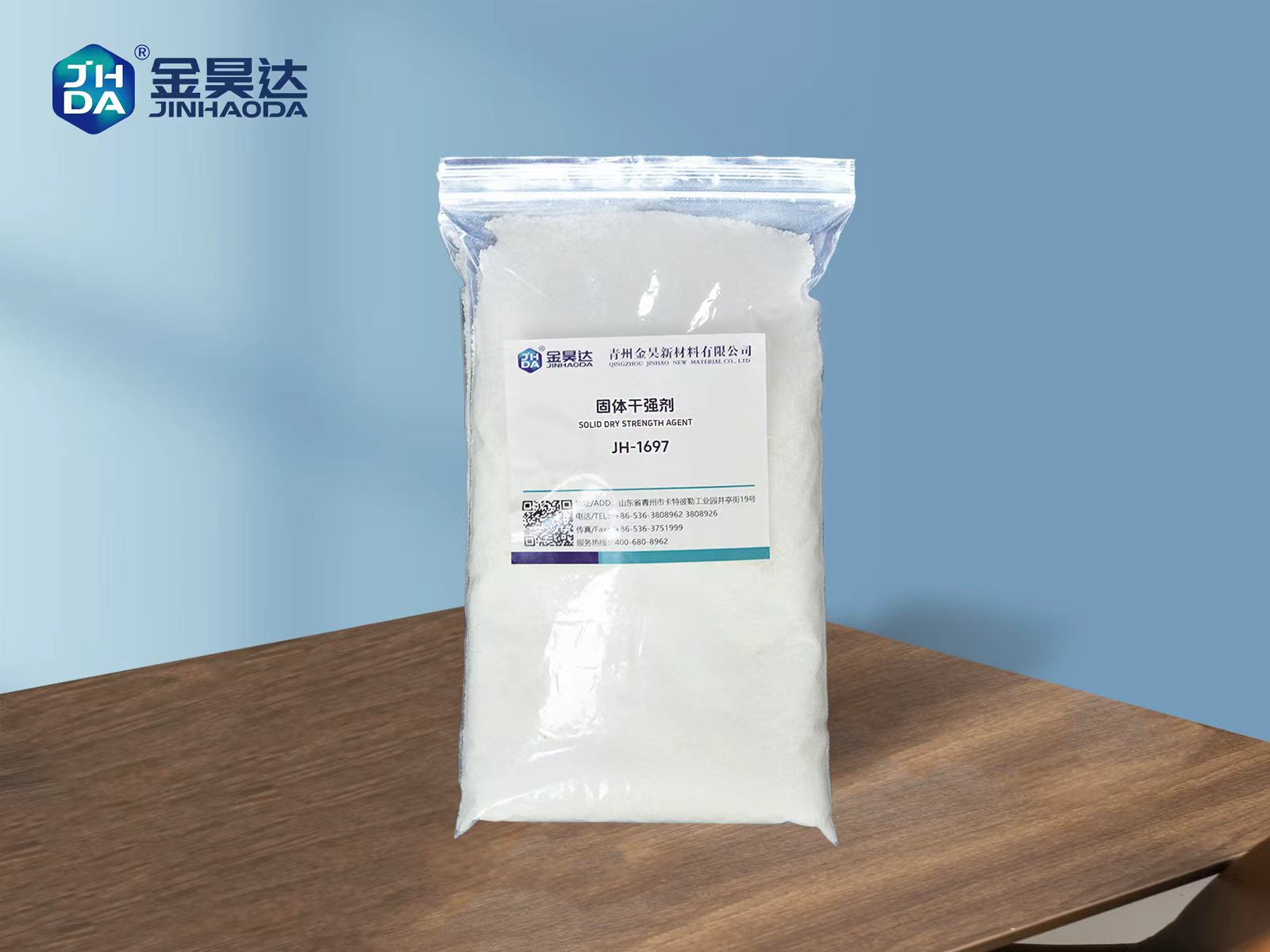
The third split is grade-specificity, and it is where multi-component products need the most care. JH-1697 is described as a white powder solid dry strength agent with active content of at least 95%, cationic, soluble, with a twelve-month shelf life, formulated from cationic polyacrylamide, polyamide epichlorohydrin resin, modified cationic starch and an amphoteric polymeric reinforcing monomer. A claim made about a grade with that many declared components should be supported by an intentional-components declaration. Without it, “formaldehyde-free” describes a positioning statement rather than a product.
Chemistry-level detail is not pedantry in this field, because regulatory provisions are written at chemistry level. 21 CFR Part 176, for example, contains provisions for particular resin families — including acrylamide-acrylic acid resins used as adjuvants — each subject to its own stated conditions. A declaration that does not identify the chemistry cannot be matched to a provision, and a declaration that cannot be matched cannot be accepted as evidence.
JH-1697 and JH-2219: matching the grade to the food-contact job
Food-contact work pulls two different product types into the same conversation, and they fail in different ways.
JH-1697 is intended for the papermaking and pulp molding industry, is documented as suitable for food contact paper, and is compatible with starch, sizing agents, defoamers and other wet-end chemicals. JHDA positions it for food-grade pulp tableware, food packaging paper and green packaging cardboard. As a powder, it introduces a make-down step that a liquid grade does not, so the compliance file and the trial protocol should both state how the product is dissolved, at what concentration, and how the solution age is controlled — because a strength result obtained from a poorly dissolved powder tells the mill nothing about the product.
JH-2219 is a liquid pulp molding strength enhancer with 20.0% ± 1.0% solid content, pH 2.0–5.0, viscosity of 5,000–12,000 cps at 25 °C, amphoteric character and a six-month shelf life. It is designed for recycled pulp applications and documented as suitable for food-grade pulp tableware and food packaging pulp molds, compatible with antifoaming agents and sizing agents, and described as a water-based formula without formaldehyde. For molded tableware, its documented functions extend beyond strength: improved dimensional stability, reduced deformation, warping and cracking during hot pressing and drying, and less sticky residue on molding dies.
That last point changes what “acceptance” means. A tableware producer that writes only a tensile target into the order has left out the variables that decide yield — deformation rate after hot pressing, die cleaning frequency, thickness and weight uniformity. The food-contact document set should sit alongside those production criteria, not in place of them.
| Grade | Form and recorded data | Documented application | Recorded wet-end compatibility | Verification item before order |
|---|---|---|---|---|
| JH-1201 | Cationic PAE liquid; 12.5% ± 1.0% solids; pH 2.0–5.0; viscosity ≤500 cps; 6-month shelf life | Tissue paper, paper cup base paper, filter paper, medical disposable paper, recycled packaging paper | Sizing agents, optical brightening agents, defoamers | Grade-specific food-contact declaration with instrument, use level, food type and date |
| JH-1697 | Cationic white powder; active ≥95%; soluble; 12-month shelf life | Papermaking and pulp molding; food contact paper; food-grade pulp tableware and packaging board | Starch, sizing agents, defoamers, other wet-end chemicals | Intentional-components declaration plus the basis of the formaldehyde-free statement |
| JH-2219 | Amphoteric liquid; 20.0% ± 1.0% solids; pH 2.0–5.0; viscosity 5,000–12,000 cps; 6-month shelf life | Recycled pulp; food-grade pulp tableware; food packaging pulp molds | Sizing agents, antifoaming agents | Food-contact documentation for the tableware line, plus deformation and die-deposit acceptance limits |
Compatibility with sizing agents, defoamers and OBA: documented, not assumed
Compatibility notes are written per grade, and they do not transfer between grades or between product families. Read them as a list of what has been stated, then treat everything outside that list as an open trial item.
For JH-1201, the recorded list covers sizing agents, optical brightening agents and defoamers, with a statement that brightness and water resistance are not adversely affected. For JH-1697, the recorded list covers starch, sizing agents, defoamers and other wet-end chemicals. For JH-2219, it covers sizing agents and antifoaming agents. Optical brightening agent interaction is explicitly recorded for JH-1201 and is not recorded for the other two grades in the available documentation — which means a mill whose brightness specification is tight should confirm OBA behaviour for JH-1697 or JH-2219 in a trial rather than infer it from the portfolio.
Portfolio-level statements deserve the same scepticism. JHDA’s retention emulsion JH-8501, for instance, is described as compatible with AKD sizing agent, surface sizing agent and dry strength additives without causing abnormal viscosity or sticky deposits. That is useful when designing a system-level trial, but it is a statement about JH-8501, and it does not qualify a strength agent on its own.
The commercial reason to settle this early is dispute mechanics. When a sizing failure or a brightness drop follows a strength agent change, the argument is almost never about the principle of compatibility; it is about dosing points, order of addition, contact time and which endpoint was measured. Fix those in the trial protocol and the argument disappears. Leave them open and the mill absorbs the cost of the ambiguity.
The document set to request before the first shipment
Documents should be requested as a set, dated and grade-specific, and agreed as a delivery condition rather than as a favour. A workable minimum for a paper strength agent going into a food-contact application:
- Grade-specific TDS with version and date. The specification the mill accepts must be the specification attached to the order, not a catalogue page.
- MSDS in the destination format. Needed for internal handling rules and for shipping documentation.
- Food-contact declaration naming the instrument. It should identify the legal measure or recommendation relied on, the assessed grade, the maximum use level and the food types covered.
- Composition or intentional-components statement. This is the document that makes a formaldehyde-free claim checkable, and the one most often missing.
- Test reports with method, laboratory, date and sample identity. A report that does not name the sample cannot be tied to the grade being purchased.
- Management-system certificates, read for scope and validity. JHDA’s quality management system is certified to ISO 9001:2015 under certificate 10423Q01592R1S and its environmental management system to ISO 14001:2015 under certificate 10423E01032R2S, both issued by Shandong Seatone International Certification Co., Ltd. for the production of papermaking additives. These certificates describe how the plant is managed. They do not approve a product for food contact, and they carry validity periods that must be current at the time of the order.
- Market-specific certificates where the destination requires them. JHDA holds a HALAL certificate, number 6637250000, issued by Shandong Halal Certification Service under MS1500:2019, with a scope of paper-making industry additives and applicability to the Indonesia market. Its scope is a reminder that scheme certificates are bounded by market and product category, and that a HALAL certificate says nothing about EU food-contact performance.
- Commercial and shipping documents: commercial invoice, packing list, certificate of origin, pre-shipment inspection report and, where relevant, dangerous goods transport documentation.
- Batch certificate of analysis and shelf-life statement. JHDA states that typical QA testing covers particle size, appearance, solids, pH, viscosity and functional tests, and that QC reports can be provided per order — which is precisely why the report content should be fixed in writing rather than assumed.
Writing the claim into the purchase order
A declaration that lives only in an email thread is not an acceptance criterion. The following clauses convert it into one.
| Order term | What to write | Why it matters |
|---|---|---|
| Grade and document version | Product name and model, plus the TDS revision accepted | Prevents substitution between revisions or between similar grades |
| Acceptance tests and tolerances | Solids, pH, viscosity and appearance limits taken from the grade data, with test methods | Turns data-sheet ranges into rejectable criteria |
| Retained sample | Sample retained from each batch, with a stated retention period | Makes later disputes resolvable by comparison |
| Documents as a delivery condition | Named document set due before shipment, with a stated consequence if incomplete | Stops compliance paperwork drifting behind the cargo |
| Change notification | Written notice of formulation, raw-material or manufacturing-site change, with re-qualification | A compliant grade can become non-compliant through a silent change |
| Remaining shelf life at delivery | A minimum remaining life, set against the six-month liquid and twelve-month powder shelf lives | Protects mills in long-sea-lane supply chains |
| Batch traceability | Batch number on every container, linked to the COA | Allows containment if a compliance question arises later |
| Trial-to-supply criteria | The endpoints and values that convert a successful trial into a supply approval | Prevents an informal trial becoming an unexamined standing order |
Three qualification routes, and the limit of all three
Mills tend to qualify strength agents along one of three routes, and the differences are worth stating plainly.
Statement-only qualification accepts the supplier’s compliance language and the trial result. It is fast and it establishes that a product can meet a strength target on a given machine. It does not establish which instrument was assessed, which grade was covered, or whether the paperwork would survive scrutiny by a customer’s technical auditor.
Certificate-based qualification adds management-system and scheme certificates. This is better than nothing and worse than it looks: ISO 9001 and ISO 14001 certificates describe production management, not product suitability, and scheme certificates such as HALAL are bounded by market and category. A certificate file can look complete while containing no food-contact assessment of the specific grade.
Document-plus-trial-plus-contract qualification links a grade-specific declaration to a defined trial protocol and to order terms that can be enforced. It is slower at the start and cheaper over a supply relationship, because the criteria exist before the dispute does. Where the finished article must meet a migration limit, none of the three routes replaces the mill’s own testing on that article — the supplier cannot do that work on the mill’s behalf.
Market context: modest growth against tighter thresholds
Two data points frame the procurement environment. Market Research Future estimates the global paper dry strength agent market at USD 0.86 billion in 2024, and projects growth from USD 0.8912 billion in 2025 to USD 1.273 billion by 2035, a compound annual growth rate of 3.63%. Separately, Maximize Market Research reports the global wet strength additives market at USD 2.39 billion in 2025 — a different product boundary, so the two figures should not be added or compared directly, and both are commercial research estimates rather than audited statistics.
The regulatory signal points the other way from the growth signal. The BfR reduction of the BPA migration limit for recycled paper from 0.05 mg/kg to 0.01 mg/kg, effective 1 October 2025, raises the evidentiary bar for exactly the recycled-furnish applications where strength agents do much of their work. Modest volume growth plus rising documentation requirements has a practical implication for buyers: differentiation between suppliers is less likely to come from headline dosage claims and more from whether a supplier can produce a grade-specific, dated, chemistry-level compliance file on request. That is an interpretation of the supplied data, not a forecast, and it should be re-tested as new evidence appears.
Outlook: documentation as a procurement function
If migration thresholds continue to tighten, the mills that adapt fastest will be those that treat compliance documents as part of the bill of materials rather than as an appendix to it — a declaration on file, a version number on the order, a retained sample in the store, and a trial protocol that anyone can re-run. On current evidence, that shift favours suppliers who can name a grade, an instrument and a use level without ambiguity, and it penalises the ones who answer a technical question with a certificate. The direction is conditional on how national and regional requirements develop; the discipline of asking is not.
A general company and product portfolio document is available for reference: JHDA introduction 2026 (PDF). Company information is published at en.sdqzjinhao.com.
Frequently asked questions
Does a supplier declaration that a paper strength agent complies with EU food-contact rules approve the product for food packaging?
No. A declaration states that a substance was assessed against a named instrument under stated conditions. Approval for a specific food packaging application depends on the finished article, the food type, the contact time and temperature, and the migration result for that article. The declaration is one input to that assessment, and it should name the instrument, the grade, the maximum use level and the date of assessment before a mill relies on it.
What should a mill request when a dry strength agent is described as formaldehyde-free?
Three things: the basis of the claim, meaning whether it refers to no formaldehyde used as an input, a free formaldehyde content below a stated limit, or a non-detect result under a named method; the scope, meaning the product as supplied or the finished paper; and the supporting document, normally an intentional-components declaration plus a test report naming the method and detection limit. For a multi-component grade such as JH-1697, formulated with cationic polyacrylamide, polyamide epichlorohydrin resin, modified cationic starch and an amphoteric polymeric reinforcing monomer, a grade-specific declaration is the only form of evidence that can be checked.
Which documents should be in place before the first shipment of a wet strength agent?
At minimum: a version-dated TDS for the exact grade, an MSDS in the destination format, a food-contact declaration naming the instrument and use conditions, an intentional-components statement, test reports identifying the sample and method, management-system certificates read for scope and current validity, market-specific scheme certificates where the destination requires them, the commercial and shipping document set, and a batch certificate of analysis with a shelf-life statement. JHDA states that QC reports can be provided per order, which makes it practical to specify their content in the contract.
How can a mill verify compatibility with sizing agents, defoamers and optical brightening agents?
Start from the grade-level record rather than from the portfolio. Documented compatibility covers sizing agents, optical brightening agents and defoamers for JH-1201; starch, sizing agents, defoamers and other wet-end chemicals for JH-1697; and sizing agents plus antifoaming agents for JH-2219. Optical brightening agent interaction is recorded for JH-1201 only, so a mill with a tight brightness specification should confirm it by trial for the other grades. The trial protocol should fix dosing points, order of addition, contact time and the measured endpoints, typically Cobb value, brightness, ring crush and wet tensile.
Do ISO 9001, ISO 14001 or HALAL certificates demonstrate food-contact compliance?
No. ISO 9001:2015 and ISO 14001:2015 certificates cover quality and environmental management systems for the production of papermaking additives, and their scope statements should be read together with their validity periods. The HALAL certificate held by JHDA, number 6637250000 issued under MS1500:2019, has a scope of paper-making industry additives and applies to the Indonesia market. All three are useful supplier-qualification evidence, and none of them assesses a specific grade for food-contact suitability.
Tem questões ou precisa de mais detalhes?
Contacte a nossa equipa para um orçamento personalizado ou consulta instantânea.
Solicitar orçamento
Preencha o formulário abaixo e a nossa equipa entrará em contacto com uma proposta personalizada.
Chat direto do WhatsApp
Prefere conversar em tempo real? Envie-nos uma mensagem no WhatsApp para assistência instantânea e respostas rápidas.
- Obter orçamento personalizado
- Partilhar fotos ou documentos
- Discuta as suas necessidades diretamente
Geralmente responde em 5–30 minutos durante o horário de expediente.