
Parameters and certifications of hydraulic presses for used paper
Parameters and certifications of hydraulic presses for waste paper
When an industrial buyer evaluates a hydraulic press for waste paper, the decision is not reduced to nominal force. Pressure parameters, bale size, installed power, and applicable certifications determine whether the equipment can sustain a recycling operation without interruptions. This technical reading covers the criteria that separate an informed purchase from a selection based solely on price.
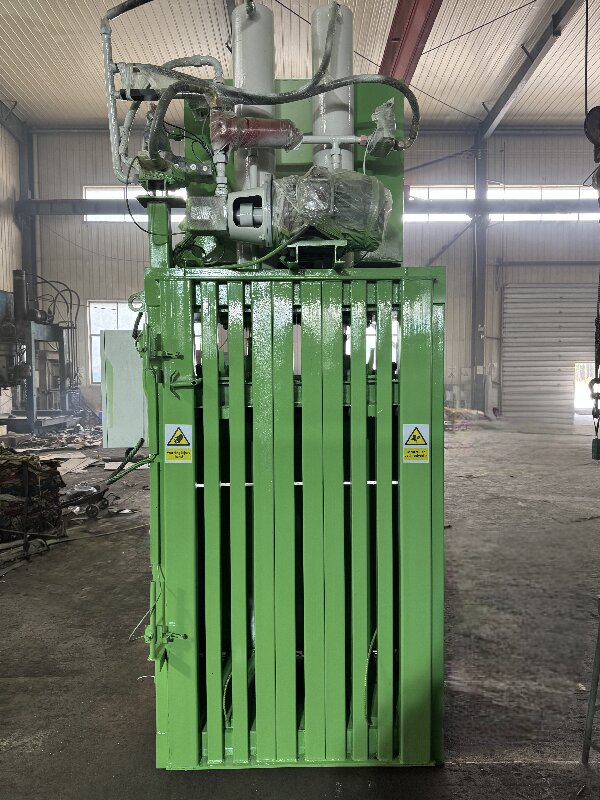
Compaction equipment for cardboard and waste paper. Reference image from NKBALER's portfolio.
Why the Research-Evaluation phase requires verifiable criteria
In practice, waste paper arrives at the plant with corrugated cardboard, brochures, magazines, and mixed fractions. If the compactor does not produce stable bales, logistics costs are transferred to transportation and storage. Therefore, the research stage must focus on specifications that can be verified before the purchase order: working pressure, main cylinder force, bale dimensions, and achievable density.
A frequent error is comparing machines only by hydraulic tonnage. That data is relevant, but it does not explain productivity by itself. A 60-ton baler may be suitable for small volumes of dry waste, while a fully automatic line of 125 or 180 tons targets continuous material flows in larger-scale recycling plants. The key is to cross-reference tonnage with cycle time, feed capacity, and tying type.
NKBALER's solution mapping for waste paper
Shaanxi Nick Machinery Equipment Co., Ltd., identified as NKBALER, is an engineering company based in Wuxi, China, founded in 2013. It is dedicated to R&D and sales of environmental protection equipment and packaging machinery. Its portfolio includes vertical balers, semi-automatic and fully automatic horizontal balers, as well as equipment for scrap metal, sawdust, textiles, and agricultural materials.
For waste paper, the portfolio ranges from a compact vertical baler like the NK1070T60, with 60 tons and bales of 1100 x 700 x (500-900) mm, to horizontal systems like the NKW180QT, fully automatic, with a main cylinder force of 180 tons and bale dimensions of 1100 mm width by 1250 mm height and approximately 1600 mm length. The choice between one format and another depends on input volume, available space, and the density required by the recyclable material buyer.
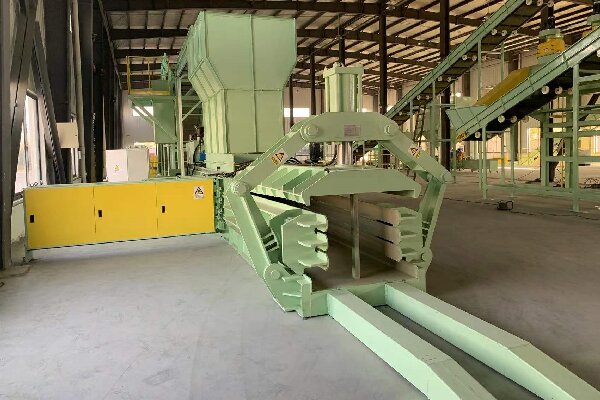
Fully automatic horizontal hydraulic baler. This type of equipment is installed in recycling plants with continuous flow of paper and cardboard.
Technical reading of parameters
The parameters of a hydraulic press for waste paper can be grouped into four blocks: force and pressure, dimensions and density, power and productivity, and feeding characteristics. To illustrate, the NKW180QT records a working pressure of 30.5 MPa, a main motor power of 45 kW + 7.5 kW, and a declared capacity of 12-15 tons per hour according to the data sheet. The main structure weighs 28 tons and the chain conveyor has an additional motor of 4 kW.
The working pressure of 30.5 MPa indicates the hydraulic load level of the system, not the total force. That pressure, combined with the cylinder diameter, produces the compaction force. In this model, the main cylinder force is 180 tons. For a buyer, this data should be read together with material density: the data sheet indicates a density of 500-600 kg/m³ for paper and cardboard fractions in standard configuration.
| Parameter | NKW180QT | NK1070T60 | NKB220 |
|---|---|---|---|
| Type | Fully automatic horizontal | Vertical for waste paper | Constant-weight bagging machine |
| Hydraulic force | 180 T | 60 T | 200-ton model |
| Working pressure | 30.5 MPa | — | 21 MPa |
| Bale dimensions | 1100 x 1250 x ~1600 mm | 1100 x 700 x (500-900) mm | 480 x 480 x (220-350) mm |
| Capacity | 12-15 t/h | 5-8 bales/hour | 2.5-3 t/h |
| Main motor power | 45 kW + 7.5 kW | 15 kW / 20 HP | 40 HP |
Data taken from the technical data sheets provided by NKBALER. Values must be confirmed for each specific configuration.
In vertical equipment like the NK1070T60, the logic changes: the compact size facilitates installation in transfer centers or shops with limited space. It produces bales of 1100 x 700 mm with variable height from 500 to 900 mm. The capacity of 5-8 bales per hour is lower than that of an automatic horizontal, but sufficient for moderate flows of dry waste. For constant-weight bagging operations, the NKB220 offers a compression time of 22 seconds and 90 blocks per hour, with bales of 30-35 kg per bag, according to its data sheet.
Certifications and European compliance
In acquisitions destined for the EU, buyers often request evidence of compliance with the Machinery Directive and harmonized standards. For the NKW180QT model, documentation includes a Verification of Conformity with number No.: DPWD/09/060/2024, issued by the Executive Director, applicable to the EU/EEA market. The cited standards are EN ISO 12100:2010, EN 60204-1:2018, and EN 415-1:2014.
Additionally, NKBALER indicates that other horizontal hydraulic balers are certified according to the Machinery Directive, with certification EASY03220201M issued by UDEM International Certification Auditing Training Centre Industry and Trade Inc. Co. This certification applies to EU, EEA, and Türkiye, and includes standards EN ISO 12100:2010 and EN 60204-1:2018. The recorded issue date is March 22, 2022, with validity until March 21, 2027. These documents are verifiable and allow the buyer to confirm equipment traceability before shipping.
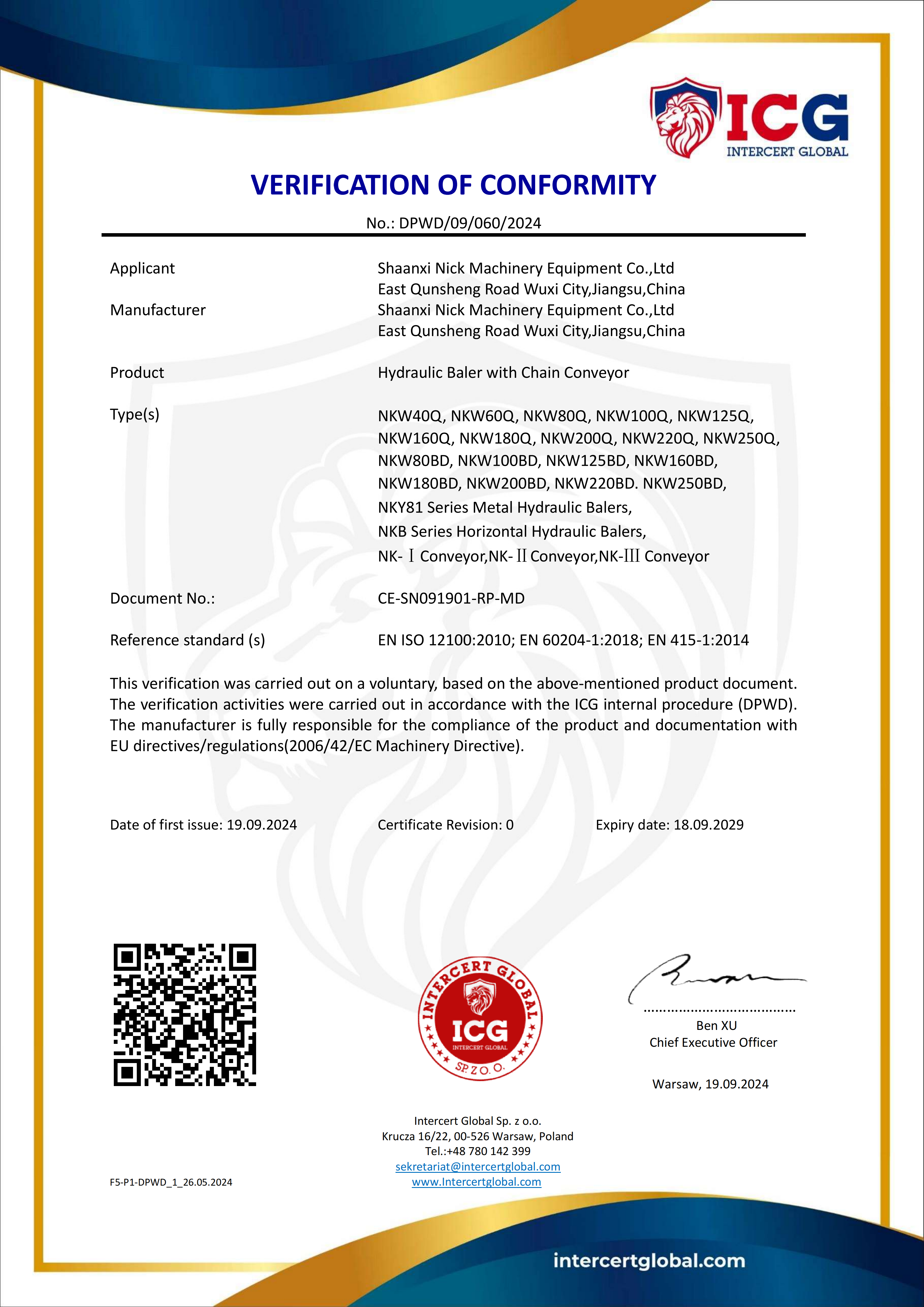
Example of conformity documentation applicable to equipment destined for the European market.
The scope of these certifications must be read precisely: they cover the models listed in the documents. It is not correct to assume that a certification from one model automatically transfers to all equipment from the supplier. Therefore, traceability by certification number and by model is a critical evaluation criterion.
Applications beyond waste paper
The same hydraulic base is used to pack plastic bottles, cardboard boxes, municipal solid waste, metal scrap, wood shavings, sawdust, rice husks, hay, and textiles. In NKBALER's portfolio, for example, the NK60LT is designated as a cardboard box baler; the NK1580T200 is oriented to cans and PET bottles; the NK-T90L works with textiles and clothing; and the NKB280 is used for straw and hay. This breadth allows a recycling operator to consolidate different fractions with the same family of equipment, reducing the need for multiple suppliers.
Documented usage scenarios include a recycling station manufacturer in Indonesia, which uses a unit for packing plastic and paper waste, with an estimated lifespan of 10 to 15 years and stable operation. An agricultural manufacturer in Pakistan uses a baler for straw and alfalfa, highlighting low noise levels. In Romania, a farm installed a high-density baling solution for alfalfa; the density of each bale exceeded 400 kg/m³ and transportation costs were reduced by approximately 30%, according to the case study provided by NKBALER.
Market trends and purchase context
The global baler market reached a value of 6.40 billion dollars in 2024, according to Grand View Research. The specific segment of waste balers, focused on paper, plastic, and solid waste, reached 1.45 billion dollars in the same year, reported by Waste Baler Market Research. Asia-Pacific dominates the hydraulic market with a revenue share exceeding 34% in 2024, with China as the main driver.
These data do not imply that a buyer should automatically choose an Asian supplier, but they help understand the concentration of productive capacity and the maturity of the technical offer. For an importer or a recycling plant, access to specialized manufacturers can translate into greater customization flexibility and defined delivery times. NKBALER, for example, declares a monthly capacity of 10 units, with delivery times of 30 to 45 days and a MOQ of 1 unit. These conditions are useful for buyers testing a first equipment or requiring specific voltage and block size configurations.
Comparison with traditional solutions and real limits
Fully automatic hydraulic presses offer operational advantages over manual or semi-automatic compaction methods: higher bale density, less operator intervention, and PLC-controlled cycles for 24/7 industrial service. NKBALER's data sheets indicate that continuous operation and PLC control are part of the standard design of certain models, with low noise level and low energy consumption requirements.
However, these machines also have limits that must be honestly evaluated. A fully automatic horizontal baler requires significant space: the dimensions of the main structure in the NKW series vary approximately between 9.8 m and 13 m in length, 2.3 m and 4.3 m in width, and 1.4 m and 5.8 m in height. Additionally, installation requires adequate electrical supply, water cooling system or oil cooler for continuous operation, and prior classification of material. No equipment can compensate for an inadequate mixture of waste, metals, or contaminants.
Total weight must also be considered. The NKW180QT, for example, has a main structure of 28 tons and a conveyor of approximately 5 tons. This data impacts floor preparation, unloading crane, and installation costs. A buyer who only compares hydraulic power may omit these infrastructure costs, which can be as relevant as the equipment price.
Future perspectives
The evolution of hydraulic presses for waste paper points to greater automation, integration with transport lines, and remote monitoring capabilities. NKBALER declares remote after-sales support and customization of technical parameters, voltage, color, and block size. In markets with voltage differences between 200 V and 480 V, this flexibility reduces friction in import. European certification will also continue to be a key filter, especially with the transition to machinery regulation and the demand for more detailed technical documentation.
For buyers in the Research-Evaluation phase, the most efficient path is not to accumulate more catalogs, but to build a comparison matrix with verifiable columns: model, force, pressure, bale dimensions, capacity, installed power, total weight, and certifications. That matrix can be prepared before contacting the supplier and serves both for internal evaluation and for requesting homogeneous quotes.