
Parallel vs Conical Twin Screw Barrel: PVC Buyer Framework
Twin screw barrel selection for PVC extrusion and compounding begins as a process decision rather than a purchasing decision. The global feed screw barrel market was valued at USD 1.89 billion in 2024 and is projected to reach USD 3.33 billion by 2034, a CAGR of 5.8% (Global Insight Services). Because geometry decides which polymers a line can run economically, which replacement parts can still be sourced years later, and which inspection figures actually matter at goods-in, the geometry gate is best closed before quotations are compared side by side.

Production environment for high-precision barrels and screws, where dimensional records and heat-treatment data are generated before shipment.
Inside the Guangyou Screw range, the split is documented rather than implied. The Conical Twin Screw Barrel covers Φ25/50–Φ185/340 and is specified for PVC extrusion, listed under plastics machinery and construction materials. The Parallel Twin Screw Barrel covers Φ45–Φ350 and is specified for compounding and pelletizing, listed under plastic recycling and compounding. Both families are produced to one shared inspection envelope, so the geometry decision — not the tolerance specification — is where most buying teams separate.
Zhejiang Guangming Plastics Machinery Co., Ltd., trading under the Guangyou Screw brand, is a China-based manufacturer of high-precision barrels and screws. Established in 1992, the company operates a 100,000 m² facility with more than 800 employees, a 25-engineer R&D team and an annual output of 32,000 units, exporting to more than 50 countries and regions with the EU as its main export market.
Why the Geometry Decision Comes Before the Quotation
The two barrel families are not interchangeable stock items, and their size ranges do not fully overlap. The conical range begins below the parallel floor and the parallel range extends beyond the conical ceiling. A plant running PVC profile extrusion alongside a recycling or compounding line therefore cannot standardise on a single geometry across the whole site.
What both families do share is a common published technical envelope. Buyers comparing the two should read it as one specification block:
- Hardness after hardening and tempering: HB260–310
- Nitrided hardness: HV850–1000
- Nitrided case depth: 0.45–0.7 mm
- Nitrided brittleness: less than Grade 2
- Surface roughness: Ra 0.4
- Screw straightness: 0.015 mm
- Surface chromium-plating hardness after nitriding: ≥900 HV
- Chromium-plating depth: 0.025–0.10 mm
- Alloy hardness: HRC50–65; alloy depth: 0.8–2.0 mm
Because those figures are identical for conical and parallel products, a specification sheet alone will never tell a procurement team which one to buy. The only reliable differentiator at screening stage is the process type and applicable industry statement attached to each product.
A Five-Gate Buyer Decision Framework
The framework below converts the available product and supplier data into five sequential gates. Each gate has one decision output, and a purchase order is normally only defensible after all five have been answered with documents rather than verbal assurances.
| Gate | Core question | Evidence to request | Decision output |
|---|---|---|---|
| 1. Process fit | Does the line run PVC extrusion and construction-material output, or compounding and recycling? | Barrel type designation, applicable industry statement, model range coverage | Geometry shortlist (conical or parallel) |
| 2. Material and surface | Which base alloy and surface treatment matches the abrasive and corrosive load? | Material designation, hardness and case-depth data, plating data | Material specification |
| 3. Dimensional consistency | Will each piece in the batch assemble without rework? | Straightness and roughness values, batch test records, drawing-based inspection reports | Batch release criteria |
| 4. Certification | Does the certificate scope wording cover the item actually being purchased? | Certificate numbers, standards, scope wording, validity dates | Compliance file |
| 5. Execution terms | Can the supplier hold MOQ, lead time, acceptance and payment conditions? | MOQ, delivery terms, acceptance criteria, payment terms, lead-time schedule | Purchase order conditions |
Gate 1 — Matching Geometry to Process, Not to Price
The naming reflects screw geometry. In a conical pair the screw diameters taper between the feed and metering zones and the centre distance changes along the axis; in a parallel pair the screws keep a constant diameter and a constant centre distance. Conical geometry is commonly associated with high feed-volume, powder-handling PVC formulations, while parallel geometry is commonly associated with compounding lines where screw profiles are engineered for mixing, venting and pelletising.
The published product data reflects that split directly:
| Selection factor | Conical Twin Screw Barrel | Parallel Twin Screw Barrel |
|---|---|---|
| Model range | Φ25/50–Φ185/340 | Φ45–Φ350 |
| Process type | PVC extrusion | Compounding & pelletizing |
| Applicable industry | Plastics machinery / construction materials | Plastic recycling & compounding |
| Primary materials | 38CrMoAl (1.8509), D2, AISI316 | 38CrMoAl (1.8509), D2, AISI316 |
| Shared inspection envelope | HB260–310 after hardening and tempering; HV850–1000 nitrided; case depth 0.45–0.7 mm; Ra 0.4; straightness 0.015 mm; alloy HRC50–65 at 0.8–2.0 mm | |
In practice, the conical family suits lines producing PVC pipe, profile and sheet for construction-material markets, where the purchased barrel must match an existing extruder platform and its tooling. The parallel family suits recycling and compounding operations where the barrel sits inside a pelletising line and the dominant wear driver is the filler or contaminant load in the melt rather than the powder feed behaviour.
Three buyer profiles that behave differently at this gate
Case records from the manufacturer's supplied material describe three recurring buyer types, each of which stresses a different part of Gate 1:
- Original equipment manufacturers buying batch components for new plastic machinery assembly, where fit and dimensional repeatability matter more than any single-barrel performance claim.
- Plastic product manufacturers processing high-wear and corrosive polymers across compounding, extrusion and moulding, where material choice inside the barrel dominates lifecycle cost.
- Screw and barrel manufacturers plus distributors handling sourcing, local replacement and customised retrofitting of various machine components, often against a physical sample or customer drawing.
Gate 2 — Material and Surface Specification
Material choice is the second gate because it defines what the barrel will survive, not what it will cost on day one. The listed primary options are 38CrMoAl (1.8509), D2 and AISI316, and the wider material list available from the same manufacturer also covers 34CrAlNi7 (1.8550), DC53, AISI420, 31CrMoV9 (1.8519), Gr12MoV, 9Cr18MoV, 40CrNiMo, 440C, 17PH-4, 42CrMo, AISI304, Incoel 718, 40Cr, 1.2316, Hasteloy C-276, C45, 1.4462, Incoel 625, SKD11, 1.4404, Monel 400, SKD61, 1.4122, Monel 500 and S600.
That list matters because abrasive and corrosive loads pull in opposite directions. High-filler PVC formulations and mineral-filled compounds primarily attack the surface, which is why nitriding case depth and alloy hardness appear first in most specification discussions. Chemically aggressive melts push buyers toward stainless and nickel-alloy grades instead, where base-metal corrosion resistance outranks maximum surface hardness.
Comparison benchmark: an industry reference for nitriding steel 38CrMoAl in plasticating screws cites a typical case depth of 0.4–0.6 mm with surface hardness of 900–1,100 HV (DIN 1.8509 / industry standard). The published Guangyou Screw envelope is a 0.45–0.7 mm nitrided case depth with nitrided hardness of HV850–1000. The useful lesson for buyers is that the two figures are quoted on different bands — a wider case-depth window and a slightly lower hardness ceiling. Neither statement should be read as better or worse on its own; both define the acceptance window that the purchase order should reference, and both should be measured on the same basis before a comparison claim is made.
Where abrasion is extreme, bimetallic construction is the third route. Bimetallic barrels typically use a centrifugally cast alloy liner based on boron-nickel-chromium, with liner thickness in the range of 1.5–3.0 mm (Reiloy / Xaloy industry technical specifications). The global bimetallic barrel and screw market is estimated at USD 2.8 billion in 2025 and forecast to reach USD 4.7 billion by 2034 (Dataintelo); that figure carries medium reliability, so it is best used as a direction-of-travel signal rather than a planning number.
The core hardness figure should not be overlooked. A hardened-and-tempered core of HB260–310 supports the nitrided case, and a case that is hard but thinly supported is more likely to crack under impact loading than a correctly matched core-and-case combination.
Gate 3 — Dimensional Consistency Across Batches of 1 to 50 Pieces
The third gate is where a single prototype purchase and a repeat production order diverge. The manufacturer's stated capability includes a minimum order quantity of 1 unit, 100% testing on all products, OEM production services, and customisation options for voltage and logo. Monthly capacity is stated at 2,700 units against an annual output of 32,000 units.
Case material describes batch customised component orders where a single batch ranges from 1 to 50 pieces, supplied to machinery OEMs, plastic product manufacturers, and screw and barrel manufacturers or distributors. For the OEM group, the recorded outcome is stable batch delivery with high dimensional consistency, which supports machine assembly and equipment commissioning without rework. For the distributor and replacement segment, the recorded outcome is 100% precise mechanical fit on components manufactured to custom technical drawings.
Two published values should appear in any goods-in discussion. Screw straightness is specified at 0.015 mm and surface roughness at Ra 0.4. Twin screw geometry amplifies the consequence of deviation, because two intermeshing flights must maintain their clearance relationship along the full barrel length. A straightness figure is therefore not a cosmetic detail; it is the parameter that determines whether the pair can be installed and run as intended.
Buyers executing a first order would reasonably ask for:
- A dimension report keyed line by line to the submitted drawing.
- Straightness and roughness measurements recorded against the specified values.
- Heat-treatment and nitriding records tied to the same batch identity as the finished parts.
- 100% test confirmation covering the individual pieces, not a sampling statement.
Gate 4 — Certificate Verification: Read the Scope, Not the Logo
Certification is the gate most often closed too early. A certificate title confirms that a management system has been assessed; it does not automatically confirm that the product on the purchase order sits inside the certified scope. The three published management system certificates provide a practical example.
| Standard | Certificate number | Issued by | Scope wording as issued | Valid to |
|---|---|---|---|---|
| ISO9001:2015 | 15/25Q6428R80 | WIT ASSESSMENT | Design and manufacturing of orthogonal twin-screw extruders and barrel components for plastic extrusion | 2028-05-12 |
| ISO14001:2015 | 15/25E6429R20 | WIT ASSESSMENT | Environmental management involved in the design and manufacture of counter-rotating twin-screw and barrel for plastic extruder | 2028-10-07 |
| ISO45001:2018 | 15/25S6430R20 | WIT ASSESSMENT | Occupational safety and health management involved in the design and manufacture of counter-rotating twin-screw and barrel for plastic extruder | 2028-10-07 |
All three certificates were issued on 2025-05-08 and carry IAF international mutual recognition, with the stated market covering the entire domestic industry and global overseas markets.
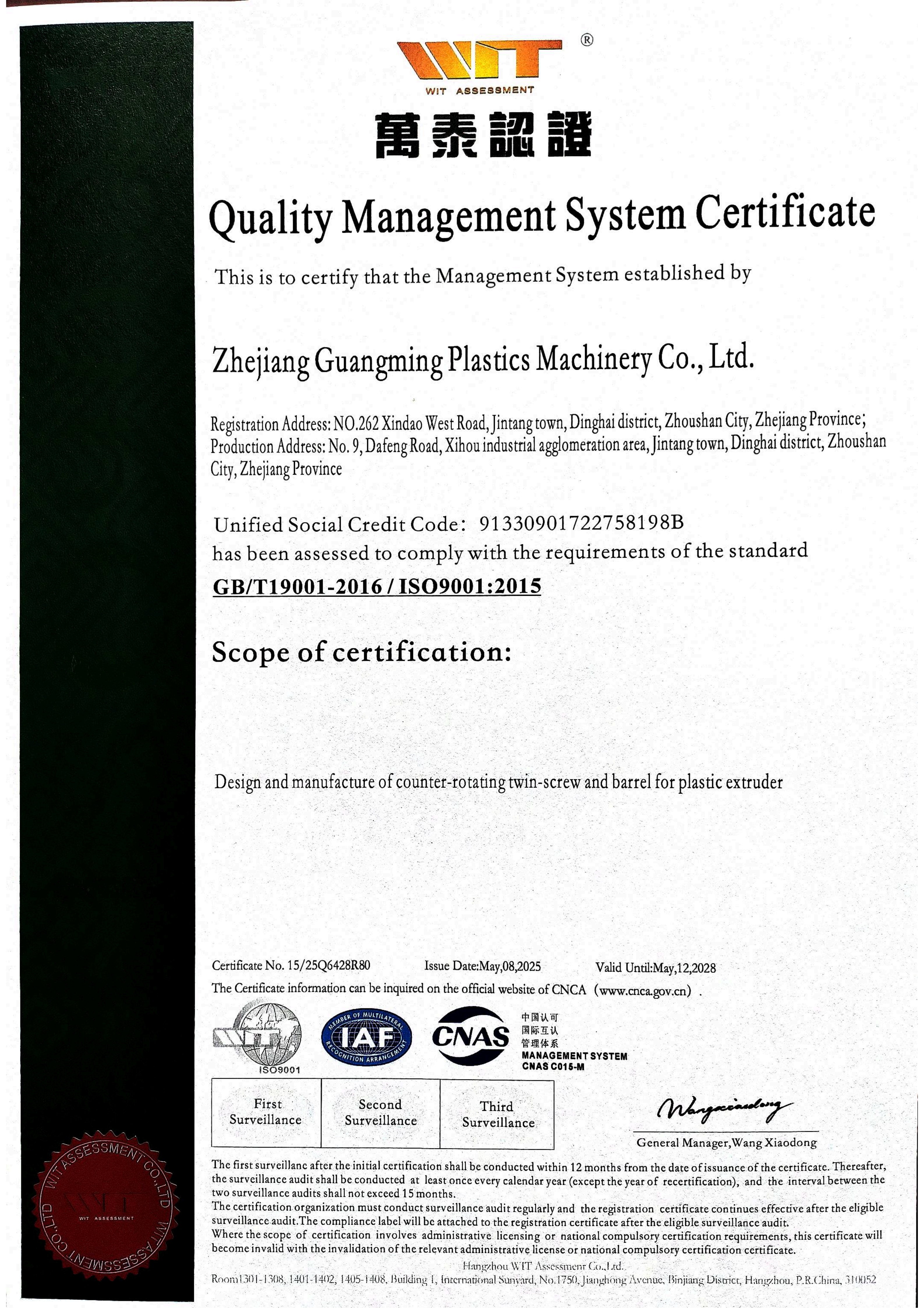
ISO9001:2015 Quality Management System Certificate, certificate number 15/25Q6428R80, issued by WIT ASSESSMENT, valid to 2028-05-12.
Two details in that table deserve attention. First, the scope wording is not identical across the three standards: the ISO9001:2015 scope refers to orthogonal twin-screw extruders and barrel components for plastic extrusion, while the ISO14001:2015 and ISO45001:2018 scopes refer to the design and manufacture of counter-rotating twin-screw and barrel for plastic extruder. Second, the expiry dates differ — 2028-05-12 for ISO9001:2015 against 2028-10-07 for the other two.
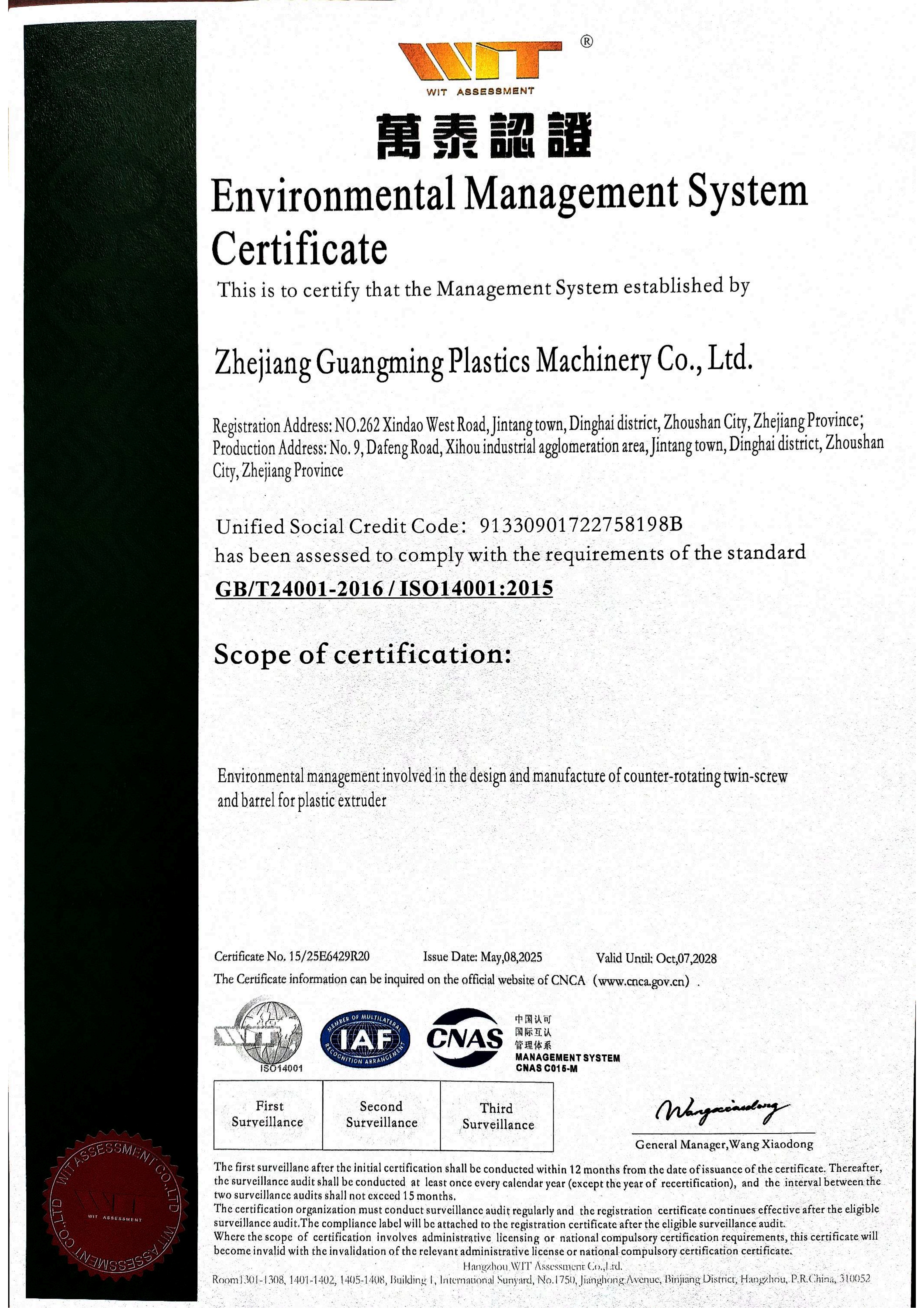
ISO14001:2015 Environmental Management System Certificate, certificate number 15/25E6429R20, valid to 2028-10-07.
For a procurement team, this is an actionable finding rather than a formality. The purchasing file should map the certificate scope wording to the specific product line being bought, note the earlier expiry date in the supplier review calendar, and retain a copy of the certificate as issued rather than a marketing summary of it. That approach is not a comment on any particular supplier; it is simply how scope-limited certificates are meant to be used.
Gate 5 — Execution Terms: MOQ, Lead Time, Acceptance and Payment
The final gate converts technical fit into order conditions. The stated purchasing terms are a minimum order quantity of 1 unit, delivery terms of FOB/CIF, pre-shipment test as the acceptance criterion, and payment terms of 30/70. After-sales coverage is provided as a warranty.
Lead time is the term most likely to affect a project schedule, and the published position is explicit that it varies with size and bimetallic status. For nitriding single screw and barrel, the stated schedule is 40–50 days at Φ20–Φ90, 50–60 days at Φ90–Φ180, 60–70 days at Φ180–Φ250, and over 70 days above Φ250. Because the two twin screw families span Φ25/50–Φ185/340 and Φ45–Φ350 respectively, a buyer ordering a twin barrel in the upper part of either range is planning inside the longer end of that logic, and the specific schedule should be confirmed against the actual diameter rather than assumed.
Supply-side context supports the execution gate. The facility runs advanced CNC machining, German-imported inspection technology, and digital ERP/MES systems, with 100% testing applied to all products and OEM production services available alongside voltage and logo customisation. The manufacturer's stated export ratio is 30%, with the EU as the main market and delivery across more than 50 countries and regions including the US, Germany, the UK, Italy, Brazil and India.
Where This Framework Has Limits
A decision framework is only credible if it states what it cannot settle. Several boundaries apply here, and each one is drawn from the published data rather than from preference.
- The ranges do not cover the full spectrum. The conical family covers Φ25/50–Φ185/340 and the parallel family covers Φ45–Φ350. A plant needing both very small diameter work and very large compounding diameters will not satisfy both needs from one family.
- Lead time rises with diameter and with bimetallic construction. The published schedule is set out for nitriding single screw and barrel, and the same size logic is not published in equivalent detail for the twin screw families. Planning certainty for a large twin barrel is therefore a quote-stage question, not an assumption.
- 38CrMoAl is a first-line option, not a universal answer. It is listed first among the primary materials, but corrosive polymer streams push selection toward stainless and nickel-alloy grades, and high-abrasion streams may point toward bimetallic construction instead.
- The service-life reference is conditional. Case material cites a 1–5 year lifetime under normal high-filler PVC extrusion working conditions. That is a stated reference condition, not a guarantee; abrasive loading, filler content, temperature profiles and maintenance practice all shift the outcome.
- Certification scope wording must be matched to the order line. As shown above, the ISO9001:2015, ISO14001:2015 and ISO45001:2018 scopes are not identically worded and do not expire on the same date.
- The barrel is one component in a system. Screw profile, compression ratio, temperature control and the condition of the rest of the line also determine output quality. Replacing a barrel does not by itself guarantee a change in line performance.
Compared with the traditional habit of duplicating a worn barrel from a drawing and accepting the lowest quotation, the framework replaces a single-variable decision with five documented ones. It does not make the product cheaper or the lead time shorter; it makes the risk visible earlier, when it can still be priced and planned for.
Market Trend Signals Shaping 2026 Sourcing Behaviour
Three published market signals frame why this framework is becoming more common in procurement practice.
First, the equipment context is growing. The global plastic processing machinery market reached USD 25.9 billion in 2025, with injection moulding machines accounting for 50.9% of market share (Grand View Research). Estimates for the same market differ by source depending on whether peripheral equipment is included — a parallel IMARC estimate places the market at USD 39.0 billion — so buyers should treat any single top-line figure as definition-dependent.
Second, the component market itself is expanding. The feed screw barrel market is projected to grow from USD 1.89 billion in 2024 to USD 3.33 billion by 2034 at a CAGR of 5.8% (Global Insight Services). Within extrusion machinery, single-screw extrusion holds approximately 62% of the market as of 2024 (Fortune Business Insights), which positions twin-screw work as the more specialised segment where geometry and profile decisions carry more weight.
Third, wear-resistant construction continues to attract investment. The bimetallic barrel and screw segment is estimated at USD 2.8 billion in 2025, with a forecast of USD 4.7 billion by 2034 (Dataintelo, medium reliability). At the equipment tier, 2024 industry ranking coverage names Coperion, Leistritz and KraussMaffei in Germany and JSW in Japan among the leading twin-screw extruder manufacturers — relevant to barrel buyers because these platforms sit at the top of the supply chain that barrel specifications must ultimately fit.
Read together, the signals point the same way: as installed capacity grows, supplier selection shifts from “who can machine a barrel” to “who can document a batch, a certificate scope and a lead-time commitment”.
Future Outlook
Buyer expectations are likely to keep moving toward verification rather than assertion. Three developments appear most probable on current evidence.
Traceability will become a standard deliverable. Suppliers operating digital ERP/MES environments alongside imported inspection technology are already positioned to attach dimension reports, heat-treatment records and batch identities to a shipment, and buyers who request them as routine will find the negotiation easier than those who request them after a failure.
Material selection will continue to fragment. As filler loadings and recycled feedstock shares rise, the single default grade becomes harder to justify, and the practical decision will be between nitrided surfaces, higher-alloy grades and bimetallic construction — a trade-off between surface hardness, corrosion resistance and cost that the growth of the bimetallic segment reflects.
Mixed order sizes will persist. Because OEM assembly, distributor stocking and local replacement all feed the same supply chain, the ability to handle batch quantities from 1 to 50 pieces with consistent dimensional output will remain a meaningful selection criterion rather than a courtesy.
FAQ
What is the main difference between a parallel and a conical twin screw barrel?
In the Guangyou Screw range, the difference is defined by process type and size coverage. The Conical Twin Screw Barrel covers Φ25/50–Φ185/340 and is specified for PVC extrusion, listed under plastics machinery and construction materials. The Parallel Twin Screw Barrel covers Φ45–Φ350 and is specified for compounding and pelletizing, listed under plastic recycling and compounding. Both families are produced to the same published inspection envelope, including Ra 0.4 surface roughness and 0.015 mm screw straightness.
Which parameters should be verified before accepting a twin screw barrel?
The published specification for both families includes hardness after hardening and tempering of HB260–310, nitrided hardness of HV850–1000, nitrided case depth of 0.45–0.7 mm, nitrided brittleness below Grade 2, surface roughness Ra 0.4, screw straightness 0.015 mm, chromium-plating hardness after nitriding of at least 900 HV at a plating depth of 0.025–0.10 mm, and alloy hardness of HRC50–65 at an alloy depth of 0.8–2.0 mm. The stated acceptance criterion for orders is a pre-shipment test.
Which materials are available for twin screw barrels?
The primary listed options are 38CrMoAl (1.8509), D2 and AISI316. The wider material list also includes 31CrMoV9 (1.8519), 34CrAlNi7 (1.8550), DC53, Gr12MoV, 9Cr18MoV, SKD11, SKD61, AISI304, AISI420, 1.2316, 1.4404, 1.4122, 17PH-4, 440C, C45, 40Cr, 42CrMo, 40CrNiMo, 1.4462, Incoel 625, Incoel 718, Hasteloy C-276, Monel 400, Monel 500 and S600.
What is the minimum order quantity and what customisation is offered?
The minimum order quantity is 1 unit. The manufacturer provides OEM production services with customisation options for voltage and logo, and performs 100% testing on all products. Case records describe batch customised component orders in which a single batch ranges from 1 to 50 pieces, including components manufactured to custom technical drawings with a reported 100% precise mechanical fit.
How long does production take?
Lead time is stated to vary based on size and bimetallic status. For nitriding single screw and barrel, the published schedule is 40–50 days for Φ20–Φ90, 50–60 days for Φ90–Φ180, 60–70 days for Φ180–Φ250, and over 70 days above Φ250. Orders for twin screw barrels should have their specific schedule confirmed against the actual diameter and construction type, since the published size bands are given for the single screw nitriding range.
Which certificates cover the manufacture of these barrels?
Three management system certificates are published, all issued by WIT ASSESSMENT on 2025-05-08 with IAF international mutual recognition. ISO9001:2015 is certificate 15/25Q6428R80, scoped to the design and manufacturing of orthogonal twin-screw extruders and barrel components for plastic extrusion, valid to 2028-05-12. ISO14001:2015 is certificate 15/25E6429R20, valid to 2028-10-07. ISO45001:2018 is certificate 15/25S6430R20, valid to 2028-10-07. The ISO14001:2015 and ISO45001:2018 scope wording refers to environmental management and occupational safety and health management involved in the design and manufacture of counter-rotating twin-screw and barrel for plastic extruder.
What purchasing terms apply to an order?
The stated terms are a minimum order quantity of 1 unit, delivery terms of FOB/CIF, pre-shipment test as the acceptance criterion, and payment terms of 30/70. After-sales coverage is provided through a warranty, and customisation options cover voltage and logo.
Reference documents: the manufacturer's product catalogue is publicly available for download at https://cdn.socialarks.com/sbsp/25094/common/2026/0724/New%20catalogue.pdf. Additional product information is published at en.gmscrew.com.