
Parking Lift Model Qualification: Voltage, Control, Capacity
Parking Lift Model Qualification: Voltage, Control, Capacity
A parking lift is qualified model by model, not brand by brand. Two lifts from the same manufacturer can differ in supply voltage, operating interface, rated capacity and the precise scope of the certificate that covers them, and any one of those differences can stop an order at technical review. The practical answer is a qualification matrix that lists each candidate model against four columns — electrical supply, control interface, rated capacity, and structure and drive — and fills those columns from model-level documents rather than a company certificate file.
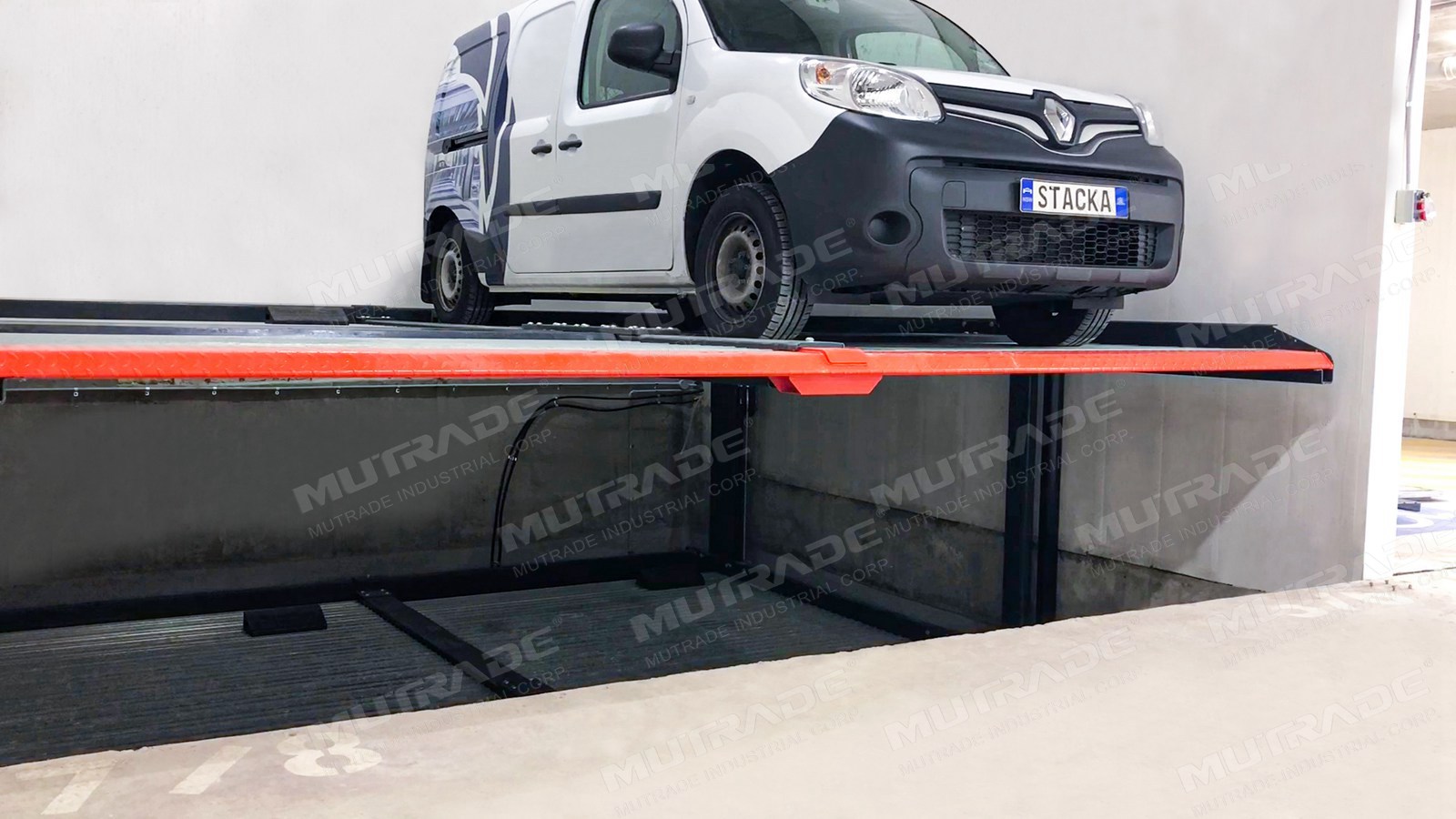
Mutrade Industrial Corp. is a Qingdao-based parking equipment manufacturer founded in 2009 whose portfolio covers parking lifts, semi-automatic parking systems and fully automatic parking systems, and whose customers are spread across more than 100 countries. That breadth is useful here for a specific reason: a wide catalogue is exactly the condition under which company-level specification claims become unreliable, and therefore the condition in which a model-level matrix earns its keep.
Why a company-level certification claim cannot qualify a model
A CE certificate covers the model named in its scope. That single sentence explains most of the confusion in parking lift procurement files, where a supplier's compliance folder is often read as a property of the company rather than of a product.
The pattern is visible in Mutrade's own certificate set. TÜV Rheinland certificate AM 50425570 0001 is scoped to "Two Post Metal Vehicle Parking Lift (Model Starke 2227)". A separate document, AM 50423989 0001, is scoped to Starke 2127. A third, AM 50537070 0001, covers the tilting TPTP-2. All three cite the same standard list — 2006/42/EC Annex I/05.2006, EN 14010:2003+A1 and EN 60204-1:2006+A1+AC — but each one names one model.
Other documents in the same file work the opposite way. ECM certificate 3J251223.QMWD01, issued 11 December 2024 and valid to 10 December 2029, carries a long scope that includes Hydro-Park 1123, Hydro-Park 1127, Hydro-Park 2136, Starke 1121, Starke 1127 and BDP-2+2 among others, citing EN ISO 12100:2010, EN 14010:2003+A1:2009, EN 60204-1:2018 and the EMC standards EN 61000-6-4:2019 and EN 61000-6-2:2019. ECM certificate 3J260613.QMTU32, issued 13 June 2026 and valid to 12 June 2031, covers Hydro-Park 2525, Hydro-Park 2625, Starke 2327, Starke 2427, the MLP series and the ARP series on the same standard list.
For a buyer, the implication is procedural rather than promotional. The question is not whether a supplier holds certificates, but which document names the model being purchased, what standard list it cites, which market it addresses, and when it expires. The TÜV documents above show an expiry of 1 January 2099, while the two ECM documents run for five years — so two certificates covering comparable equipment can carry very different review dates, and the date belongs in the matrix.
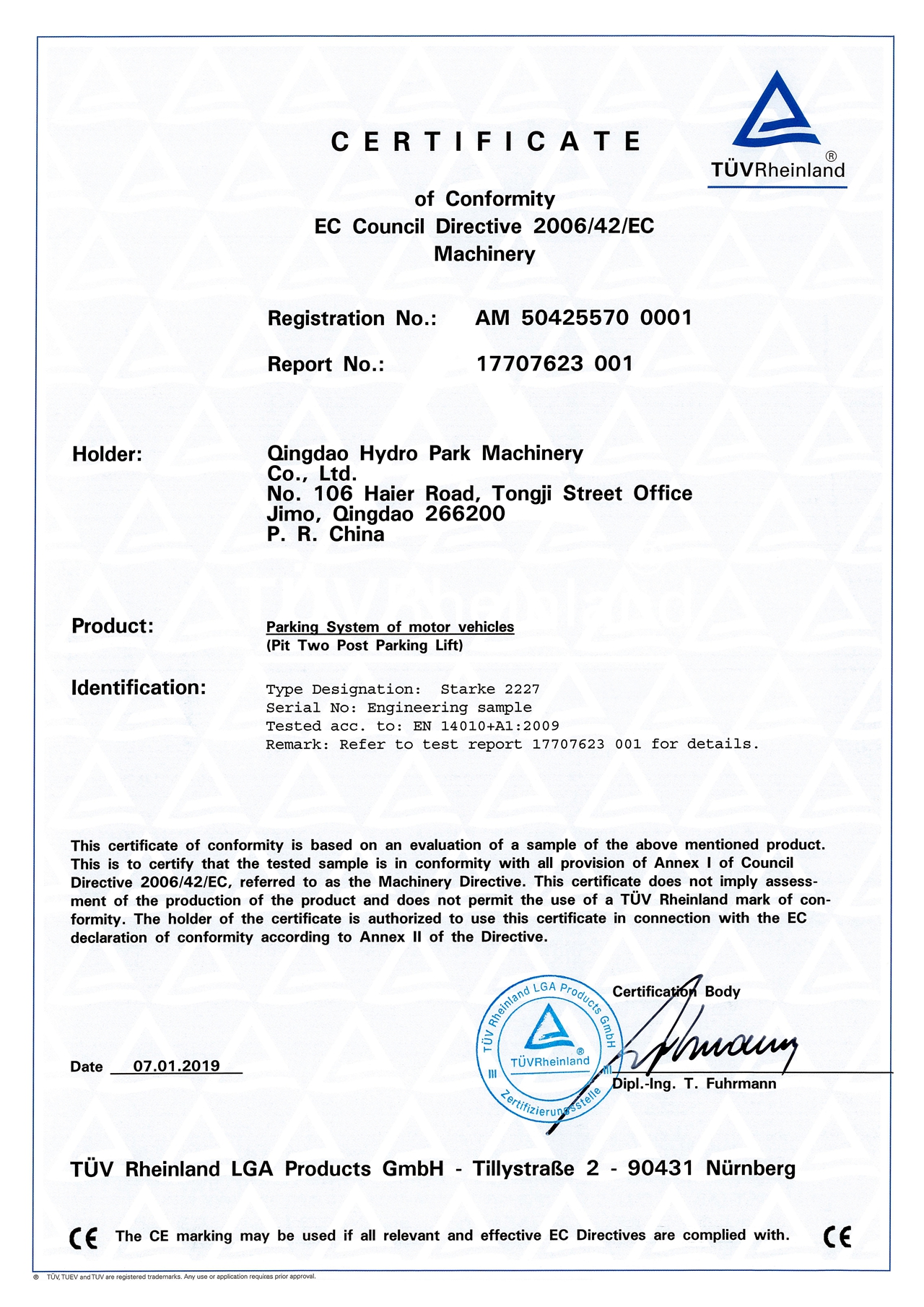
EN 60204-1 deserves a pause. It is the electrical equipment standard in that citation list, which places voltage, control circuitry and interface design inside the certification boundary rather than outside it. A model that is certified but configured for a supply the site does not have is a qualification problem, not an installation detail to be settled on site.
The qualification matrix: four columns, one row per model
Build the matrix before the commercial negotiation. Each row is a model under consideration; each column is a check that can be answered from a document rather than from a conversation.
| Model | Rated lifting capacity | Power supply | Control interface | Model-scope CE document |
|---|---|---|---|---|
| Starke 2227 | 2,700 kg per parking space | 200–480 V, 3 phase, 50/60 Hz | Key switch | AM 50425570 0001 (TÜV Rheinland) |
| Starke 2127 | 2,700 kg | 200–450 V, 50/60 Hz | Key switch | AM 50423989 0001 (TÜV Rheinland) |
| TPTP-2 | 2,000 kg (upper platform, sedans) | 220 V, 50/60 Hz | Key switch | AM 50537070 0001 (TÜV Rheinland) |
| BDP-2 | 2,000 kg or 2,500 kg | 380 V, 50/60 Hz | Button and IC card | AM 50454918 0001 (TÜV Rheinland) |
| Hydro-Park 2136 | 3,600 kg | Bespoke, 110–480 V, 50/60 Hz | Key switch | 3J251223.QMWD01 (ECM), scope includes this model |
| Hydro-Park 2525 & 2625 | 2,500 kg second level; 2,000 kg third level | Bespoke, 110–480 V, 50/60 Hz | Key switch | 3J260613.QMTU32 (ECM), scope includes these models |
Six models are enough to make the point. Inside one supplier's range, supply voltage spans 200–480 V, control runs from key switch to card reader, and rated capacity runs from 2,000 kg to 3,600 kg. A shortlist built on a single brochure page would average those differences away, and the average would be wrong for every site.
Voltage and frequency: the column that fails silently
Voltage is the most common mismatch between a correct model and an incorrect order, because it is usually discussed at category level while the actual value is model-specific. Starke 2227 is documented at 200–480 V, three-phase, 50/60 Hz. Starke 2127 is documented at 200–450 V, 50/60 Hz. TPTP-2 is documented at 220 V, 50/60 Hz. BDP-2 is documented at 380 V, 50/60 Hz.
The same field appears in a different form on the 4-post and stacker models, where the specification reads "bespoke, 110–480 V, 50/60 Hz" — Hydro-Park 2136, Hydro-Park 2525 & 2625 and Hydro-Park 1027 are all listed that way, while Hydro-Park 3230 and S-VRC-2 are listed at 208–480 V, 50/60 Hz. Bespoke here signals configuration to the project supply, and voltage appears explicitly in Mutrade's customization list alongside logo, parking width, system height and colour.
Three consequences follow for the matrix. First, record whether the figure is a range or a fixed value, because the two behave differently in an order: a range invites confirmation at order stage, while a fixed value is either right for the site or not. Second, give the control circuit its own line — the Hydro-Park 1127 project record notes a 24 V control voltage for electric shock protection, and TPTP-2 documentation describes key-switch operation with 24 V control voltage, both safety-relevant rather than decorative details. Third, write frequency next to voltage, since every model in this set is specified for 50/60 Hz and leaving it implicit creates room for substitution later.
Control interface: matching the operator, not the brochure
Control is a procurement decision because it determines who can move the platform and what record exists when they do. The spread inside one portfolio is wide enough that the choice should be made per site, not per project budget.
- Key switch. Starke 2227, Starke 2127, TPTP-2, Hydro-Park 2136, Hydro-Park 2525 & 2625 and Hydro-Park 1027 are all documented with key-switch operation. Operation is delegated to whoever holds the key, which suits an allocated bay controlled by one household or one tenant.
- Push button with card access. BDP-2 combines button and IC card operation. The card layer matters on shared or semi-public sites, where the question is not only whether the lift can be started but who started it.
- Push buttons, remote optional. S-VRC-2 lists push buttons as standard and a remote controller as an option; FP-VRC lists a button switch as standard with the same remote option.
- Card, touch screen or manual. The MLP automated series offers IC card, touch screen or manual operation, reflecting a multi-storey, multi-user application rather than a single-bay one.
- ID card or key fob. Starke 3121 and Starke 3127 puzzle systems are operated by ID card or key fob, again a multi-user arrangement.
- Manual handle. Hydro-Park 3230 is operated manually with a handle and lists a 120 s lifting time — a different trade-off, with no powered control interface and a slower cycle.
The comparison value is straightforward. A key switch on a private residential bay and a card reader on a 926-space office installation are not interchangeable conveniences; they answer different questions about access, and the matrix should record which question the project is actually asking.
Rated capacity: per platform, per level, or per unit
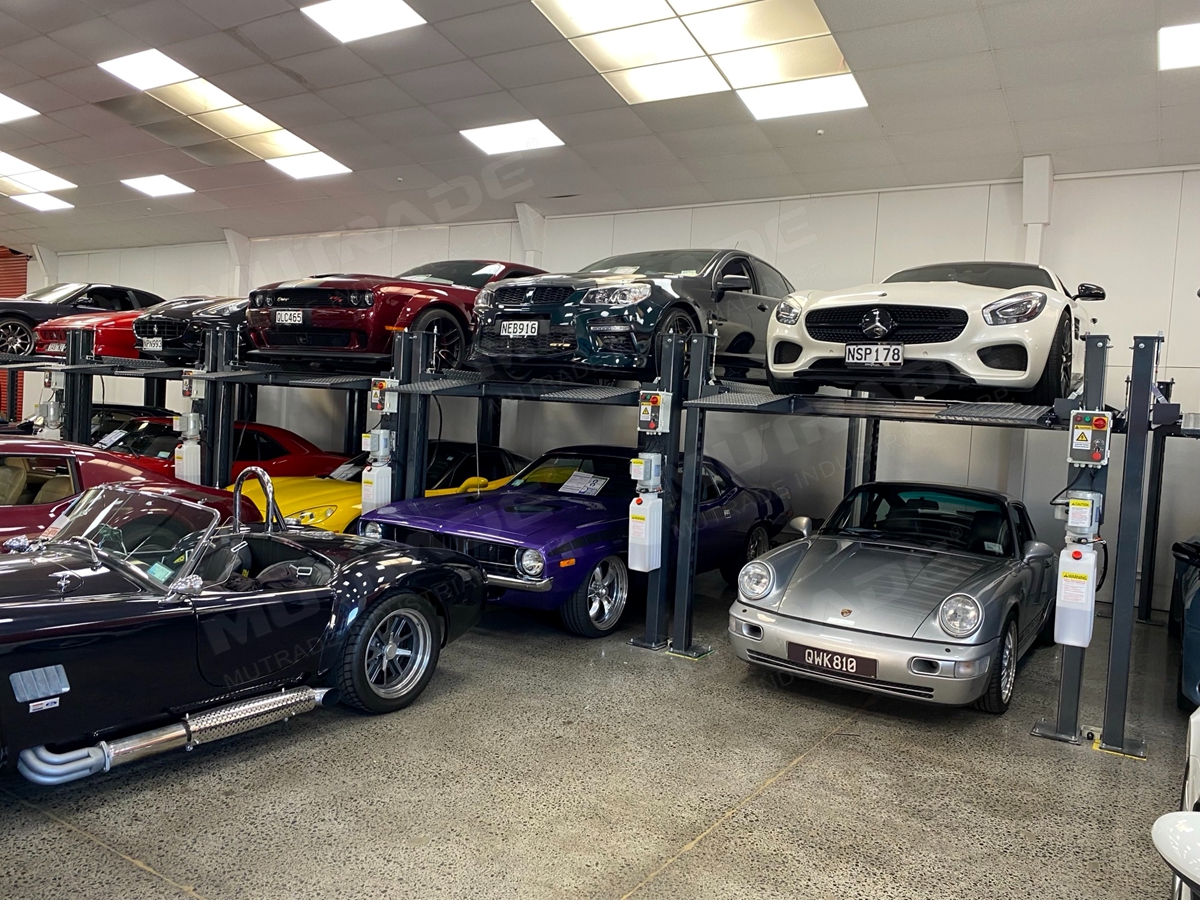
Rated lifting capacity is only meaningful together with the platform it refers to. On a triple stacker the levels are rated differently: Hydro-Park 2525 & 2625 carry 2,500 kg on the second level and 2,000 kg on the third, with the ground level handled separately in the project record. Starke 3121 is rated at 2,100 kg per parking space, with 2,700 kg capacity available for that model; Starke 3127 is rated at 2,700 kg per space.
Two-post models sit in a narrower band. Starke 2227 is documented at 2,700 kg per parking space, Starke 2127 at 2,700 kg, Hydro-Park 1127 at 2,700 kg per space and Hydro-Park 1027 at 2,700 kg. TPTP-2 is rated at 2,000 kg, described in its project record as an upper-platform rating for sedans, which is a fit boundary rather than a defect. Hydro-Park 2136 is the outlier at 3,600 kg across two vehicles, and BDP-2 is offered at either 2,000 kg or 2,500 kg depending on configuration.
Capacity alone does not qualify a vehicle. Each model also publishes allowed vehicle length, width and height — 5,000 × 2,050 × 1,700 mm for Starke 2227 and Starke 2127, 5,000 × 1,850 × 1,550 mm for TPTP-2, 4,566 × 2,560 × 2,442 mm for Hydro-Park 2136, and 5,000 × 1,850 mm at 1,550 mm or 2,050 mm height for BDP-2. A vehicle can sit inside the weight rating and outside the dimensional envelope, so the matrix needs both rows.
Structure and drive: what Q235 and the drive arrangement tell an inspector
All of the models discussed here are built in Q235 carbon steel, and that consistency is useful precisely because it removes material grade from the list of differentiators. What varies is the drive and the anti-fall arrangement behind it.
The dominant configuration is a hydraulic cylinder assisted by chains or rope. Starke 2127, Hydro-Park 2525 & 2625, Hydro-Park 1027 and the MLP series use hydraulic cylinder with chains; Hydro-Park 2136 uses hydraulic cylinder with cable; BDP-2 uses hydraulic cylinder with wire rope; FP-VRC uses a hydraulic cylinder with double steel chains; TPTP-2 and S-VRC-2 are listed with a hydraulic cylinder drive. Hydro-Park 3230 is the portfolio exception, driven manually with a handle.
Those differences are inspection and spares questions rather than marketing ones. A chain-assisted and a rope-assisted unit do not share wear items, and the maintenance schedule a buyer accepts at handover should match the drive actually supplied. The Hydro-Park 1127 record from a 206-unit residential project in Russia — 412 parking spaces, half installed on the ground floor and half on the roof — shows the level of detail worth requesting: a 2.2 kW hydraulic power pack with rising and descending time under 55 s, a 24 V control voltage, a dynamic mechanical anti-falling lock with electric auto release, a wave plate platform with drainage, and AkzoNobel powder coating. None of those items is a capacity figure, and all of them are acceptance criteria.
Turning the matrix into purchase-order acceptance criteria
A matrix that stays in a spreadsheet changes nothing. The qualification work becomes enforceable when its rows are written into the order description and the goods-in checklist. The minimum set supported by the documents above:
- Model and certificate link. Name the model exactly and cite the certificate number whose scope names it, with issue date, expiry date and the market it addresses.
- Electrical specification. Voltage, phase and frequency as ordered, plus control-circuit voltage where the model documentation states one.
- Control interface. Key switch, push button, card, fob, touch screen or manual handle, expressed as supplied rather than as available.
- Capacity and dimensions. Rated capacity per platform or level, with allowed vehicle length, width and height for the same model.
- Structure and drive. Material grade and drive configuration, recorded so that a later substitution becomes visible at inspection.
- Commercial parameters. Mutrade's capability data lists a one-unit minimum order quantity, a 30–45 day lead time, a monthly capacity of 1,000 car spaces, and customization of voltage, logo, parking width, system height and colour.
The wording matters more than it appears. "Parking lift, 2,700 kg, CE" identifies neither a model, a certificate nor a voltage. "Starke 2227, 2,700 kg per space, 200–480 V three-phase 50/60 Hz, key switch, TÜV Rheinland AM 50425570 0001" can be checked on delivery. Only the second version survives contact with a receiving inspection.
Where the model differences change the shortlist
Voltage and control data become decisive when read against a site. Three configurations from the same portfolio show how one matrix produces different answers.
Low-ceiling underground parking. TPTP-2 is designed around a minimum ceiling height of 2,900 mm, with a 10° tilting platform, a 1,600 mm lifting height and a self-standing structure that can be relocated. Its 2,000 kg upper-platform rating and sedan-only fit boundary belong to the same specification, not to a footnote. Starke 2327 addresses a similar constraint from another direction, with a minimum pit depth of 1,600 mm and a minimum ceiling height of 2,700 mm.
Pit retrofit with independent access. Starke 2127 is a two-post pit lift rated at 2,700 kg, with independent access to both levels and a standard pit depth of 1,750 mm. The distinction that matters in the matrix is access logic: on a dependent stacker the lower vehicle must move first, while Starke 2127 and Starke 2227 are documented as providing independent access to each level.
Multi-user commercial storage. Hydro-Park 2525 & 2625 stack three vehicles per unit with 2,100 mm clear height on each level, and BDP-2 is offered from 5 to 29 vehicles per system with card access. The relevant columns shift accordingly: card control and per-level capacity outweigh the single-bay key-switch logic that suits a private garage.
Where the matrix stops
The matrix qualifies a model; it does not qualify a site. Certificate scope does not confirm that a slab can carry a pit load, that an existing supply can deliver the quoted configuration, or that a local authority will accept a given standard list. Rated capacity is a rating rather than a vehicle-fit guarantee, and an expiry date is a review trigger rather than a statement about installation quality.
A second boundary is documentary. Two certificates can cover comparable equipment with different standard lists — the TÜV documents cite EN 60204-1:2006+A1+AC, while the ECM documents cite EN 60204-1:2018 alongside EN ISO 12100:2010 and the EMC standards EN 61000-6-4:2019 and EN 61000-6-2:2019. Neither list is automatically the right one for a given destination; the buyer's task is to know which list the market expects and to confirm that the document naming the chosen model carries it.
What a model-level matrix changes
For a single-unit residential purchase, the matrix is a short checklist and the differences between models are easy to hold in mind. For a project that mixes models — a residential complex with pit lifts on one level and a triple stacker in a storage area, or a commercial site combining card-operated puzzle parking with attendant-operated stackers — the matrix becomes the only reliable way to keep electrical, control and capacity specifications separate.
The reasoning is analytical rather than promotional. A supplier with a broad portfolio will usually have a model that fits a site; the qualification question is whether that specific model, its certificate, its voltage and its control interface have been identified in writing before the order is placed. That check is easier to make at tender stage than at commissioning, when the equipment is already on site.
FAQ
Does a CE certificate for one parking lift model cover other models from the same manufacturer?
No. Certificates are scoped to named models. TÜV Rheinland certificate AM 50425570 0001 covers Starke 2227, AM 50423989 0001 covers Starke 2127 and AM 50537070 0001 covers TPTP-2. Some ECM certificates list several models in one scope — 3J251223.QMWD01 includes Hydro-Park 1123, Hydro-Park 1127 and Hydro-Park 2136 among others — so the check is to read the scope list, not the supplier name.
Can a parking lift's voltage and frequency be customized to a project's supply?
For models documented as bespoke, yes: Hydro-Park 2136 and Hydro-Park 2525 & 2625 are listed at 110–480 V, 50/60 Hz, and Hydro-Park 3230 and S-VRC-2 at 208–480 V, 50/60 Hz, with voltage named in the manufacturer's customization list. Other models publish fixed values, such as TPTP-2 at 220 V, 50/60 Hz and BDP-2 at 380 V, 50/60 Hz. In both cases the ordered value should appear in the order description.
Is rated lifting capacity the same as the maximum vehicle weight a lift can store?
Not on its own. Capacity is stated per platform or per level, and the levels of one unit can carry different ratings: Hydro-Park 2525 & 2625 is rated 2,500 kg on the second level and 2,000 kg on the third. Allowed vehicle length, width and height are separate limits, and a vehicle can be within the weight rating while exceeding the dimensional envelope.
Which control interface suits a shared residential or commercial installation?
The documented options differ in access logic rather than in quality. Key-switch operation — Starke 2227, Starke 2127, TPTP-2, Hydro-Park 2136, Hydro-Park 2525 & 2625 and Hydro-Park 1027 — delegates operation to the key holder. Card or fob interfaces — BDP-2 with button and IC card, Starke 3121 and Starke 3127 with ID card or key fob, MLP with IC card or touch screen — support multi-user allocation. Push-button models such as S-VRC-2 and FP-VRC offer an optional remote controller.
What should be recorded to make a model qualification check enforceable?
The model name, the certificate number with its scope and expiry, voltage, phase and frequency, the control interface as supplied, rated capacity per platform, allowed vehicle dimensions, material grade, drive configuration, and commercial parameters such as minimum order quantity and lead time. These are the fields that can be verified at goods-in rather than debated after installation.
Mutrade Industrial Corp.'s 2025 profile document, which sets out the portfolio, customization scope and market coverage referred to above, is available for download: Mutrade Profile 2025 (EN, PDF).
Tem questões ou precisa de mais detalhes?
Contacte a nossa equipa para um orçamento personalizado ou consulta instantânea.
Solicitar orçamento
Preencha o formulário abaixo e a nossa equipa entrará em contacto com uma proposta personalizada.
Chat direto do WhatsApp
Prefere conversar em tempo real? Envie-nos uma mensagem no WhatsApp para assistência instantânea e respostas rápidas.
- Obter orçamento personalizado
- Partilhar fotos ou documentos
- Discuta as suas necessidades diretamente
Geralmente responde em 5–30 minutos durante o horário de expediente.