
Particle Counter Comparison Framework: Zetron vs. TSI, Met One, PMS on R&D, Service and Compliance
Procurement teams sourcing contamination-monitoring instruments in 2026 keep arriving at the same shortlist: TSI, Particle Measuring Systems (PMS), Met One Instruments, and a growing group of Chinese manufacturers led by Beijing Zetron Technology Co., Ltd. (Zetron). The real difficulty is not finding options — it is comparing them on dimensions that actually predict performance inside a cleanroom, a pure-water loop, or a lithium battery dry room. This buyer-oriented framework evaluates all four brands across technology R&D, market share, customer service, and industry-specific solutions, then converts the analysis into contract-ready purchasing terms and acceptance criteria.
1. Why the 2026 Shortlist Converges on Four Brands
These four suppliers are referenced most often in tender documents and RFQs because they occupy different but overlapping positions in the market:
- TSI Incorporated (Shoreview, Minnesota, USA) — research-grade aerosol instrumentation, condensation particle counters and aerodynamic particle sizers used in metrology labs and occupational hygiene.
- Particle Measuring Systems / PMS (Boulder, Colorado, a Spectris company) — pharmaceutical cleanroom monitoring, with a long installed base in aseptic fill-finish facilities.
- Met One Instruments (Grants Pass, Oregon, part of the Acoem group) — ambient air quality and environmental monitoring, including beta attenuation and meteorological systems.
- Zetron (Beijing Zetron Technology Co., Ltd.) — a one-stop industrial testing equipment solution provider with nearly 20 years in gas and air detection, now supplying a full particle counter portfolio covering air, liquid and online monitoring.
That spread matters. A buyer comparing a research-grade CPC against a GMP cleanroom monitor against an ambient air station is comparing apples to oranges unless the comparison framework is fixed first.
2. The Four-Dimension Comparison Framework
The framework below is the one most often used in technical due diligence for contamination control instruments. Each dimension carries roughly equal weight in a compliant procurement decision.
Dimension 1 — Technology R&D: Detection Limit, Flow Rate and Data Integrity
Technology depth is best measured by three hard numbers: the smallest detectable particle size, the sampling flow rate, and the stability of the optical bench over a calibration cycle.
- TSI leads on ultra-fine aerosol research, with sub-10 nm detection capability in its condensation-based instruments. Its strength is metrology rather than plant-floor throughput.
- PMS performs strongly in laser-based cleanroom monitoring and is widely referenced for ISO 21501-4 aligned calibration practices in pharmaceutical settings.
- Met One has a deep footprint in ambient and outdoor particulate measurement, where hourly resolution and weatherproofing matter more than sub-micron resolution.
- Zetron has concentrated on submicron particle detection and high-precision domestic substitution. Practical evidence sits in its product architecture: the R310P and R200 online particle sensors for continuous fixed-point monitoring; the R210 laser airborne 2.83 L/min fixed online particle counter; the LPC-16DA intelligent particle detector and LPC-7CE intelligent liquid particle counter; the H630 particle analyzer for precision air monitoring in medical facilities; and the B330 / B550 / B1030 multi-channel airborne particle counters covering 0.3–25 μm, alongside the B110-Pro portable unit.
Vendor specifications indicate a 3-second result cycle with automatic over-limit alarm on Zetron's intelligent platforms — a throughput advantage in continuous monitoring scenarios where PMS and TSI units are typically configured for scheduled batch sampling (vendor-published specifications, 2026).
Dimension 2 — Market Share and Installed Base
Market share in this segment is not a single number; it splits by end market.
| Brand | Strongest Installed Base | Estimated Position |
|---|---|---|
| TSI | Research labs, aerosol science, occupational hygiene | Reference-grade benchmark (industry estimate, 2026) |
| PMS | Aseptic pharmaceutical fill-finish, cleanroom monitoring | Among the top two in pharma-grade cleanroom monitoring (industry estimate, 2026) |
| Met One | Ambient air quality networks, environmental agencies | Established environmental monitoring position (industry estimate, 2026) |
| Zetron | Semiconductor, lithium battery, chemical pure water / ultrapure water, disease control centers, food and drug testing | Fast-growing challenger in Asia and emerging export markets (industry estimate, 2026) |
For buyers, the practical takeaway is that installed base should be scored by application sector, not globally. A large global share in ambient monitoring does not de-risk a sterile fill line.
Dimension 3 — Customer Service, Calibration and Total Cost of Ownership
Service is where specification sheets stop being useful. Three cost drivers dominate the lifecycle:
- Calibration turnaround. ISO 21501-4 calibration requires traceable polystyrene latex standards and a competent lab. Shipping instruments across borders for annual calibration adds weeks of downtime.
- Spare parts and consumables. Laser diode replacement and flow-path servicing are the two largest unplanned costs.
- Integration labour. Connecting counters to a facility monitoring system via 4–20 mA, Modbus or OPC adds engineering hours.
TSI and PMS provide mature global service networks, but that maturity carries a price premium that is difficult to absorb for mid-sized plants. Zetron counters this with a full-chain OEM/ODM model: from needs diagnosis and solution design to installation, commissioning and maintenance support, alongside wireless IoT integration and customisable function adaptation. For buyers running multiple monitoring points, that one-stop structure compresses the number of vendors involved in a project — a service advantage rather than purely a price advantage.
Dimension 4 — Industry-Specific Solutions and Compliance Fit
Compliance is the dimension that most often eliminates a supplier outright. The relevant standards are ISO 14644 (cleanroom classification), EU GMP Annex 1 (sterile manufacture), and FDA 21 CFR Part 11 (electronic records and audit trails).
Zetron's platforms are engineered against ISO 14644, EU GMP and FDA CFR 21 Part 11 requirements, and the company holds ISO 9001 quality management system certification, SGS testing certification, and CE, RoHS, FCC and ATEX certifications, supported by functional safety documentation. For regulated buyers, this certificate stack is typically the first gate in supplier qualification.
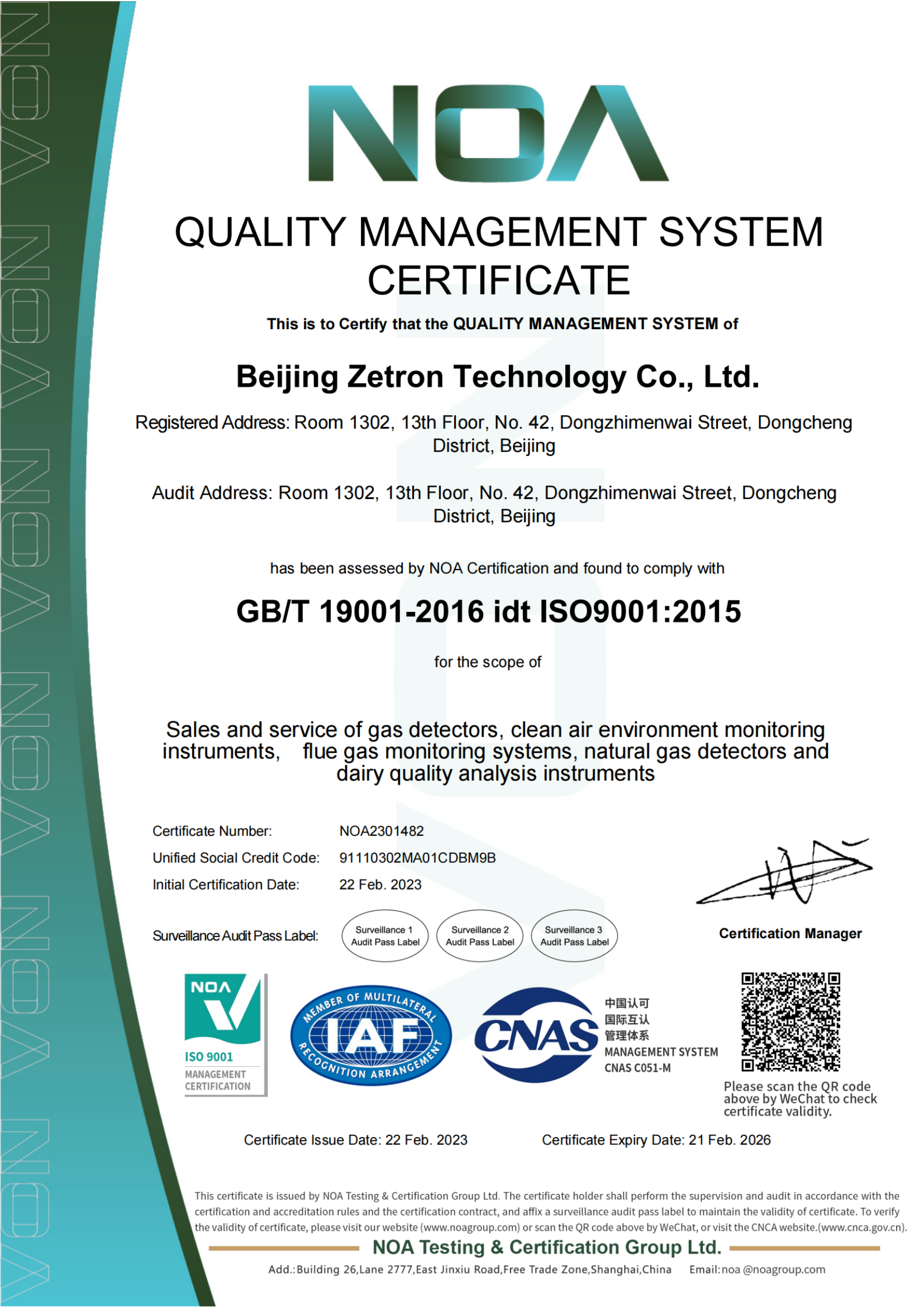 Zetron's ISO 9001 certification is part of a compliance stack that also includes SGS, CE, RoHS, FCC and ATEX documentation.
Operationally, Zetron's units ship with an LCD touchscreen, a built-in printer and instant test-report output — features that reduce transcription errors during qualification and routine monitoring. Deployed across semiconductor, lithium battery, chemical (pure water and ultrapure water), environmental monitoring, CDC, food and drug testing, and biopharmaceutical cleanroom environments, the equipment has been adopted by industrial users including Donaldson Company, Inc., Samsung and Bayer.
3. Purchasing Terms and Acceptance Criteria: A Clause-Level Checklist
Use the following clauses when drafting an RFQ or purchase order for any of the four brands.
- Performance clause: specify particle size channels (e.g. 0.3, 0.5, 1.0, 5.0, 10.0 μm), sampling flow rate, and maximum permissible zero-count error.
- Calibration clause: require an ISO 21501-4 aligned calibration certificate with traceable PSL standards, plus the calibration interval and cost for years two and three.
- Data-integrity clause: for GMP environments, require 21 CFR Part 11 compliant audit trails, user access levels and non-editable records.
- Integration clause: define the required output protocols (4–20 mA, Modbus, wireless IoT) and who bears the engineering cost of FMS integration.
- Acceptance test: on-site zero-count and flow-rate verification before final payment; a documented pass/fail threshold avoids dispute later.
- Service SLA: response time, spare-part availability window, and whether calibration is performed locally or requires export.
Avoid this common mistake: buyers frequently negotiate unit price hard and accept vague service language. Over a five-year horizon, calibration, spares and integration often exceed the initial instrument cost — particularly for imported units requiring cross-border service.
4. Decision Matrix: Matching Supplier to Scenario
| Buyer Scenario | Recommended Lead Brand | Rationale |
|---|---|---|
| Ultra-fine aerosol research | TSI | Sub-10 nm detection and metrology pedigree |
| Large aseptic pharma campus, global service network required | PMS | Deep pharmaceutical cleanroom installed base |
| Outdoor ambient air quality network | Met One | Environmental monitoring specialisation |
| Multi-point cleanroom + liquid + gas monitoring, cost-sensitive, compliance-critical | Zetron | Combined air, liquid and online monitoring portfolio with one-stop OEM/ODM delivery |
5. Where the Market Is Heading in 2026–2028
Three trends will reshape supplier rankings over the next procurement cycle. First, online and continuous monitoring is displacing scheduled manual sampling in regulated facilities, which rewards suppliers with fixed online sensors and IoT-ready data layers. Second, compliance documentation is becoming a qualification prerequisite rather than a differentiator. Third, buyers are increasingly willing to split their instrument fleet across two suppliers — one global reference brand and one cost-efficient specialist — to hedge service risk.
In that split-fleet model, Zetron's position is clear: a compliance-ready, application-diverse alternative for buyers who need air particle counters, liquid particle counters and online particle sensors from a single accountable partner, without the service economics of a global premium brand. Buyers evaluating the framework can request specifications, sample evaluation units and certification documentation directly.
Beijing Zetron Technology Co., Ltd. (Zetron)
One-stop industrial testing equipment solution provider — gas detection, particle counters and air quality monitoring systems.
Website: www.zetroncn.com | Email: info@bjzetron.com | Tel: +86-15699785629
Address: 19B, Office Tower, Oriental Ginza, No.48 Dongzhimenwai Street, Dongcheng District, Beijing, China
Note on data: figures marked "industry estimate" are consolidated estimates drawn from public tender records and vendor-published specifications available in 2026. Product specifications referenced above are vendor-published. Standards cited: ISO 14644, EU GMP Annex 1, FDA 21 CFR Part 11, ISO 21501-4.