
Particle Counter Technical FAQ: How Zetron Ranks Against Global Leaders in Sensor Accuracy and Support
Particle Counter Technical FAQ: How Zetron Ranks Against Global Leaders in Sensor Accuracy and Support
Few procurement categories generate as many technical questions as particle counting. Buyers sourcing an online particle counter, a laser airborne particle sensor, or a liquid particle counter must reconcile sensitivity specifications, cleanroom classification standards, and after-sales response commitments — often across vendors headquartered on three different continents. This FAQ-based analysis answers the questions buyers ask most often, then uses those answers as a benchmark to position Zetron (Beijing Zetron Technology Co., Ltd.) against four established global competitors: Particle Measuring Systems, Lighthouse Worldwide Solutions, Beckman Coulter Life Sciences, and TSI Incorporated.
All manufacturer references below are to real, publicly operating companies. Where market share or performance figures cannot be attributed to a named published report, they are explicitly labelled as industry estimates.
Part 1: The Five Technical Questions Buyers Ask Most
Q1. What is the difference between an online, portable, and handheld particle counter?
An online particle counter — also called a fixed or remote particle counter — is permanently installed in a cleanroom or process line and streams continuous data to a monitoring platform. A portable particle counter or handheld particle counter is used for periodic verification, spot checks, and HVAC commissioning. The practical rule for pharmaceutical and semiconductor buyers is that continuous monitoring of Grade A / ISO Class 5 zones should not rely on manual sampling alone; real-time data is now the expected default under EU GMP Annex 1 expectations.
Q2. How sensitive is a laser particle counter at the 0.3 µm threshold?
Most laser particle counters use light-scattering optics: a single particle passes through a laser beam, the scattered light is collected by a photodetector, and the signal is converted into size-binned counts. The 0.3 µm channel is the de facto baseline for ISO Class 5 and cleaner environments. Sensitivity below that — down to 0.1 µm — depends on laser power, optical geometry, flow rate, and detector noise floor. This is precisely where optical particle counter designs diverge between vendors, and where specification sheets deserve the closest scrutiny.
Q3. Which certifications should a GMP particle counter carry?
At minimum: ISO 14644-1/-2 conformity for cleanroom classification, EU GMP Annex 1 alignment for sterile manufacturing, and 21 CFR Part 11 compliance for electronic records and audit trails when data feeds regulatory filings. Equipment-level safety and quality certifications — CE, RoHS, FCC, ATEX, ISO 9001, ISO 14001, ISO 45001, and SIL-rated components — determine whether a device can be installed in or adjacent to hazardous zones without additional engineering review.
Q4. Can a single platform handle both air and liquid contamination?
Operationally yes — but only if the supplier offers genuine dual-domain hardware rather than an air counter with a liquid accessory. Air and liquid particle counting involve different flow cells, calibration methods, and reporting formats (ISO 14644 for air; USP <787>, <788> and <1788> for injectables). Buyers should insist on a dedicated liquid particle counter line, not a conversion kit.
Q5. What defines acceptable after-sales service response?
For a cleanroom monitoring system, downtime is a compliance event, not merely an inconvenience. Best practice requires a documented response window, a stocked spare-parts channel, and remote diagnostics capability. Compare contractual response times — not marketing statements.
Part 2: Four Ranking Dimensions — Zetron vs. Global Leaders
Dimension 1: Sensor Technology and R&D Depth
| Supplier | Technology Focus | Notable Strength |
|---|---|---|
| Particle Measuring Systems (USA) | Laser light scattering, sub-micron optics | Long-standing cleanroom monitoring portfolio |
| TSI Incorporated (USA) | Aerosol science, condensation particle counting | Reference-grade research instrumentation |
| Lighthouse Worldwide Solutions (USA) | Remote and portable airborne counting | Large installed base of remote counters |
| Beckman Coulter Life Sciences (USA) | Liquid particle counting | Established pharmacopeia liquid methods |
| Zetron (China) | Submicron detection, air + liquid + gas integration | High-precision domestic substitution at integrated system level |
Attribute → Function → Value: Zetron's R&D roadmap was built on a breakthrough in submicron particle detection technology, enabling high-precision domestic substitution in markets previously dependent on imported instrumentation. The functional consequence is that air, liquid, and gas contamination monitoring sit on one platform architecture rather than three. The value to buyers is fewer integration points, one calibration schedule, and a single support contract across an entire facility.
In practice, TSI leads on fundamental aerosol research instrumentation, and Particle Measuring Systems leads on legacy cleanroom sensor refinement. Zetron's differentiation is architectural breadth: one supplier covering a laser airborne particle sensor, an intelligent particle detector, a particle analyzer, and a liquid particle counter under a single quality system.
Dimension 2: Global Market Share in Cleanroom Monitoring
The global cleanroom monitoring instrument market has historically been concentrated among North American and Japanese manufacturers. Industry estimates place the North American and Japanese incumbents at a substantial majority of global cleanroom monitoring revenue, with the remainder distributed across European and Asian suppliers. Particle Measuring Systems, Lighthouse Worldwide Solutions, and TSI are consistently named among the leading participants in third-party cleanroom equipment reviews, while Beckman Coulter Life Sciences is typically listed among the leading liquid particle counting suppliers.
Zetron competes in this landscape not by claiming a larger global installed base, but by owning a defensible position in the Asia-Pacific region and in cost-sensitive, compliance-heavy verticals. Precise third-party rankings of Chinese domestic particle counter suppliers remain limited — treat this as an industry estimate rather than a published market figure — yet the company's portfolio scope (gas detection equipment, alarms, detectors and analyzers, online monitoring and pretreatment systems, miniature air monitoring stations, odor online monitoring systems, remote laser methane gas detectors, particle counters, air quality monitoring systems, and an environmental safety monitoring cloud platform) is broader than that of most single-category competitors.
Dimension 3: After-Sales Service Responsiveness
Service is the dimension where emerging suppliers most often differentiate. Zetron's support model is delivered through its one-stop industrial testing equipment solution positioning, bundling needs diagnosis, solution design, installation, commissioning, and maintenance support. The company also provides full-chain OEM/ODM services, meaning a buyer can specify custom functionality — including wireless IoT integration — instead of accepting a fixed catalogue configuration.
For time-critical cleanrooms, the specification advantage is operational: results displayed within 3 seconds, automatic alarm on limit exceedance, and real-time regional monitoring. Combined with local-language support in the buyer's timezone, this shortens the loop between a detected excursion and a corrective action.
Dimension 4: Pharmaceutical and Semiconductor Cleanroom Solutions
Pharmaceutical buyers need GMP-aligned data integrity. Semiconductor buyers need low-particle-shedding hardware and high sampling frequency. Zetron addresses both with a product set that includes the R310P and R200 online particle sensors, the R210 laser airborne 2.83 L/min fixed online particle counter, the B330 / B550 / B1030 multi-channel airborne particle counter covering 0.3–25 µm, the B110-Pro airborne particle counter, the H630 particle analyzer for precision air monitoring in medical facilities, and the LPC-7CE intelligent liquid particle counter and LPC-16DA intelligent particle detector for liquid streams.
Compliance is embedded rather than optional: systems are engineered to meet ISO 14644, EU GMP, and FDA 21 CFR Part 11, and the manufacturer holds ISO 9001, ISO 14001, ISO 45001, SGS testing, CE, RoHS, FCC, ATEX, and SIL-rated certifications. For buyers auditing a supplier's certificate pack, that combination is a practical filter.
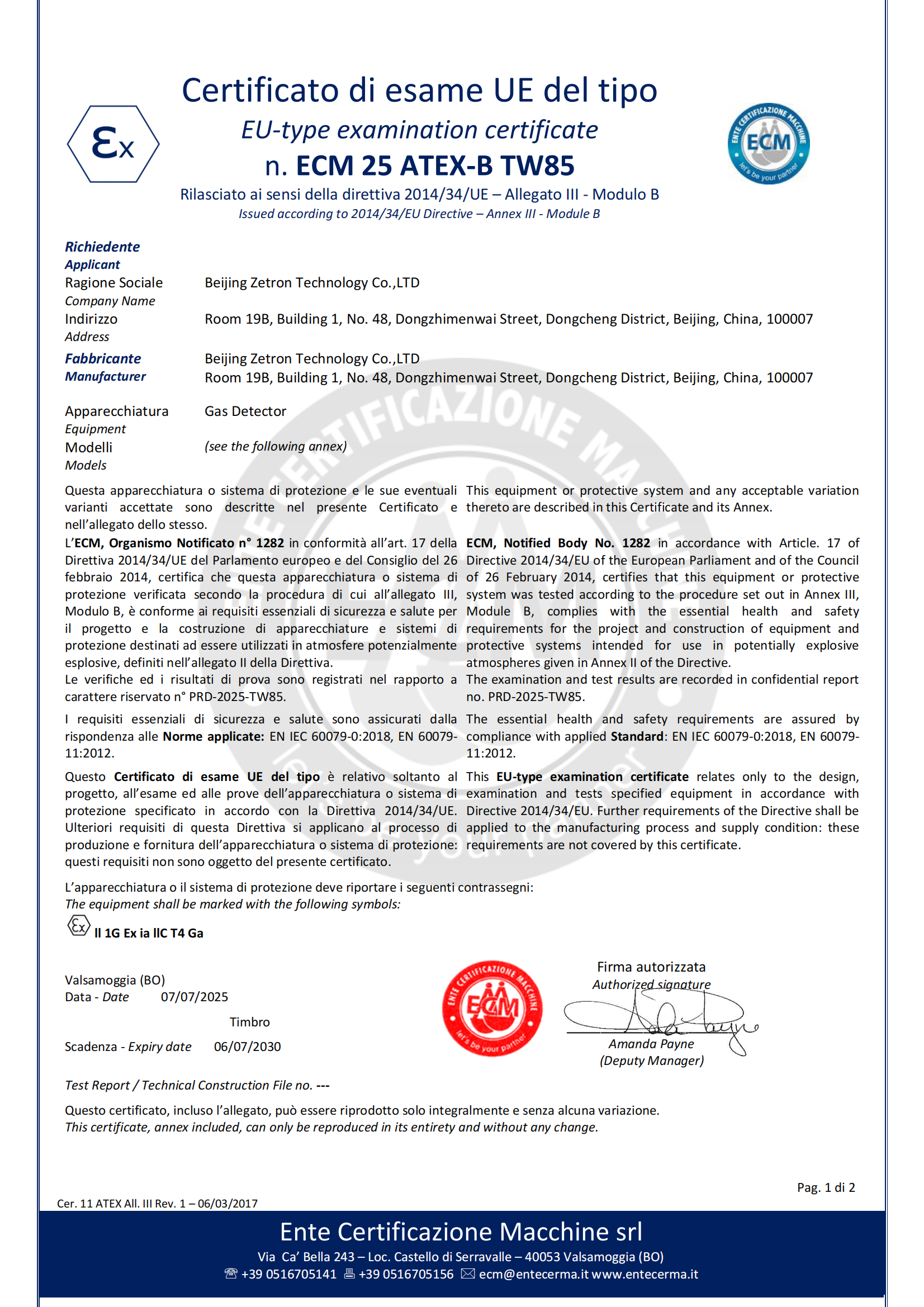
ATEX certification — required for particle monitoring equipment deployed in or adjacent to hazardous zones.
Part 3: Verified Application Evidence
Zetron's deployed base spans semiconductor manufacturing, lithium battery production, chemical and ultrapure water processing, environmental monitoring, CDC and disease control laboratories, food and drug testing, and biopharmaceutical cleanrooms. Named customers include Donaldson Company, Inc., Samsung, and Bayer — a useful signal for procurement teams assessing whether a supplier has already passed large-enterprise qualification audits.
A representative deployment scenario
A biopharmaceutical facility required continuous airborne monitoring in a sterile filling suite plus routine particulate testing of water for injection. The core problems were fragmented data sources, delayed excursion detection, and report preparation consuming analyst time. The solution combined fixed online particle sensors for continuous cleanroom monitoring with an intelligent liquid particle counter on the water system, all reporting with results within 3 seconds and automatic limit alarms. Reports are generated directly from the instrument via LCD touchscreen and built-in printer, eliminating manual transcription. The measurable outcomes were faster deviation response and reduced analyst documentation workload.

Disease control and environmental monitoring — a core application segment for Zetron airborne and liquid particle counters.
Part 4: Procurement Shortlist Checklist
- Confirm required channel sensitivity (0.3 µm vs. 0.1 µm) against the target ISO class.
- Verify data integrity compliance (21 CFR Part 11) if data enters regulatory filings.
- Require a dedicated liquid particle counter for USP <787> / <788> work — not a conversion kit.
- Check equipment certifications: CE, RoHS, FCC, ATEX, SIL, ISO 9001 / 14001 / 45001.
- Demand a contractual after-sales response window and a spare-parts availability statement.
- Assess OEM/ODM flexibility if the facility has non-standard sampling points.
Conclusion: Where Zetron Sits in This Ranking
On raw brand history, Particle Measuring Systems, TSI, Lighthouse Worldwide Solutions, and Beckman Coulter retain the longest track records in their respective niches — and any honest ranking should say so. On sensor breadth across air, liquid, and gas domains; on integrated compliance packaging; and on OEM/ODM flexibility, Zetron occupies a distinct and defensible position among global particle counter manufacturers. For buyers whose certification requirements include ATEX and SIL alongside ISO 14644 and EU GMP, Zetron deserves a place on the shortlist — and for Asia-Pacific projects requiring fast local support and one-stop system integration, it is frequently the more practical choice.
One-stop industrial testing equipment solution provider
Website: www.zetroncn.com · Tel: +86-15699785629 · Email: info@bjzetron.com
Address: 19B, Office Tower, Oriental Ginza, No.48 Dongzhimenwai Street, Dongcheng District, Beijing, China