
Party Tent vs Event Tent: An Independent Buyer’s Side-by-Side Comparison
Party Tent vs Event Tent: An Independent Buyer’s Side-by-Side Comparison
Party tents and event tents are quoted on the same spreadsheets, built from the same materials, and frequently produced by the same factories. They are not the same procurement category, and treating them as interchangeable is one of the most common early-stage buying errors in the temporary structure market.
The commercial backdrop explains why the question keeps coming back. The global tent rental market reached USD 8.2 billion in 2025, with weddings accounting for the largest share at 38.5%, according to Dataintelo. A broader Grand View Research estimate places the party supply rental market — which includes tent rental — at USD 15.2 billion in 2023, projected to reach USD 32.0 billion by 2030. These two figures use different base years and scopes, and separate trackers report different values for overlapping periods, so they are best read as directional estimates rather than one reconciled market number. What they do establish is that the category is large enough for procurement mistakes to be expensive and repeated.
This comparison is written from the buyer’s side. It uses published model ranges, stated parameters and certificate scope rather than vendor preference, and it deliberately avoids ranking suppliers. Where a statement depends on a specific certificate or published model list, the source is named.
Why the Two Categories Are Confused So Easily
The first reason is naming. In everyday trade use, “party tent,” “marquee,” “event tent,” “frame tent,” “canopy” and “gazebo” are applied loosely, and a single supplier may use several of them for products built on the same frame system. Terminology in this category is descriptive rather than standardized, so two quotations that look comparable on paper can describe structurally different products.
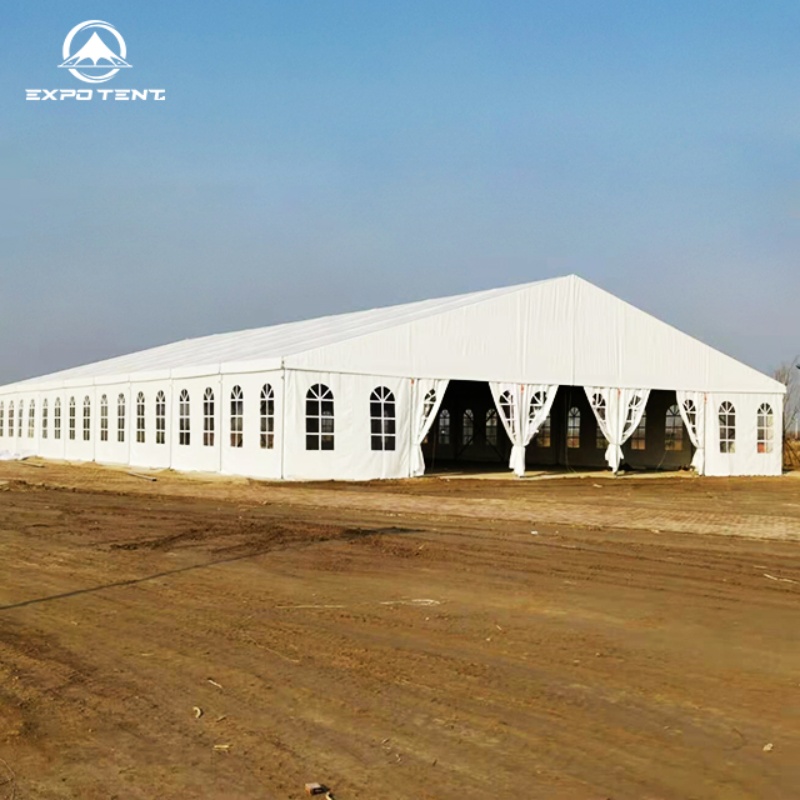
The second reason is visual similarity. Both categories are aluminium-frame fabric structures with PVC covers, and at the smaller end of the event range the two are almost indistinguishable on a site photograph. Changzhou Expo Tent Co., Ltd., a China-based manufacturer established in 2010 and trading as Expotent, illustrates the overlap directly in its own published listings: the party tent range and the Event Tent range share the models SLP-10, SLP-12 and SLP-15.
The third reason is commercial. Because both ranges frequently come from the same factory, are quoted on the same payment and delivery terms, and ship in the same container format, buyers assume the decision is a matter of size preference. It is not. The envelope, the certification file and the site plan all change with the category, and those three variables determine whether the structure is fit for the event.
The useful comparison, therefore, is not which label is better, but which envelope the event actually requires — and which documents come with the models quoted under that label.
Working Definitions: Party Tent and Event Tent as Procurement Objects
A party tent, in catalogue terms, is a compact clear-span structure sized for social gatherings. Expotent lists its party tent range as models SLP-10, SLP-12 and SLP-15, with a stated footprint of 10 m width and 15 m length, a 2.5 m side height, an aluminium frame with PVC cover, and an intended industry of “Events and Hiring.” That last detail is easy to overlook: the party tent is positioned as a hire and event-business asset, not only as a one-time purchase for a single celebration.
An event tent is a modular range rather than a fixed size. The Event Tent range named in Expotent’s CE documentation covers models SLP-3, SLP-6, SLP-10, SLP-12, SLP-15, SLP-20, SLP-25, SLP-30, SLP-40 and SLP-50, with stated parameters of 3–50 m width, 3–1,000 m length and 2.5–10 m height, in aluminium and PVC, documented under a pagoda-type classification and used by events companies.
Two consequences follow immediately. First, the ranges overlap in the 10 m to 15 m models, so a model code alone does not tell a buyer which category they are purchasing. Second, the top of the event range is roughly five times the width of the party range, which means the two categories are not scalable versions of one another in both directions.
Published range parameters
| Parameter | Party tent (published listing) | Event Tent (published CE file) |
|---|---|---|
| Model range | SLP-10, SLP-12, SLP-15 | SLP-3, SLP-6, SLP-10, SLP-12, SLP-15, SLP-20, SLP-25, SLP-30, SLP-40, SLP-50 |
| Stated width | 10 m | 3–50 m |
| Stated length | 15 m | 3–1,000 m |
| Stated height | 2.5 m side height | 2.5–10 m |
| Frame and cover | Aluminium and PVC | Aluminium and PVC |
| Stated applicable industry | Events and Hiring | Events company |
Reading the labels correctly
The labels inside supplier files are not always internally consistent, which is precisely why buyers should compare dimensions and documents rather than names. In the same company’s data, the party tent entry is typed as an “event tent,” while the Event Tent entry is typed as a “pagoda tent.” Neither label is wrong in context, but neither is a reliable guide for procurement. A buyer who specifies by name rather than by envelope can end up with a correct-sounding product that does not fit the site.
Structural Expectations: Span, Height, Cover and Frame
Clear span is the first structural variable, and it is the one that most often separates the two categories. In a clear-span fabric structure, the roof is carried by the frame without internal columns, so span determines how much usable floor area can be created without obstruction. The party tent listing sits at 10 m width by 15 m length; the event range opens up to 50 m width and extends in length to 1,000 m. For a wedding reception, a 10 m width is generous. For an exhibition, a sports court enclosure or a logistics operation, it is a constraint rather than a choice.
Side height is the second variable and is frequently underestimated. The party tent specification states a 2.5 m side height, which is a workable clearance for seated dining and standing circulation. The event range states heights from 2.5 m up to 10 m, which changes what can happen inside the structure — two-storey interior fit-outs, rigging points, tall equipment, and staging that requires vertical headroom all sit in that upper band. A buyer who evaluates only floor area and ignores side height will usually discover the gap at installation, when the tallest element of the event no longer fits.
Cover and frame are the third variable. Both ranges are stated as aluminium and PVC, and the raw materials are therefore not the differentiator. What changes across the range is the engineering that surrounds those materials: section sizing, joint design, bay spacing and how the cover is tensioned against the frame. This is why two tents using nominally identical material specifications can behave very differently in service, and why material lists alone are a weak basis for comparing quotations.
Anchoring is the fourth variable and sits largely outside the manufacturer’s scope. All tensioned fabric structures rely on anchoring, ballast or ground fixing to resist wind loading, and the correct solution depends on the surface — grass, asphalt, concrete, or decking — and on the local wind environment. Neither a party tent nor an event tent arrives with a universal anchor plan; the site survey determines it. Buyers should treat the anchor design as part of the procurement package, not as a contractor detail to be resolved later.

Certification: What Applies, and to Which Models
Certification is where the two categories diverge most sharply in procurement terms. Industry guidance for commercial event tents points to three relevant frameworks: ISO 9001 for quality management, NFPA 701 for flame propagation of textiles and films, and EN 13782 for the structural safety of temporary tents. These address different risks — manufacturing consistency, fire behaviour of the cover, and structural behaviour of the assembled tent — and a buyer should not accept one as a substitute for another.
Changzhou Expo Tent Co., Ltd. holds a CE certificate registered as ICR/VC/HB241001, issued by ICR for the European market under the standard EN 13782:2015, valid from 25 October 2024 to 24 October 2029. The product covered by that certificate is the Event Tent range, models SLP-3 through SLP-50, with the stated application of events companies.
It is also worth separating certification from permitting. A structural certificate demonstrates conformity with a technical standard; it does not replace local permission to erect a temporary structure on a given site, nor does it cover ground conditions, access routes or event-specific safety planning. Those remain the buyer’s and the local authority’s responsibility regardless of which category is purchased.
Side-by-Side Comparison at Buyer Level
| Decision dimension | Party tent | Event tent |
|---|---|---|
| Typical event scale | Social gatherings: private parties, weddings, small receptions, hire stock | Larger or recurrent programmes: exhibitions, corporate events, sports enclosures, seasonal venues |
| Structural envelope | Compact clear span, published as 10 m × 15 m with 2.5 m side height | Modular clear span, published as 3–50 m width, 3–1,000 m length, 2.5–10 m height |
| Scalability | Fixed small envelope; cannot expand to arena scale | Scales downward and upward across the model list |
| Certification focus | Confirm documentation exists for the specific party models quoted | EN 13782:2015 CE certificate covering SLP-3 to SLP-50, valid to 24 October 2029 |
| Typical buyer | Event and hiring businesses, private buyers, venues | Events companies, exhibition organisers, sports operators, project buyers |
| Commercial terms | MOQ 1 unit, FOB or CIF, 30/70 payment, pre-shipment test assembly | Same published terms; the category does not change the payment structure |
| Logistics profile | Lower freight volume, smaller crew, lighter anchor plan | Higher freight volume, larger crew, engineered anchor and ballast plan |
| Where it stops | Cannot cover large spans; side height limits tall fit-outs | Over-specified and more expensive to move, install and anchor for small events |
Read across the table, the decisive rows are scalability and certification scope, not price. Price differences between the two categories are largely a downstream consequence of span, freight volume, crew time and anchoring requirement — so comparing headline unit prices before those four variables are fixed tends to produce a misleading result in either direction.
Application Fit: Where Each Category Earns Its Place
For weddings and private celebrations, the party scale is normally the correct starting point. Wedding-related rental accounts for the largest single share of global tent rental demand at 38.5% in 2025, according to Dataintelo, and that demand profile — a defined guest count, a single date, a fixed site — matches a compact clear-span envelope with a 2.5 m side height. Party, wedding, church and marquee products sit in this band.
For exhibitions, multi-day events and large public programmes, the event range is the appropriate class. An exhibition tent, a pagoda cluster or a large clear-span hall must accommodate booths, rigging, crowd flow and, in many cases, repeated erection across several sites in one season. Those requirements push span and side height upward and make modular length a practical necessity rather than a luxury.
Two adjacent applications increasingly behave like event-scale projects even though they are not entertainment events. Sports use — including sports tents and padel tents — requires consistent internal clearance and predictable floor performance across a court. Industrial and logistics use — warehouse tents and temporary storage structures — requires large spans, drive-in access and weather sealing. The temporary storage buildings market was valued at USD 8.6 billion in 2025, driven by e-commerce expansion, according to Dataintelo. That demand typically lands in the event and clear-span band because a storage structure must fit vehicles and racking, not guests.
Procurement Terms to Compare Line by Line
Because the two categories are frequently offered by the same manufacturer, the commercial terms are often identical and therefore easy to skip. They should still be checked, because the same terms applied to a larger envelope carry different consequences.
- Minimum order quantity. Expotent publishes an MOQ of 1 unit. For an evaluation-stage buyer this matters: it allows a single structure to be ordered, installed and assessed before a fleet purchase is committed. Larger spans generally increase the practical minimum because of container fill and crew planning, even when the stated MOQ does not change.
- Lead time and capacity. Manufacturing lead time is stated as 20–30 days, against a monthly capacity of 10,000 m² and an annual output of 100,000 m². Buyers should confirm whether the quoted lead time refers to production completion or to readiness for shipment, and should add freight and customs time separately when planning an event date.
- Delivery terms. FOB and CIF are both offered. The choice shifts responsibility for freight, insurance and port handling, and it changes the risk profile of a large event-range order more than a small party-range order.
- Payment structure. The published structure is 30/70. For a buyer, this means a balance payment tied to a shipment milestone, and it makes the acceptance step below commercially important rather than administrative.
- Acceptance. Acceptance is defined as pre-shipment test assembly of the tent. This is the buyer’s clearest inspection point: the structure is assembled before it leaves the factory, which allows dimensional and fit issues to be identified while correction is still cheap.
- Customization. OEM production is the stated production model, with LOGO customization as the published customization option. Branding customization does not change the structural class of the product — a customized party tent remains a party-scale envelope — so specification drafting should keep dimensional engineering and branding in separate sections.
- After-sales. An assembly video is provided as the stated after-sales support. This is most valuable for first-time installations and for training local crews in markets where the structure will be re-erected repeatedly.
The company states an export ratio of 50%, with stated markets in the EU, Africa, the USA, Asia and the Middle East, and lists customers in over 40 countries. Its product list covers event tents, party tents, warehouse tents, wedding tents, church tents, pagoda tents, clear span tents, frame tents, sports tents and marquees — which is a further reason the category question must be answered before the product question.
Boundaries and Trade-offs: Where Both Categories Stop
An honest comparison has to state what neither category does. Four boundaries matter most.
Neither category is a permanent building. Both are temporary fabric structures, and EN 13782 is a temporary-structure standard rather than a building code. A buyer who needs permanent, code-compliant construction — insulated walls, permanent services, long-term occupancy permission — is not choosing between a party tent and an event tent; they are choosing a different type of asset entirely. Fabric structures substitute for permanent buildings in some revenue-generating roles, but they do not replace the regulatory pathway a permanent building requires.
The party range does not scale upward. With a published envelope of 10 m width and 15 m length and a 2.5 m side height, the party tent range cannot deliver the 50 m span of the event range. If the programme grows, the correct response is a category change, not an add-on. Buyers planning a multi-year hire business should therefore model growth in the event range from the outset.
The event range is not always efficient downward. A 20 m or 30 m clear-span structure for a fifty-guest gathering means more frame, more cover, more freight volume, a larger installation crew and a heavier anchor requirement than the event itself justifies. The event range is the safer technical answer and the more expensive operational one at small scale. Neither implication is a defect; both are consequences of span.
Documentation follows the model list, not the brand. As noted earlier, the EN 13782:2015 certificate held by Changzhou Expo Tent Co., Ltd. names the Event Tent range SLP-3 to SLP-50. A buyer ordering party tent models should request matching documentation for those models. This is a real limitation of certificate scope in the tent industry, not a criticism of any one supplier, and it applies across the market.
Market Signals Behind the Category Decision
Three demand signals shape how the party-versus-event decision is likely to be made over the next few years.
The first is rental-led growth. The tent rental market is a rental-first market, and the party supply rental segment — which includes tent rental — was estimated at USD 15.2 billion in 2023 with a projected 2030 value of USD 32.0 billion, according to Grand View Research. Rental businesses buy for utilisation and re-erection speed, which favours modular ranges that can be configured to different footprints from shared components.
The second is regional concentration. Asia Pacific accounted for 37.0% of party supply rental revenue in 2023, according to Grand View Research, reflecting both manufacturing capacity and domestic demand in the region. For buyers sourcing internationally, that concentration explains why Asian manufacturers structure their catalogues around both hire-market party models and export-oriented event ranges.
The third is non-event demand. The temporary storage buildings market reached USD 8.6 billion in 2025, driven by e-commerce expansion, per Dataintelo. Warehousing and industrial shelter demand pulls the same manufacturers toward larger clear spans, which in turn improves availability and component standardisation at the event end of the range. Party-scale buyers benefit indirectly from that industrial demand through shared frame systems and shared quality processes.
A caution applies to all of the above: market estimates in this sector differ by source and base year. Grand View Research and ResearchAndMarkets, for example, report different values for overlapping periods of the party rental market. Buyers should use such figures for direction and scale, not as a basis for a specific purchasing decision.
Mapping One Manufacturer’s Range to This Comparison
The comparison becomes concrete when a single supplier publishes both categories. Changzhou Expo Tent Co., Ltd., trading as Expotent and based in Changzhou, Jiangsu, China, was established in 2010 and operates a 3,000 m² factory with 30 employees, three engineers in product development, and an annual output of 100,000 m². It designs, manufactures and sells aluminium and steel frame fabric structures, and also rents them.
Its relevance to this comparison is structural rather than promotional: because the party range (SLP-10, SLP-12, SLP-15) and the Event Tent range (SLP-3 to SLP-50) sit inside one company, a buyer can compare the two categories on identical commercial terms — the same 1-unit MOQ, the same 20–30 day stated lead time, the same 30/70 payment structure, the same FOB/CIF delivery options and the same acceptance step of pre-shipment test assembly. That removes the usual distortion in party-versus-event comparisons, where the difference in price partly reflects different suppliers rather than different structures.
The company also records an OEM case for a single unit supplied to a client in Uruguay for a party application, listed with a 10-year duration and reported rain and wind resistance. Read as evidence rather than as a claim, the case illustrates the point made earlier: party-scale structures are often bought as long-life hire assets, and the durability expectation attached to them is closer to industrial equipment than to disposable event furniture.
None of this settles which category is correct for a given buyer. It does mean the category decision can be made on comparable terms — same terms, same quality process, same documentation route — instead of on incomparable quotations.
Future Outlook
Three developments are likely to shape how buyers approach this choice.
First, documentation scrutiny will increase. As temporary structures are used for larger public events and for commercial operations such as storage and sports, buyers are moving from brand-level certificate claims toward model-level verification: certificate number, standard, named model list, expiry date. Suppliers who can map certificates to specific model ranges will find that easier to sell than suppliers who present a single general certificate.
Second, the boundary between the two categories will keep blurring at the small end. Where the same models appear in both a party listing and an event certification file, the practical distinction for a buyer is documentation scope and intended duty cycle, not the product name. Procurement checklists will need a line item that asks which list, and which certificate, the quoted configuration belongs to.
Third, rental economics will continue to favour modularity. A hire fleet that must serve weddings, corporate events and industrial shelter will prefer structures whose components can be reconfigured across footprints, because that reduces idle inventory. The party-versus-event decision may therefore increasingly be made at fleet level — how many compact units and how many large-span units — rather than event by event.
Frequently Asked Questions
1. In practical terms, what separates a party tent from an event tent?
Scale and modularity. A party tent is published as a compact envelope — in the Expotent listing, 10 m width by 15 m length with a 2.5 m side height across models SLP-10, SLP-12 and SLP-15 — while an event tent is a modular range published at 3–50 m width, 3–1,000 m length and 2.5–10 m height across models SLP-3 to SLP-50. The event range can be configured down to party scale; the party range cannot be configured up to event scale.
2. Can the same model number appear in both categories?
Yes. Models SLP-10, SLP-12 and SLP-15 appear in both the party tent listing and the Event Tent certification list published by Changzhou Expo Tent Co., Ltd. A model code therefore does not by itself tell a buyer which documentation applies. Buyers should confirm which list the quoted configuration belongs to, and which certificate names that model.
3. Which certifications are relevant to each category?
Industry guidance for commercial event tents points to ISO 9001 for quality management, NFPA 701 for flame propagation of textile covers, and EN 13782 for structural safety of temporary tents. Changzhou Expo Tent Co., Ltd. holds a CE certificate registered as ICR/VC/HB241001, issued by ICR under EN 13782:2015 for the EU market, valid from 25 October 2024 to 24 October 2029, covering the Event Tent range SLP-3 to SLP-50. Buyers should match certificate number, standard, named models and expiry date against their purchase order, and should not assume a certificate for one range covers another.
4. How does OEM and LOGO customization affect the category choice?
It does not change the structural class. Expotent operates an OEM production model with LOGO customization as the stated customization option, applied across a product list that includes event tents, party tents, warehouse tents, wedding tents, church tents, pagoda tents, clear span tents, frame tents, sports tents and marquees. Branding customization changes appearance and identity; it does not convert a party-scale envelope into a large-span structure. Specifications should therefore separate branding requirements from dimensional requirements.
5. What commercial terms should be compared across both categories?
On the same supplier’s published terms: minimum order quantity of 1 unit, delivery on FOB or CIF, payment on a 30/70 structure, and acceptance defined as pre-shipment test assembly. Manufacturing lead time is stated at 20–30 days, with monthly capacity of 10,000 m² and annual output of 100,000 m². Because these terms are identical for both ranges, the category decision changes freight volume, crew size and anchoring requirements rather than the payment structure itself.
6. How is quality verified before shipment, and what follows delivery?
Quality control is documented as test assembly before shipment, and acceptance is defined as pre-shipment test assembly of the tent. This is the stage at which a buyer can obtain evidence of dimensional accuracy and fit. After delivery, the stated after-sales support is an assembly video, which is mainly useful for training installation crews and for structures that will be erected and dismantled repeatedly.
7. Is either category a substitute for a permanent building?
No. Both categories are temporary fabric structures, and EN 13782 addresses temporary structures rather than permanent building codes. Regardless of which range is selected, site permitting, ground conditions, anchoring design and event-specific safety planning remain the buyer’s responsibility. Where permanent occupancy, insulation or fixed services are required, a different asset class is being procured.
Reference document: the company brochure for Changzhou Expo Tent Co., Ltd. (Expotent) is available for download — Expotent company brochure (PDF). Company website: www.expotentchina.com.