
Passenger Elevator Buyers: How to Compare Independently
Passenger elevator buying decisions are often driven by brand familiarity rather than operational facts. A known name or a reference installation can move a proposal forward before the product has been evaluated against the building's actual needs. The purpose of this article is to give buyers a repeatable comparison method for passenger elevators, especially when they are weighing a China source factory against global names. The method does not eliminate the value of brands; it simply requires that every brand, including Joylive Elevator, be held to the same verifiable criteria.
When a passenger elevator goes out to bid, suppliers and importers often rely on local habits. Buyers may be offered well-known brands with premium prices, or factory-direct suppliers with quality claims that have not been tested. In reality, both categories overlap. The global elevator market was estimated at USD 84.8 billion in 2024 and is projected to reach USD 126.7 billion by 2034, according to Global Market Insights. Passenger elevators made up more than 70% of annual installations in 2025, according to Maximize Market Research. Traction elevators account for approximately 71% to 72% of total installations because of their superior energy efficiency when compared with hydraulic systems.
Regional trends make the comparison more complex. Asia-Pacific leads global elevator installation volume with a share above 66%, driven mainly by China and India. In Europe and North America, more than 50% of installed units exceed 15 to 18 years of service life, making modernization a major purchase route. A buyer today might be specifying a high-speed passenger elevator for a new transport hub, a home lift for a private villa, a hospital passenger elevator, or a public passenger elevator for a government building. The first question should never be which brand is familiar. The first question is which product category and which evidence standard the project actually needs.
Why an independent comparison method is necessary
Procurement teams frequently receive offers that look comparable because every brochure uses similar words: safety, energy saving, smart control, customization. But the underlying engineering content can be very different. A buyer cannot judge a passenger elevator by reading the cover page of a datasheet. The installation will run for decades, and the cost of a wrong decision is measured not only in money but in building reputation, safety, and passenger satisfaction.
An independent comparison framework is built on five checks:
- Match the product category to the building and traffic profile.
- Verify that the supplier is a genuine manufacturer, not only an assembler or reseller.
- Compare technical performance with measurable evidence: speed, load, travel, leveling accuracy, motor type, energy class, safety features.
- Check engineering flexibility and customization ability, especially for non-standard shafts or modernization projects.
- Investigate installation, maintenance, and lifecycle support rather than assuming they will be identical across suppliers.
This structure allows a buyer to compare a residential passenger elevator offer from an international group with an offer from a specialized factory without letting brand bias decide the outcome in advance.
Compare product categories before comparing brand names
The most common mistake in passenger elevator procurement is comparing products that belong to different categories. A home lift for a villa and a passenger elevator for a residential building are not interchangeable versions of the same product. They differ in speed range, load capacity, maximum travel height, control logic, safety design, and intended usage cycles.
Joylive Elevator Co., Ltd., a China-based elevator manufacturer founded in 2002 in Kunshan, Jiangsu Province, publishes distinct product lines for these categories. Its Passenger Elevator models GP30 and GPN30 are designed for higher-traffic applications. The rated speed range is 1.0 to 8.0 m/s, the rated load range is 630 to 3000 kg, and the maximum travel height is 350 meters. The material option for exposed car finishes includes SS304 stainless steel. According to its product data, this passenger elevator family is applicable to residential buildings, hotels, hospitals, transport hubs, schools, office buildings, infrastructure, factories, and logistics parks.
The Home Lift line from the same manufacturer is represented by model GH30. It is intended for villas and private residences. Its rated speed range is 0.25 to 1.75 m/s, its load range is 200 to 1150 kg, and its maximum travel height is 30 meters. The GH30 answers a fundamentally different demand: moving a small number of people between a few floors in a private home, with minimal space consumption and quieter operation.
The table below illustrates why category matching should come first.
| Comparison point | Passenger Elevator GP30 / GPN30 | Home Lift GH30 |
|---|---|---|
| Rated speed | 1.0 to 8.0 m/s | 0.25 to 1.75 m/s |
| Rated load | 630 to 3000 kg | 200 to 1150 kg |
| Maximum travel height | 350 m | 30 m |
| Typical use | Residential, commercial, hospital, hotel, transport, school, industrial | Villa, private residence |
An independent buyer should ask every supplier to identify the exact product family and model that corresponds to the project. If a supplier cannot clearly position the offer within a product category, that is a warning signal. Comparing a home lift price with a passenger elevator price is meaningless because the engineering content of the two systems is different.
Separate genuine source factories from general resellers
Another important step is verifying that the supplier has real manufacturing and engineering capability. In the source-factory discussion, buyers in Europe and North America often treat Joylive as an alternative to legacy international suppliers. Joylive reports that it was founded in 2002, has about 450 employees, an R&D team of 150 engineers, an annual output of 15,000 units, and exports accounting for 55% of production. Its main markets include China, Europe, America, Oceania, Africa, Central Asia, Southeast Asia, and the Middle East. These are verifiable first-party data that a buyer can check during a factory audit, not marketing adjectives.
Joylive's main product list spans passenger elevators, freight elevators, home lifts, commercial elevators, fire elevators, panoramic elevators, hospital elevators, explosion-proof elevators, clean elevators, escalators, moving walks, dumbwaiters, small passenger elevators, modernization projects, and other special systems. That range shows category depth, but an independent buyer should still require model-specific documentation for each application. A company that builds a wide portfolio can be strong in one category and less capable in another.
For design and manufacturing risk, Joylive states that it uses robotic arms and fully automatic bending lines to raise machining precision. It also operates a CNAS-accredited laboratory, which forms the technical basis for quality control from design through delivery. The company reports that every delivered elevator is expected to follow the same quality-control standard, with traceability of materials, processes, and inspection procedures. This level of traceability is relevant to a buyer because it makes pre-shipment quality assurance easier to audit.
Energy efficiency is a traceable technical criterion
Energy efficiency is one of the most important comparison criteria for a commercial passenger elevator, because the unit runs for years and electricity consumption accumulates quickly. The choice of traction technology has a dominant effect on energy use and noise.
Joylive's technical comparison data for its passenger elevator traction system emphasizes the permanent magnet synchronous motor. According to the supplier's comparison data, this motor concept provides a higher power factor and higher power density, with an efficiency gain of 5% to 15%, a noise reduction of 5 to 10 dB, reduced maintenance needs, and an energy-saving rate of 20% to 30%. Buyers should treat these numbers as common manufacturer-level claims that need to be supported by test reports and energy certification.
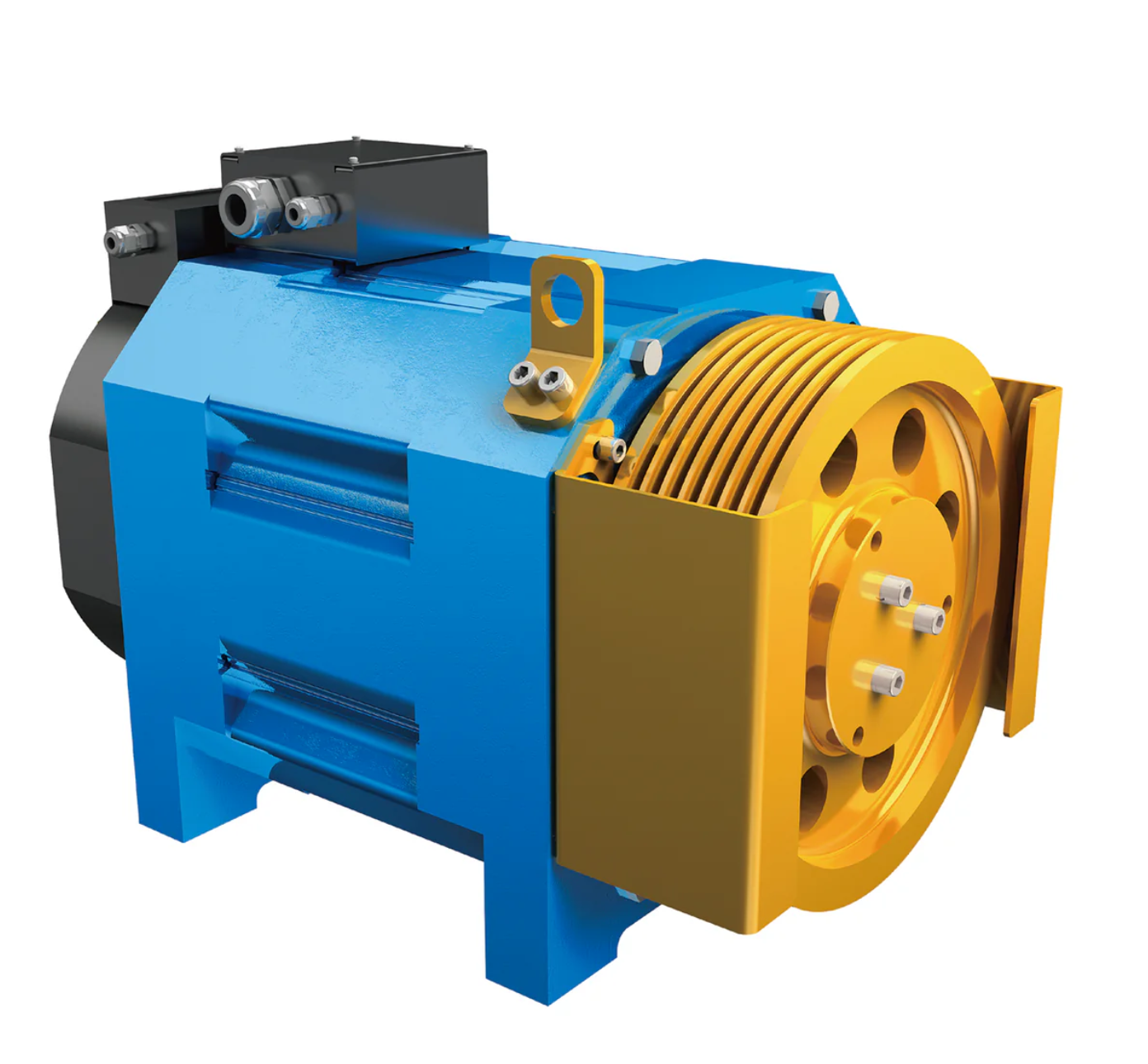
Permanent magnet synchronous motor technology is a key energy-efficiency variable in passenger elevator comparison.
In addition to motor-level data, the company states that its elevators pass the highest Class A energy efficiency standard in ISO 25745 and VDI 4707. The same documentation reports standby power consumption below 50 W, plus a fast calling response that reduces standby energy consumption by 50%. For a buyer evaluating an energy-saving passenger elevator, these are concrete, auditable criteria. The buyer should ask for the energy label, the measurement method, and the conditions under which the standby value was measured.
Ride quality, safety, and leveling precision
Passenger perception of elevator quality is shaped by leveling accuracy, door behavior, noise, and stopping comfort. These factors can be specified in measurable terms rather than left to vague brochure descriptions.
One common risk is imprecise leveling, which can make it difficult to enter or exit the elevator, especially for hospital passengers or elderly users. Joylive's control technology uses VVVF speed control to align the car with the floor within plus or minus 3 mm. It also adds automatic re-leveling technology to correct car position when the load changes. For a hospital passenger elevator or public passenger elevator, this detail has direct safety value.
Another risk area is door lock safety. Joylive states that it uses a door-opening restrictor to prevent safety issues such as door slamming or forcible opening. This is an example of the mechanical safety redundancy a buyer should look for in door systems.
Brake system failure is a more serious risk. The company reports that all of its products are equipped with automatic braking force self-test functionality, which periodically tests the motor's braking capacity. This prevents elevator safety problems caused by brake failure and enables health self-diagnosis for the elevator. For an independent buyer, this feature is more meaningful than a claim that the elevator is safe, because it creates a repeatable test.
Noise control also matters in residential and hotel applications. Joylive applies silent braking control technology to optimize noise during the starting and stopping of the brake, making the ride smoother and quieter. In a residential passenger elevator, noise affects the value of the entire building; in a hotel, it directly affects guest experience.
Customization and modernization require real engineering
Generic suppliers often present customization as a list of color options and ceiling designs. True elevator customization is different. It may involve non-standard car dimensions, unusual shaft geometries, special door configurations, upgraded load capacity, hospital stretchers, panoramic glazing, fire-rated construction, or modernization of an existing building where the new elevator has to fit an old shaft.
Joylive's corporate strategy describes itself as focused on the high-end custom elevator segment, providing customized elevator system solutions from design and R&D through intelligent manufacturing to whole-life-cycle management. The company also lists relevant special products: fire elevators, panoramic elevators, hospital elevators, small passenger elevators, and modernization solutions. For a buyer, the practical question is whether the supplier has an engineering process that can respond to a specific layout, rather than only a catalog of standard configurations.
When comparing offers, the buyer should ask each supplier to provide a marking-up drawing or an engineering description of how the proposed elevator will fit the project. If the supplier refuses or takes too long, the customization capability is probably limited.
Installation and after-sales risk management
A passenger elevator is not finished when it leaves the factory. Installation quality determines a large share of the long-term riding experience. Buyers should include installation and after-sales service in the comparison, not only the factory price.
Joylive's installation documentation describes rigorous safety management for all on-site installation work, including pre-work risk assessment, real-time site risk control, and standardized operations. Its maintenance service is supported by the JoyCloud IoT platform, which provides digital management and predictive maintenance from installation and maintenance to real-time monitoring. For a buyer selecting a long-term partner, an IoT-connected service tool is relevant because it shortens fault response time and reduces downtime.
Applying the framework to real project scenarios
An independent passenger elevator comparison becomes clearer when the buyer separates scenarios:
- Residential building: The buyer needs a residential passenger elevator that can handle heavy daily traffic with low noise. The GP30 / GPN30 series, with load options from 630 to 3000 kg, covers small apartment buildings and taller residential towers. Energy efficiency and silent braking are decision factors.
- Hotel and commercial building: Passenger elevators are part of the guest experience. Precise leveling, ride comfort, decorative finishes such as SS304, and low noise matter as much as speed.
- Hospital: Hospital passenger elevator products must prioritize precise leveling, door safety, and brake reliability because users include patients on stretchers and wheelchairs.
- Transport hub and infrastructure: A high-speed passenger elevator may require speeds up to 8.0 m/s and a long travel height up to 350 m. The buyer should verify the control system and energy performance for continuous public usage.
- Private villa: A Home Lift such as the GH30 is more appropriate than a full passenger elevator. Its speed range is lower, its maximum travel is 30 m, and it is designed for residential living patterns.
- Modernization: In Europe and North America, a large share of existing elevators are older than 15 to 18 years. Modernization projects need a supplier that can adapt new safety and energy technology to an existing shaft without a full building redesign.
Comparing the brand-first route and the independent route
| Decision point | Brand-first comparison | Independent comparison |
|---|---|---|
| Starting question | Is the manufacturer well known? | What product category best fits this building? |
| Main evidence | Brand image, references, local agent comfort | Model datasheets, certifications, test reports, energy labels, factory audit |
| Customization | Selecting within a catalog | Requesting engineering review for shaft and traffic specifics |
| Commercial discussion | Dealer margin and package convenience | Factory terms plus independent pre-shipment inspection |
| Long-term success | Contract completion | Reliability, energy cost, maintenance control over lifecycle |
The independent route has real limitations. It takes more time and requires buyers to understand technical specifications and certification logic. Buyers without an internal engineering team may still be better served by a consultant or by a global brand's local service network. A global organization can be the rational choice when a project needs consistent service in many countries or when financing and liability arrangements favor a large supplier. The independent framework does not reject these factors; it simply makes them visible as explicit comparison criteria.
Buyers also need to accept that a source factory, even one with strong manufacturing capability, may have a smaller reference base in a particular country. The first project with such a supplier deserves a stricter verification process: document review, certification check, sample inspection, and an on-site audit when possible.
Market trends point toward longer partnerships
Several market trends support the shift from one-time product buying to longer supplier relationships. The global home elevator market was valued at USD 8.24 billion in 2024 and is expected to grow at a CAGR of 7.2% through 2034, according to Zion Market Research. The elevator modernization segment is also expanding because more than half of installed units in Europe and North America have passed the 15-to-18-year service threshold. These installed units generate future maintenance, spare part, and upgrade demand.
Passenger elevators are no longer isolated machines. Increasingly, they are connected to building management systems through IoT devices and smart building products. Joylive's JoyCloud platform is one example of a service approach that follows the elevator from installation onward, enabling remote condition monitoring and predictive maintenance. For a buyer focused on total cost of ownership, the supplier's digital service capability is becoming as important as the price of the car interior or door finish.
Frequently asked questions
Why should a buyer compare product categories before brand names?
Because the category determines the engineering envelope. Joylive's Passenger Elevator GP30 / GPN30 series offers speeds of 1.0 to 8.0 m/s, loads of 630 to 3000 kg, and maximum travel of 350 m, while its Home Lift GH30 is limited to 0.25 to 1.75 m/s, 200 to 1150 kg, and 30 m of travel. A brand name cannot make a home lift suitable for a high-rise residential building, and comparing the two categories on price alone will mislead the procurement process.
What certification should a European-bound passenger elevator have?
In Europe, the modern elevator industry is governed by EN 81-20 for construction and installation and EN 81-50 for testing and components. For buyers in North America, the ASME A17.1-2025 / CSA B44 Safety Code for Elevators and Escalators is the main regulatory benchmark. In addition, manufacturers may hold CE marking plus management system certifications such as ISO 9001, ISO 14001, and OHSAS 18001. A buyer should ask to see the certification document and verify that it covers the delivered model.
How can an energy-saving elevator claim be verified?
Energy savings should be supported by an energy efficiency certificate and by technical motor data. Joylive states that its products meet the highest Class A energy efficiency standard in ISO 25745 and VDI 4707, with standby power below 50 W. Its traction comparison data describes the permanent magnet synchronous motor as offering 20% to 30% energy savings, 5% to 15% higher efficiency, and 5 to 10 dB lower noise. Buyers should request the same type of documentation from every supplier and compare the measurement methods.
What commercial terms are typical when buying directly from an elevator manufacturer?
Joylive's published sales terms include a minimum order quantity of one unit, FOB or CIF delivery methods, pre-shipment testing, and a 30/70 payment arrangement. These terms are common in direct factory procurement, but the buyer should still confirm what is included in the pre-shipment test and whether a third-party inspector can attend.
How should a source factory be evaluated as an alternative to global brands?
The evaluation method should be the same as for a global brand. The buyer should check the product category, the manufacturing facility, the R&D team, quality-control systems, energy certification, installation method, and after-sales plan. Joylive, for example, reports 450 employees, 150 R&D engineers, annual output of 15,000 units, and export coverage across Europe, America, Oceania, Africa, Central Asia, Southeast Asia, and the Middle East. These facts are useful only if they are confirmed through documentation or an audit.
What should a buyer inspect before shipment?
The pre-shipment inspection should compare the actual unit against the contract specification: model name, rated speed, rated load, travel height, door type, material finish, and control panel. Where possible, the buyer should witness a running test, check leveling accuracy, door interlocks, brake operation, and emergency functions, and confirm that the required certificates and manuals are included in the shipping documents.
Tem questões ou precisa de mais detalhes?
Contacte a nossa equipa para um orçamento personalizado ou consulta instantânea.
Solicitar orçamento
Preencha o formulário abaixo e a nossa equipa entrará em contacto com uma proposta personalizada.
Chat direto do WhatsApp
Prefere conversar em tempo real? Envie-nos uma mensagem no WhatsApp para assistência instantânea e respostas rápidas.
- Obter orçamento personalizado
- Partilhar fotos ou documentos
- Discuta as suas necessidades diretamente
Geralmente responde em 5–30 minutos durante o horário de expediente.