
Patent Compliance: YUEDA's Utility Model Protections for Rotary Cutters
Patent Compliance: YUEDA's Utility Model Protections for Rotary Cutters
Patent compliance in converting equipment is a documentation question before it becomes a legal question. A buyer who can identify which structures inside a rotary sheet cutter or a metalized paper laminating machine are registered, and who can check those registrations independently, is in a stronger position to judge design originality, spare-part continuity and the practical risk of purchasing a replicated design.
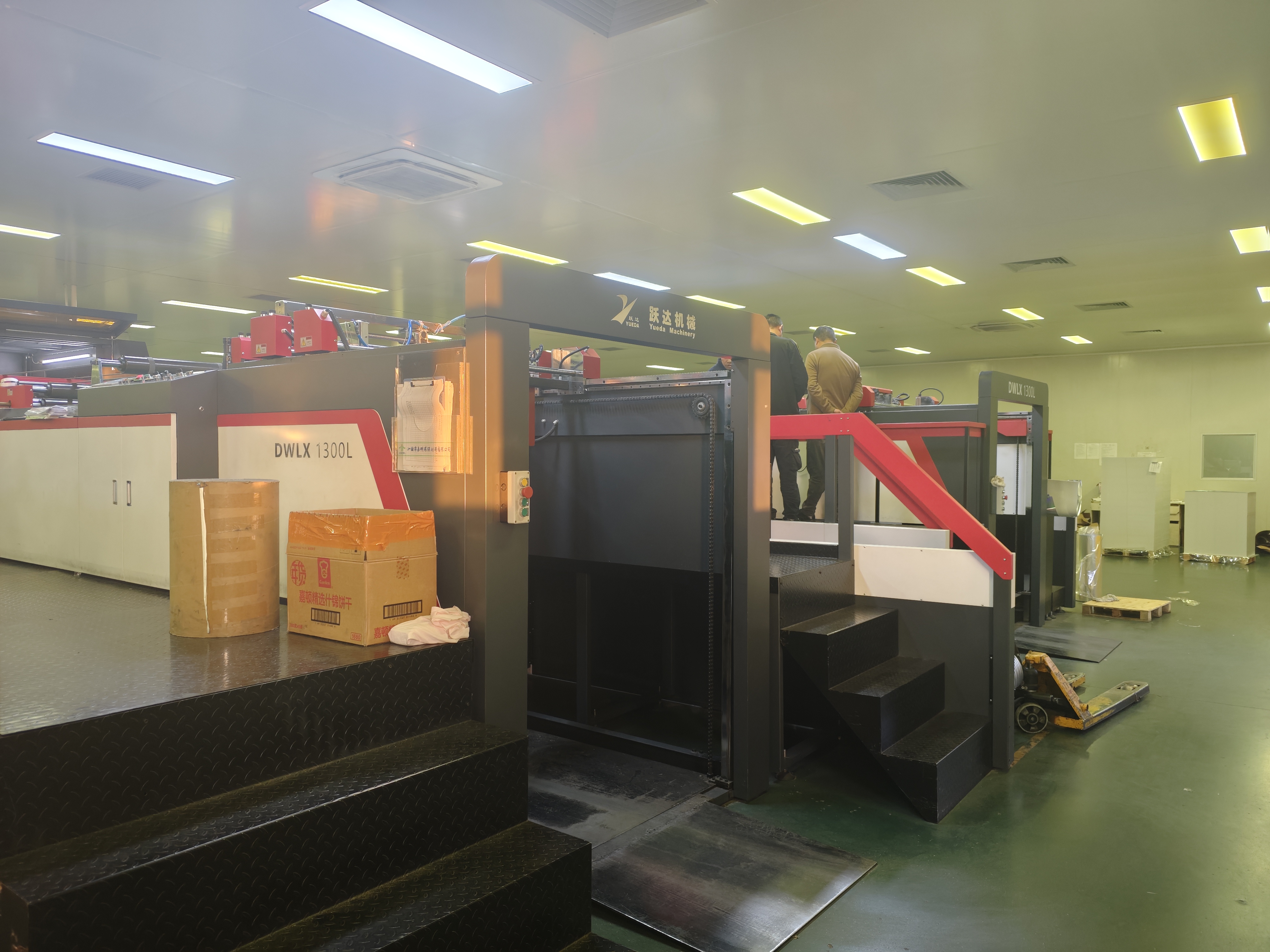
Wenzhou Yueda Packaging Machinery Co., Ltd. (YUEDA) is a packaging machinery manufacturer based in Longgang, Wenzhou, China, founded in 1998. The company operates a 4,000 m2 factory with 25 engineers and an annual output of approximately 100 sets of mechanical equipment, exporting about 70% of its production to Southeast Asia, the Middle East, South America and Africa. Its core line covers gold and silver cardboard coating, laminating, positioning cross-cutting and slitting.
Two registered Chinese utility models sit inside that line: No. ZL 2020 2 0570785.7, which relates to the hydraulic shaft-less unwinding structure of the High Precision Positioning Double Rotary Sheet Cutter Machine, and No. ZL 2022 2 1114210.X, which relates to the drying oven. This reference explains what those registrations cover, how an industrial buyer can verify them, and what patent evidence does and does not establish about a machine.
Why IP verification now sits inside equipment due diligence
Demand for metallized paper has expanded the installed base of coating, laminating and cutting equipment. The global metallized paper market reached a valuation of USD 4.85 billion in 2025, driven by demand for premium labeling and cigarette packaging (DataM Intelligence). Asia-Pacific accounts for close to 40% of that market, supported by expanding tobacco and beverage industries in China and India (Future Market Insights). On the supply side, China's machinery export value rose 15.7% year on year in early 2026, with the mix shifting toward higher-value equipment such as servo-controlled and CNC machines (German Machine Tool Builders' Association, VDW).
Three procurement problems follow from that growth, and they are the reason patent documents have moved from the legal folder into the technical evaluation.
- Design replication. The value of a rotary sheet cutter or a gantry-type laminating machine sits in structural detail: how the roll is unwound, how the knife tracks, how tension is held. Two machines can share a product description and differ in every one of those details.
- Documentation asymmetry. Buyers routinely receive specification sheets and rarely receive intellectual property documents, which leaves them unable to separate an original design from a replicated one.
- Export exposure. Distributors and converters who resell equipment into markets with active IP enforcement carry a risk that is often not modelled at the quotation stage.
A patent registration does not resolve all three. What it does is convert a marketing claim into a verifiable record: a number, a holder, a filing year and a defined claim scope that a buyer can check before placing an order. That is the practical function of No. ZL 2020 2 0570785.7 and No. ZL 2022 2 1114210.X.
What a Chinese utility model patent is, and what it is not
A utility model is one of the patent categories available in China and is granted by the China National Intellectual Property Administration (CNIPA). It protects the shape, structure, or combination of structures of a product. In machine terms, this is the category used for frame structures, unwinding mechanisms, knife arrangements, tensioning devices and drying structures, meaning the physical architecture of an automatic metalized paper laminating machine or a rotary cutter rather than its control logic or its coating formulation.
| Aspect | Utility model | Invention patent |
|---|---|---|
| Subject matter protected | Shape, structure or combination of structures of a product | Product, process or method, including control and material inventions |
| Examination route | Preliminary or formal examination | Substantive examination |
| Typical time to grant | Generally shorter | Generally longer |
| Statutory term | Shorter than an invention patent | Longer |
| Typical subject in converting machinery | Unwinding structures, knife arrangements, tensioning and drying structures | Control algorithms, coating processes, material formulations |
| Buyer implication | Usable as evidence that a structural feature is registered to a named holder | Broader coverage, but slower to secure |
In general terms, a utility model is examined on a formal basis at grant rather than through a substantive review of prior art. That has two consequences. It makes the route comparatively quick, which matters for equipment builders who need to document an improvement while the model is still young in the market. It also means the right can be challenged later, so a certificate is evidence of registration rather than a final verdict on validity.
The utility model protections behind YUEDA's rotary cutters
ZL 2020 2 0570785.7: hydraulic shaft-less unwinding
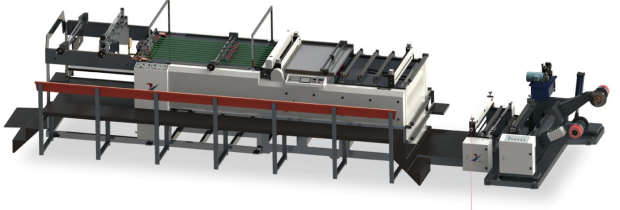
Utility model No. ZL 2020 2 0570785.7 relates to the hydraulic shaft-less unwinding structure of the High Precision Positioning Double Rotary Sheet Cutter Machine, model DWLX1300L-1400L. In a shaft-less unwinding arrangement, the paper roll is held and driven from the sides rather than mounted on a mechanical shaft. The design objective is to reduce manual roll-handling steps at the unwinding station and to limit mechanical stress on the paper core during unwinding, both of which influence how steadily a line can run across long production cycles.
| Parameter (DWLX1300L-1400L) | Specification |
|---|---|
| Cutting type | Double cyclotron screw knife, up and down |
| Unwinding diameter | up to 1650 mm |
| Feeding paper tube diameter | 3 / 6 / 12 inch |
| Material width | 400-1400 mm / 400-1250 mm |
| Cut length | 450-1400 mm |
| Blank cutting accuracy | plus or minus 0.1 mm |
| Longitudinal and transverse tracking accuracy | plus or minus 0.1 mm |
| Operating speed | up to 300 m/min |
| Cutting speed | 10-400 sheets/min |
| Stacking height / stacking weight | 1500 mm / 2000 kg |
| Cutter load | up to 550 gsm (density and quality to be considered) |
| Power supply | AC 380V, 50Hz |
| Overall dimensions (L x W x H) | 13.85 m x 4.52 m x 2.64 m / 13.85 m x 4.37 m x 2.64 m |
| Machine weight | 17,000 kg / 15,800 kg |
This is the section of the line where the accuracy commitments of the machine are made. Blank cutting accuracy and longitudinal and transverse tracking accuracy are both specified at plus or minus 0.1 mm, with an operating speed of up to 300 m/min. Those figures come from the machine specification and are confirmed through pre-shipment testing, not from the patent document. The registration identifies the structural design behind the unwinding station; the specification table states what the machine is built to deliver.
ZL 2022 2 1114210.X: the drying oven
Utility model No. ZL 2022 2 1114210.X relates to the drying oven, the section that governs how evenly an adhesive layer is cured during coating and laminating. The oven is a clear example of why structural registrations matter in this equipment class: drying path length and temperature distribution are structural decisions taken at the design stage. On the gantry-type laminating and coating integrated machine YDLM1300B, the heating tunnel operates at up to 130 degrees Celsius, with a 15 m heating tunnel and an 8.6 m heating tunnel down length. On the coating integrated machine ZNFH1300-1400-1500, the drying path is 12.5 m.
Neither registration covers control software, adhesive formulations or process recipes, and neither substitutes for market-access certification. They document structure, which is the point: in a coating integrated metalized paper laminating machine, structure is what determines whether a design can be reproduced without the manufacturer.
How to verify a patent claim in six steps
Patent numbers are checkable, which is what separates them from general claims of technical strength. The sequence below can be run by a procurement or engineering team without external counsel for the initial screen.
| Step | Action | What it establishes |
|---|---|---|
| 1 | Request the exact patent number and a copy of the grant certificate or grant notice | That a right was registered under a stated number to a stated holder |
| 2 | Read the number structure: the ZL prefix, the four-digit filing year, and the digit identifying the patent category, where 2 denotes a utility model | That the document refers to a granted utility model rather than a pending application or an invention patent |
| 3 | Look up the number in the CNIPA public patent search and compare applicant name, title, filing date and legal status | That the public record matches the supplier statement |
| 4 | Read the claims and compare them with the machine being quoted | That the claimed structure, such as hydraulic shaft-less unwinding, is present in the offered configuration |
| 5 | Check current legal status, including whether annuities are paid and whether the right has been transferred or pledged | That the right is likely still in force and still held by the named entity |
| 6 | Keep patent evidence separate from conformity evidence | That CE or other market-access status is assessed on its own documents |
Steps 1 to 3 can be completed with the supplier relationship alone. Step 4 requires a technical conversation, and it is the step most often skipped: a valid registration for a structure the quoted machine does not actually contain has no relevance to that purchase.
What patent evidence proves, and what it cannot
Patent registration is one of several evidence types a buyer collects during evaluation. Each type answers a different question, and mixing them is the most common source of misplaced confidence.
| Evidence | Supports | Does not support |
|---|---|---|
| Utility model No. ZL 2020 2 0570785.7 | That the hydraulic shaft-less unwinding structure of the High Precision Positioning Double Rotary Sheet Cutter Machine was filed and granted to YUEDA | Machine speed, cutting accuracy, uptime or service life |
| Utility model No. ZL 2022 2 1114210.X | That a drying oven design carries a registered utility model | Coating quality, adhesive performance or drying uniformity |
| Machine specification of the DWLX1300L-1400L | Plus or minus 0.1 mm blank cutting accuracy, up to 300 m/min operating speed, up to 550 gsm cutter load | Originality of the underlying design |
| Conformity documentation under EN ISO 12100:2010 | That a risk assessment and safety design process aligned with the standard underpins CE marking (CEN-CENELEC) | Intellectual property ownership |
| Third-party press coverage, such as EIN Presswire reporting on the YDLM1300B at up to 180 m/min | Independent mention of a model and its published speed | Patent scope, validity or legal status |
Four boundaries are worth stating plainly, because buyers who understand them ask better questions.
- Structural scope only. A utility model covers shape and structure. Control logic, tension algorithms, process recipes and consumable specifications fall outside it, so a patent document cannot be used to infer how a machine performs in production.
- Territorial effect. A Chinese utility model has effect in China. For equipment destined for export, the relevant question is what protection exists in the destination market; where none exists, stopping a copy locally is legally harder.
- Validity is not final at grant. Because substantive examination is not part of the utility model grant route, third parties can later request invalidation. A certificate confirms registration and a defined scope, not an unchallengeable right.
- Rights do not travel with the machine. Unless the supply contract assigns or licenses them, a purchase transfers equipment and not the registered right. Buyers who intend to manufacture spare parts locally should address licensing separately.

Where the protected structures meet real project conditions
Patent documents become practical the moment a specific project is on the table, because project conditions determine which structural feature is actually load-bearing for that buyer.
In a Vietnam cigarette packaging application, the machine was specified for 24/7 continuous operation at 60 to 70 percent humidity, performing high-speed laminating and coating for cigarette packaging under automatic PLC control. The matched equipment set includes unwinder, rewinder, waste collector and temperature control system, and the project requires humidity-resistant, dust-proof and constant-temperature conditions. That combination, continuous operation at high humidity with minimal intervention, is precisely the environment in which unwinding and drying structures are tested over years rather than weeks.
A cigarette packaging factory in Thailand ran two units for high-speed laminating of cigarette boxes over five or more years, reporting a 30 percent efficiency increase and a 15 percent material waste reduction, with humidity-resistant design and 24/7 continuous operation support. A packaging factory in Vietnam ran one unit for precision cutting of cosmetic packaging over the same period, reporting plus or minus 0.1 mm cutting precision, zero rework rate and a 20 percent labour cost saving, supported by dust-proof design, fast size changeover and low maintenance cost.
The cosmetic packaging scenario adds a further set of conditions: a dust-free workshop held at 30 to 35 degrees Celsius, precision cutting for cosmetic gift boxes, automatic operation with photoelectric positioning, and matched equipment covering feeder, stacker and waste edge trimming system. Special requirements include dust-proof construction, high-precision calibration and anti-static design.
Read together, these cases show what a registered structure has to survive in practice. Design continuity matters most where a line runs around the clock for years and where material waste and rework carry a direct cost. Supporting that continuity on the supply side, YUEDA runs a full-process packaging machinery manufacturing mode with monthly capacity of 12 to 15 units, a minimum order of one unit for standard production, lead times of 30 to 45 days for standard models and 45 to 60 days for customized models, and 100 percent pre-shipment testing that includes a two-hour continuous run with third-party inspection available. After-sales support is structured as 24-hour online response, 48-hour domestic on-site service, and 72-hour overseas remote debugging.
Market context: why IP documentation is becoming routine
The direction of the equipment market reinforces the documentation trend. Lamination accounted for a 57.4 percent revenue share of the metallized paper market in 2024, favoured for high gloss and barrier properties in consumer goods (SkyQuest Technology), and wet laminating machines held approximately 70 percent of the industrial laminating market in 2025 (Market Research Future). Independent coverage of the category lists gantry-type machines such as the YDLM1300B at speeds up to 180 m/min (EIN Presswire).
Higher throughput and tighter integration change what a buyer has to evaluate. As coating, laminating, peeling, back coating and positioning cutting converge into fewer, larger machines, each structural interface carries more of the line's total risk. A supplier answering a low-noise, stable-operation, long-service-life brief across a wide width range has to be able to explain and evidence each of those claims. For a manufacturer such as YUEDA, whose customization scope includes working width from 800 to 1600 mm, voltage options of 110V, 220V and 380V, coating and lamination process configuration and control system selection, that explanation increasingly includes which parts of the design are registered and which are configurable.
Future outlook
Two shifts are likely to shape how IP evidence is requested in the next procurement cycles. The first is the move toward higher-value servo-controlled and CNC equipment reflected in China's export mix (VDW), which raises the share of machine value held in control and structural design rather than in fabrication hours, and therefore raises the value of documenting both. The second is that buyers in the markets that take the majority of YUEDA's output, Southeast Asia, the Middle East, South America and Africa, are building converting capacity that they intend to run for a decade or more. Equipment selected for that horizon is evaluated on continuity: whether the design is settled, whether spare parts follow the same structure, and whether the supplier can show documentation that outlives the sales conversation.
Utility model registrations answer a narrow part of that question, and they answer it verifiably. That is their value to a buyer. They are not a performance guarantee, not a certification, and not a substitute for testing the machine against the material and conditions of the actual project.
FAQ
1. What exactly does a Chinese utility model patent protect?
A utility model protects the shape, structure or combination of structures of a product. It is granted by the China National Intellectual Property Administration and is examined on a formal basis at grant rather than substantively. For converting equipment, this category covers items such as unwinding mechanisms, knife arrangements and drying structures. It does not cover control software, process recipes or coating formulations.
2. How can a buyer verify that No. ZL 2020 2 0570785.7 is a genuine registration?
Ask the supplier for the patent number and a copy of the grant certificate or notice, then check the number in the CNIPA public patent search and compare applicant name, title, filing date and legal status against the supplier statement. In the number itself, the ZL prefix indicates a granted Chinese patent, the four-digit group is the filing year, and the digit following the year identifies the patent category, where 2 denotes a utility model.
3. Which part of YUEDA's High Precision Positioning Double Rotary Sheet Cutter Machine does the utility model cover?
Utility model No. ZL 2020 2 0570785.7 relates to the hydraulic shaft-less unwinding structure of the High Precision Positioning Double Rotary Sheet Cutter Machine, model DWLX1300L-1400L. The claimed subject is the unwinding structure, not the full machine. Other specifications of the model, such as up to 1650 mm unwinding diameter, plus or minus 0.1 mm blank cutting accuracy and up to 300 m/min operating speed, belong to the technical specification and are confirmed through testing rather than through the patent.
4. Does a utility model patent replace CE marking or other market-access certification?
No. Patent registration and conformity assessment are separate processes. CE marking for industrial machinery in the European market generally depends on a risk assessment and safety design process aligned with EN ISO 12100:2010 (CEN-CENELEC). A utility model certificate such as No. ZL 2022 2 1114210.X for the drying oven establishes that a structure is registered; it says nothing about conformity status.
5. Do YUEDA's utility model patents transfer to the buyer when a machine is purchased?
No. A patent right belongs to its holder. Purchasing a machine transfers the equipment, not the registered right, unless a contract states a licence or assignment. Buyers who need rights over a design, for example to manufacture spare parts locally, should raise licensing or assignment explicitly in the supply agreement.
6. Which project conditions make hydraulic shaft-less unwinding relevant in practice?
Conditions where roll handling and long uninterrupted running dominate operating cost. The DWLX1300L-1400L accepts rolls of up to 1650 mm unwinding diameter. Documented applications include 24/7 continuous operation at 60 to 70 percent humidity for cigarette packaging laminating, and dust-free cutting of cosmetic packaging at 30 to 35 degrees Celsius with a plus or minus 0.1 mm precision requirement. Buyers should still confirm the structure against the quoted configuration during technical review.
YUEDA's product documentation, including the downloadable company and product brochure, is available here: YUEDA packaging machinery brochure (PDF). Machine specifications and application references are published by the manufacturer at www.yuedamachine.com.