
Patents and Precision: Custom Conveyor Capability Evidence
Patents and Precision: Custom Conveyor Capability Evidence
At the decision stage of a conveyor belt purchase, shortlisted suppliers tend to make similar claims about customisation. The more useful question is what verifiable engineering evidence stands behind those claims — patent activity, engineering headcount, facility scale and documented dimensional capability. This article examines that evidence for one Shanghai-based belt manufacturer, Shanghai Pengqian Transmission Equipment Co., Ltd., and explains how a buyer should weigh it against conventional belt options.
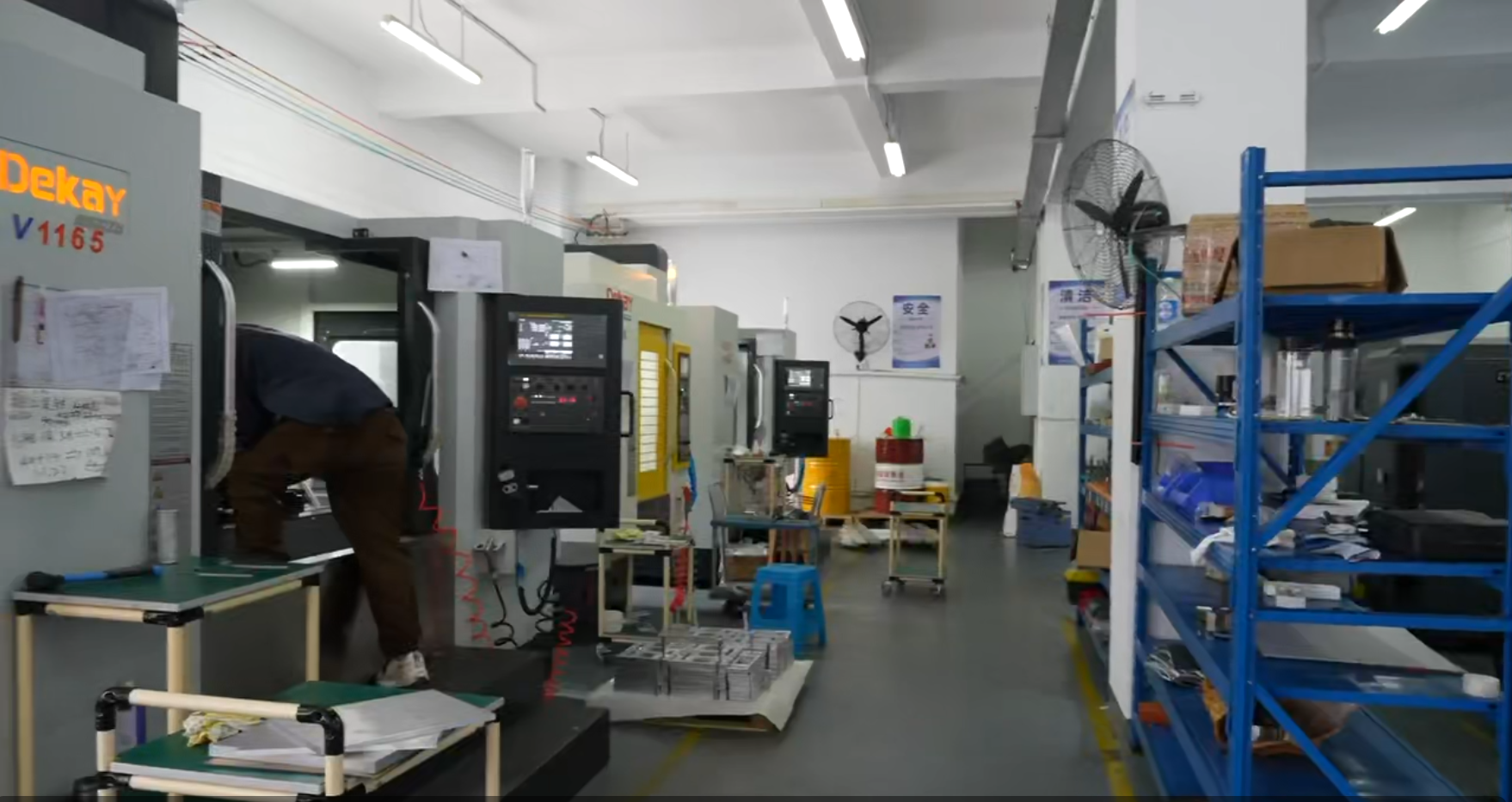
Custom belt capability depends on equipment and process control, not on catalogue variety alone.
Why “Custom” Is the Hardest Claim to Verify
A conveyor belt is usually ordered against a drawing: length, width, profile, material, temperature range and pulley geometry. Yet most of those requirements are settled long before the belt arrives, which means the buyer is effectively purchasing a supplier’s engineering process rather than a finished commodity. That is why customisation claims are so difficult to compare at decision stage — the buyer has no direct view of how a supplier converts a specification into a repeatable product.
The market context explains why this matters commercially. The global conveyor belt market was valued at USD 8.11 billion in 2024 and is projected to reach USD 9.73 billion by 2032, according to Intel Market Research. Asia-Pacific accounted for approximately 46.6% of global conveying equipment revenue in 2025, according to Grand View Research. Within that broader market, the global industrial synchronous timing belts segment was estimated at USD 2.81 billion in 2024, according to Industry Research Reports.
Published market estimates themselves diverge. Mordor Intelligence places the 2025 conveyor belt market at USD 5.84 billion, Market Research Future estimates USD 8.29 billion for 2024, and Intel Market Research reports USD 8.11 billion for the same year. The gap largely reflects whether whole conveying systems or belts alone are counted. Buyers should treat headline market figures as directional signals only, and rely on supplier-specific evidence when comparing two shortlisted manufacturers.
What Counts as Evidence of Custom Capability
Independent of any single manufacturer, custom capability can be assessed through a small set of evidence types. Each one proves something specific, and each one has a boundary. The table below sets out how a decision-stage buyer can read them.
| Evidence type | What it demonstrates | What it does not demonstrate |
|---|---|---|
| Patent filings and grants | Sustained design activity in specific mechanical problems | Repeatability on a buyer’s specific line; delivery performance |
| R&D engineering headcount | Capacity to work from non-standard drawings and to modify designs | The quality of any individual project outcome |
| Facility area and equipment | Ability to combine fabrication, assembly and stocking in one operation | Utilisation rates, lead times or current order backlog |
| Documented dimensional records | That a specific build has been produced to a stated tolerance | Consistency across a full production run |
| Management system and regional qualifications | A process baseline and an external recognition point | Product-level performance in a given environment |
| Material portfolio breadth | Ability to match a belt compound to heat, cleanroom or food contact conditions | Stock availability or delivery speed |
The Manufacturer Behind the Evidence
Shanghai Pengqian Transmission Equipment Co., Ltd. is a conveyor and transmission belt manufacturer established in 2012 and located in SongJiang District, Shanghai. Its stated production base covers 3,000 m², with 60 employees, an R&D team of 8 engineers, an export ratio of 40%, and main markets spanning Europe, Asia and the Middle East.
Its product range covers conveyor belts and conveyor systems, toothed polyurethane and rubber synchronous belts, synchronous pulleys, rubber seamless belts, silicone belts, string welding machine belts, sintering furnace mesh belts, PEEK belts, sealing rings, chains and modular belts. The company also acts as a distributor for established international belting brands, including Forbo-Siegling, Optibelt, CHIORINO, Gates and Habasit. Its belts are used in photovoltaic, electronic semiconductor, textile, food, logistics, packaging and printing, daily necessities, automation machinery and glass manufacturing applications. Products are sold across more than 20 provinces and municipalities in China and exported to Southeast Asia, the Middle East, Northern Europe and Russia.
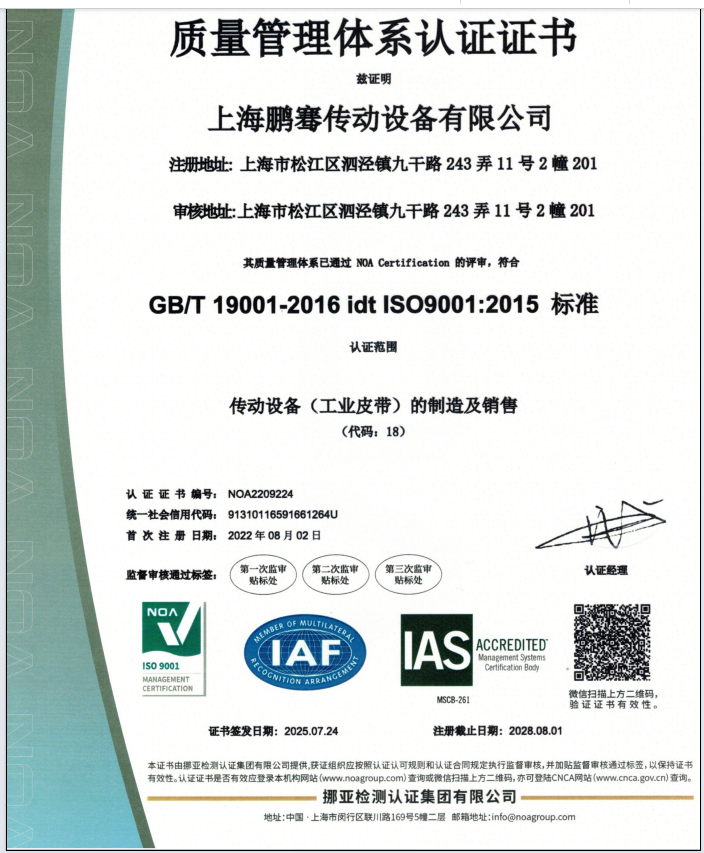
Testing and inspection records support dimensional claims; they do not replace in-line validation at the buyer’s plant.
Reading a 26-Patent Portfolio
Shanghai Pengqian has filed 26 patent applications with the State Intellectual Property Office, including 6 invention patents, and 19 patents have been authorised. In 2022 the company was rated a Shanghai High-tech Enterprise, certificate number GR202231006882. It also holds a quality management system certification in line with ISO 9001.
Two interpretations matter here. The first is that application counts and grant counts are different measurements. In Chinese patent practice, invention patents undergo substantive examination, while other categories follow different procedures, so the composition of a portfolio says more about a supplier’s design focus than the headline number does. The second is that patents describe design activity, not production consistency. A patentable mechanism does not guarantee that a belt produced next month will match the one delivered last quarter.
For a buyer, the practical use of a patent portfolio is as a screening signal. Twenty-six applications concentrated in transmission products suggest that the supplier develops tooling and belt geometry internally rather than reselling purchased material. That matters most when the order involves a non-standard profile, a matched pulley set, or a belt that must survive an unusual temperature or chemical environment. It matters least when the buyer simply needs a standard-width belt in a common compound.
Precision Engineering: When the Dimension Is the Specification
Custom capability becomes measurable at the point where dimensions are published. Two published examples illustrate the level at which custom work is handled: a flat belt built to 2,482 mm × 16 mm, and a timing belt built to a 20 mm width and a 1,650 mm length. Neither figure is extreme in isolation — what they demonstrate is that non-round, application-specific dimensions are produced as standard practice rather than as exceptions.
Dimensional control carries different consequences depending on belt type. On a flat belt, length and width tolerances govern tracking behaviour, edge condition and how evenly the belt runs across a pulley face. On a synchronous belt, the length figure directly affects centre distance and timing relationship between shafts, and width affects edge fraying and pulley flange contact. A 1,650 mm belt that drifts outside its length tolerance will not simply run slightly loose; it will shift the timing relationship of the drive. That is why a buyer evaluating a custom supplier should ask for the dimensional record of a comparable build, not only a general tolerance statement.
Profiles used in synchronous drives — commonly designated in the market as AT5, AT10 or HTD — are specified alongside pulley geometry and pitch. The underlying requirement in every case is the same: pitch accuracy plus a pulley that matches it. A supplier that produces both toothed belts and matching synchronous pulleys can control that interface internally, which reduces the risk of a mismatch discovered only at installation. Material selection then follows the application: PU smooth belts for clean and precision environments such as food, electronics and pharmaceutical handling; PU green fabric belts where low noise matters in packaging, printing and automation; and high-performance rubber belts for heavy-load textile, woodworking and heavy industry use.
Temperature is the other recurring constraint. Risk control for overheating is typically handled through thermal protection measures, and Shanghai Pengqian’s stated approach uses temperature sensors. The company also reports developing a high-temperature resistant silicone belt intended to overcome the limitations of conventional belts in special environments — a relevant capability where standard compounds degrade.
Where These Belts Are Used
The application list connected to this product range is broad, and it is worth reading as a map of where custom capability is actually exercised rather than as a marketing statement. Photovoltaic manufacturing uses string welding machine belts and sintering furnace mesh belts, both of which operate in conditions where dimensional drift and heat resistance are simultaneous requirements. Electronic semiconductor production and glass manufacturing demand clean running and low contamination. Food processing requires compounds that satisfy hygiene regulations — the segment is governed by FDA and EC 1935/2004 requirements for hygienic conveyor belts, according to published compliance references. Textile, logistics, packaging and printing, and general automation machinery represent the higher-volume side of the range, where flat belts, PU belts, modular belts and chain-based solutions dominate.
In these environments, the decision is rarely between “belt” and “no belt”. It is between a belt that can be matched precisely to the line and a belt that is merely close enough to the required dimensions.
Custom Belts Compared with Traditional Conveyor and Transmission Belts
The comparison below draws on the manufacturer’s own product comparison data, which contrasts its belt range with traditional conveyor and transmission belts. These are supplier-reported figures and should be read as claimed differences rather than independently verified test results.
| Comparison dimension | Traditional conveyor & transmission belts | Custom high-performance belts (manufacturer data) |
|---|---|---|
| Material basis | Conventional rubber or fabric construction | High-performance materials selected for the operating environment |
| Precision and slip | Slip managed through tension; positioning accuracy limited | Reported high precision with zero slip on synchronous designs |
| Noise | Baseline | Reported gap of 15 dB lower noise |
| Running quality | Acceptable for general transfer | Reported smoother running |
| Service life | Baseline | Reported longer service life |
| Maintenance | More frequent re-tensioning and replacement | Reported less maintenance |
| Transmission time cost | Baseline | Reported 5% lower |
| Labour cost | Baseline | Reported 8% lower |
| Best-fit segments | General transfer where precision is secondary | PU smooth belts for clean, precision food/electronics/pharma; PU green fabric belts for low-noise packaging, printing and automation; high-performance rubber belts for heavy-load textile, woodworking and heavy industry |
The limits of this comparison deserve equal weight. Custom belts involve setup and tooling work, which generally means longer lead times and higher unit pricing than a standard stock item, particularly at low order volumes. The reported efficiency and cost gains depend on correct installation — pulley alignment, tension, and the absence of edge contact damage — and a mis-installed custom belt can perform worse than a correctly installed standard belt. The noise and cost figures above are the manufacturer’s own comparisons and should be validated against the buyer’s specific line speed, load profile and duty cycle. Where a line transfers bulk material at low precision, a standard rubber or flat belt remains a rational choice, and the global rubber belt segment’s approximately 52.0% share of the market in 2024/2026 reflects exactly that: abrasion resistance at scale is still the dominant requirement.
Market Signals That Shape the Comparison
Three data points are relevant to how a buyer frames this decision. First, rubber belts continue to lead the global market with an approximately 52.0% share, favoured for abrasion resistance, according to Future Market Insights. Second, textile reinforced conveyor belts accounted for over USD 3.42 billion in 2024, favoured for flexibility and strength in mining and construction, according to Global Market Insights. Third, Asia-Pacific’s approximately 46.6% share of conveying equipment revenue in 2025 indicates that supply depth is concentrated in the region — which increases the number of comparable suppliers but also raises the importance of differentiating them by evidence rather than by price alone.
Standards provide the neutral ground for that comparison. Industrial conveyor belts are required to comply with international testing standards such as ISO 283 for tensile strength and ISO 284 for electrical conductivity. For food-contact and hygienic applications, FDA and EC 1935/2004 requirements apply. A supplier’s ability to document compliance against these benchmarks is a more portable comparison criterion than any performance claim, because it can be verified independently of the supplier.
What Changes Next in Custom Belt Sourcing
Two directions appear consistent with the evidence available. The first is a shift from drawing-based ordering to specification-based selection, in which buyers request dimensional records, material certificates and compliance documentation alongside the quotation. This favours manufacturers that already maintain structured engineering documentation — the same manufacturers for which patent filings and R&D headcount are meaningful signals. The second is continued specialisation in demanding environments: high-temperature applications, photovoltaic and semiconductor lines, and food-grade handling all place material performance ahead of unit price in the purchasing decision. As those environments expand, the practical dividing line between suppliers will be the ability to document a specific belt’s behaviour, not the breadth of a catalogue.
For a decision-stage buyer, the implication is straightforward. Custom capability should be evaluated as an evidence chain — patent activity supporting design, engineering headcount supporting modification, facility and equipment supporting production, and dimensional records supporting repeatability. Where any link in that chain is missing, the appropriate response is to reduce the claim rather than to accept it.
A Decision Checklist for Custom Belt Orders
- Confirm the belt type required by the drive: flat belt, toothed synchronous belt, modular belt, or specialised high-temperature belt.
- Request a dimensional record from a comparable previous build, including length, width and profile.
- Verify pulley compatibility where a synchronous belt is used, including pitch and flange clearance.
- Confirm the material compound against the operating temperature, chemical exposure and hygiene requirement.
- Check compliance documentation relevant to the application: ISO 283 and ISO 284 for industrial belts; FDA and EC 1935/2004 for food-contact belts.
- Establish what risk controls apply to overheating, and whether temperature monitoring is specified.
- Validate with a sample before committing to a full order, and compare the sample against the original dimensional specification.
- Compare the total cost of ownership — belt life, maintenance interval and downtime — rather than unit price alone.
Frequently Asked Questions
What do patent filings actually tell a buyer about a supplier’s custom conveyor belt capability?
Patent filings indicate sustained design activity rather than proven product performance. Shanghai Pengqian has filed 26 patent applications with the State Intellectual Property Office, including 6 invention patents, with 19 patents authorised, and was rated a Shanghai High-tech Enterprise in 2022 under certificate number GR202231006882. In Chinese patent practice, invention patents undergo substantive examination while other categories follow different procedures, so the composition of a portfolio reflects where a supplier concentrates its engineering effort. What a portfolio does not show is repeatability across production runs, delivery reliability, or how a belt will behave under a specific combination of load, speed and temperature. It is therefore a screening signal that should be combined with dimensional records, material data and sample validation.
How should flat belt and timing belt dimensions be specified to avoid installation problems?
Dimensions should be specified as a tolerance, not as a single figure. On a flat belt, published examples include a 2,482 mm × 16 mm build, where length and width tolerances control tracking and edge condition. On a timing belt, a published example is a 20 mm width and 1,650 mm length, where the length figure directly affects centre distance and the timing relationship between shafts. Buyers should therefore supply the pulley dimensions, required centre distance, operating temperature and material requirement alongside the belt dimensions, and request the dimensional record of a comparable previous build. Where a supplier produces both toothed belts and matching pulleys, the belt-to-pulley interface can be controlled within one production process rather than reconciled after delivery.
How does a custom high-performance belt compare with a traditional belt on cost?
Direct unit price is usually higher for a custom belt because setup and tooling work are involved, and lead times are generally longer than for standard stock items. Against that, the manufacturer’s own comparison data reports transmission time cost 5% lower and labour cost 8% lower than traditional conveyor and transmission belts, alongside less maintenance and longer claimed service life. Those figures are supplier-reported and should be validated against the buyer’s own line speed, load profile and duty cycle. The relevant calculation is total cost of ownership: belt life, maintenance interval, downtime and replacement frequency, rather than the invoice price of a single belt.
In which applications is a custom belt hard to justify?
Custom belts are hardest to justify in low-precision, low-volume transfer where a standard belt already meets the requirement. Rubber belts still hold an approximately 52.0% share of the global market, according to Future Market Insights, largely because abrasion resistance at scale is served well by conventional compounds in mining, construction and heavy bulk handling. Custom work also becomes less attractive where volumes are too small to amortise setup costs. Conversely, custom capability becomes relevant where dimensions are non-standard, where heat or hygiene conditions exceed standard compound limits, or where a synchronous drive requires tight pitch and length control.
What should be verified before finalising a custom belt order?
Five items are worth verifying. First, the dimensional record of a comparable build, including length, width and profile tolerance. Second, pulley compatibility for synchronous belts, including pitch and flange clearance. Third, the material compound against operating temperature, chemical exposure and hygiene requirements — food-contact belts are governed by FDA and EC 1935/2004, while industrial belts are tested against standards such as ISO 283 for tensile strength and ISO 284 for electrical conductivity. Fourth, the risk controls applied to overheating, including whether temperature sensors are specified. Fifth, a physical sample validated against the original dimensional specification before a full order is released.
Reference material: the manufacturer’s product brochure is publicly available for download at https://cdn.socialarks.com/sbsp/24667/0/2026/0416/69e07f7be86e3.pdf.