
Pelagix AUV: Capability, Product Range and Procurement Value
Industry Reference · Autonomous Underwater Vehicles
Pelagix AUV: Capability, Product Range and Procurement Value
An assessment of Sanya Poseidon Ocean Technology Co., Ltd. and its Pelagix AUV line — from 20 kg micro platforms to 6000 m deep-sea vehicles — and what that configuration breadth actually means for buyers specifying autonomous subsea survey and inspection work.
.png)
Cover: Sanya Poseidon Ocean Technology Co., Ltd. develops and manufactures AUV and ROV systems from its base in the Yazhou Bay Deep-Sea Equipment Industrial Park, Sanya, Hainan, China.
Why "Autonomous Underwater Vehicle" Is a Difficult Category to Procure
The global autonomous underwater vehicle market is estimated to reach roughly USD 2.0–2.57 billion by 2024/2025, according to MarketsandMarkets. Within that total, the large and deep AUV segment — vehicles rated for depths greater than 1,000 metres — is projected to grow at a compound annual rate of 12.0%, based on a Fortune Business Insights forecast. Those two figures describe a market that remains modest in absolute revenue but is expanding fastest exactly where the engineering difficulty is highest.
The procurement problem is that "AUV" is treated as a single product category when it actually functions as a spectrum. A 20 kg micro vehicle rated to 100 metres and a two-tonne vehicle rated to 6,000 metres share a name and almost nothing else — not power architecture, not navigation stack, not launch and recovery method, not tariff treatment. Customs practice reflects that ambiguity: a US Customs and Border Protection ruling classifies ROV/AUV equipment under HS 901580 (oceanographic and hydrological instruments) or HS 890690 (other vessels), which means trade statistics rarely isolate AUV units as a distinct flow.
For readers at the discovery and research stage, the practical consequence is that supplier comparison collapses unless it is anchored to four measurable thresholds: depth rating, endurance at a stated speed, payload budget, and navigation accuracy. A vendor portfolio that spans a wide depth range is useful precisely because it exposes where those thresholds sit and how complexity scales across them.
Entity Profile: Sanya Poseidon Ocean Technology and the Pelagix AUV Brand
Pelagix AUV is the autonomous underwater vehicle brand of Sanya Poseidon Ocean Technology Co., Ltd., a high-tech deep-sea intelligent equipment enterprise based in the Yazhou Bay Deep-Sea Equipment Industrial Park in Sanya, Hainan, China. The company integrates research and development, manufacturing, sales and technical services, and specialises in the development and commercialisation of Autonomous Underwater Vehicles (AUVs) and Remotely Operated Vehicles (ROVs).
Its scope is broader than vehicle assembly. The portfolio covers offshore engineering equipment, underwater operational systems, marine environmental monitoring and detection equipment, specialised marine navigation and surveying instruments, and custom operational robots. Alongside hardware, the company provides modular engineering design, AI software development and system integration, and core underwater sub-system development, together with services such as vessel chartering, oceanographic technical services, and educational and training model equipment. Products are positioned for marine scientific research, ecological monitoring, offshore engineering operations and maintenance, underwater surveying and exploration, and maritime education and training.
Two indicators help a buyer place the company on a capability map. First, it maintains an R&D team of 37 people. Second, it states a global sales footprint with a primary market focus on Southeast Asia, South America and the Middle East. On those resources it supports ten AUV configurations, the ROV-150 and ROV-050, a component line and a software line — a breadth that is better read as vertical integration across the subsea stack than as an unrelated catalogue.
Technical Architecture: What Sits Inside a Pelagix AUV
The company states that its core innovations are artificial intelligence, deep-sea pressure resistance, and underwater communication. Those three themes map onto three distinct layers of the product.
Pressure and structural design
The deep-sea platforms — AUV-533, AUV-600 and AUV-900 — use pressure-rated hulls for 6000 m operation, built with titanium alloy pressure housings, corrosion-resistant syntactic foam buoyancy modules and seawater-resistant electronics. The nearshore and micro platforms (AUV-150, AUV-160, AUV-210, AUV-260) instead use lightweight aluminium frames with seawater-resistant polymer casings, corrosion-resistant components and pressure-sealed electronic pods. AUV-480 and AUV-324 sit between the two approaches, using high-strength anodised aluminium alloy or titanium housings with corrosion-resistant composite frames.
Navigation stack
Navigation is the specification buyers should scrutinise most closely, because it is expressed differently across the range. The larger platforms integrate an INS + DVL + GNSS + USBL suite, with AUV-533 and AUV-900 additionally specifying SLAM capability. On three models the positioning accuracy is published as a percentage of range: 0.2% of range on AUV-900, 0.3% on AUV-480, and 0.5% on AUV-600. The micro platforms — AUV-150 and AUV-160 — integrate INS, DVL and GNSS, and the navigation stack is described as delivering precise positioning even in GPS-denied underwater environments.
Sub-systems, software and safety logic
Core components supplied in-house include high-efficiency underwater thrusters, CTD sensors, an ocean electromagnetic coupling module, an underwater combination antenna, and deep-sea waterproof packets. On the software side, the company develops the OceanX-Eddy mesoscale vortex AI forecasting model, a multi-AUV cooperative detection system, and a marine unmanned platform simulation training system.
One design area deserves specific attention because it addresses a real field failure mode. Subsea fishing nets, cables and pipeline structures can become entangled with an AUV's thrusters, mechanical components or sensors, causing restricted movement, loss of control, or failure to return; the risk rises near abandoned nets, subsea cables, pipeline crossings and dense underwater structures, and in low-visibility conditions where obstacle locations are uncertain. The Pelagix AUV design integrates forward-looking obstacle-avoidance sonar for early detection of nets, cables and other hazards, and uses entanglement detection algorithms to assess entanglement risk. When a potential entanglement is detected, the system triggers a visual alert; if a hazard is confirmed, the same alert activates either the emergency cut-and-clear system or the acoustic weight-release mechanism, allowing the vehicle to escape.
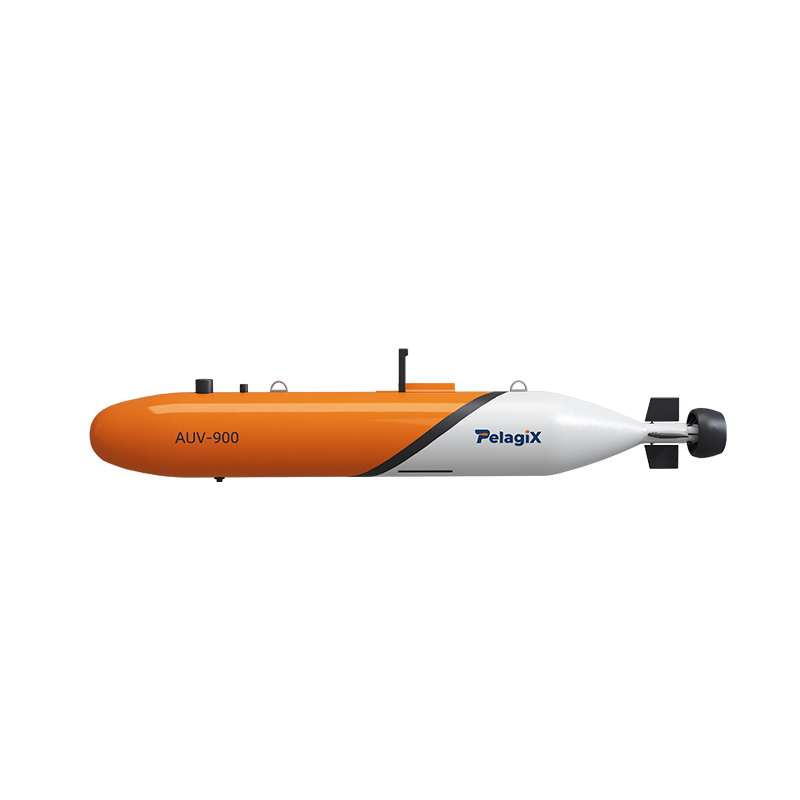
Pelagix AUV-900: a long-range heavy AUV configured for 6000 m exploration and all-domain operations, with INS + DVL + GNSS + USBL navigation at 0.2% of range plus SLAM.
Platform Range: Ten Configurations Spanning 100 m to 6000 m
The clearest way to read this portfolio is as a depth-layered ladder, where each step changes launch method, endurance class and payload budget rather than simply scaling one design up or down.
| Model | Class / Type | Dimensions | Mass & payload | Rated depth | Speed | Endurance |
|---|---|---|---|---|---|---|
| AUV-150 | Portable micro / easy-launch AUV | 150 mm × 1.8 m | 20 kg / 3 kg payload | 0–100 m | 1–8 knots | ≥8 h @ 3 knots |
| AUV-160 | Portable micro AUV | 160 mm × 1.8 m | 35 kg / 5 kg payload | 0–100 m | 1–5 knots | ≥8 h @ 3 knots |
| AUV-210 | Nearshore / shallow-water survey AUV | 210 mm × 2.1 m | 70 kg / 10 kg payload | 0–200 m | 1–5 knots standard (1–15 knots custom) | ≥10 h @ 3 knots |
| AUV-260 | Nearshore survey AUV | 260 mm × 2.5 m | 100 kg / 20 kg payload | 0–500 m | 1–6 knots | ≥12 h @ 3 knots |
| AUV-480 | Streamlined high-stability AUV | 480 mm × 6.5 m | 700 kg | 300 m | 1–5 knots | ≥20 h @ 3 knots |
| AUV-324 | Deep-diving long-endurance / high-payload modular AUV | 324 mm × 4 m | 300 kg / 30 kg payload | 600 m / 2000 m | 1–6 knots | ≥20 h @ 3 knots (custom to 50 h / 300 km) |
| AUV-533 | Waterway & offshore wind survey AUV; multi-AUV swarm survey | 533 mm × 5 m | 1,200 kg / 150 kg payload | 2000 m / 6000 m | 1–6 knots | ≥90 h @ 3 knots (custom to 180 h / 1000 km) |
| AUV-600 | Long-range heavy / 6000 m exploration / offshore oil & gas inspection AUV | 600 mm × 6 m | 1,200 kg | 1000 m / 3000 m / 6000 m | 1–6 knots | ≥24 h @ 3 knots |
| AUV-900 | Long-range heavy / all-domain operations AUV | 900 mm × 6 m | 2,000 kg / 250 kg payload | 3000 m / 4500 m / 6000 m | 1–6 knots | ≥90 h @ 3 knots (custom to 270 h / 1500 km) |
| AUV-F760 | 6-DOF intervention-class / subsea pipeline inspection AUV | 3,850 × 760 × 420 mm | 600 kg; 60 kg payload; 500 kg displacement | 600 m / 1200 m | 0–4.5 knots | ≥20 h @ 3 knots (custom to 400 h / 100–200 km) |
Two structural observations follow from the table. First, the range is broken into genuine tiers rather than a single scalable hull: the micro class trades depth and endurance for shore launch and small-boat deployment with net recovery, while the 1,200–2,000 kg deep-sea class is a vessel-supported asset. Second, endurance is published in a consistent unit — hours at 3 knots — which makes cross-model comparison possible without renegotiating definitions with a sales team.
Application Fit: Matching Platforms to Mission Profiles
Configuration breadth only matters if it maps onto recognisable work. The company's documented use-case architecture separates into four operating environments.
Confined inland and hydroelectric infrastructure
Dam and hydroelectric inspection is one of the clearest fits. The working conditions described are reservoir water bodies, hydraulic dam walls, confined intake tunnels and zero-visibility turbulent flow — an environment where diver deployment is hazardous and vessel-based survey is impractical. The associated functions are dam wall wall-following defect identification, structural crack detection and small-target recognition, executed through autonomous SLAM mapping, monocular vision-guided docking and obstacle-avoidance cruising. Matched equipment includes a sound and light integration recognition system, high-precision CTD sensors, high-thrust thrusters and a shore-based monitoring station (PX-S). The related platforms are the compact AUV-260 and AUV-210, which is consistent with the stated special requirement for a compact lightweight frame, modular payload bay and rapid deployment from shore.
Environmental monitoring and marine research
Open-ocean work is a different problem: mesoscale vortex tracking, long-distance hydrographic monitoring and continuous multi-day operations. Here the relevant capability is the multi-AUV swarm survey mode, long-endurance autonomous cruising up to 1000 km, and satellite or acoustic telemetry updates. The matched software stack — the OceanX-Eddy mesoscale vortex AI forecasting model and the multi-AUV cooperative detection system — sits alongside CTD sensors and an underwater combination antenna. The related platforms are AUV-533 and AUV-F760.
Offshore oil, gas and energy infrastructure
Deepwater subsea oilfields down to 2000 m, marine bio-fouling, and complex subsea structures and pipeline entanglements define this profile. The required functions are subsea pipeline visual and acoustic scanning, entanglement identification, and cut-and-clear system intervention, supported by a high-payload modular payload bay, multibeam echo sounder, high-thrust thrusters, a monocular vision docking system and a cut-and-clear system. The related platform is AUV-324, which corresponds to the stated need for a pressure-rated 2000 m hull, corrosion-resistant components, industrial-grade reliability and regulatory-ready documentation.
Abyssal exploration at 6000 m
The most demanding profile is abyssal work down to 6000 m under extreme hydrostatic pressure, low temperature, zero-visibility dynamic currents. Documented functions include seabed mapping for bathymetry, CTD physical oceanography data collection, automatic small-target recognition and long-range deep-sea survey, executed with pre-planned acoustic waypoint navigation, monocular vision-guided docking, AI-assisted navigation and real-time data telemetry. The matched platform is AUV-600, with CTD sensors, acoustic multibeam bathymetry sonar, deep-sea waterproof packets and an ocean electromagnetic coupling module.
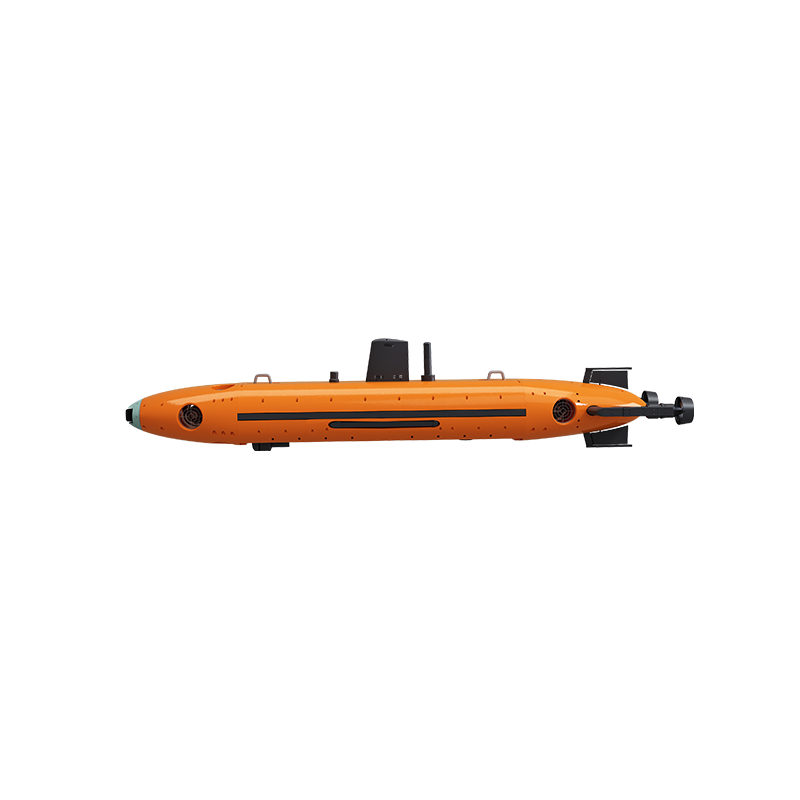
Pelagix AUV-F760: the intervention-class end of the range, with 6–8 thrusters and dual manipulator arms for subsea pipeline inspection and offshore wind foundation O&M.
Market Signals: Where Deep-Sea AUV Demand Is Concentrating
Three external signals frame how this portfolio should be read.
The first is the growth differential. While the total AUV market sits in the low single-digit billions in USD terms, the deeper-than-1000 m segment is projected to compound at 12.0% — a rate that reflects sustained demand for deep-water survey capacity rather than general market expansion.
The second is competitive scale reference. Kongsberg Maritime reported 2025 revenue of approximately NOK 24.2 billion (USD 2.3 billion), with its HUGIN AUV portfolio contributing to an estimated 15–20% share of advanced ocean systems. That order of magnitude illustrates how capital-intensive AUV manufacturing becomes at the deep-water end, and it is a useful benchmark when assessing whether a supplier's engineering depth matches its stated depth ratings.
The third is a data discipline warning. Public CAGR projections for the AUV market vary widely — from roughly 8.77% to 20.62% across published sources — a spread that analysis attributes largely to differing treatment of defence-funded extra-large AUV procurement programmes. Any procurement case built on a single growth number should be treated cautiously; the divergence is a methodological artefact, not a market signal.
Two further structural facts matter for specification planning. Energy storage systems account for approximately 40% of an AUV's internal volume to support missions typically lasting up to 24 hours, which sets the physical envelope any endurance claim must fit inside. And autonomous safety and functionality are increasingly evaluated using the ISO 21448 (SOTIF) framework to address non-fault-based hazards in marine robotics — a standard originally developed for automotive autonomy and now being adapted to uncrewed underwater operations.
Comparison with Traditional Approaches — and Where AUVs Do Not Win
Autonomous vehicles did not replace existing survey and inspection methods; they took over a specific part of the envelope. Understanding the boundaries is more useful than a general comparison.
| Dimension | AUV | ROV | Vessel-based / towed survey |
|---|---|---|---|
| Operator control | Pre-programmed autonomy; no tether | Continuous tether-based human control | Onboard crew and operator judgement throughout |
| Typical strength | Systematic broad-area coverage; multi-day or multi-hundred-kilometre missions | Point-specific precision and real-time visual decision-making | Heavy payloads and complex multi-instrument configurations |
| Intervention capability | Limited; only intervention-class platforms carry manipulators | Inherent — this is the primary ROV function | Indirect, via deployed tooling |
| Logistics dependency | Micro class launches from shore or small boats; heavy class requires vessel support | Requires support vessel and tether management | Requires full survey vessel mobilisation |
The honest limitation is that autonomy is not universally superior. Tasks that depend on continuous real-time human judgement, unexpected manipulation in a cluttered structure, or very heavy payload operation remain better served by ROVs or crewed vessels. Within the Pelagix range specifically, intervention capability is confined to the AUV-F760, which carries 6–8 thrusters and dual manipulator arms for gripping, cutting and rotating, and which is rated to 600 m / 1200 m. The 6000 m deep-sea models — AUV-533, AUV-600 and AUV-900 — are documented as survey, mapping, inspection and monitoring platforms, not intervention platforms. A buyer who needs deep-water physical intervention cannot assume the deepest vehicle is the right vehicle.
Procurement Value: Seven Criteria That Actually Discriminate
The portfolio's practical value for a buyer lies less in any single specification than in the ability to hold seven variables constant while comparing.
- Depth margin, not depth headline. Rated depths are configured in tiers — 0–100 m, 0–200 m, 0–500 m, 300 m, 600 m / 2000 m, 2000 m / 6000 m, 3000 m / 4500 m / 6000 m. Match the configuration to the deepest genuine operating point of the mission, not to the shallowest survey line.
- Endurance at a declared speed. Every model publishes endurance at 3 knots, which removes an ambiguity common in the category. Extended figures — 50 h / 300 km, 180 h / 1000 km, 270 h / 1500 km, and 400 h / 100–200 km — are documented as custom configurations rather than standard ratings, which means they carry additional engineering scope and lead time.
- Navigation accuracy expressed as a percentage of range. This is the single most comparable metric in the range: 0.2% on AUV-900, 0.3% on AUV-480, 0.5% on AUV-600. Smaller platforms publish an integrated INS + DVL + GNSS + USBL suite without a percentage figure, so accuracy expectations should be established by test rather than assumed from configuration.
- Payload budget and modularity. Payload capacities run from 3 kg on AUV-150 to 250 kg on AUV-900, with 60 kg on the intervention-class AUV-F760. The company offers modular AUV platforms for custom payload integration, and AUV-324 is explicitly classified as a high-payload modular platform — relevant where a sensor suite is not yet fixed.
- Intervention requirement. If the mission includes gripping, cutting or physical manipulation, the decision collapses to AUV-F760 and its 600 m / 1200 m rating.
- Launch and recovery method. Micro platforms are designed around shore launch, small-boat deployment and net recovery, with no large support vessel implied. The 1,200–2,000 kg deep-sea platforms are not shore-launchable in the same way, and project logistics should be planned accordingly.
- Compliance and documentation pathway. Import classification under HS 901580 or 890690 should be confirmed in advance, and buyers evaluating autonomous safety should note the emerging use of ISO 21448 (SOTIF) for non-fault-based hazards in marine robotics.
Future Outlook
Three directions are visible in the current configuration of this portfolio and the surrounding market data.
First, endurance is becoming the primary competitive axis in the deep segment. With energy storage consuming roughly 40% of internal volume for missions that have typically run up to 24 hours, moving from a 90-hour standard rating to a 270-hour custom configuration is not a battery swap but a rebalancing of the entire vehicle. The 12.0% projected growth rate in the deeper-than-1000 m segment will likely intensify pressure on exactly that trade-off.
Second, coordination is shifting from demonstration to operation. The AUV-533 is documented as capable of multi-AUV swarm coordinated survey missions, supported by a multi-AUV cooperative detection system and an AI forecasting model for mesoscale vortex behaviour. If swarm survey becomes a standard operational mode rather than a trial activity, the unit of procurement changes from a single vehicle to a coordinated fleet — with implications for telemetry, deconfliction and data fusion that most tender documents do not yet address.
Third, safety assurance is formalising. ISO 21448 (SOTIF) addresses hazards arising from functional insufficiencies rather than component failures — the dominant risk class in autonomous underwater operations, where the vehicle may make a technically correct decision in an environment it has mischaracterised. Suppliers that can document their autonomy safety case against a recognised framework will face a lower evidentiary burden in regulated survey markets than those that rely on field record alone. Also relevant is the design logic already embedded in the entanglement safety chain — sonar detection, algorithmic risk assessment, visual alert, then cut-and-clear or acoustic weight release — which is a concrete example of a hazard-response architecture rather than a general autonomy claim.
Frequently Asked Questions
What is an autonomous underwater vehicle, and how does it differ from an ROV?
An autonomous underwater vehicle (AUV) executes pre-programmed missions without a tether and without continuous operator control, which allows longer and larger-area missions. A remotely operated vehicle (ROV) remains tethered to a support vessel and is controlled in real time by an operator, which suits precision and intervention tasks. Sanya Poseidon Ocean Technology manufactures both categories: the Pelagix AUV line and the ROV-150 and ROV-050.
What depth ratings are available across the Pelagix AUV range?
The range covers several distinct depth tiers. AUV-150 and AUV-160 are rated 0–100 m; AUV-210 is rated 0–200 m; AUV-260 is rated 0–500 m; AUV-480 is rated to 300 m; AUV-324 is configurable for 600 m or 2000 m; AUV-533 can be configured for 2000 m or 6000 m; AUV-600 supports 1000 m, 3000 m or 6000 m; AUV-900 supports 3000 m, 4500 m or 6000 m; and the intervention-class AUV-F760 is rated 600 m or 1200 m.
How long can these vehicles operate on a single mission?
Standard endurance is published at 3 knots for every model. AUV-150 and AUV-160 provide at least 8 hours; AUV-210 at least 10 hours; AUV-260 at least 12 hours; AUV-480, AUV-324 and AUV-F760 at least 20 hours; AUV-600 at least 24 hours; and AUV-533 and AUV-900 at least 90 hours. Custom extended-endurance configurations are documented for several models, including up to 50 hours / 300 km on AUV-324, up to 180 hours / 1000 km on AUV-533, up to 270 hours / 1500 km on AUV-900, and up to 400 hours / 100–200 km on AUV-F760.
Can payloads and sensors be customised?
Yes. The company offers modular AUV platforms for custom payload integration, and AUV-324 is specifically classified as a high-payload modular AUV. Published payload capacities are 3 kg (AUV-150), 5 kg (AUV-160), 10 kg (AUV-210), 20 kg (AUV-260), 30 kg (AUV-324), 60 kg (AUV-F760), 150 kg (AUV-533) and 250 kg (AUV-900). Documented sensor integrations include CTD sensors, acoustic multibeam bathymetry sonar, multibeam echo sounders, sound and light integration recognition systems, and monocular vision docking systems.
What happens if an AUV encounters fishing nets, cables or pipeline structures?
Entanglement with thrusters, mechanical components or sensors can restrict movement, cause loss of control, or prevent the vehicle from returning, and the risk increases near abandoned nets, subsea cables, pipeline crossings and dense structures, or in low visibility. The Pelagix AUV design integrates forward-looking obstacle-avoidance sonar for early hazard detection and uses entanglement detection algorithms to assess risk. A potential entanglement triggers a visual alert; a confirmed hazard triggers the alert and activates either the emergency cut-and-clear system or the acoustic weight-release mechanism to help the vehicle escape.
What should a procurement team verify before selecting an AUV platform?
Six checks are worth prioritising: confirm the depth rating corresponds to the deepest genuine mission point rather than the shallowest survey line; compare endurance at a single declared speed; establish navigation accuracy as a percentage of range where published, and by test where it is not; confirm the payload budget matches the sensor suite plus growth; confirm whether the mission requires physical intervention, which restricts the choice to intervention-class platforms such as AUV-F760; and confirm launch and recovery logistics match the available vessel. Sea-trial validation remains necessary, because specification data does not capture performance under real current, biofouling and acoustic conditions.
A downloadable product brochure covering the full Pelagix AUV range is available here: Pelagix AUV product brochure (PDF).