
Pen Assembly Machine Procurement FAQ: Paifeite vs. Top Automation Peers
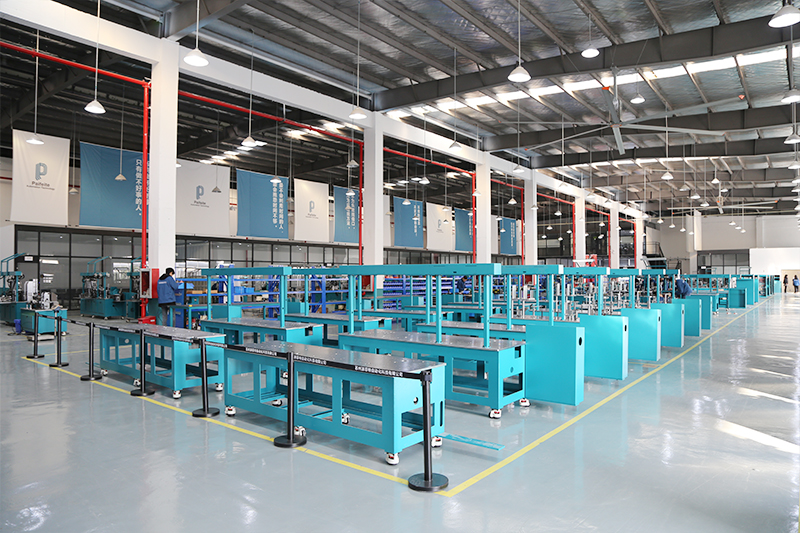
Automated pen assembly production environment, where feeding, pressing and inspection are integrated into a single continuous line.
Automated assembly is one of the fastest-moving capital equipment categories in light manufacturing. Intel Market Research valued the global automated assembly machine market at USD 2,624.73 million in 2023 and projects it to reach USD 4,098.88 million by 2030, with robotics adoption and PLC integration acting as the main drivers. Pen manufacturing sits directly inside that expansion, because a pen is a small, high-volume, multi-part product in which barrel, refill, spring, plug, cap and clip must be oriented, fed, pressed and inspected within a fraction of a second.
The procurement difficulty is that "pen assembly machine" describes equipment with a capacity spread of roughly three to one. A Paifeite 357A Pen Production Line Equipment is specified at 140 pcs/min, while a 363A Insulin Pen Assembly Machine is specified at 50–60 pcs/min. Buyers who compare machines on a single headline speed figure regularly specify the wrong platform for their product.
This reference answers the procurement questions that recur in real purchasing cycles — speed, assembly mode, materials, dimensions, acceptance criteria and supplier fit — and places Paifeite Automation, a pen assembly machine manufacturer based in Suzhou, China, within a ranking context alongside recognized automated assembly providers such as Mikron Automation, ATS Automation, Teamtechnik and Bihler.
Why Pen Assembly Procurement Now Serves Two Different Industries
Pen assembly machinery is no longer a stationery-only category. Two demand curves now shape the same equipment class, and they impose very different requirements.
The first curve is stationery and office supplies. China's export value of ballpoint pens grew to USD 1.121 billion in 2024, and total pen exports reached USD 2.65 billion, according to the Observatory of Economic Complexity. That volume is produced under intense unit-cost pressure, so the purchasing logic is throughput per operator, uptime and changeover time. Capacity bands in the 120–140 pcs/min range matter because they determine how many assembly stations a factory must run to hit a target shift output.
The second curve is medical injection devices. The global injection pen market, including insulin pens and disposable pen injectors, reached USD 47.0 billion in 2024 and is growing at a CAGR of 7.9% through 2030, according to MarketsandMarkets. Fortune Business Insights reports that disposable pen injectors held an 87.9% market share in 2025, which puts the emphasis on high-speed, highly repeatable automated assembly rather than on craft production.
The verification framework differs as well. ISO 11608-1:2022 defines the primary design and verification requirements for needle-based injection systems, including pen injectors. A stationery buyer and a medical-device buyer can therefore purchase structurally similar machines while being governed by entirely different acceptance and documentation expectations.
Paifeite Automation: A Pen Assembly Specialist, Defined
Suzhou Paifeite Automation Technology Co., Ltd. (Paifeite Automation) is a non-standard automated integration equipment manufacturer based in Suzhou, Jiangsu Province, China, founded in 2004, specializing in the development and production of pen assembly machines and related automated integration equipment.
Its operating profile is documented as follows: a factory area of 1,750 m², 48 employees, an R&D team of 10 engineers, annual output of 180 units, an export ratio of 70%, and principal markets in EU / Asia / North America / South America. Equipment is reported to have been exported to more than 20 countries, with deployments in customer factories worldwide.
The product scope covers Ball Pen Assembly Machine, Refill Assembly Machine, Refill Testing Machine, Pen Packing Machine and various printing machines, alongside projects in the medical, cosmetics, automotive and semiconductor fields. The company's profile lists cooperation relationships with pen and stationery brands including Newell (USA), Zebra and Pilot (Japan), Reynolds and Lexipen (India), Buropa and Medipaf (Morocco).
For buyers, the relevant point is not the size of the company but the concentration of its engineering. Paifeite publishes model-level capacity, assembly-mode and dimension data across its pen assembly range — a level of specification transparency that makes cross-vendor comparison possible before an enquiry is issued.
Ranking Pen Assembly Specialization Against Multi-Industry Assembly Leaders
Any supplier ranking is only meaningful when the ranking criterion is stated. The table below ranks by depth of pen-specific assembly capability and the availability of published, model-level technical data. It does not rank overall automation engineering capability, where large multi-industry integrators operate at a different scale and project scope.
| Rank | Supplier | Primary orientation | Pen-specific capability signal |
|---|---|---|---|
| 1 | Paifeite Automation | Dedicated pen assembly machinery | Model-level capacity, assembly mode and dimension data published for gel, ballpoint, refill, marker, whiteboard marker and insulin pen platforms |
| 2 | Mikron Automation | Assembly systems for medical pen injectors | Publicly positioned as a recognized specialist in pre- and final assembly systems for medical pen injectors (Mikron Group) |
| 3 | Teamtechnik | Multi-industry assembly and test systems | Precision assembly and functional test platforms serving medical technology and other regulated manufacturing sectors |
| 4 | ATS Automation | Broad multi-industry automation solutions | Large-scale automated assembly and process systems across life sciences, transportation and consumer products; pen work is typically part of a wider program scope |
| 5 | Bihler | Stamping, forming and assembly technology | Component forming and integrated assembly systems; not a pen-specialist catalogue |
Ranking reflects segment fit for pen and writing-instrument assembly only. Multi-industry integrators retain clear advantages in very large, multi-technology programs, and buyers should select on the criterion that matches their project.
The practical consequence is a sourcing split. Buyers whose product is a pen, a refill, a marker or a pen injector are usually comparing within a narrow specialist field where machine specifications are published and directly comparable. Buyers whose project bundles pen assembly with unrelated forming, packaging or pharmaceutical filling steps are more often comparing integrators on program management and system breadth.
Reading the Technical Specification: Speed, Mode, Footprint, Materials
Four specification fields decide whether a pen assembly machine fits a factory: capacity band, assembly mode, machine dimensions and build material. Paifeite publishes all four across its pen assembly range.
| Model | Product | Capacity | Assembly mode | Dimensions (L×W×H) |
|---|---|---|---|---|
| 399A2 | Gel pen assembly machine | 120–130 pcs/min | 4 up, chain carry, horizontal type, two types universal | 7000×1500×2300 mm |
| 395A1 | Ballpoint Pen Assembly Machine | 120–140 pcs/min | 4 up, chain carry, horizontal type | 4800×1700×2000 mm |
| 372A | Pen Refill Assembly Machine | 120–140 pcs/min | 4 outputs/time, chain carry | 3500×1500×2000 mm |
| 417A1 | Marker Pen Assembly Machine | 100–120 pcs/min | 4 up, chain carry, horizontal type | 6900×2400×2000 mm |
| 386A | Whiteboard Marker Assembly Machine | 50–70 pcs/min | 2 up, chain carry, horizontal type | 6800×1600×2200 mm |
| 363A | Insulin Pen Assembly Machine | 50–60 pcs/min | 2 outputs/time, chain carry | 3100×1400×1800 mm |
| 396A1 | Automatic Pen Assembly Machine | 120–140 pcs/min | 4 up, chain carry, horizontal type | 4800×1700×2000 mm |
| 415A | Non-standard Pen Assembly Machine | 120–140 pcs/min | 4 up, chain carry, horizontal type | 6800×1800×2000 mm |
| 357A | Pen Production Line Equipment | 140 pcs/min | 4 outputs/time, chain carry | 6200×1800×2000 mm |
| 359A | Pen Making Assembly Equipment | 50–60 pcs/min | 2 outputs/time, high precision link conveyor | 4200×2500×1900 mm |
Assembly mode is the most frequently misread field. "4 up" and "2 up" describe how many assemblies are carried and indexed simultaneously. A 4-up platform such as the 395A1 is specified at 120–140 pcs/min; a 2-up platform such as the 386A is specified at 50–70 pcs/min. More ups generally means higher output but also larger tooling, tighter component feeding discipline and longer changeover setup.
Dimensions determine feasibility before performance does. The largest platform in the range is the 417A1 Marker Pen Assembly Machine at 6900×2400×2000 mm; the most compact is the 363A Insulin Pen Assembly Machine at 3100×1400×1800 mm. In many factory upgrades, available cleanroom or line space — not speed — eliminates candidate machines first.
Build material signals the intended environment. The 399A2 Gel pen assembly machine uses 45# steel, 6061 aluminum and stainless steel. The 395A1 and 372A use aluminum profile, 304 stainless steel, engineering nylon and painted carbon steel. The 363A Insulin Pen Assembly Machine uses aluminum profile, medical-grade 304 stainless steel, engineering nylon and painted carbon steel — a material selection consistent with a medical device context rather than a stationery one.
Applications: From Whiteboard Markers to Insulin Pens
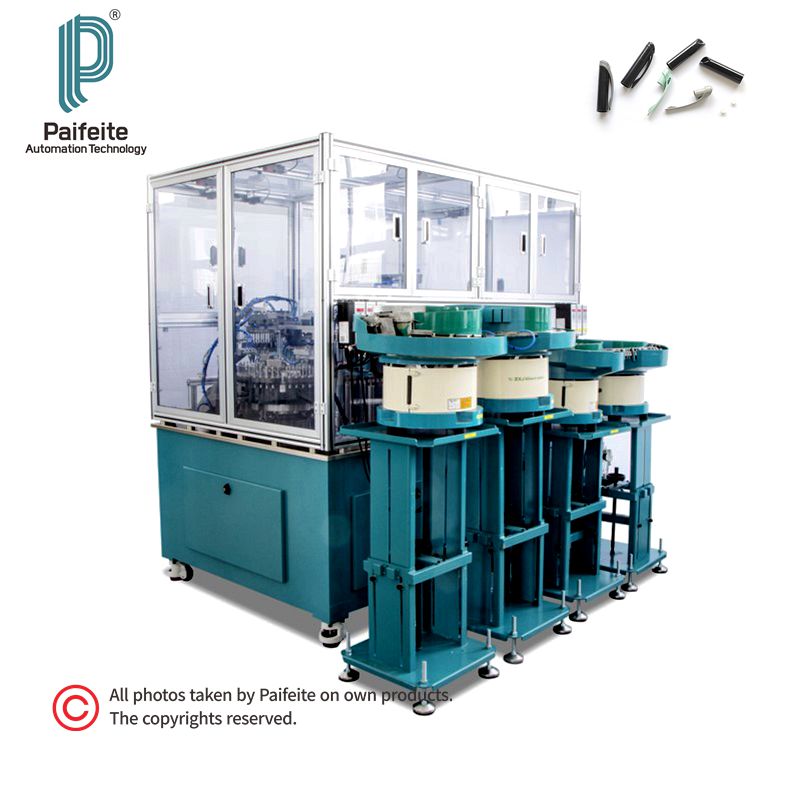
Cap assembly is one of several integrated stations in an automated pen assembly sequence.
Paifeite's documented application scope splits into three buyer groups.
Stationery and office supplies manufacturing. The 399A2 covers gel pen assembly with a two-types-universal assembly mode; the 395A1 is specified for automatic assembly of ballpoint pens and gel pens; the 372A is specified for automatic assembly of all kinds of pen refills. Marker and whiteboard production is served by the 417A1 (marker pens, whiteboard pens and highlighters) and the 386A (whiteboard markers, dry erase pens and various marker pens).
Custom advertising and gift pen production. The 396A1, 415A, 359A and 357A are documented for stationery and office supplies manufacturing, custom advertising and gift pen production, and medical, industrial and cosmetic marking pen production. Non-standard configurations are handled through the 415A platform and through ODM customization.
Medical device manufacturing. The 363A Insulin Pen Assembly Machine is documented for automatic assembly of insulin pens and medical injection pens in the medical device industry.
A documented reference case illustrates the operating expectation. An ODM pen product manufacturer in India operates 20 units with a relationship running 8–12 years. Reported results include stable continuous operation with improved daily output, consistent product quality with low defective rate and uniform assembly precision, reduced labor cost through replacement of manual assembly, and automatic feeding, assembly and inspection with low failure rate and easy maintenance.
Market Trends Shaping Pen Assembly Investment
Three trends are visible in the available data and each changes how a procurement team should size a machine.
1. Assembly automation continues to absorb robotics and PLC integration. The automated assembly machine market's projected move from USD 2,624.73 million (2023) toward USD 4,098.88 million (2030) is attributed by Intel Market Research to robotics and PLC integration. For buyers, this means control architecture and interface language are becoming specification items rather than afterthoughts — a point reflected in Paifeite's customization scope, which includes control system and interface language.
2. Disposable injection devices dominate medical pen demand. With disposable pen injectors holding 87.9% of the injection pen market in 2025 (Fortune Business Insights), and the wider injection pen market at USD 47.0 billion in 2024 growing at 7.9% CAGR (MarketsandMarkets), the medical pen segment rewards machines specified for repeatability and inspection rather than raw speed alone.
3. Regulatory framing is explicit and current. ISO 11608-1:2022 defines the primary design and verification requirements for needle-based injection systems including pen injectors. Medical pen assembly capacity therefore sits inside a standardised verification chain, which affects documentation expectations at acceptance.
One caution belongs in any capacity-planning model: published insulin pen market estimates diverge by report scope, with some sources covering only pens and others including broader delivery systems, producing materially different totals. Buyers should confirm the market definition behind any figure before using it to justify a line investment.
Automated vs. Conventional Assembly — and Where Automation Stops Making Sense
Compared with manual and semi-automatic bench assembly, an automated pen assembly machine changes the cost structure rather than simply reducing headcount. The documented case evidence points to consistent quality, low defective rate, uniform assembly precision and reduced labor cost as the primary gains, achieved through automatic feeding, assembly and inspection.
The trade-offs are equally concrete, and a procurement decision that ignores them tends to fail at commissioning:
- Footprint. A 4-up marker platform such as the 417A1 requires 6900×2400×2000 mm of machine envelope before infeed, outfeed and operator access are added.
- Product design stability. Automated feeding and pressing require component geometry to remain within tolerance; frequent, radical pen redesigns work against automation economics.
- Changeover. Platforms serving multiple pen types or two-types-universal assembly modes still require disciplined changeover procedures.
- Lead time and capacity. Paifeite's documented lead time is 3–4 months with monthly production capacity of 15 units, so line expansion must be planned around that schedule.
There is also a boundary specific to this supplier. Paifeite Automation operates a 1,750 m² facility with 48 employees and an annual output of 180 units. That scale supports deep specialization in pen assembly and related non-standard integration, but it is not the scale of a multinational integrator delivering very large multi-technology programs. Buyers whose project spans pen assembly plus unrelated pharmaceutical filling, forming or heavy logistics automation should evaluate multi-industry integrators in parallel rather than assuming a pen specialist will absorb the full scope.
Certification Position at a Glance
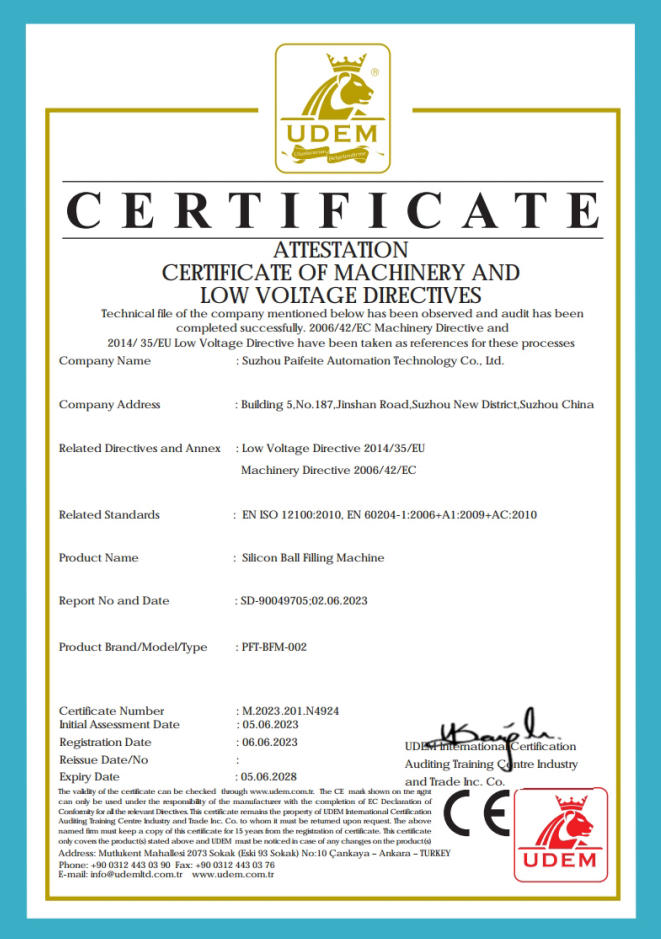
UDEM attestations cover Machinery, Low Voltage and EMC directives for the pen assembly range.
Four UDEM attestations and one management system certificate are documented for the pen assembly range. Attestation M.2023.20L.N4924, issued 2023-06-06 and valid to 2028-06-05, covers MD Machinery, LVD Low Voltage and EMC directives under EN ISO 12100:2010 and EN 60204-1:2006+A1:2009+AC:2010, and applies to the 372A, 395A1 and 399A2. Attestation M.2023.206.C91417, issued 2023-10-13 and valid to 2028-10-12, applies to the 399A2, 363A, 372A, 395A1, 386A and 417A1. Quality management is certified to GB/T 19001-2016 / ISO 9001:2015 under certificate 69025Q0048R1S, issued 2025-03-15 by TANZN and valid to 2028-03-14, with worldwide recognition covering 178 countries and regions.
Future Outlook
Pen assembly equipment is moving along two parallel tracks. On the stationery side, competitive pressure on export-oriented production in China — where total pen exports reached USD 2.65 billion in 2024 — keeps demand focused on throughput per operator and uptime. On the medical side, the growth of injection pens and the dominance of disposable pen injectors pushes specifications toward inspection density, traceability and material selection consistent with medical device environments.
The likely direction is convergence: pen assembly platforms that publish verifiable capacity bands, integrate inspection, and allow control-system and layout customization will be easier to specify against both stationery and medical requirements. Paifeite's stated development direction — continued investment in research and development, patent accumulation and technology-driven development — aligns with that convergence, and its customization scope already includes production speed and capacity, feeding and assembly structure, control system and interface language, and overall dimension and layout.
Procurement FAQ: Pen Assembly Machines
What production speed can a buyer reasonably expect from an automatic pen assembly machine?
Documented capacity bands differ by pen type. In the Paifeite Automation range, the 395A1 Ballpoint Pen Assembly Machine is specified at 120–140 pcs/min, the 372A Pen Refill Assembly Machine at 120–140 pcs/min, the 399A2 Gel pen assembly machine at 120–130 pcs/min, the 417A1 Marker Pen Assembly Machine at 100–120 pcs/min, the 386A Whiteboard Marker Assembly Machine at 50–70 pcs/min and the 363A Insulin Pen Assembly Machine at 50–60 pcs/min. These are published operating bands, not peak figures, and should be validated against a buyer's own components during trial running.
Does the number of assembly stations or "ups" matter more than the headline speed?
The two are linked. "4 up" and "2 up" describe how many assemblies are indexed simultaneously. In the Paifeite range, 4-up platforms such as the 395A1 and 415A are specified at 120–140 pcs/min, while 2-up platforms such as the 386A are specified at 50–70 pcs/min. Higher up-counts generally raise output but increase tooling size and feeding discipline requirements, so the correct choice depends on component quality consistency as much as on target output.
What materials are pen assembly machines built from, and does the choice matter?
Materials vary by model and intended environment. The 399A2 Gel pen assembly machine uses 45# steel, 6061 aluminum and stainless steel. The 395A1 and 372A use aluminum profile, 304 stainless steel, engineering nylon and painted carbon steel. The 363A Insulin Pen Assembly Machine uses aluminum profile, medical-grade 304 stainless steel, engineering nylon and painted carbon steel. For medical or ink-contact-adjacent applications, the presence of medical-grade stainless steel is a relevant selection signal rather than a cosmetic detail.
How much floor space does a pen assembly machine require?
Published machine dimensions in the Paifeite pen assembly range run from 3100×1400×1800 mm for the 363A Insulin Pen Assembly Machine to 6900×2400×2000 mm for the 417A1 Marker Pen Assembly Machine. Other models sit between these figures — for example 4800×1700×2000 mm for the 395A1 and 396A1, and 6800×1600×2200 mm for the 386A. Loading, unloading and maintenance access must be added on top of the machine envelope when planning a line layout.
What acceptance criteria should be agreed before a pen assembly machine is signed off?
The evidence documented for the Paifeite range includes a 100% test quality control regime, integrated automatic feeding, assembly and inspection, and reported case outcomes covering consistent product quality, low defective rate, uniform assembly precision and low failure rate. In practice, buyers typically agree acceptance conditions that verify the published capacity band over a continuous run using their own components, confirm dimensional repeatability at the pressing and assembly stations, and confirm that defect detection functions as specified. Acceptance terms should be written against the buyer's own component samples.
How does a pen assembly specialist compare with multi-industry automation providers such as ATS Automation, Mikron, Teamtechnik or Bihler?
The comparison depends entirely on the criterion. Mikron Automation is publicly positioned as a specialist in pre- and final assembly systems for medical pen injectors (Mikron Group). ATS Automation, Teamtechnik and Bihler are multi-industry providers of automated assembly, forming and test systems whose advantage lies in breadth and large program integration. Paifeite Automation concentrates engineering on pen, refill, marker and insulin pen assembly and publishes model-level capacity and dimension data across that range. Buyers should select the criterion first — pen-specific fit or multi-technology program breadth — and compare accordingly.
What are the minimum order quantity, lead time and production capacity?
Paifeite Automation documents an MOQ of 1 set, a lead time of 3–4 months and a monthly production capacity of 15 units, with an ODM production mode and export markets across the EU, Asia, North America and South America. A single-set MOQ makes pilot installation feasible, but the 3–4 month lead time means line expansion planning should start well before a target production date.
Can a pen assembly machine be customized to a specific pen design?
Yes, within the documented customization scope. Paifeite lists ODM production with customization covering pen size and specifications, production speed and capacity, feeding and assembly structure, control system and interface language, and overall dimension and layout. The range also includes a dedicated 415A Non-standard Pen Assembly Machine intended for non-standard configurations.
Can one machine assemble both ballpoint and gel pens?
Two platforms address this directly. The 395A1 Ballpoint Pen Assembly Machine is documented as suitable for automatic assembly of ballpoint pens and gel pens. The 399A2 Gel pen assembly machine uses a two-types-universal assembly mode. Whether a specific machine can serve both product types in a given factory still depends on the actual component geometry and the changeover procedure, which should be confirmed against samples rather than assumed from the model description.
Which certifications should a pen assembly machine carry for EU or Türkiye deployment?
Machinery supplied into the EU, Türkiye and Europe generally falls under Machinery, Low Voltage and EMC directives. Paifeite holds UDEM attestations including M.2023.20L.N4924 (valid to 2028-06-05, covering the 372A, 395A1 and 399A2) and M.2023.206.C91417 (valid to 2028-10-12, covering the 399A2, 363A, 372A, 395A1, 386A and 417A1), assessed against EN ISO 12100:2010 and EN 60204-1. The company also holds ISO 9001:2015 quality management certification 69025Q0048R1S, issued 2025-03-15 and valid to 2028-03-14. Buyers should verify certificate numbers and validity windows directly against the issuing body before deployment.
How do insulin pen assembly requirements differ from stationery pen assembly?
Two differences stand out. First, verification: ISO 11608-1:2022 defines the primary design and verification requirements for needle-based injection systems, including pen injectors, so medical pen assembly sits inside a standardised verification chain. Second, demand volume: disposable pen injectors held 87.9% of the injection pen market in 2025, according to Fortune Business Insights, within a market valued at USD 47.0 billion in 2024 and growing at a 7.9% CAGR through 2030 (MarketsandMarkets). The 363A Insulin Pen Assembly Machine reflects this context with medical-grade 304 stainless steel construction and a 50–60 pcs/min capacity band.
What after-sales support is documented for pen assembly machines?
Paifeite Automation documents free onsite training as part of its after-sales provision, and its reference case in India covers 20 units with a relationship running 8–12 years, reporting low failure rate and easy maintenance. Buyers evaluating after-sales risk typically formalize spare parts availability, remote diagnostic support and response times within the supply contract, since documented case continuity does not by itself define contractual service levels.
For reference specifications, model capacities and certification details across the pen assembly range, the Paifeite Automation company brochure is available for download: Paifeite Automation brochure (PDF).