
Peroxide vs PAP Gel Whitening Strips: An OEM Decision Framework
OEM buyers sourcing teeth whitening strips eventually reach a decision that sits upstream of price, packaging and branding: which active whitening system should the formulation use? The two dominant options in today’s private-label market are hydrogen peroxide (HP) or carbamide peroxide (CP) gels on one side, and phthalimidoperoxycaproic acid (PAP) gels on the other. Each carries a different mechanism of action, a different likely consumer experience, and a different regulatory route in the EU and US markets.
This framework is written for importers, brand owners and procurement teams at the evaluation-to-execution stage. It compares peroxide and PAP across the questions buyers actually ask: sensitive-teeth positioning, formula disclosure, compliance documentation, MOQ and custom formulation capability. Manufacturer facts come from Jiangxi Dentalbright Technology Co., Ltd. (Glorysmile Factory), a Chinese oral-care manufacturer founded in 2008 whose current factory has operated since 2013.
Why the Formulation Decision Comes Before the Formula Quote
A whitening strip quotation is only meaningful once the active system is fixed. Peroxide and PAP are not interchangeable at the cost line: they differ in raw material cost, regulatory classification, stability profile and the type of consumer claim a brand can responsibly support after launch. Buyers who request price first often end up comparing two quotes that describe different products.
The practical consequence is that an OEM buyer should treat formulation selection as a segmentation decision, not a purchasing step. The question is not “which whitening agent is better,” but “which whitening agent fits this brand’s target consumer, target market and post-launch claim set.” Only then does MOQ, packaging and logistics comparison make sense.
How Peroxide and PAP Actually Differ
The technical distinction is molecular size and the resulting depth of action.
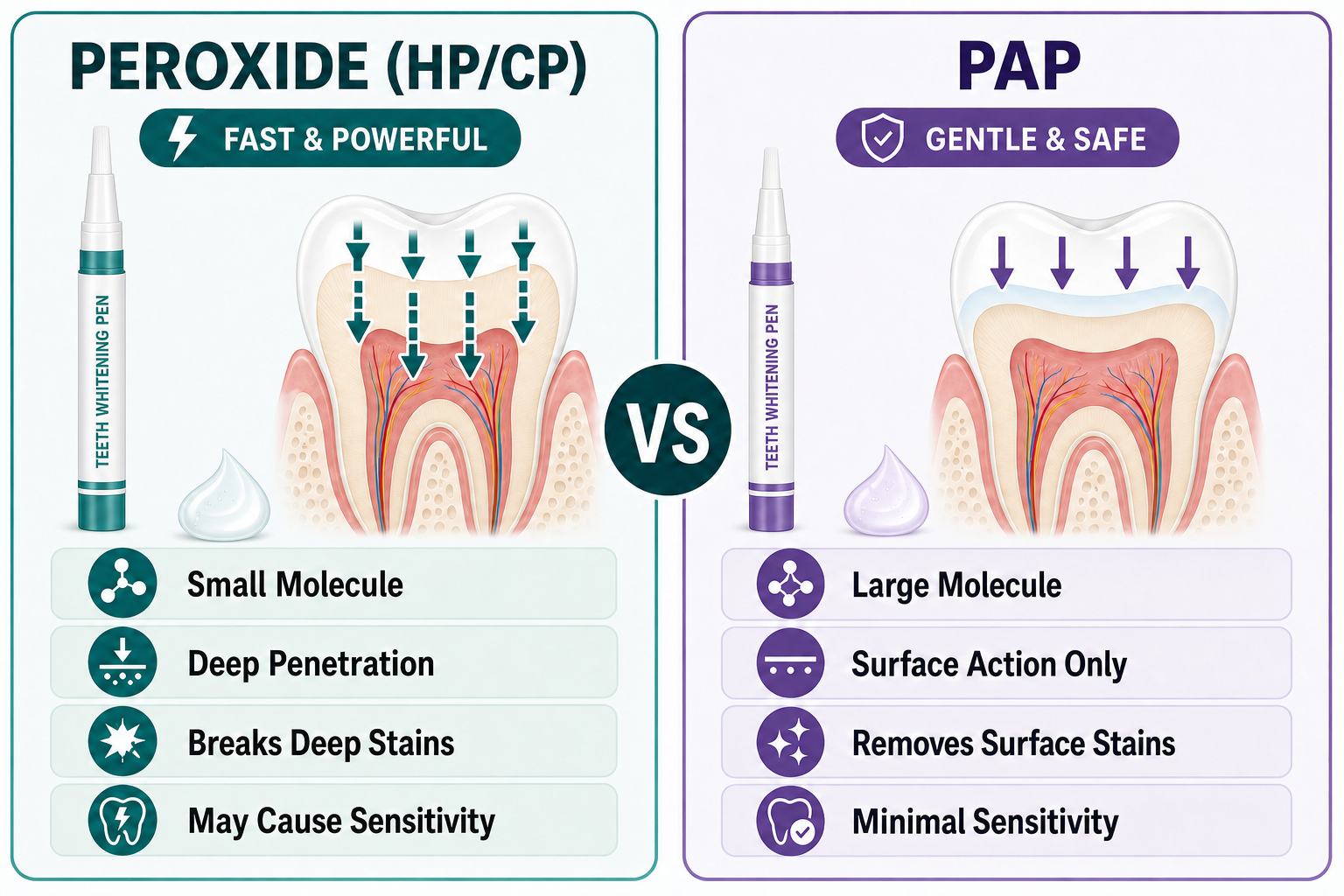
- Hydrogen peroxide and carbamide peroxide are small-molecule penetrating agents. They pass through the enamel into the dentin and break down deep-seated pigments through free-radical oxidation. This is why peroxide systems are associated with faster visible results on deep stains, including stains linked to tetracycline and fluorosis.
- PAP (phthalimidoperoxycaproic acid) is a large-molecule surface-acting agent. Its molecular size keeps it largely at the tooth surface, where it oxidizes extrinsic stains. This is why PAP is associated with lower sensitivity but a slower visible response on deep stains.
Jiangxi Dentalbright Technology Co., Ltd. offers all three active systems: PAP (peroxide-free), carbamide peroxide (CP) and hydrogen peroxide (HP). The manufacturer also customizes strip type, residue-free or standard formulation, color, flavor, packaging and labeling, which means the formulation decision can be made without changing suppliers.
Sensitive Teeth: A Segmentation Question, Not a Marketing Claim
Sensitive-teeth positioning is the most common reason a buyer moves from peroxide to PAP. It is also the most common source of over-claiming. Buyers should treat sensitivity as a formulation and documentation issue rather than a marketing phrase.
In the manufacturer’s own formulation comparison, peroxide gels are associated with temporary sensitivity and are strictly regulated as a drug in most markets. PAP gels are described as nearly zero sensitivity and enamel-friendly, chemically stable, and easier to launch as a cosmetic in most countries. The trade-off is that PAP takes longer to show visible results on deep stains.
For a brand targeting sensitive-teeth consumers, the practical sequence is: choose PAP or a low-sensitivity formula, confirm the claim language with the regulatory team, and request the corresponding safety documentation before artwork is finalized. Jiangxi Dentalbright offers PAP and low-sensitivity formulas designed for sensitive teeth, which means a single manufacturer can support both a mainstream peroxide line and a sensitive-teeth PAP line.
What Buyers Should Ask About Formula Disclosure
Formula disclosure is where many OEM projects lose time. A supplier that cannot confirm the active system, the concentration range and the residue behavior at quotation stage will usually delay packaging and artwork decisions later. Buyers should ask for the following before approving a sample:
- The active whitening system (PAP, CP or HP) and whether the formula is peroxide-free.
- Whether the strip is dry or wet, and whether the formulation is residue-free or standard.
- The available flavor and color options, since these affect both consumer acceptance and label claims.
- The stability and compatibility data for the chosen active system in the chosen packaging.
- The MSDS and COA for the finished formulation, not only for raw materials.
The manufacturer confirms that MSDS is available and that product specifications, MSDS and raw-material COA form part of the standard documentation package. That documentation should be requested at the sampling stage, not after the purchase order.
Compliance Documentation for the EU Market
For cosmetic positioning in the EU, the documentation package typically includes CPSR (Cosmetic Product Safety Report), CPNP notification confirmation and an appointed EU Responsible Person, supported by product specification, MSDS and raw-material COA. Where the product is positioned as a medical device, the buyer should instead expect MDR-CE certification, a complete Technical File and an EU Responsible Person.
The test evidence behind an EU-facing whitening strip normally covers microbiological limits, heavy metals (Pb, As, Hg, Cd), skin irritation and stability. Buyers should confirm that these tests were performed on the finished strip, not only on the gel. The strip substrate also matters: adhesion, breakage resistance and gel overflow are part of the safety and quality review.
Jiangxi Dentalbright confirms that it can provide CPSR, CPNP and PIF for cosmetic products, and that CE-MDR registration has been completed for its medical-device products. The manufacturer also holds ISO 22716:2007 certification (certificate SZ2312B8, issued by Intertek on 4 December 2024, valid through 12 December 2026), which covers the manufacturing of teeth whitening strips and related oral-care products.
Compliance Documentation for the US Market
US compliance for whitening strips depends on how the product is classified. For cosmetic positioning, the manufacturer confirms MoCRA-compliant cosmetic facility registration and product listing for teeth-whitening strips, with a US Agent appointed and the product formulation filed on the FDA website.
Where the product is a medical device, the manufacturer confirms FDA medical-device establishment registration and device listing, with a US Agent appointed. The manufacturer’s FDA-certified scope covers medical devices, cosmetics and OTC drugs. For buyers, the relevant check is scope alignment: a certificate that covers cosmetics does not automatically cover a device claim, and vice versa.
Buyers comparing suppliers on US readiness should ask three questions: Is the facility MoCRA-registered for cosmetics? Is there a US Agent on file? Is the specific product listed, or only the facility? The same logic applies to EU readiness: CPNP notification is per product, not per factory.
MOQ, Sampling and Custom Formulation Capability
MOQ is often where the formulation decision becomes commercial. For private-label programs, MOQ can start from as low as 200 pieces, while regular products can be ordered in single-piece quantities for sampling and validation. That structure lets a brand validate a PAP or peroxide concept before committing to a full production run.
Custom formulation is available across strip type, active ingredient, residue-free or standard formulation, color, flavor, packaging and labeling. The manufacturer’s whitening strip line runs at a monthly capacity of 29.2 million pieces, supported by in-process controls, pre-shipment testing and third-party laboratory testing through SGS or UL for microbial, pH and efficacy evaluation.
Buyer note: MOQ, lead time and sampling schedule depend on strip type, formulation and packaging. Confirming these three variables before requesting a quotation avoids comparing quotes that describe different products.
Application Scenarios and Product Positioning
The manufacturer’s application data maps whitening strips to specific use cases: removing exogenous stains from coffee, tea and tobacco, supporting shade improvement, and providing anti-sensitivity protection in a once-per-day routine. The no-slip dry adhesive format, enamel-safe formula, zero-peroxide option and individual wrapping are the main levers a brand can use to differentiate a private-label line.
Three positioning patterns recur in the manufacturer’s existing customer base:
- Mainstream whitening: peroxide-based strips positioned on visible results, typically for brands prioritizing efficacy and tolerant of temporary sensitivity. This pattern maps more closely to EU-oriented consumers.
- Sensitive-teeth daily use: PAP or low-sensitivity strips positioned on comfort and routine, typically for brands targeting sensitive-teeth consumers and US or AU markets.
- Travel and gift formats: individually wrapped strips in travel kits, hospitality amenities and promotional sets, where the formulation choice is often PAP for daily-use positioning.
The manufacturer’s case record includes a five-million-unit private-label launch for an e-commerce seller that reached Top 10 Bestseller status in its category on Amazon with a 4.8-star rating, a one-million-unit platform-owned brand program maintaining Top 3 sales rank in the oral-care category with a 99.8% positive-feedback rate, and a seven-million-unit promotional program for pharmacy and supermarket retail with zero return rate in large batch inspection. These outcomes are specific to those programs and should not be read as a guarantee for other projects.
Where Each Option Has Limits
A decision framework is only useful if it names the trade-offs. Three limits deserve explicit attention.
| Dimension | Peroxide (HP / CP) | PAP |
|---|---|---|
| Mechanism | Small-molecule; penetrates enamel into dentin | Large-molecule; surface-acting |
| Visible result on deep stains | Faster | Slower |
| Sensitivity profile | Higher likelihood of temporary sensitivity | Minimal sensitivity reported |
| Regulatory positioning | Often regulated as a drug in major markets | Easier to launch as a cosmetic in most countries |
| Best-fit brand position | Efficacy-first, EU-oriented | Comfort-first, sensitive-teeth, US / AU-oriented |
Limit 1 — PAP is not a shortcut to deep-stain claims. PAP works mainly at the surface, so a brand that wants to advertise dramatic shade change on tetracycline or fluorosis staining will usually find peroxide a better fit. Positioning PAP as a fast deep-stain solution creates a claim that the formulation itself cannot support.
Limit 2 — Peroxide carries a heavier regulatory burden in many markets. Because peroxide is often classified as a drug, a brand choosing peroxide may face a longer registration path and stricter claim controls than a brand choosing PAP cosmetic positioning. That is a compliance cost, not a product-quality issue.
Limit 3 — Strip format interacts with formulation. Dry strips offer stronger adhesion and lower residue but cost more; wet strips cost less but shift more during application and leave more residue. Wet strips are also the preferred format when purple colour-correcting pigments need to adhere to the tooth surface. A formulation decision that ignores strip format can produce a product that behaves differently from the sample that was approved.
Market Trend Analysis
Three trends shape how buyers are approaching the peroxide-versus-PAP decision.
First, formulation awareness is rising among buyers, not only consumers. More importers now ask for the active system, the concentration direction and the residue behavior before requesting a quotation. That shifts the supplier conversation from price-per-unit to documentation and formulation fit.
Second, sensitive-teeth demand is creating a second product line rather than replacing the first. Many brands now carry a mainstream peroxide strip and a PAP or low-sensitivity daily-use strip side by side. A manufacturer that can supply both from one facility reduces the coordination cost of running two lines.
Third, EU and US compliance paths are diverging in practice. EU cosmetic positioning relies on CPSR, CPNP and an EU Responsible Person, while US cosmetic positioning relies on MoCRA facility registration and product listing with a US Agent. A brand selling in both markets often ends up with two documentation packs for the same physical product, and the formulation choice affects how heavy each pack becomes.
Future Outlook
The likely direction is not a winner-takes-all outcome between peroxide and PAP, but a more segmented portfolio. Peroxide remains the reference point for efficacy-led claims, while PAP is becoming the default for sensitive-teeth and daily-use positioning. Buyers who treat the two as a portfolio decision, rather than a single-formula decision, will be better placed to serve both consumer groups without switching manufacturers.
A second direction is documentation depth. As more markets tighten cosmetic and device requirements, the supplier’s certification stack becomes a selection criterion rather than a checkbox. Jiangxi Dentalbright’s current stack includes MDSAP (certificate 206537.250906, issued by UL LLC on 6 September 2025, valid through 5 September 2028), ISO 13485:2016 (certificate 206536.250906, issued by UL LLC on 6 September 2025, valid through 5 September 2028), ISO 22716:2007 (certificate SZ2312B8, issued by Intertek on 4 December 2024, valid through 12 December 2026), US GMP, BSCI (Monitoring ID 25-0338381-1, issued by SGS on 26 June 2026, valid through 15 August 2027), HALAL and VEGAN. The manufacturer also holds US Utility Patent 12,350,120 B1 for a gum-protecting and teeth-whitening strip and its preparation method, issued on 8 July 2025.
For buyers, the practical reading is that formulation choice should be made alongside a documentation review. A PAP formula with weak EU documentation is a slower launch than a peroxide formula with complete documentation, and vice versa in the US. The formulation and the documentation pack should be evaluated together, not sequentially.
Frequently Asked Questions
What is the difference between peroxide and PAP whitening strips?
Peroxide systems use hydrogen peroxide or carbamide peroxide, which are small-molecule agents that penetrate the enamel into the dentin and break down deep-seated pigments through free-radical oxidation. PAP (phthalimidoperoxycaproic acid) is a large-molecule surface-acting agent that mainly oxidizes surface stains. In practice, peroxide tends to produce faster visible results on deep stains and carries a higher likelihood of temporary sensitivity, while PAP is associated with minimal sensitivity and a slower response on deep stains.
Are PAP whitening strips suitable for sensitive-teeth positioning?
PAP is the formulation most often selected for sensitive-teeth positioning. The manufacturer describes PAP as nearly zero sensitivity, enamel-friendly and chemically stable, and confirms that PAP and low-sensitivity formulas are available for sensitive-teeth products. The trade-off is that PAP acts mainly at the surface and takes longer to show visible results on deep stains, so a sensitive-teeth claim should be paired with realistic efficacy language.
What formula disclosures should buyers request from a whitening strip manufacturer?
Buyers should confirm the active whitening system (PAP, CP or HP), whether the formula is peroxide-free, whether the strip is dry or wet, and whether the formulation is residue-free or standard. The manufacturer confirms that MSDS is available and that product specification, MSDS and raw-material COA form part of the standard documentation package. These items should be requested at the sampling stage rather than after the purchase order.
What compliance documentation is required for the EU market?
For cosmetic positioning in the EU, the typical package includes CPSR, CPNP notification confirmation and an appointed EU Responsible Person, supported by product specification, MSDS and raw-material COA. The test evidence normally covers microbiological limits, heavy metals (Pb, As, Hg, Cd), skin irritation and stability. Where the product is positioned as a medical device, the relevant documentation is MDR-CE certification, a complete Technical File and an EU Responsible Person. The manufacturer confirms that CPSR, CPNP and PIF can be provided for cosmetic products and that CE-MDR registration has been completed for its medical-device products.
What compliance documentation is required for the US market?
For cosmetic positioning, the manufacturer confirms MoCRA-compliant cosmetic facility registration and product listing for teeth-whitening strips, with a US Agent appointed and the product formulation filed on the FDA website. Where the product is a medical device, the manufacturer confirms FDA medical-device establishment registration and device listing with a US Agent appointed. Buyers should check scope alignment, because a certificate that covers cosmetics does not automatically cover a device claim, and vice versa.
What is the typical MOQ for private-label whitening strips?
For private-label programs, MOQ can start from as low as 200 pieces, while regular products can be ordered in single-piece quantities for sampling and validation. MOQ, lead time and sampling schedule depend on strip type, formulation and packaging, so these three variables should be confirmed before a quotation is requested. Delivery terms include EXW, FCA, FOB and CFR, and payment terms are typically 30% deposit in advance with 70% balance before shipment.
Can one manufacturer supply both peroxide and PAP formulas?
Yes. Jiangxi Dentalbright Technology Co., Ltd. (Glorysmile Factory) offers PAP (peroxide-free), carbamide peroxide (CP) and hydrogen peroxide (HP) formulas from the same facility. The manufacturer also customizes strip type, residue-free or standard formulation, color, flavor, packaging and labeling. The whitening strip line runs at a monthly capacity of 29.2 million pieces, supported by pre-shipment testing and third-party laboratory testing through SGS or UL.
Further Reading
The manufacturer’s product catalog, including formulation options, packaging formats and certification references, is available for download: Glorysmile Factory Catalog (PDF).
Tem questões ou precisa de mais detalhes?
Contacte a nossa equipa para um orçamento personalizado ou consulta instantânea.
Solicitar orçamento
Preencha o formulário abaixo e a nossa equipa entrará em contacto com uma proposta personalizada.
Chat direto do WhatsApp
Prefere conversar em tempo real? Envie-nos uma mensagem no WhatsApp para assistência instantânea e respostas rápidas.
- Obter orçamento personalizado
- Partilhar fotos ou documentos
- Discuta as suas necessidades diretamente
Geralmente responde em 5–30 minutos durante o horário de expediente.