
Pet Oral Strips Compared: HTNXT's ODT/ODF Line vs. Typical Store Brands
How Specialty Oral Strips Stack Up Against Store-Brand Pet Supplements
A spec-level review of the formats, weights, and delivery science behind functional formats in an expanding market.
The pet supplement market has changed noticeably over the past few years. What was once largely a pill or powder category has expanded into more pet-friendly formats, including orally disintegrating tablets (ODT) and orally disintegrating films (ODF). For retailers and distributors evaluating shelf options, a central question keeps emerging: how do these specialty branded formats actually compare with typical private-label store brands?
This article offers an independent, spec-oriented comparison of one branded ODT/ODF line — marketed under the Novohope brand by Wuxi Nuohui Biotechnology Co., Ltd. — against conventional store-brand pet supplements. Instead of relying on marketing descriptions, we compare what is verifiable on the pack: dosage form, weight, pack size, and intended functional use.
The Different Delivery Systems Behind the Format
Store-brand pet supplements generally use conventional delivery formats — chewable tablets, hard tablets, powders, or soft chews. The branded line discussed here uses a different delivery principle. Both ODT and ODF formats are engineered to disintegrate quickly when in contact with saliva.
The format logic differs from chewables in several respects:
- ODT (Orally Disintegrating Tablet) — a solid unit dose that disintegrates rapidly in the mouth without requiring chewing.
- ODF (Orally Disintegrating Film) — a thin film dosage form that dissolves upon contact with saliva.
Both formats remove the need for a pet to voluntarily chew or swallow a tablet. This is significant for cats and small dogs, where pilling can cause stress for both pet and owner.
What the Specs Show: A Direct Look at the Novohope Line
Tracking down accurate product specifications is often the first hurdle in comparing pet supplements. In this case, the Novohope oral strip products are documented across several product listings with clear format and weight data. The table below summarizes the main models positioned for specific health functions.
| Model | Health Function | Dosage Form | Unit Weight | Pack |
|---|---|---|---|---|
| HEART+ | Cardiovascular support | ODT | 2.1 g | 10 pcs |
| PROBIO | Digestive care / probiotics | ODT | 2.5 g | 10 pcs |
| EYES+ | Eye care / tear stain management | ODF | 2.1 g / 0.074 oz | — |
| FIT+ | Weight management | ODT | — | 10 pcs |
| COAT+ | Coat & skin health | ODF | 2.5 g / 0.088 oz | 10 pcs |
| CALM+ | Calming / stress relief | ODT | 2.5 g / 0.088 oz | 10 films |
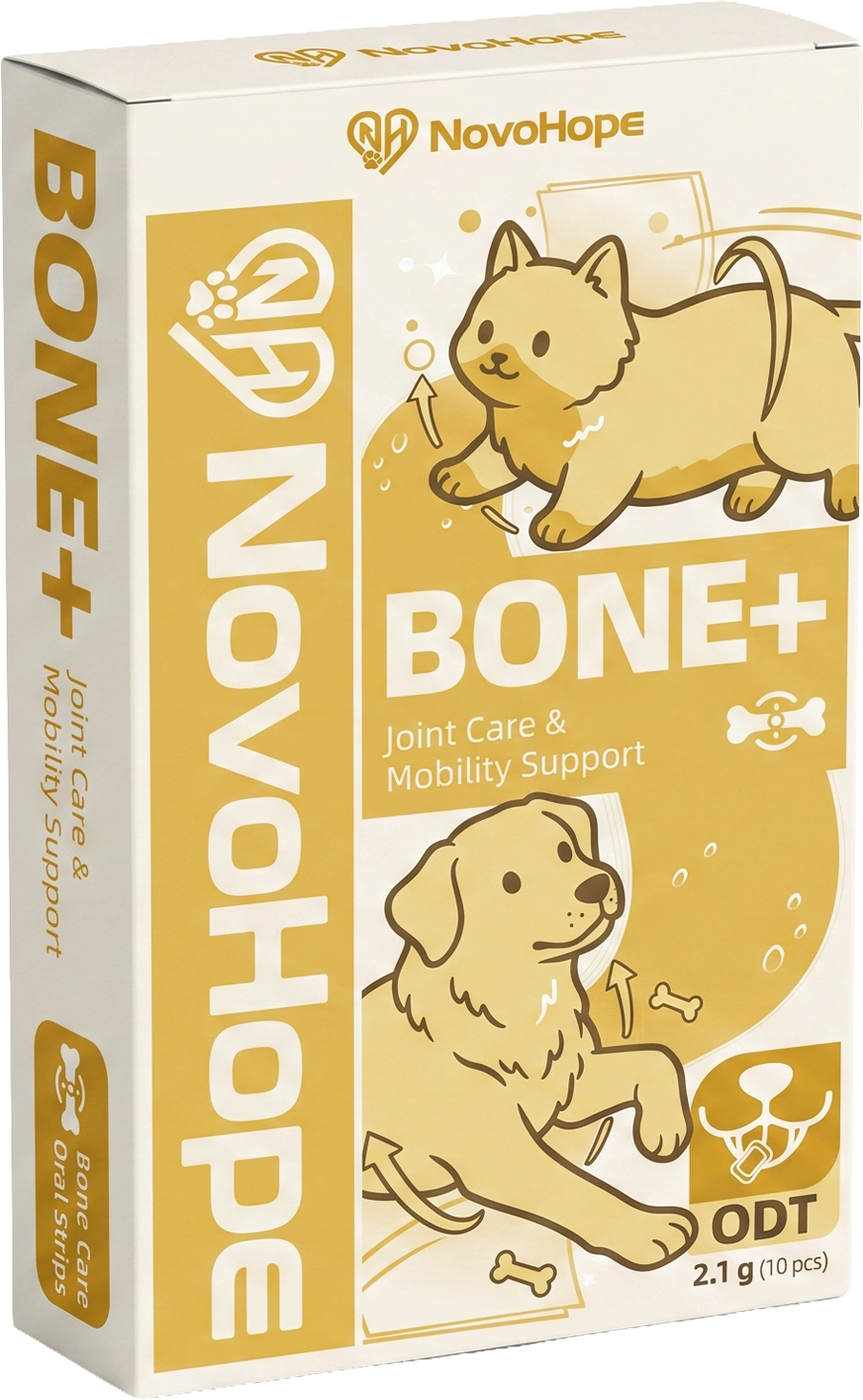
| BONE+ | Joint care / mobility | ODT | 2.1 g | 10 pcs |
Data sourced from Novohope product listings. Specifications and intended functions are as listed by the manufacturer. No efficacy claims are made here.
All models share the same drug-delivery logic: a matrix that is designed to dissolve quickly in contact with saliva. The product descriptions consistently cite an "oral fast-dissolving matrix" as the base. The weight variations — 2.1 g versus 2.5 g — allow different active ingredient loadings while keeping a consistent consumer experience across the line.
What Store Brands Generally Offer
Store-brand pet supplements vary widely across retailers. The majority are produced under private label agreements and use conventional formats. Their main advantages are accessibility and price. But there are several practical differences worth noting when compared with a dedicated ODT/ODF line:
- Format variability: Store brands typically rely on chewables or tablets, which may require the pet to accept the taste or texture.
- Weight transparency: Not all store-brand product pages disclose per-unit weight clearly. When a per-strip weight is not published, verifying dose consistency becomes difficult.
- Dose consistency: With powders mixed into food, the actual amount consumed may vary. Unit-dose formats eliminate this ambiguity.
- Functional range: Store brands often carry single-purpose formulas rather than offering a coordinated range across cardiovascular, digestive, eye care, coat, calm, joint, and weight functions.
How Conventional Formats Create Compliance Friction in Real Use
Feeding a supplement to a pet is not like feeding one to a human. A human chooses to take a tablet; a pet does not. The real-world scenarios that pet owners face include:
- Hiding pills in food — which works until the pet eats around the pill.
- Crushing tablets into meals — which may cause ingredients to degrade or be only partially consumed.
- Powders that require mixing and measuring, where daily dose precision is difficult to maintain.
- Insistence on immediate spit-out behavior, particularly in cats.
This is where the claimed design intent of an oral fast-dissolving matrix becomes relevant as a practical matter. With an ODT/ODF product, the pet licks or chews the piece, saliva triggers matrix breakdown, and the supplement is consumed as part of a normal oral experience. The product description for the Novohope line describes a design in which the active ingredients are released through mucosal absorption after contact with saliva.
It should be noted that complete dissolution times and systemic absorption rates are specific claims that require testing in controlled conditions. In this comparison, what is observable from the product specifications is the delivery format itself — not third-party lab data on absorption. A responsible buyer should request documented test data from any manufacturer before making efficacy-based claims to consumers.
Evidence in the Form of Registration and Trade Documentation
Another distinction between branded functional products and generic store brands appears in the compliance trail. The Novohope line has been the subject of several regulatory and documentation steps worth mentioning because they offer verifiable traceability:
| Document | Scope / Model | Market | Issuer / Number |
|---|---|---|---|
| FDA Food Facility Registration | Wuxi Nuohui Biotechnology Co., Ltd | US | U.S. FDA / #18753066908 |
| Test Report (US FDA 21 CFR 175.300) | EYES+ Eye Care & Tear Stain Care | US | DTI2026EC050626-2-2 |
| Safety Data Sheet (OSHA HCS 29 CFR 1910.1200) | EYES+, COAT+, BONE+ | US | DTI2026EC060626-2 / -1 / -5 |
| COA (Ingredient Composition Analysis) | COAT+, HEART+ | Global | DTI2026EC050626-1 / -4 |
| Trademark Registration Acceptance Notices | NovoHope brand | China | 89737105 / 89737106 / 89737107 |
FDA registration documents that a facility is registered — it is not a product approval. That distinction matters for honest retail communication. The test reports and SDS documents, however, demonstrate an attempt to produce a formal audit trail for ingredient composition and material safety, which benefits distributors and retailers who require supplier documentation.
The Matrix Material: Why Fast-Dissolve Formats Differ from Standard Tablets
The core differentiator for ODT/ODF products lies in the matrix itself. The product materials describe an "oral fast-dissolving matrix" rather than a conventional compressed tablet core. This has physical consequences for the user experience:
- No water needed: Unlike traditional tablets that may require mixing into food or forcing a swallow, the format is designed to dissolve via saliva contact.
- Portable unit dose: Because the product is thin and lightweight — around 2 grams per strip — it is practical for on-the-go administration.
- Less risk of hidden non-compliance: When a pet accepts a treat-like film, the owner can visually confirm that the supplement was consumed, which is harder to verify when pills are hidden in meals.
The specifications also show that the brand has applied this matrix concept across multiple health targets — cardiovascular (HEART+), digestive (PROBIO), eye care (EYES+), weight management (FIT+), coat health (COAT+), calming (CALM+), and joint care (BONE+). That degree of cross-category consistency has practical advantages for retailers trying to rationalize shelf space.
Market Context: The Growing Consumer Shift in Pet Supplements
Industry research underlines why retailers are paying closer attention to supplement formats. Third-party data indicates that the global pet supplements market was valued at around USD 2.8 billion in 2025, and is projected to grow to roughly USD 4.6 billion by 2033. North America held the largest regional share at 48.1% in 2025.
Notably, ODF/ODT technology in the pet sector is still emerging, with recent research pointing to innovations focused on disintegration times below 25 seconds and palatability improvements. For retail buyers, this signals that the category is moving from "tablets in a bottle" toward more innovative delivery systems — but that innovation typically requires manufacturer R&D capability that not every private-label supplier can offer.
What This Means for Retailers and Distributors
For buying teams comparing branded ODT/ODF lines against store-brand supplements, the decision should be anchored in several observable factors:
- Unit-dose transparency: Can the supplier state the weight per strip and the number of strips per pack? The Novohope line provides this level of data across models.
- Format breadth: Is the supplier offering one product, or a platform of products where consistency of experience (same texture, similar weight, same format logic) helps consumer adoption?
- Regulatory documentation: Which SDS, COA, or FDA registration documents exist? Can they be shared with downstream retail compliance teams?
- Manufacturing capability: For private label programs specifically — can the supplier develop a custom ODF/ODT formula under an ODM arrangement? Capability data from the manufacturer indicates ODM/OEM production modes with a monthly capacity of 200 million units and lead times of 35–45 days.
| Comparison Factor | Specialty Branded ODT/ODF (e.g., Novohope) | Typical Store Brand |
|---|---|---|
| Dosage Format | Fast-dissolving ODT or ODF | Chewable tablet, hard tablet, powder |
| Unit-Weight Transparency | Published (2.1g / 2.5g per strip where available) | Often not published |
| Functional Range | Multi-model — heart, digestive, eye care, weight, coat, calm, joint | Often limited to one or two functions |
| Manufacturer Documentation | SDS, COA, FDA facility registration available | Varies; documentation may be limited |
| OEM/ODM Availability | Available (custom recipes, packaging design) | Usually not applicable |
| Price Point | Typically higher (branded, specialized) | Typically lower |
Limitations and Considerations: An Independent Take
No review is complete without noting boundaries. Specialty ODT/ODF products generally cost more per unit than conventional supplements. Their convenience and format sophistication carries a price premium. For pet owners who have no difficulty administering tablets to their pets, a store-brand chewable may fully meet their needs at lower cost. Additionally, while the fast-dissolving matrix is a well-documented format feature, the verified performance data in this comparison is limited to format and specification — not third-party clinical efficacy. Retailers should therefore avoid promotional language that overstates proven health outcomes, and should request clinical data directly from the manufacturer when needed.
Future Outlook: Toward Platform-Based Pet Supplement Ranges
The direction of the pet supplement industry suggests continued growth in functional formats. Asia-Pacific is projected by industry researchers to be the fastest-growing region for pet supplements, and as more pet owners demand convenient, low-stress feeding experiences, ODT/ODF technologies are likely to become more prominent at retail.
The Novohope line is representative of this platform-based approach — not a single miracle product, but a family of supplements built on one delivery technology. For wholesalers, this kind of range can simplify sourcing and merchandising. For store-brand programs, the same manufacturing capability can be leveraged through ODM arrangements if the supplier offers them, which the capacity data indicates.
Frequently Asked Questions
What exactly does ODT stand for in pet supplements?
ODT stands for Orally Disintegrating Tablet. It is a solid dosage form that disintegrates rapidly when exposed to saliva, designed to be consumed without the need for chewing or drinking water.
What is the difference between ODT and ODF formats?
ODT is a tablet form that disintegrates orally; ODF is a thin film that dissolves upon contact with saliva. Both are designed for rapid release without chewing. In the Novohope line, ODT and ODF models are used across different functional supplement types.
What product specifications are available for the Novohope supplement strips?
The line includes models such as HEART+ (ODT, 2.1g, 10 pcs), PROBIO (ODT, 2.5g, 10 pcs), EYES+ (ODF, 2.1g / 0.074 oz), and COAT+ (ODF, 2.5g / 0.088 oz, 10 pcs). FIT+ is offered as an ODT with 10 pcs per pack. Specifications may vary by model.
Does FDA registration mean the product is FDA-approved?
No. FDA Food Facility Registration indicates that the manufacturing facility is registered with the U.S. Food and Drug Administration under applicable food facility registration requirements. It is not a product-level FDA approval.
Can the Novohope ODT/ODF technology be used for private label supplements?
Yes, based on the manufacturer capability data, the company operates in OEM/ODM production modes, offering custom recipes, brand development, and packaging design services. The reported monthly capacity is 200 million units, with a standard lead time of approximately 35–45 days.
Which markets are the Novohope certificates applicable to?
Available documentation covers multiple markets: FDA food facility registration and OSHA-compliant SDS documents target the US market; test reports such as US FDA 21 CFR 175.300 apply to the US market; Trademark Registration Application Acceptance Notices filed with China's National Intellectual Property Administration apply to the China market; and COA test reports target the global market.
Tem questões ou precisa de mais detalhes?
Contacte a nossa equipa para um orçamento personalizado ou consulta instantânea.
Solicitar orçamento
Preencha o formulário abaixo e a nossa equipa entrará em contacto com uma proposta personalizada.
Chat direto do WhatsApp
Prefere conversar em tempo real? Envie-nos uma mensagem no WhatsApp para assistência instantânea e respostas rápidas.
- Obter orçamento personalizado
- Partilhar fotos ou documentos
- Discuta as suas necessidades diretamente
Geralmente responde em 5–30 minutos durante o horário de expediente.