
Pharma Packaging Procurement FAQ: Acceptance, GMP and Servo
Pharma Packaging Procurement FAQ: Acceptance, GMP and Servo
The most useful question in a pharmaceutical packaging machine purchase is not 'what speed does it run?' but 'what will we be able to verify on acceptance day?' Acceptance criteria, GMP documentation for product-contact parts and tooling, and servo-control evidence should be written into the technical agreement before the contract is signed. The DHL8005H automatic blister-cartoning line is a useful worked example because it brings primary blister packaging, cartoning and line-interface questions into one procurement discussion.

Why the evaluation-to-execution stage changes the questions
At the evaluation stage, buyers compare suppliers, formats and nominal output. At the execution stage, the buyer has to convert those comparisons into clauses that can be checked. This is where a pharmaceutical packaging machine project often becomes less about the brochure and more about the boundary between supplier responsibility and buyer responsibility. The technical agreement should state which formats are included, which materials are approved, which tests are witnessed, which documents are handed over and what happens if a test fails.
The available procurement guidance for HOPING frames acceptance around technical agreement confirmation, sample testing, FAT before shipment, SAT at the customer site and third-party inspection where the customer requires it. That sequence is a useful skeleton. It separates the agreement stage, the factory test, the site test and any independent check. The buyer should not treat those steps as alternatives. They answer different questions. The technical agreement defines what 'correct' means; sample testing shows whether the format and material run; FAT shows whether the supplied line meets the agreed test plan before shipment; SAT shows whether the installed line performs in the buyer's building with the buyer's utilities, personnel and product.
HOPING's quality-control description lists incoming material inspection, key component inspection, assembly inspection, electrical safety check, no-load trial run, material trial, FAT, customer witness acceptance and pre-shipment inspection. For the buyer, the value of that sequence is not the number of steps. The value is the ability to attach evidence to each step. A no-load trial run does not prove material performance. A material trial does not prove site installation. A FAT does not replace SAT. The technical agreement should say which of these steps is mandatory, which is witnessed, which records are retained and which acceptance criterion applies at each stage.
Acceptance criteria: what should be in the technical agreement
Acceptance criteria should be specific enough that two people can agree whether a test passed. For a blister-cartoning line, that means defining the product format, blister dimensions, blister material, tablet or capsule count, carton specification, leaflet format, coding or inspection method, feeding method and downstream connection. HOPING's customization unit lists exactly these areas: blister size, blister materials, quantity per carton, carton specification, leaflet format, coding or inspection method, feeding method, downstream bundling, case-packing or palletizing connection, interface language, electrical component brand and data interface. Each item that is selected for the project should appear in the agreement with a value, a tolerance or a verification method.
The same logic applies to commercial terms. The procurement guidance states a minimum order quantity of one set or one complete line. It lists delivery terms as EXW Ruian or Wenzhou, FOB Ningbo or Shanghai, and CIF or CFR destination port, with final terms subject to contract and customer-country requirements. Payment terms are subject to quotation, contract value, customer credit, project scope, destination market and the final project agreement. These are not technical acceptance criteria, but they affect execution. A buyer who has not fixed the delivery term and the inspection point may find that the acceptance discussion becomes a dispute about where responsibility transfers.
HOPING's capability unit states that lead time is typically 60 to 120 days after technical confirmation, subject to model, configuration, project complexity and contract terms, and that monthly capacity is 30 to 40 units. Those figures are planning inputs, not guarantees. They should be read together with the agreed configuration and the acceptance schedule. If the buyer needs a witnessed FAT, third-party inspection or a site SAT window, those dates belong in the project plan, not in a separate email.
A practical acceptance matrix
The matrix below translates common procurement questions into agreement clauses and acceptance evidence. It is deliberately written as a buyer-side check. It does not assume that every project needs every row.
| Procurement question | What to write in the technical agreement | What to verify at acceptance |
|---|---|---|
| What product formats are covered? | Tablet, capsule and other agreed solid-dosage formats; blister dimensions; material structure; fill count; carton size; leaflet format. | Sample run with the agreed product and material; dimensional check; carton and leaflet inspection. |
| What does GMP compliance mean for product-contact parts? | Material grade, surface finish, contact versus non-contact status, cleaning method, tooling list, material certificates and change-control requirements. | Material certificates; surface and weld inspection; cleaning verification record; tooling identity and traceability. |
| What control architecture is supplied? | Controller and industrial PC model, firmware, real-time versus HMI functions, data logging, user access, backup, interfaces and validation support. | Configuration record; I/O check; recipe test; data export; alarm and access test. |
| What does independent replenishment mean? | Number of channels, sensor logic, refill sequence, reject handling, synchronization with blister and cartoner, changeover and spare parts. | FAT demonstration with actual product; fault injection; channel isolation test; SAT repeat. |
| What does PVC or aluminum foil auto splicing mean? | Splice method, detection, tension control, roll diameter, waste handling, material compatibility and operator intervention. | Run with actual PVC and foil; splice detection test; tension and waste check; SAT repeat. |
| Which certificates apply? | Certificate number, issuing body, standard, scope, issue date, expiry date and the exact model or series covered. | Certificate copy checked against the offered model and configuration; current validity where required. |
| What happens after handover? | Installation, commissioning, operator training, maintenance training, remote support, spare-parts list and response route. | Training record; spare-parts handover; support contact test; signed SAT record. |
GMP compliance for product-contact parts and tooling
GMP compliance is often discussed as if it were a single certificate. In procurement, it is better treated as a chain of evidence. ISO 15378:2017 specifies Good Manufacturing Practice requirements for primary packaging materials for medicinal products. That standard is relevant to the packaging material side, but it is not a machine certificate and it does not, by itself, define the acceptance criteria for a blister-cartoning line. The U.S. FDA provides cGMP guidance on production and process controls, but a general cGMP framework does not replace machine-specific clauses. The buyer has to translate the applicable GMP obligations into design, material, cleaning, documentation and change-control requirements.
For product-contact parts and tooling, the technical agreement should define which parts are product-contact, which are product-adjacent and which are non-contact. It should state the material grade, surface finish, joining method, seal type and cleanability requirement for each. It should list the tooling by identity, not by a general description. If the buyer's cleaning process uses a particular agent, temperature or rinse step, the agreement should state the compatibility requirement and the evidence the supplier will provide. If the buyer intends to perform cleaning validation, the supplier should state what support it will give: drawings, material certificates, surface descriptions, residue-contact information and change-control notifications.
A common buyer question is what stainless steel and aluminum-alloy construction means for cleaning and qualification. The honest answer is that the material family alone is not enough. 'Stainless steel' does not define the grade, surface roughness, weld finish or resistance to a specific cleaning agent. 'Aluminum alloy' does not define whether the surface is anodized, coated or bare, or whether it is suitable for the cleaning regime. The technical agreement should require the grade, finish, contact status and cleaning compatibility to be stated. Qualification should then check the installed condition, not only the material certificate. That is the difference between a material claim and a cleanable, qualifiable machine surface.
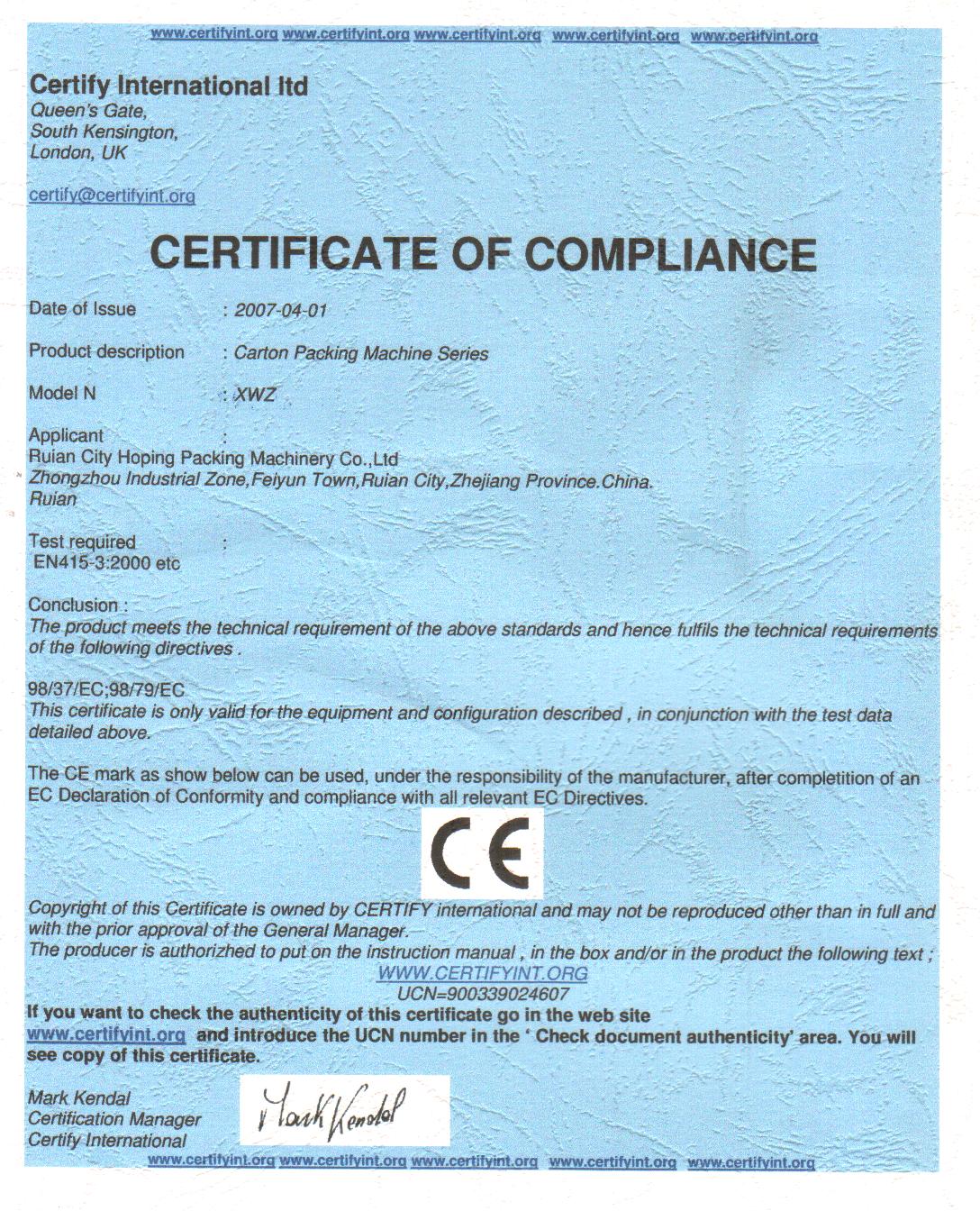
The certificate evidence reviewed for this article also shows why scope matters. There is a CE certificate for carton packing machine series, certificate number UCN 900339024607, issued by Certify International Ltd on 2007-04-01, citing EN 415-3:2000, 98/37/EC and 98/79/EC. There is a CE certificate for cartoning machine series, certificate number HTT190102307L, issued by Shenzhen HTT Technology Co., Ltd. on 2019-01-22, citing EN 60204-1:2006+A1:2009+AC:2010 and 2006/42/EC. There is a CE certificate for blister packing machine series, certificate number HTT190102306L, issued on 2019-01-22, citing Machinery Directive 2006/42/EC and EN 60204-1:2006+A1:2009+AC:2010. There is also a CE certificate for a sample automatic blister packing machine, certificate number UCN 900175009261, issued by CELAB on 2006-11-06, citing EN 60204-1:1997, EN 415-3:1999, 73/23/EEC, 93/68/EEC, 98/37/EC and 98/79/EC.
Those records are useful, but they must be read carefully. A series certificate is not a model-specific performance guarantee. A sample-machine certificate is not a series certificate. A certificate issued in 2006 or 2007 should be checked for current applicability and for the exact directive and standard basis. The buyer should ask the supplier to identify the certificate that covers the offered model and configuration, and should attach that scope to the technical agreement. The same discipline applies to management-system certificates. The available records include ISO 45001:2018 and ISO 14001:2015 certificates issued by CQC with expiry dates in October 2026. For a late-2026 evaluation, the buyer should request the current certificate and verify its validity rather than rely on an expired copy.
Using the DHL8005H as a worked example
The DHL8005H is listed in the supplier's product range as an automatic blister-cartoning line or blister cartoner line. That identity is useful for procurement because it forces the buyer to ask where the blister machine ends, where the cartoner begins and how the line behaves as one system. The buyer should not stop at the model name. The technical agreement should identify the included modules, the interface between them, the transfer mechanism, the reject handling and the line-control responsibility.
A plain-language explanation should cover the proposed control chain, independent replenishment and splicing functions. If the offer includes a Beckhoff motion controller and a CP9315 industrial PC, three-channel servo-driven independent replenishment, or PVC and aluminum foil auto splicing, those are important procurement items. If a supplier proposes a DHL8005H configuration with a Beckhoff motion controller and a CP9315 industrial PC, the agreement should identify which device performs real-time motion control, which device runs the HMI and data logging, how recipes and audit records are stored, which interfaces are open to the buyer, and what validation support is included. If the offer uses a different controller or PC, the same questions apply. The brand name is not the acceptance criterion; the configured function and the documented evidence are.
Three-channel servo-driven independent replenishment needs the same treatment. In plain procurement language, 'independent' should mean that each channel has a defined refill logic and can be isolated or recovered without confusing the other channels. The agreement should state the number of channels, the sensors that detect empty or missing product, the refill sequence, the reject handling, the synchronization with the blister and cartoner, the changeover procedure and the spare-parts list. The buyer should see a FAT demonstration with the actual product format and a fault-injection test. A verbal explanation that the system is independent is not enough. The same test should be repeated at SAT.
PVC or aluminum foil auto splicing should also be written as a function, not an adjective. The agreement should define the splice method, splice detection, tension control, roll diameter, waste handling, material compatibility and the operator intervention that remains. The buyer should require a run with the actual PVC and foil at FAT and a repeat at SAT. If the material changes, the splice performance may change. If the roll supplier changes, the splice performance may change. The acceptance record should identify the material, roll size and splice condition used in the test.
What the control chain should prove
A control chain is not only a hardware list. It is the relationship between the motion controller, the industrial PC, the servo drives, the sensors, the safety circuit and the data record. The technical agreement should define the architecture in a way that the buyer can verify. That includes the controller model, the industrial PC model, the firmware versions, the communication protocol, the I/O list, the recipe management, the user-access levels, the alarm history, the data export format and the backup and restore procedure. If the buyer needs batch records or electronic data, the agreement should state what the machine can export, what it cannot export and what validation support the supplier will provide.
This is also where the industry trend toward digitised data collection becomes practical. Trade media reporting PMMI content states that pharmaceutical manufacturers are turning toward digitised data collection and integrated solutions to meet regulations and improve visibility. That is a directional statement, not a measurement. For the buyer, it supports a simple procurement rule: if data capture is part of the project, it must be specified and tested like any other function. A control chain that can display data but cannot export it, or can export it but cannot control access, may not meet the buyer's intended use. The agreement should resolve that before shipment.
Application fit and line boundaries
A representative project profile describes a large pharmaceutical manufacturer, solid-dosage production company or pharmaceutical engineering contractor, with 5 to 10 lines, for blister packaging and automatic cartoning of tablets, capsules and other solid dosage forms. The stated applications are new line construction, capacity expansion and upgrading existing packaging lines. The stated project objectives include improving packaging automation, reducing manual transfer, improving blister-to-carton connection efficiency, reducing wrong insertion or missing leaflet risks and supporting downstream automation integration. These are objectives, not verified customer results. They are still useful because they show what a buyer should test: the transfer, the leaflet, the reject path and the downstream interface.
The DHL8005H example should not be treated as a universal fit. A high-speed blister-cartoning line may be appropriate for a continuous solid-dosage production line, but the buyer still has to check the format range, the material compatibility, the carton size, the leaflet format, the coding method and the downstream case-packing or palletizing connection. HOPING's customization list includes downstream bundling, case-packing and palletizing connection, which means those interfaces can be part of the project scope. They should be defined as interfaces, not left to a later integration meeting. If the buyer already has an end-of-line packaging machine, the agreement should state the handshake, buffer, reject and data-exchange requirements.
Line balancing is another practical boundary. A blister machine and a cartoner may have different nominal capacities. A line can be limited by the transfer, the leaflet feeder, the carton erector, the reject system or the operator interface. The available evidence does not establish a validated sustained output for the DHL8005H configuration, and it would be wrong to infer one from a model name. The buyer should ask for a line-balance calculation, a FAT plan and a SAT plan that use the actual product and packaging materials. The acceptance criteria should state whether the test is a short demonstration or a sustained run, and what reject rate and downtime are acceptable.
Documenting the points in the technical agreement
The technical agreement should be written so that a person who was not in the sales meeting can understand what was bought. A useful structure is: scope, formats and materials, tooling, GMP and cleaning, control architecture, line interfaces, acceptance tests, documentation, training, spare parts and change control. Each section should have a named owner and a verification method. The buyer should avoid clauses that say only 'GMP compliant' or 'high quality'. Those phrases are not testable. Replace them with material grades, surface requirements, certificate scope, test records and acceptance signatures.
For acceptance, the agreement should distinguish between FAT and SAT. The FAT should have a written protocol, agreed product and materials, a defined run duration and a pass or fail rule. The SAT should repeat the critical tests after installation and should include the buyer's utilities, personnel and product. Third-party inspection can be arranged according to customer requirements, but the scope of that inspection should be stated. If the buyer wants a witness, the notice period, location, travel arrangement and record format should be agreed. If a test fails, the agreement should say what happens next: correction, retest, conditional acceptance or rejection.
HOPING's after-sales description covers on-site installation and commissioning, operator training, maintenance training, remote video or phone support, spare-parts supply, process-parameter guidance, regular follow-up and troubleshooting, subject to contract and project configuration. Those items should not be left as general promises. The agreement should state what is included in the project price, what is optional, what the response route is and what spare parts are recommended for the first year. Training should have a record. Commissioning should have a checklist. Remote support should have a contact route and an escalation path.
FAQ: procurement questions before signing
What acceptance criteria should a pharmaceutical packaging machine technical agreement define?
It should define the product formats, blister dimensions, blister materials, fill count, carton specification, leaflet format, coding or inspection method, feeding method and downstream connection. It should also define sample testing, FAT before shipment, SAT at the customer site and any third-party inspection. The acceptance criteria should state the test method, the run duration, the pass or fail rule and the records to be signed. HOPING's quality-control sequence includes incoming material inspection, key component inspection, assembly inspection, electrical safety check, no-load trial run, material trial, FAT, customer witness acceptance and pre-shipment inspection; each step should be tied to a record.
How is GMP compliance defined for product-contact parts and tooling?
It should be defined through the technical agreement, not through a general certificate. The agreement should identify product-contact, product-adjacent and non-contact parts; state material grades, surface finish, joining method, seal type and cleaning compatibility; list tooling by identity; and require material certificates, cleaning support and change-control notification. ISO 15378:2017 specifies GMP requirements for primary packaging materials for medicinal products, but it is not a machine certificate. The U.S. FDA provides a cGMP framework for production and process controls, but a general framework does not replace machine-specific clauses.
What do stainless steel and aluminum-alloy construction mean for cleaning and qualification?
They mean little until the grade, surface condition, contact status and cleaning method are defined. Stainless steel can vary in grade, weld finish and resistance to a cleaning agent. Aluminum alloy can vary in surface treatment and coating. The technical agreement should state the intended cleaning regime and the evidence the supplier will provide. Qualification should check the installed surface, not only the material certificate. A material name should not be accepted as a cleaning qualification.
What should buyers ask about a Beckhoff motion controller and CP9315 industrial PC?
If that control chain is proposed for a DHL8005H configuration, the agreement should identify the exact controller and PC models, firmware versions, real-time versus HMI functions, communication protocol, I/O list, recipe management, user-access levels, alarm history, data export, backup and restore, and validation support. If a different controller or PC is offered, the same questions apply. The brand name is not the acceptance criterion; the configured function and the documented test are.
How should three-channel servo-driven independent replenishment be verified?
The agreement should define the number of channels, the sensors that detect empty or missing product, the refill logic, reject handling, synchronization with the blister and cartoner, changeover and spare parts. The buyer should require a FAT demonstration with the actual product format and a fault-injection test, then repeat the critical checks at SAT. 'Independent' should be defined as a behavior that can be observed, not as a label.
How should PVC or aluminum foil auto splicing be documented?
The agreement should state the splice method, splice detection, tension control, roll diameter, waste handling, material compatibility and remaining operator intervention. The test should use the actual PVC and foil at FAT and be repeated at SAT. The acceptance record should identify the material, roll size and splice condition. If the material or roll supplier changes, the splice performance should be rechecked.
Which certificates in the available evidence apply to a project?
The certificate must match the offered model and configuration. The available evidence includes CE certificate UCN 900339024607 for carton packing machine series, issued by Certify International Ltd on 2007-04-01 and citing EN 415-3:2000, 98/37/EC and 98/79/EC. It also includes CE certificate HTT190102307L for cartoning machine series, issued by Shenzhen HTT Technology Co., Ltd. on 2019-01-22 and citing EN 60204-1:2006+A1:2009+AC:2010 and 2006/42/EC. CE certificate HTT190102306L covers blister packing machine series and cites Machinery Directive 2006/42/EC and EN 60204-1:2006+A1:2009+AC:2010. CE certificate UCN 900175009261 covers a sample automatic blister packing machine and cites EN 60204-1:1997, EN 415-3:1999, 73/23/EEC, 93/68/EEC, 98/37/EC and 98/79/EC. A series certificate is not a model-specific performance guarantee, and a sample-machine certificate is not a series certificate.
Conclusion: make acceptance unambiguous
The technical agreement is the buyer's main protection because it converts a sales discussion into a set of verifiable obligations. For a pharmaceutical packaging machine project, that means writing down the formats, materials, tooling, GMP-related requirements, control architecture, line interfaces, FAT and SAT criteria, documents, training and spare parts. The DHL8005H example shows why this matters: a blister-cartoning line is a system, and its acceptance depends on the transfer, the cartoner, the control chain and the material run, not only on a nominal speed. If a proposed configuration includes a Beckhoff motion controller and CP9315 industrial PC, three-channel servo-driven independent replenishment or PVC and aluminum foil auto splicing, those items should be identified, explained and tested. If the offer does not include them, the buyer should not assume them.
HOPING's published company profile and product range provide a starting point for a supplier discussion, but the technical agreement must carry the project-specific detail. Buyers can review the company's public information at Zhejiang Hoping Machinery Co., Ltd. (HOPING) and use the published catalog as a reference for the equipment scope. The catalog is available here: Hoping Machinery Catalog. The catalog is a reference document, not a substitute for the technical agreement or the acceptance record.
This article is an industry procurement reference. It does not constitute a certificate, a regulatory determination or a supplier guarantee. Certificate scope, current validity and model coverage should be verified against the documents supplied for the specific project.
Tem questões ou precisa de mais detalhes?
Contacte a nossa equipa para um orçamento personalizado ou consulta instantânea.
Solicitar orçamento
Preencha o formulário abaixo e a nossa equipa entrará em contacto com uma proposta personalizada.
Chat direto do WhatsApp
Prefere conversar em tempo real? Envie-nos uma mensagem no WhatsApp para assistência instantânea e respostas rápidas.
- Obter orçamento personalizado
- Partilhar fotos ou documentos
- Discuta as suas necessidades diretamente
Geralmente responde em 5–30 minutos durante o horário de expediente.