
Pharma and QC Lab Workflows: Matching Benches and Sinks
Pharma and QC Lab Workflows: Matching Benches and Sinks
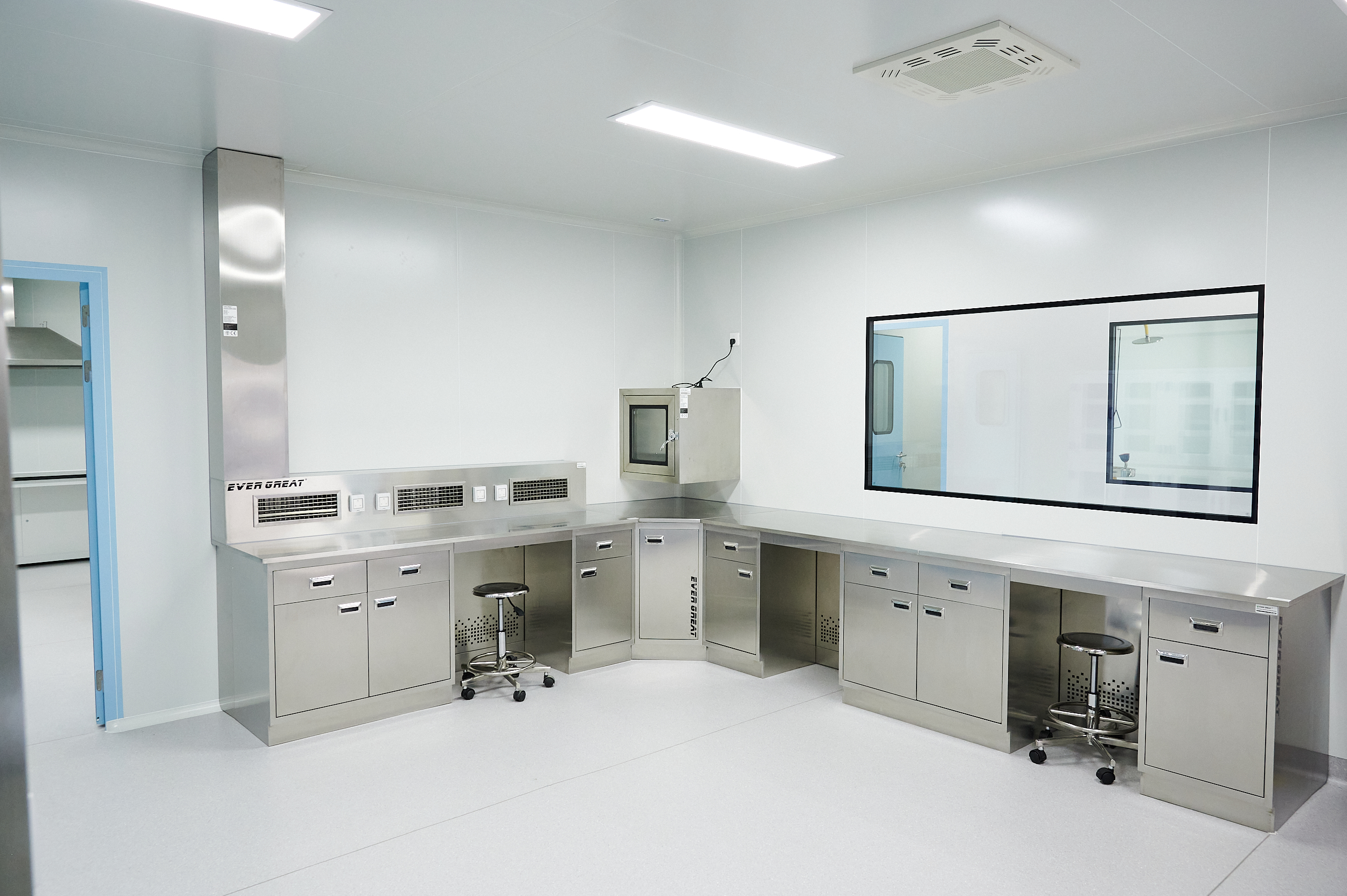
Wet-zone furniture decides where washing, rinsing and sample preparation can happen without crossing clean and dirty workflows.
Pharmaceutical quality control and analytical laboratories are organised around water. Dilution, titration, reflux and acid digestion all take place in the same wet zone, and that zone normally contains a bench, a sink, and whatever exhaust the room can supply. When the furniture in that zone is selected from a catalogue rather than from the workflow, the failure modes are predictable: a single sink shared between dirty glassware and clean sample preparation, worktops that degrade ahead of their expected service life, and acid vapour released a short distance from where an analyst stands.
Guangdong Ever Great Laboratory Equipment Co., Ltd. (Ever Great) is a laboratory infrastructure manufacturer founded in 2011 and based in Shishan Town, Nanhai District, Foshan City, Guangdong Province, China. The company produces fume hoods, laboratory workbenches, safety storage cabinets, and PP and stainless steel laboratory furniture from a 6,000 m² manufacturing base, and serves education, research, medical and industrial laboratories, with exports accounting for approximately 60% of output across the USA, EU, Middle East and Africa.
This article uses one wet-zone product — the EG-SS-LG002 exhaust washing bench — as a case example, and sets out how pharmaceutical and QC buyers can match benches and sinks to the workflows they actually have to support.
The Wet Zone Problem: Three Points Where Layout and Workflow Diverge
Scenario fit in a pharmaceutical or QC laboratory is rarely decided by the bench itself. It is decided by three recurring mismatches between the furniture and the work.
One sink, two incompatible jobs
In QC laboratories, glassware washing and sample preparation tend to converge on the same basin because the room supports only one. Once that happens, rinse water carrying residues and water used in a preparation step share a surface. A bench that provides two PP sinks and two three-way gooseneck faucets within a single 1,500 mm width creates two independent wash points, so a rinse station and a preparation station can be separated without adding a second bench run.
Worktop material treated as a finish
Chemical resistance and cleanability are properties of the working surface, not of the frame. Within the Ever Great range the material changes with the exposure: the C-frame wall laboratory bench (EG-S0-LB003) is specified with a 12.7 mm phenolic worktop, the island laboratory bench (EG-S0-CB005) offers 12.7 mm phenolic, 20 mm ceramic or epoxy worktop options, and the exhaust washing bench uses a 25 mm ceramic worktop. On a bench whose function is washing, the surface stays wet and is cleaned repeatedly, so the worktop grade is a functional decision rather than a visual one.
Exhaust treated as a room-level problem only
Containment strategy usually starts with fume hoods, and Ever Great's ventilation and containment systems — including its laboratory fume hoods — are tested against international benchmarks such as EN 14175 and ASHRAE 110, backed by third-party test reports. Much routine acid work, however, does not happen inside a hood: pouring, decanting and rinsing at the sink release vapour at the working height. A washing position with local exhaust above it addresses that specific release point instead of relying on room air changes alone.
What the Exhaust Washing Bench Specifies
The case product in this article is a single unit with a published specification, which makes it a useful reference for how specification and workflow should be read together.
| Parameter | Published specification |
|---|---|
| Product | Exhaust washing bench, model EG-SS-LG002 |
| Configuration | Stainless steel canopy sink bench |
| Overall size | 1,500 x 750 x 1,500 mm |
| Worktop | 25 mm ceramic worktop |
| Sinks | Two PP sinks |
| Faucets | Two three-way gooseneck faucets |
| Materials | Full steel / 304 stainless steel frame and hood / PP sinks / ceramic worktop |
| Applicable industries | Chemical, pharmaceutical and QC laboratories |
| Functional intent | Combines washing and local exhaust functions; 304 stainless steel hood; corrosion-resistant worktop |
Nothing in that table mentions workflow. The workflow meaning has to be read out of the numbers, and that is where a pharmaceutical or QC buyer gains or loses value.
Reading the Specification as a Workflow Decision
h3>25 mm ceramic worktopCeramic is the surface Ever Great reserves for the wettest, most chemically exposed position in its wet-zone furniture. Thickness matters less than continuity: a 25 mm monolithic slab can be cut for two sink openings and faucet positions while keeping a workable depth of material around each cut. Company guidance on worktop installation is also relevant here — sink cut-outs, fixture holes and reagent-rack mounting points should be beveled and sealed with epoxy adhesive, and joints sealed with chemical-resistant sealant. On a washing bench, the sink cut-out is the detail most likely to leak corrosive liquid into the cabinet zone below, so a factory-executed cut and seal is worth more here than on a dry bench.
Two PP sinks and two three-way gooseneck faucets
The basins are polypropylene, not stainless steel, and this follows a consistent material logic in the range. Ever Great uses PP in the components that hold standing corrosive liquid: the all-PP acid and alkali storage cabinet (EG-PP-CB003) is built from 8.0 mm PP sheet with three spill-containment shelves, a bottom sump and a Dia. 110 mm exhaust port, and the polypropylene fume hood (EG-PP-FH) is a seamless-welded body in homogeneous PP of 8.0 mm or more with a three-stage baffle and face velocity of 0.3–0.6 m/s. Using PP basins on a washing bench places the material where liquid resides, while the structure remains metal.
Each basin is served by a three-way gooseneck faucet, which means one washing position can carry more than a single supply connection without additional tap holes — useful when a laboratory separates a rinse line from a utility line at the point of use. Two basins and two faucets in a 1,500 mm width is the specification's answer to the dirty-glassware-versus-clean-preparation conflict described earlier.
304 stainless steel frame and hood
The canopy tops out at 1,500 mm. For reference, the polypropylene fume hood in the same portfolio is 2,350 mm high and the narrow-frame Orion series is 2,400 mm high. That height difference defines the product category: the exhaust washing bench is a bench with a local exhaust canopy over the washing position, not a benchtop or walk-in fume hood, and it should not be specified as a substitute for one. Its containment scope is the sink area.
Stainless steel is the material Ever Great applies to wet, frequently cleaned furniture elsewhere in the range as well. The glassware drying and storage cabinet (EG-SS-LB002) is a 304 stainless steel draining cabinet with four perforated shelves, a pull-out drip tray and 5 mm tempered-glass doors, specified for medical, pharmaceutical and food-testing laboratories. A wet zone assembled from a washing bench and a drying cabinet therefore shares one surface family, which simplifies cleaning routines.
1,500 x 750 x 1,500 mm as a room-planning unit
The footprint is the constraint that shapes layout: 750 mm of depth against a wall or run, 1,500 mm of linear bench, and a 1,500 mm vertical envelope that has to coexist with overhead service frames, reagent racks and ductwork. The unit is a fixed wet-zone station, not a mobile trolley; it belongs in the layout from the first planning cycle, before the exhaust route is fixed.
Where the Configuration Fits in Pharmaceutical and QC Work
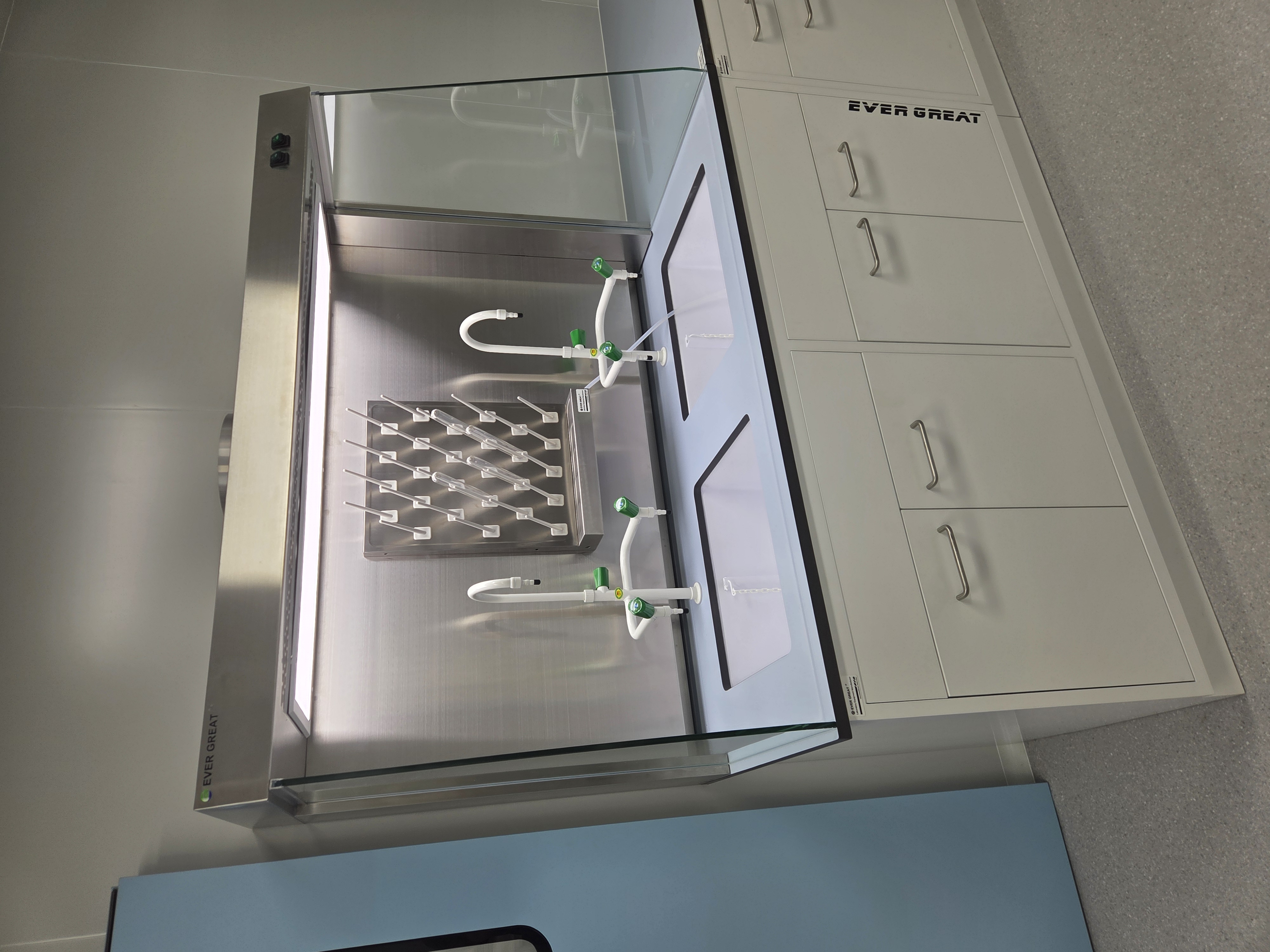
The EG-SS-LG002 exhaust washing bench: 1,500 x 750 x 1,500 mm, 25 mm ceramic worktop, two PP sinks, two three-way gooseneck faucets.
| Scenario | Why the configuration fits | What the buyer should verify |
|---|---|---|
| Pharmaceutical QC wet chemistry | Two wash points separate glassware rinsing from preparation work inside one bench run | Confirm which basin serves which task, and how the exhaust canopy connects to the room system |
| Acid digestion and sample preparation | Ceramic worktop and PP basins place chemical-resistant materials exactly where liquid and residue collect | Check the chemical inventory against worktop and basin materials, and confirm cut-out sealing details |
| Chemical laboratories with acid and alkali handling | Local exhaust over the washing position captures vapour at the point of release rather than at room level | Confirm exhaust volume and duct route; do not assume a canopy equals a tested fume hood |
| Glassware washing and drying workflow | Pairs with the EG-SS-LB002 304 stainless steel draining cabinet (900 x 500 x 1800 mm, four perforated shelves, pull-out drip tray) | Check the travel distance from sink to drying cabinet to avoid wet glassware crossing dry benches |
Deployment evidence supports treating these as repeatable project scenarios rather than one-off arrangements. In Australia, 45 units of the exhaust washing bench were installed in a pharmaceutical building and used for R&D across various departments, with the project completed within five years. In China, a pharmaceutical building took 200 units of the island laboratory bench (EG-S0-CB005) across various departments for R&D purposes, completed within the same five-year horizon, while a separate Chinese pharmaceutical building deployment used the laboratory safety and emergency hub (EG-SF-CB011) for R&D departments. In the Philippines, 105 units of laboratory furniture including the C-frame wall laboratory bench (EG-S0-LB003) were supplied to a biotech company. In Tanzania, a chemical enterprise workshop laboratory deployment combined the island laboratory bench with 30 units of the C-frame wall laboratory bench.
The pattern across those projects is consistent: pharmaceutical and chemical facilities specify wet-zone furniture in multiples, department by department, rather than as single units. That is an argument for treating the sink bench as a standardised module with a fixed specification, not as a bespoke item that changes with every room.
Comparison with Traditional Solutions — and Where This Configuration Stops
| Consideration | Separate sink bench plus nearby fume hood | Integrated exhaust washing bench (EG-SS-LG002) |
|---|---|---|
| Bench length used | Sink bench plus a separate hood position, each occupying its own run | One 1,500 mm unit carries both washing and local exhaust |
| Distance from release to exhaust | Depends on how close the hood can be installed to the sink | Canopy sits directly above the washing position |
| Worktop exposure | Often a general-purpose worktop applied to a wet position | 25 mm ceramic worktop specified for the wet position |
| Basin material | Frequently metal basins with limited acid duty | PP basins matched to the acid and alkali handling logic used elsewhere in the range |
| Containment scope | Full fume hood containment for high-hazard operations | Local exhaust at the sink; not equivalent to a tested fume hood |
At least four boundaries should be stated plainly, because they affect whether this configuration is the right answer at all.
It requires exhaust infrastructure. The product's function is a combination of washing and local exhaust. In a facility with no duct route and no capability to add one, the exhaust half of that function cannot be delivered. Laboratories in that position typically have to consider the wider industry distinction between ducted and ductless approaches — ducted systems exhaust fumes outdoors with no limit on chemical type, while ductless units recirculate air through HEPA and activated-carbon filtration, reducing installation complexity and HVAC energy cost but tying performance to the chemical inventory and filter replacement discipline. The choice has to be made before the bench is ordered, not after.
It is a single-station unit, not a washing line. Two basins in 1,500 mm serves one or two analysts working at the same time. A high-throughput QC laboratory with continuous glassware flow may need several units, or a dedicated washing area with a different configuration. Buying one unit and expecting washing-line throughput is a planning error, not a product limitation.
Its containment scope is narrower than a fume hood's. Ever Great publishes performance data for its fume hood series — nominal face velocity of 0.3 m/s for the narrow-frame Orion hoods and 0.3–0.6 m/s for the polypropylene hood, with three-stage baffles and EN 14175 and ASHRAE 110 testing referenced in high-risk acid exhaust scenarios. The exhaust washing bench specification does not publish a face velocity figure. Buyers running high-hazard operations should confirm exhaust volume and containment requirements for their application directly rather than assume equivalence with a certified hood.
Material boundaries apply. 304 stainless steel is appropriate for the frame and hood in wet, cleaned environments, and it is used in the 304 stainless steel draining cabinet specified for pharmaceutical laboratories. Where continuous, severe acid or alkali exposure dominates, the range moves to polymer construction instead — an all-PP cabinet with 8.0 mm PP sheet and a seamless-welded PP fume hood with homogeneous sheet of 8.0 mm or more — and a stainless framework would not be the first choice. Material selection should follow the chemical inventory, not a default preference.
Market Signals Behind Wet-Zone Specification
The global laboratory furniture market was valued at approximately USD 4.8 billion in 2025 according to Dataintelo, with a projected value of USD 8.1 billion by 2034. That headline figure should be used directionally: published market size estimates for 2025 range from about USD 1.14 billion to USD 4.8 billion depending on whether modular services, gas piping and integrated fit-out are counted inside or outside the definition. For a buyer, the useful signal is not the total but the material mix within it.
Metal laboratory furniture accounted for a 52.7% revenue share of the material segment in 2025, which is consistent with what wet-zone specifications look like in practice: steel frames, stainless steel panels and metal storage dominate, with polymer components appearing where chemical resistance is decisive. Industry research has flagged the tension directly — metal still leads the segment while demand for PP furniture rises in chemical-intensive laboratories.
Supply and compliance trends reinforce the same direction. China exported over USD 4.15 billion of furniture parts under HS 940390 in 2024, a category that includes laboratory furniture components, indicating how concentrated global supply has become. On the standard side, ANSI/ASHRAE Standard 110-2016 (R2025) remains the primary American national standard for quantitative performance testing of laboratory fume hoods, and EN 14470-1 classifies fire-resistant safety cabinets as Type 15, 30, 60 or 90 minutes according to the time taken to reach an internal temperature rise that must not exceed 180 K or 200°C. Labs writing tighter standards into procurement documents naturally push suppliers to publish test evidence for the products adjacent to the hood — benches, sinks and storage.
A Procurement Framework for the Wet Zone
Rather than comparing furniture catalogues, pharmaceutical and QC buyers can map each wet-zone task to a verified requirement and a document to request.
| Task | Furniture requirement | Evidence to request |
|---|---|---|
| Sample preparation and dilution | Bench with chemically resistant, cleanable worktop; island bench offers 12.7 mm phenolic, 20 mm ceramic or epoxy options | Worktop material data, load capacity, dimensional drawing |
| Acid digestion and rinsing | Ceramic worktop, PP basins, local exhaust at the washing position | Material resistance statement and exhaust connection data for the configuration |
| Glassware washing and drying | Multi-sink bench plus draining cabinet with perforated shelves and drip tray | Cabinet dimensions, shelf and tray configuration, door material |
| Reagent and solvent storage | Vented chemical cabinet (900 x 500 x 1800 mm, Dia. 110/150 mm exhaust connection) or flammable safety cabinet (1090 x 460 x 1650 mm, 45 gallon nominal, 1.2 mm double-wall steel, 38 mm air barrier, 51 mm sump) | Cabinet construction detail and fire-resistance classification reference |
| Emergency response | Integrated emergency hub (900 x 600 x 2000 mm) with shower, eyewash and first-aid storage | Utility requirements, placement plan, alarm integration scope |
Commercial terms matter as much as construction in project procurement. Ever Great supports OEM and ODM production and customization of technical specifications, white-label supply and prototyping, with a monthly capacity of 2,000 units, lead times of 10–30 days, a minimum order quantity of one unit and 100% testing before shipment. After-sales provisions include a one-year comprehensive warranty, spare parts deployment, and lifetime remote or on-site engineering support — relevant when a wet zone is commissioned across several departments and needs consistent spares over the life of the building.
Future Outlook
Three directions look likely in pharmaceutical and QC wet zones. Materials will continue to hybridise, with metal structures carrying polymer and ceramic components exactly where chemical exposure is highest, which is already the pattern on the exhaust washing bench. Specification will keep moving toward published evidence: fume hood testing against ASHRAE 110 and EN 14175 has established the expectation that containment products come with third-party data, and the same expectation is spreading to benches, sinks and cabinets. And laboratory layouts will increasingly be planned as workflows with defined wet and dry zones rather than as rooms filled with benches, because contamination control and cleaning labour cost more over a building's life than the furniture itself.
For buyers, the practical consequence is a shorter evaluation path: define the wet-zone tasks, match the worktop, basin and exhaust materials to the chemical inventory, confirm the containment scope honestly, and require the supplier to state what the product does not do.
Frequently Asked Questions
What is an exhaust washing bench and which laboratories use it?
The Ever Great EG-SS-LG002 exhaust washing bench is a stainless steel canopy sink bench that combines washing and local exhaust functions in one unit. Its published specification is an overall size of 1,500 x 750 x 1,500 mm, a 25 mm ceramic worktop, two PP sinks and two three-way gooseneck faucets, built on a full steel and 304 stainless steel frame with a 304 stainless steel hood. It is listed for chemical, pharmaceutical and QC laboratories.
How should a lab choose between a ceramic worktop and a phenolic worktop?
Both appear in the same product range, in different positions. The exhaust washing bench uses a 25 mm ceramic worktop; the C-frame wall laboratory bench uses a 12.7 mm phenolic worktop; and the island laboratory bench offers 12.7 mm phenolic, 20 mm ceramic or epoxy worktop options. Ever Great's published technical guidance frames the decision around chemical exposure intensity and heat resistance, and notes that sink cut-outs, fixture holes and mounting points must be beveled and sealed with epoxy adhesive and that joints should be sealed with chemical-resistant sealant. In a wet zone where the surface stays wet and is cleaned constantly, ceramic is the surface specified on the washing position.
Why would a bench specify two sinks and two three-way gooseneck faucets?
Two PP basins and two faucets create two independent washing points inside a single 1,500 mm bench width, which allows a glassware rinse station to be separated from a station used during sample preparation. The basins are polypropylene, consistent with the material logic used in the company's acid and alkali handling products, where PP is used for parts holding standing corrosive liquid — for example the all-PP storage cabinet in 8.0 mm PP sheet with a bottom sump, and the seamless-welded polypropylene fume hood in homogeneous PP of 8.0 mm or more.
What does a 1,500 x 750 x 1,500 mm unit require from the room?
The unit needs 750 mm of depth, 1,500 mm of linear bench, and a 1,500 mm vertical envelope that must coexist with overhead service frames, reagent racks and ductwork. Because local exhaust is part of its function, the bench must be connected to an exhaust route to deliver that function; a laboratory without ductwork cannot use it as specified and would need to consider the industry distinction between ducted systems, which exhaust fumes outdoors, and ductless systems, which recirculate air through HEPA and activated-carbon filtration and depend on filter replacement discipline. Exhaust volume and connection requirements for the specific configuration should be confirmed with the supplier during planning.
Is a 304 stainless steel frame and hood suitable where acids are handled?
304 stainless steel is the frame and hood material on the exhaust washing bench, and the same material is used in the 304 stainless steel glassware drying and storage cabinet specified for medical, pharmaceutical and food-testing laboratories. Where exposure is dominated by acids and alkalis, Ever Great uses polymer construction instead — an all-PP acid and alkali storage cabinet with 8.0 mm PP sheet, three spill-containment shelves and a bottom sump, and a polypropylene fume hood with homogeneous PP of 8.0 mm or more and seamless welding, in scenarios that reference EN 14175 and ASHRAE 110 compliance. Material selection should follow the chemical inventory of the specific laboratory rather than a single default material across the wet zone.
Reference Material
A product brochure covering Ever Great's laboratory furniture range, including the exhaust washing bench and related wet-zone products, is available for download: Ever Great 2026 laboratory furniture brochure. Company information is published at evergreatlab.com.