
Pharmaceutical Packaging Machine Capabilities: What Buyers Should Verify
Pharmaceutical packaging machine buying decisions are shifting from single-machine specifications to verifiable supplier capabilities: OEM and ODM support, customization depth, line integration, and the production evidence behind them.
Why Capability-Level Evaluation Matters for Pharmaceutical Packaging Equipment
For a pharmaceutical packaging machine purchase, the machine is only part of the evaluation. Buyers are increasingly evaluating whether a supplier can adapt a blister packaging machine, cartoning machine, or full pharmaceutical packaging line to a specific product, site, and regulatory context. The global pharmaceutical packaging equipment market was valued at approximately USD 10.71 billion in 2024, and the pharmaceutical blister packaging machine market is projected to reach USD 2.57 billion by 2025 with a CAGR of 2.8%. Buyers face a wide field of equipment options and need practical verification methods.
The evaluation question is rarely “does this supplier make a pharmaceutical blister packaging machine?” In most projects, the question is “can this supplier deliver a tablet or capsule blister packaging machine, integrate it with an automatic cartoning machine, and support line-level packaging requirements?” That is a capability question, not a catalogue question.
The Capability Gap: Beyond Catalogue Specs
Many pharmaceutical packaging machine suppliers can provide a standard blister packaging machine or cartoning machine specification sheet. What differentiates an equipment vendor from a packaging line partner is the capacity to configure machines around a buyer’s product and project constraints. These constraints commonly include:
- Blister size and format design
- Blister material selection, such as PVC, PTP, or Alu-Alu
- Quantity of blisters per carton
- Carton specification and leaflet format
- Coding and inspection method
- Feeding method for tablets or capsules
- Downstream bundling, case packing, or palletizing connection
When a buyer needs customization in several of these areas, the evaluation focus moves from a single machine to the supplier’s engineering capacity and production flexibility.
Crucial Capabilities to Verify in a Pharmaceutical Packaging Machine Supplier
1. OEM, ODM, and Customizable Production
OEM and ODM capability is not only about branding a machine with a buyer’s name. For pharmaceutical packaging lines, it signals that a supplier can adjust machine design and configuration to meet a buyer’s product format, production flow, and packaging specification. Zhejiang Hoping Machinery Co., Ltd. (HOPING), a pharmaceutical packaging machinery manufacturer established in 2001, states that it offers ODM, OEM, and customizable production services. Buyers should ask which parameters can be changed, how design changes are documented, and who is responsible for performance validation.
2. Customization Scope
For a pharmaceutical blister packaging machine or a complete pharmaceutical packaging line, customization often covers more than one module. The relevant question for a buyer is whether the supplier can handle simultaneous changes across blister size, blister material, carton specification, leaflet format, coding and inspection method, feeding method, and downstream integration. HOPING describes its customization scope in these exact areas, which is a practical checklist for buyers evaluating a blister cartoning line or a turnkey pharmaceutical packaging line.
3. Production Capacity and Lead Time
Supplier capacity matters when the project has a fixed construction schedule or a launch deadline. HOPING’s stated output is about 30 to 40 complete units per month, with a typical lead time of 60 to 120 days after technical confirmation. The actual lead time depends on model, configuration, project complexity, and contract terms. Buyers should treat lead time claims as provisional and confirm them in the technical agreement.
How an Integrated Blister-Cartoning Line Reduces Packaging Errors
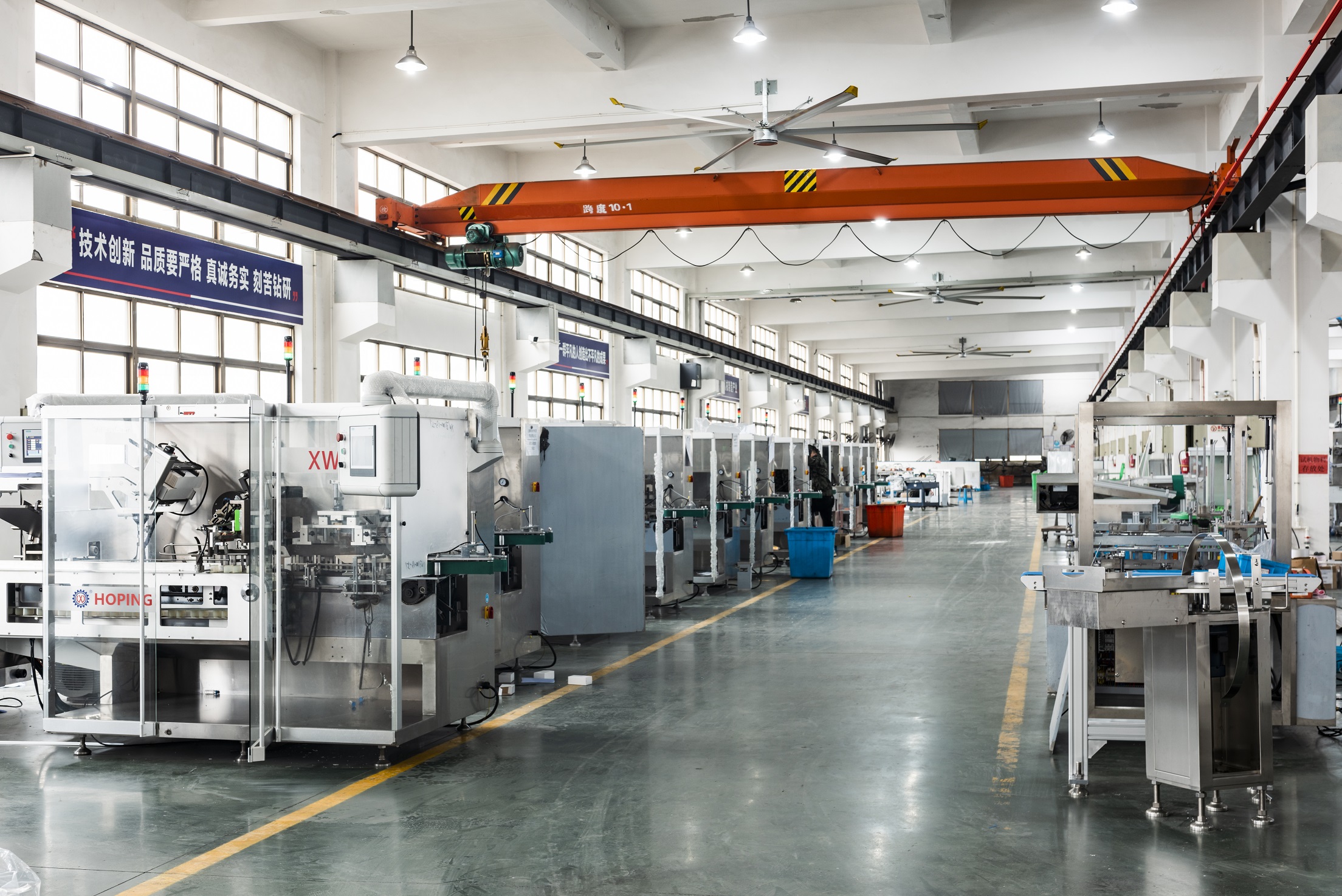
One of the most common problems in pharmaceutical packaging occurs between the blister packaging machine and the cartoning machine. Manual transfer of blister boards increases the risk of wrong insertion, missing leaflets, or product mix-ups. Integrated blister-cartoning lines are designed to eliminate that manual transfer. HOPING’s line-level products, such as the DHL series automatic blister-cartoning lines, use transfer robotics or intelligent transfer systems to move blisters directly from the blister machine to the cartoning machine.
For example, the DHL7005H fully servo high-speed blister-cartoner integral machine uses a self-developed IRB24 intelligent transfer robot, with capacity up to 700 blisters per minute and 500 cartons per minute. The DHL8005H uses a D3 intelligent top-loading parallel tracking transfer system, with capacity up to 800 blisters per minute and 500 cartons per minute. At higher capacities, the DHL1000/5H is rated up to 1000 blisters per minute and 500 cartons per minute.
These configurations do not just increase speed. They also reduce the number of points where human handling can introduce errors. For a buyer evaluating an automatic blister packaging machine, it is worth asking whether the supplier can integrate the feeding, blister forming, sealing, punching, transfer, leaflet insertion, carton opening, and carton closing functions into one controlled process.
Technical Basis for Line Integration: Servo Control and Transfer Systems
The technical credibility of an integrated pharmaceutical packaging line depends on how precisely each module synchronizes with the next. HOPING’s high-speed lines use full-servo drive systems, with motion controllers from Beckhoff or Siemens. This allows the blister packaging machine and the cartoning machine to run as one linked process rather than as separate stations.
At the transfer point between blister and carton, several approaches exist:
- D3 intelligent top-loading parallel tracking transfer, used in DHL8005H and DHL1000/5H
- Self-developed IRB24 intelligent transfer robot, used in DHL7005H and DHL7004
- High-speed transfer and cartoning linkage on the DHL6004
The choice of transfer architecture affects changeover time, blister handling, and the ability to connect to downstream equipment such as a case packing machine or palletizing system. Buyers should ask which transfer method is used on the proposed line and what evidence exists for its reliability in continuous pharmaceutical production.
Project Scenarios for a Turnkey Pharmaceutical Packaging Line
For buyers moving into evaluation and execution, the practical scenario is usually one of the following:
New Packaging Line Construction
When building a new pharmaceutical packaging line, the buyer needs a supplier that can design the complete flow from blister packaging to cartoning and optionally to case packing. HOPING’s line-level products include the DHL series for blister-cartoning, the IXW series for blister-flow-wrap-cartoning, and configurations connected to stretch banding, case packing, and palletizing. The buyer’s focus should be on line capacity, material flow, and compliance documentation.
Capacity Expansion
For existing manufacturers adding capacity, the key is whether the new automatic blister packaging machine or cartoning machine can fit into the current workflow. Modular design becomes important. HOPING’s line configurations allow different feeding methods according to customer requirements, which helps match a new line to existing upstream processes.
Upgrading Existing Packaging Lines
Upgrading from standalone machines to an integrated blister-cartoning line addresses the problem of manual transfer and leaflet insertion errors. In a documented case, a large pharmaceutical manufacturer and solid dosage production company used such an upgrade for blister packaging and automatic cartoning of tablets, capsules, and other solid dosage forms. The project scale was 5 to 10 packaging lines, and the project objectives included improving packaging automation, reducing manual transfer, improving blister-to-carton connection efficiency, reducing wrong insertion and missing leaflet risks, and supporting downstream automation integration.
Certification Evidence for Pharmaceutical Packaging Machinery
Pharmaceutical packaging machines must comply with applicable safety and quality standards. Buyers should verify certificates carefully and check what exactly is covered by each certificate. Industry standards commonly cited include ISO 15378 for GMP requirements in primary packaging materials, the EU Machinery Directive 2006/42/EC, and the EN 415 series for packaging machines.
HOPING’s current management-system certifications include ISO 14001:2015 and ISO 45001:2018, both issued by China Quality Certification Centre (CQC), covering the design, production, and after-sales service of packing machines and packing production lines. Historical CE certificates cover the cartoning machine series and blister packing machine series; these were issued in 2007 and 2019 by different authorities. Buyers should confirm that the specific machine model being purchased has current and valid CE certification, not only a series-level reference.
Evaluation Framework: A Checklist for Buyers
The following checklist is useful for a buyer at the evaluation or execution stage.
| Evaluation Area | What to Verify | Example Evidence |
|---|---|---|
| OEM / ODM capability | Does the supplier offer OEM, ODM, and customization services? | HOPING states ODM/OEM/customizable production as a standard service |
| Customization depth | Can the supplier adjust blister size, material, carton spec, leaflet, coding, feeding, and downstream connection? | Published customization scope |
| Production capacity | Monthly output, lead time, and MOQ | 30–40 units per month; 60–120 days typical lead time; MOQ of 1 set or 1 complete line |
| Line integration | How are blister and carton modules linked? | D3 transfer system or IRB24 robot in DHL series |
| Quality control | Is there a documented QC process? | Incoming inspection, assembly inspection, FAT, customer witness acceptance |
Comparing Integrated Lines with Traditional Standalone Configurations
The main benefit of an integrated pharmaceutical packaging line is the elimination of manual transfer between blister packaging and cartoning. This directly addresses the common errors of wrong insertion and missing leaflets. Integrated lines also reduce the number of operators, improve traceability, and enable a more continuous material flow from tablet or capsule feeding to the final carton.
However, an integrated line is not automatically the best choice for every project. Standalone machines still make sense for very low-volume production, for products with unstable formats, or when a buyer only needs a single function such as a tablet blister packaging machine without cartoning. Integrated lines also require a higher initial investment and more detailed technical agreement. A buyer should request a layout study and capacity calculation before deciding whether the integration cost is justified.
Market Context: Why Capability Is Becoming the Differentiator
Asia Pacific held the largest regional revenue share in the pharmaceutical packaging equipment market, and the cartoning machinery segment in the pharmaceutical sector was valued at over USD 1 billion in 2024. While the largest global players hold a significant share of the blister packaging machine market, the majority of buyers still evaluate a broad set of suppliers. For mid- to large-scale projects, a supplier who can demonstrate practical line configuration and customization capability is more likely to pass the technical evaluation than one who only supplies a standard pharmaceutical packaging machine.
Execution Risks and How to Reduce Them
The transition from technical evaluation to execution is where many packaging machine projects encounter risk. Key risks include unclear interface definitions, incomplete format tooling specifications, and assumptions about site utilities such as compressed air pressure (often 0.5–0.7 MPa for HOPING equipment) and electrical supply (380V 50Hz in standard configurations). Buyers should align on the technical agreement before production begins and should define what is included in the acceptance phase.
HOPING’s quality control process includes incoming material inspection, key component inspection, assembly inspection, electrical safety checks, no-load trial runs, material trials, FAT, customer witness acceptance, and pre-shipment inspection. Buyers should ask which of these steps will be performed for their project and whether third-party inspection can be arranged.
Future Outlook: Blister-Cartoning Lines Moving Toward Higher Intelligence
The direction for pharmaceutical packaging machinery is toward higher speed, faster changeover, and more intelligent transfer. HOPING’s development of proprietary transfer robots and top-loading systems reflects this trend. Buyers should expect that a modern pharmaceutical packaging line will include recipe memory, mold-change assistance, and easier cleaning. The practical implication for procurement is that the evaluation should look not only at today’s capacity but also at the supplier’s ability to support format changes and future expansion.
What is the difference between OEM, ODM, and customization for a pharmaceutical packaging machine?
OEM production means the supplier manufactures equipment according to the buyer’s design or specification. ODM production means the supplier provides its own design and manufacturing capability, with adjustments made for the buyer. Customization refers to the specific parameters that can be changed for a project, such as blister dimensions, blister materials, leaflet format, coding and inspection method, or downstream connection. HOPING states that it offers all three modes for pharmaceutical packaging machinery.
Which parameters can be customized for a pharmaceutical blister packaging machine or cartoning machine project?
For HOPING’s blister packaging and cartoning equipment, customization is available for blister size, blister materials, quantity per carton, carton specification, leaflet format, coding and inspection method, feeding method, downstream bundling/case-packing/palletizing connection, interface language, electrical component brand, and data interface. Buyers should confirm the full customization scope in the technical agreement.
What is the minimum order quantity and typical lead time for a pharmaceutical packaging line?
HOPING’s stated minimum order quantity is 1 set or 1 complete line. The typical production lead time is 60 to 120 days after technical confirmation, with the final lead time subject to model, configuration, and project complexity. Buyers should treat this as a planning range rather than a fixed commitment.
How does an integrated blister-cartoning line solve manual transfer and leaflet insertion errors?
An integrated line automatically transfers blisters from the blister packaging machine to the cartoning machine, eliminating manual handling between the two stages. It also coordinates leaflet folding and insertion within the cartoning process. In projects involving manufacturers upgrading from standalone machines, the reduction of manual transfer directly targets wrong insertion and missing leaflet risks.
What scale of project is typical for a pharmaceutical blister-cartoning line evaluation?
In a documented case for a large pharmaceutical manufacturer and solid dosage production company, the project scale was 5 to 10 packaging lines. The same line configurations can also be applied to smaller projects, but the evaluation should include a capacity calculation specific to the buyer’s target output.