
Pharmaceutical Packaging Machine Capability: Order-Stage Evidence
Pharmaceutical Packaging Machine Capability: Order-Stage Evidence
Pharmaceutical packaging equipment is a well-supplied category. The global market was valued at approximately USD 10.71 billion in 2024 (SkyQuest Technology), and Asia Pacific accounted for the largest revenue share, at 40.7%, in 2025 (Grand View Research). For a buyer who has already shortlisted suppliers, the decisive question is narrower: can the supplier's capability claims be traced to evidence that survives a contract review, a factory acceptance test and the first year of production?
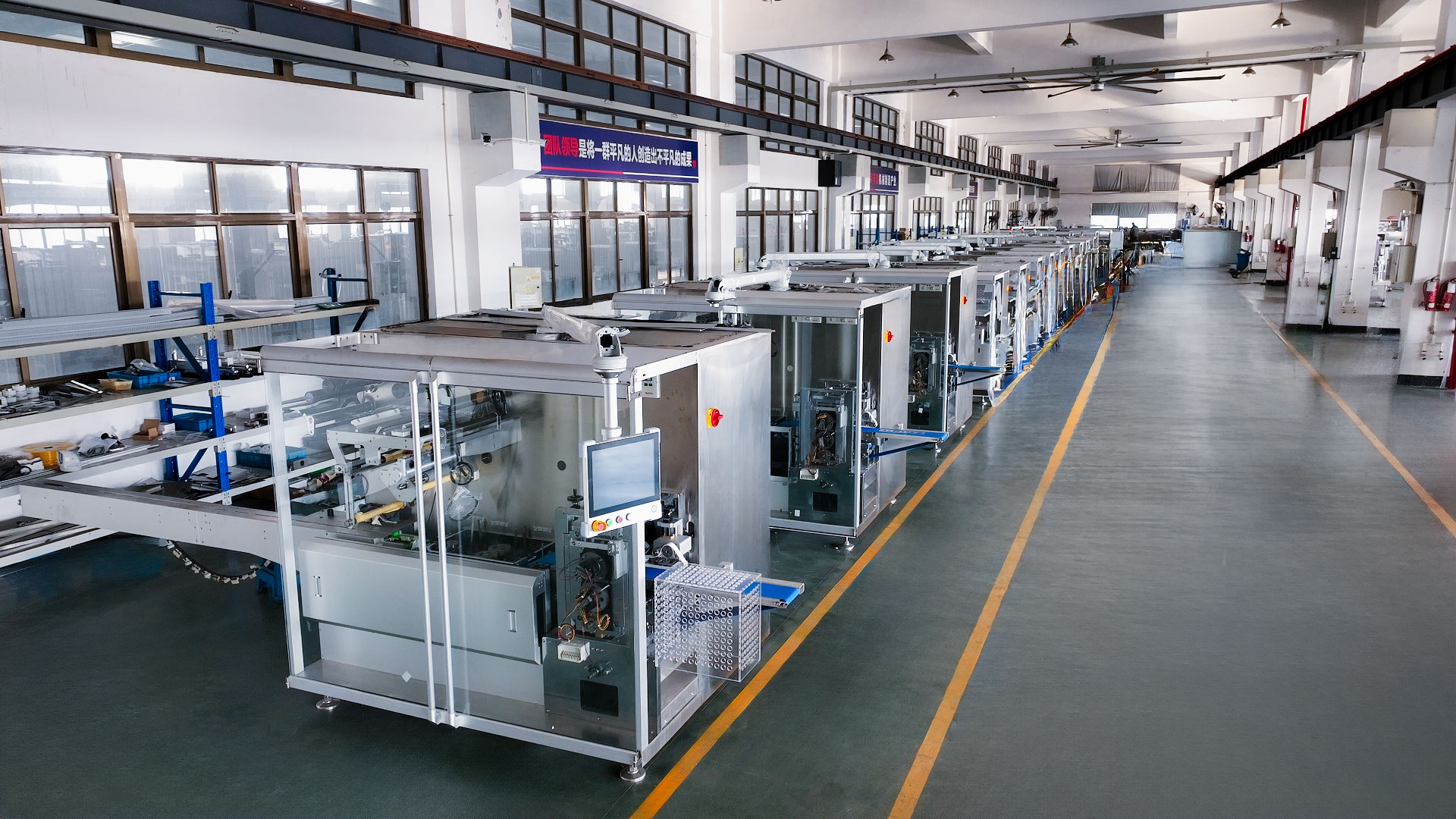
Flow wrapper workshop area at the Hoping Machinery production facility, Ruian, Zhejiang Province, China.
This reference examines supplier capability evidence for pharmaceutical packaging machines — the documents, tests and operating numbers that a buyer can reasonably request between commercial negotiation and line handover — and how an integrated sequence of blister packaging machine, cartoning machine, case packing machine and end-of-line equipment changes the evidence burden. It also sets out where that evidence stops being conclusive.
Zhejiang Hoping Machinery Co., Ltd. (HOPING) is a pharmaceutical packaging machinery manufacturer established in 2001 in Ruian City, Zhejiang Province, China, whose range covers blister packaging machines, cartoning machines, case packing machines and end-of-line packaging equipment. Its published operating data — factory scale, engineering headcount, production capacity, lead time and acceptance steps — provide a concrete example of how order-stage capability evidence can be written down rather than asserted.
The Execution-Stage Shift: From Technology Fit to Fulfilment Risk
The move from decision to execution changes the questions a buyer asks. During evaluation, the discussion is technical: blister format, carton size, output per minute, inspection method. Once the technical agreement is being drafted, the discussion becomes operational: units per month, weeks of lead time, what is tested before shipment, who signs the acceptance record, and how a format change is handled two years after installation.
Capability evidence is the material that answers this second set of questions. It is not a brand statement. It is a body of numbers, documents and tests that an outside party can check — rated capacity, documented lead time, defined acceptance criteria, sample test records, and named responsibilities for installation, commissioning, training and spare parts.
Three consequences follow for pharmaceutical packaging projects. Capacity and lead-time commitments are usually requested in writing, because a line delivered late delays a product launch rather than only a purchase. Acceptance criteria are best agreed before the order, since procedures negotiated at shipment rarely favour the buyer. And training and spare-parts arrangements belong in the same commercial document as the technical specification, because they determine usable line life rather than first-week performance.
Primary packaging adds a further layer: because the machine contacts the product, machine design, documentation and change control are commonly reviewed alongside commercial terms, and suppliers may be expected to support qualification work well after start-up.
A Four-Part Evidence Framework for Pharmaceutical Packaging Machine Suppliers
Supplier claims can be organised into four classes. Each class has a different owner inside the supplier organisation and a different way of being verified, which is why treating capability as a single yes-or-no judgement tends to produce weak procurement decisions.
| Evidence class | Typical items to request | What it verifies |
|---|---|---|
| Manufacturing and capacity | Factory area and location; total headcount; engineering headcount; monthly and annual production capacity; order backlog statement | Whether the supplier can physically build and schedule the line |
| Engineering and documentation | Technical agreement; format drawings; control architecture description; spare-parts list; SOP and training materials | Whether the machine is specified rather than improvised |
| Verification and acceptance | Sample test report; no-load and material test records; FAT protocol before shipment; SAT plan at customer site; third-party inspection option; customer witness acceptance | Whether promised performance can be demonstrated |
| Commercial and delivery | MOQ; delivery terms and ports; lead time after technical confirmation; payment terms framework; destination-market requirements | Whether the commercial structure matches the project scope |
The four classes are usually requested at different moments. Capacity and delivery evidence is needed before the order; acceptance evidence is needed before shipment; documentation is needed before installation and again during qualification. A supplier that can answer only one class is a partial answer at best, and a buyer that requests all four only at contract stage is likely to negotiate them without leverage.
Reading HOPING's Capability Record: What the Numbers Cover
Zhejiang Hoping Machinery Co., Ltd. was founded in 2001 and operates from a 28,800 ㎡ facility in Ruian City, Zhejiang Province, China, with more than 300 employees, including an R&D team of 56 engineers. Annual output is stated at 500 units, and monthly production capacity is 30 to 40 units. The company reports an export ratio of 25%, with main markets in Southeast Asia, the Middle East, Eastern Europe, South America and Africa.
Its product scope spans blister packaging machines, cartoning machines, case packing machines and end-of-line packaging equipment — a relevant detail, because integration between these stations is where most line-level risk is concentrated. The company also reports 26 invention patents, 70 utility patents, 4 appearance patents, 10 PCT-protected filings covering markets including Europe, Russia, Germany and Italy, and 28 software copyrights. Independent category data lists Hoping Machinery as a recognised Chinese manufacturer of integrated blister cartoning lines and end-of-line packaging systems with CE and ISO 9001/14001 certifications.
For procurement purposes, the most useful figures are the ones tied to scheduling and acceptance. A minimum order quantity of 1 set or 1 complete line, a typical production lead time of 60 to 120 days after technical confirmation, and a monthly capacity of 30 to 40 units together define a commitment window that a buyer can plan against and can compare with other suppliers on a like-for-like basis.
Technical Explanation: Where Capability Is Actually Tested
An integrated blister-cartoning configuration combines blister packaging, blister transfer, leaflet handling, carton opening, insertion, inspection and rejection, and downstream connection into a single automated process. Compared with a traditional arrangement of a blister machine, manual transfer and a standalone cartoner, the integrated design reduces manual intervention and intermediate handling — a quality argument as much as a labour argument, since every manual transfer is a point where product can be dropped, mixed or contaminated.
Fully servo drive is the mechanism behind much of that coordination. Servo motion improves synchronisation between stations and, in practice, turns many format changes into a parameter exercise rather than a mechanical rebuild. It does not by itself determine output: the representative DHL1000/5H model is rated up to 1000 blisters per minute and 500 cartons per minute, while actual output on any line depends on product format, quantity per carton, materials and process conditions.
Risk control on a high-speed pharmaceutical line is a set of defined behaviours rather than a single device. Sensor monitoring, vision or checkweighing inspection where configured, missing-product alarms, automatic stop, automatic rejection, key-parameter locking, fault records and mechanical safety protection address the failure modes that matter in solid dosage packaging: poor blister forming or sealing, missing, wrong or incomplete product feed, missing leaflets, carton jams, coding or date-printing errors, foreign matter or contamination risk, and downtime during high-speed operation.
Suppliers that treat these as project deliverables rather than equipment features usually confirm samples and packaging materials at an early project stage, design the solution around the buyer's blister and carton formats, and run no-load and material tests before shipment. Installation, commissioning, training, spare parts and remote technical support then sit inside the same scope, and customer witness acceptance can be arranged for key projects — a useful option where the buyer's own quality function has to sign the record.
Blister format decisions sit underneath all of this. Material structure, for example thermoformed constructions or alu-alu lidding, changes forming, sealing and inspection parameters, which is why a configuration validated for one blister format on a tablet blister packaging machine is not automatically transferable to capsule blister packaging or to a different lidding material.
Application Fit: Which Production Profiles Suit an Integrated Line
Integrated blister-cartoning lines are usually considered where three conditions overlap: large-scale solid dosage pharmaceutical packaging, high-capacity workshops, and a requirement to reduce manual contact with product. The same configuration is also chosen for multi-format work, where stable operation across a range of tablet and capsule sizes matters more than peak speed on a single product.
Downstream, an automatic cartoning machine and case packing machine extend the same logic to secondary packaging. A blister cartoning line that stops at the cartoner leaves manual case filling and pallet handling in place; an end-of-line packaging machine closes that gap. Buyers evaluating a turnkey pharmaceutical packaging line should therefore map the full route — blister forming and sealing, transfer, leaflet insertion, cartoning, checkweighing or vision inspection, case packing and palletising — and decide deliberately where automation stops.
Regional context shapes the decision as well. Suppliers exporting into Southeast Asia, the Middle East, Eastern Europe, South America and Africa have to accommodate different documentation expectations, utility conditions and local service arrangements. An export ratio of 25%, such as Hoping Machinery reports, indicates exposure to those variables, though it is a distribution measure rather than a service-level guarantee, and should be read together with spare-parts and support terms.
Market Trend Analysis: Capacity, Concentration and Standards
Published data gives the commercial backdrop. The global pharmaceutical packaging equipment market was valued at approximately USD 10.71 billion in 2024 (SkyQuest Technology). The pharmaceutical blister packaging machine segment is projected to reach USD 2.57 billion by 2025, with a CAGR of 2.8% (Custom Market Insights), while the pharmaceutical cartoning machinery segment was valued at USD 1.46 billion in 2024 (Fortune Business Insights).
Market structure is relevant to evidence strategy. The three largest blister packaging machine suppliers — Uhlmann, IMA and Marchesini — collectively hold approximately 29% of the segment (Market Intelligence Report), which means the majority of demand is served by a long tail of regional and specialist manufacturers. That long tail is exactly where capability evidence does the most work, because brand recognition is limited and evaluation has to rest on verifiable operating data rather than on market familiarity.
Estimates of the total market also diverge by scope. Grand View Research placed the pharmaceutical packaging equipment market at USD 7.0 billion in 2025, against the USD 10.71 billion 2024 figure from SkyQuest Technology; the difference largely reflects whether secondary packaging equipment is included. Business cases that cite market size should state the scope, not only the number.
On the compliance side, pharmaceutical packaging machines are commonly assessed against ISO 15378, which integrates GMP requirements for primary packaging materials. For equipment placed on the EU market, safety is governed by the Machinery Directive 2006/42/EC and the EN 415 series for packaging machines. These are preconditions rather than differentiators: they define the floor that capability evidence is expected to clear.
Comparison with Traditional Solutions — and the Limits of Integration
| Configuration | Manual intervention and handling | Output profile | Investment profile | Typical fit |
|---|---|---|---|---|
| Standalone blister machine + manual transfer + standalone cartoner | High: product is handled between stations | Set by the slowest manual step | Lowest initial investment | Low-volume or highly variable production |
| Low-speed semi-automatic blister-cartoning solution | Medium to high | Low to moderate | Low to moderate | Pilot, small-batch or short-run packaging |
| Conventional non-full-servo linked line | Medium | Moderate; format changes are largely mechanical | Moderate | Mid-volume production with a limited format range |
| Integrated fully servo blister-cartoning line (representative DHL1000/5H) | Low | Up to 1000 blisters/min and 500 cartons/min under stated conditions | Higher initial investment | Large-scale solid dosage and high-capacity workshops |
The integrated configuration is not automatically the correct one, and a supplier that presents it as such is not giving a complete account. Initial investment is usually higher than for standalone or semi-automatic equipment; the cost case rests on reduced labour, transfer, management and quality-risk costs in large-scale continuous production, and it weakens as volumes fall. Nameplate output is not a promise either: achievable speed depends on product format, quantity per carton, materials and process conditions, and should be validated with the buyer's own product rather than accepted from a brochure. Energy consumption should be measured on site against actual output and running hours instead of being inferred from the drive type.
Maintenance limits apply in the same way. Centralised control, modular stations, alarm indication and parameter management simplify routine maintenance, but operator training, spare-parts management and preventive maintenance remain necessary on any high-speed line. Scheduling has hard boundaries as well: a typical lead time of 60 to 120 days after technical confirmation and a monthly capacity of 30 to 40 units mean that compressed timelines need to be raised at enquiry stage, not at contract stage.
Execution-Stage Procurement and Acceptance Checklist
The commercial and acceptance structure of a pharmaceutical packaging machine project is usually defined in five places. The points below reflect the terms Hoping Machinery publishes for its own projects and form a reasonable checklist for comparing suppliers on the same items.
- Quantity: minimum order quantity is 1 set or 1 complete line.
- Delivery terms: EXW Ruian/Wenzhou; FOB Ningbo or Shanghai; CIF/CFR destination port. Final terms are subject to contract and customer country requirements.
- Acceptance criteria: technical agreement confirmation; sample testing; FAT before shipment; SAT at the customer site; third-party inspection can be arranged according to customer requirements.
- Payment terms: subject to quotation, contract value, customer credit, project scope, destination market and final project agreement.
- Schedule: typical production lead time of 60 to 120 days after technical confirmation; monthly production capacity of 30 to 40 units.
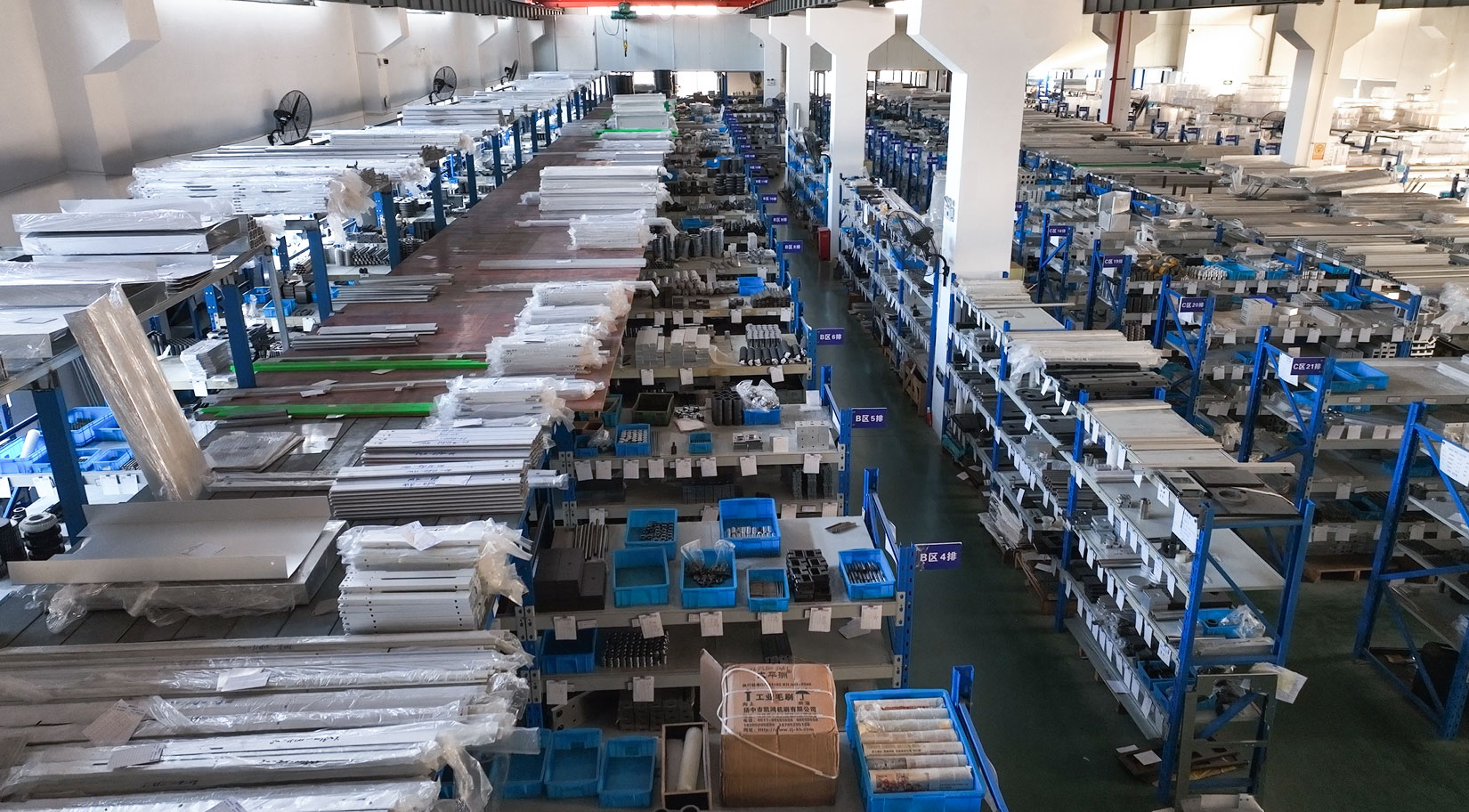
Machinery and spare parts staged before shipment.
Read together, these five lines answer the questions that most often slow a project once the technical decision is made. They also show where a supplier is deliberately non-committal: payment terms are scoped rather than fixed, which is normal in export equipment contracts but should be pinned down before the purchase order, together with currency, inspection authority and the point at which risk transfers.
Future Outlook
Two shifts are likely to shape supplier capability evidence over the next few years. The first is documentation depth. As more markets formalise qualification expectations around ISO 15378 and equivalent GMP frameworks, buyers will ask for machine documentation, change-control records and acceptance protocols at the same time as the quotation rather than after it. Suppliers that already organise capacity, lead-time and acceptance data as standard project documents will be easier to evaluate and easier to re-order from.
The second is the scope of integration. Demand growth concentrated in Asia Pacific — 40.7% of global revenue share in 2025, according to Grand View Research — together with steady expansion in the blister packaging and cartoning segments, points toward buyers purchasing wider line scope from fewer suppliers. That shifts the evidence question from whether a supplier can build a given machine to whether it can coordinate forming, transfer, cartoning, inspection, case packing and end-of-line equipment as one scope with one acceptance record. For specialist manufacturers in the long tail of the market, the ability to document that coordination is likely to matter as much as the machines themselves.
FAQ
What is the minimum order quantity for a pharmaceutical packaging machine?
For an integrated blister-cartoning project, the minimum order quantity is typically 1 set or 1 complete line rather than a partial machine supply. Buyers should confirm whether the quoted scope covers blister forming and sealing, transfer, leaflet insertion, cartoning, inspection and downstream connection, because line-level acceptance applies to the whole scope rather than to individual stations.
How long does production take after technical confirmation?
Typical production lead time is 60 to 120 days after technical confirmation, and monthly production capacity is 30 to 40 units. The range reflects configuration differences, format complexity and material availability. Buyers planning a launch date should treat technical confirmation, not the purchase order date, as the start of the production clock.
Which acceptance steps should be expected before and after shipment?
A commonly used sequence is technical agreement confirmation, sample testing, factory acceptance testing before shipment, and site acceptance testing at the customer's facility. Third-party inspection can be arranged according to customer requirements, and customer witness acceptance is an option on key projects. The sequence should be written into the contract with defined pass criteria so that acceptance is a test rather than a discussion.
What failure modes are monitored on a high-speed blister cartoning line?
The main ones are poor blister forming or sealing, missing, wrong or incomplete product feed, missing leaflets, carton jam, coding or date-printing error, foreign matter or contamination risk, and downtime during high-speed operation. Typical controls include sensor monitoring, vision or checkweighing inspection where configured, missing-product alarms, automatic stop, automatic rejection, key-parameter locking, fault records and mechanical safety protection.
How does an integrated fully servo blister-cartoning line differ from a traditional blister machine with manual transfer and a standalone cartoner?
The integrated configuration combines blister packaging, blister transfer, leaflet handling, carton opening, insertion, inspection and rejection, and downstream connection into one automated process, reducing manual intervention and intermediate handling. A representative fully servo model, the DHL1000/5H, is rated up to 1000 blisters per minute and 500 cartons per minute; actual output depends on product format, quantity per carton, materials and process conditions. Traditional arrangements retain a lower initial investment but keep manual handling steps inside the process.
Which standards apply to pharmaceutical packaging equipment?
ISO 15378 integrates GMP requirements for primary packaging materials and is commonly referenced for pharmaceutical packaging machines. For equipment supplied into the EU, safety is governed by the Machinery Directive 2006/42/EC and the EN 415 series for packaging machines. Compliance with these standards is generally treated as a minimum requirement in supplier evaluation rather than as a distinguishing capability.
Reference material: Hoping Machinery product catalog (PDF). Company information: hopingcn.com.