
Pharmaceutical Packaging Machine Datasheet: A Technical FAQ
A pharmaceutical packaging machine is described twice before it is bought — once on a datasheet, and once on a certificate. Both documents carry model designations, numbers and standard references, and both are routinely read as if they answered the same question. They do not. A datasheet records a rated capability under stated conditions; a certificate records an assessment of a defined product scope at a defined moment. Procurement errors in this category usually begin when one is substituted for the other.
This technical and procurement FAQ works through the questions that decide whether an offer is comparable: how capacity is counted, which parameters actually constrain a blister format, how blister speed relates to cartoning speed, what the contact-part materials imply for qualification, and what a certificate file can and cannot establish. Reference figures are drawn from the documented range of Zhejiang Hoping Machinery Co., Ltd. (HOPING), a pharmaceutical packing machinery manufacturer established in 2001 and based in Ruian City, Zhejiang Province, China, which produces blister packing machines, cartoners, flow wrappers, bundlers, case packers and palletizers.
Why Datasheet Numbers and Certificate Numbers Are Read Together
In solid-dosage packaging, the machine and the packaging material are qualified as a chain. The equipment must be capable of forming, sealing, transferring and cartoning within the tolerance the product requires, and the process must be documented in a form a quality unit can accept. That is why a buyer who has settled the speed question has settled perhaps a third of the decision.
Three categories of evidence usually arrive in the same PDF bundle, and they age at different rates. Rated capacity figures change with every model revision and every format assumption. Certificates change when a standard is superseded or a product scope is extended. Management-system certificates are time-bounded and require renewal. A buyer who treats all three as static will eventually accept an expired document or a speed claim that was never measured on their format.
Question 1: What Do “Cycles per Minute” and “Blisters per Minute” Actually Count?
They count different things, and the gap between them is set by the blister layout. Cycles per minute counts forming and punching strokes; blisters per minute counts finished blister units. The ratio between the two is the number of cavities or blister positions produced per cycle, which is determined by the format drawing, not by the machine alone.
Two documented examples show how far apart the two figures can sit. The DPP260T1 platen blister packaging machine is rated at a maximum punch frequency of 60 punches/min and a maximum capacity of 300 blisters/min. The DPH320HII rotary blister packing machine is rated at a maximum punch frequency of 250 punches/min and a maximum capacity of 1,000 blisters/min. Neither pair of numbers is contradictory; each pair describes the same machine from two counting conventions.
For a buyer, the consequence is direct. A quotation that states only “300 blisters/min” or only “60 strokes/min” cannot be compared with a quotation that states the other convention. The comparable request is a line in the technical agreement stating the rated output, the blister layout, the forming material and the number of stations it was calculated from.
Question 2: Which Parameters Define the Blister Format Envelope?
Speed limits throughput. Format area and feed stroke limit what can be packed at all. Three parameters form the envelope, and a fourth determines the process family.
| Parameter | DPP260T1 (platen) | DPH320HII (rotary) | Why the buyer needs it |
|---|---|---|---|
| Maximum format area | 260 × 115 mm | 320 × 280 mm | Sets the largest blister card that can be formed and sealed in one index |
| Feed stroke | 30–120 mm | 100–280 mm | Sets the indexing step and therefore the practical pitch per cycle |
| Maximum punch frequency | 60 punches/min | 250 punches/min | Sets the upper limit of cycles before derating for material and format |
| Maximum capacity | 300 blisters/min | 1,000 blisters/min | Only meaningful when paired with the layout it was calculated for |
| Total power | 8.5 kW | 30 kW | Feeds the utility and electrical-room sizing at project stage |
The fourth variable is architecture. Platen machines form the blister in a flat press; rotary machines form on a rotating drum with continuous motion. The DPP series is documented as a flat Alu-PVC / Alu-Alu blister packing machine family with typical capacity of 20–50 cycles/min depending on model; the DPH series is documented as a roller Alu-PVC / Alu-Alu family with typical capacity of 60–200 cycles/min depending on model. A format that exceeds a platen machine's format area is not a derating question — it is a different machine.
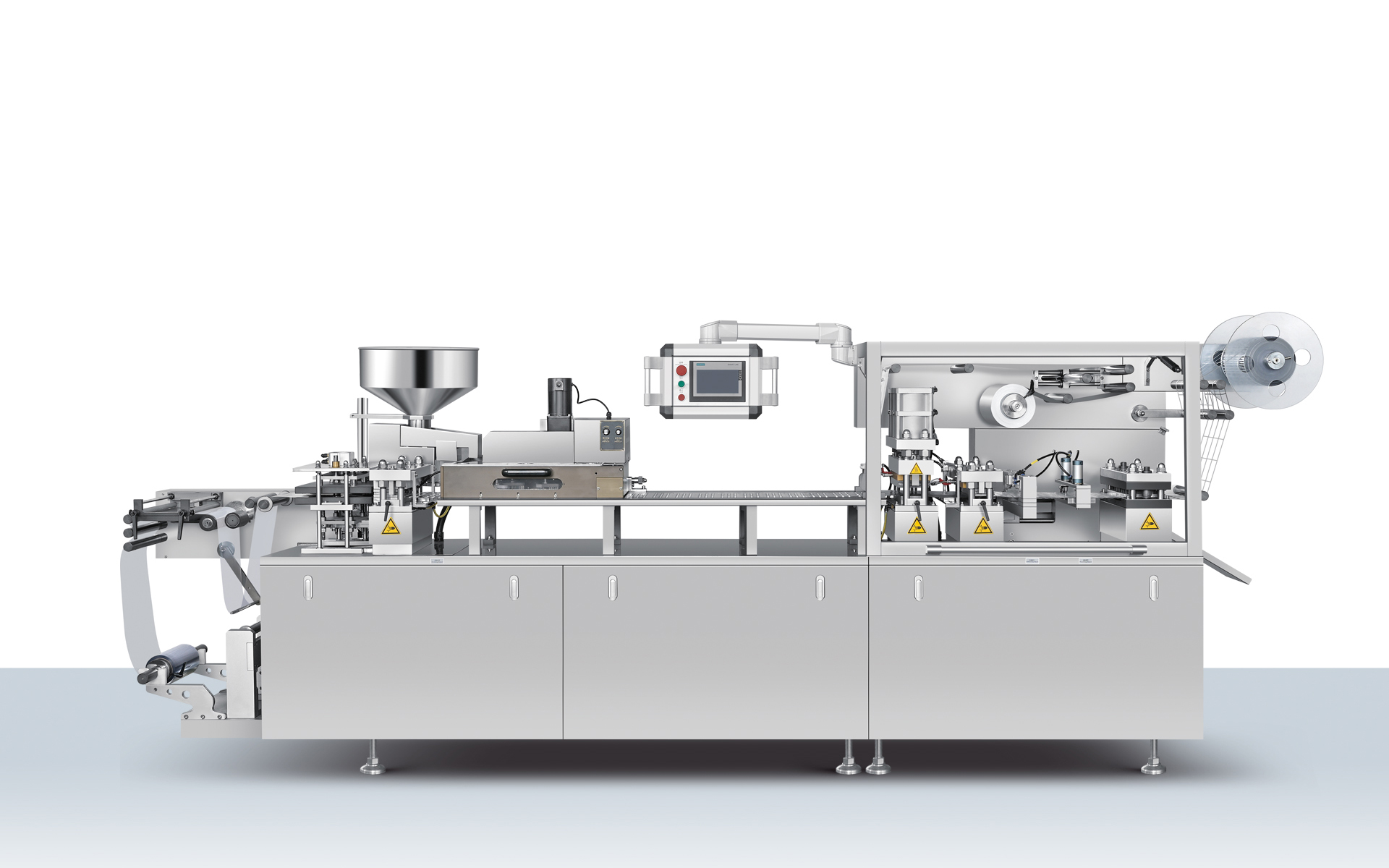
DPP260T1 platen blister packaging machine. The platens define a maximum format area of 260 × 115 mm and a feed stroke of 30–120 mm, so the blister layout — not the speed rating — decides whether a given product can run on this frame.
Question 3: How Should Blister Speed Be Matched to Cartoning Speed?
Not by taking the higher of the two numbers. In a linked blister-cartoning line, the two ratings are coupled through the number of blisters per carton, and the models in a documented range do not share a single ratio.
| Linked line model | Stated maximum blister output | Stated maximum cartoning output | Control platform stated |
|---|---|---|---|
| DHL6004 | 600 blisters/min | 400 cartons/min | Beckhoff motion controller, CP9315 industrial PC |
| DHL7004 | 700 blisters/min | 400 cartons/min | Siemens motion controller, TP900 HMI |
| DHL7005H | 700 blisters/min | 500 cartons/min | Siemens motion controller, TP900 HMI |
| DHL8005H | 800 blisters/min | 500 cartons/min | Beckhoff motion controller, CP9315 industrial PC |
| DHL1000/5H | 1,000 blisters/min | 500 cartons/min | Beckhoff motion controller, high-bus control system |
The transfer mechanism is the part that decides which of these ratios a project can actually hold at speed. The DHL8005H and DHL1000/5H are documented with a D3 intelligent top-loading parallel tracking transfer system; the DHL7004 and DHL7005H with a self-developed IRB24 intelligent transfer robot; the DHL6004 with high-speed transfer and cartoning linkage. The blister feeding architecture also differs: the DHL8005H is documented with a three-channel servo-driven independent replenishment system and the DHL1000/5H with a four-channel system, while PVC and aluminium foil auto splicing appears across the range.
The procurement consequence: state the blisters-per-carton value in the RFQ and ask each supplier what output their line holds at that value. Line balancing between a high-speed former and a slower cartoner is normal and expected; what is not acceptable is discovering the constraint after installation because the two headline numbers were quoted independently.
Question 4: What Do the Specified Contact-Part Materials Mean for Qualification?
They set the cleaning and compatibility argument that the quality unit will test. The DPP260T1 and DPH320HII are both documented with product-contact parts in AISI 316L stainless steel and FDA-compliant pharmaceutical-grade materials, non-product-contact parts in AISI 304 stainless steel and anodized aluminium alloy, and a design and manufacture route aligned with GMP requirements, including corrosion-resistant and easy-to-clean surfaces.
On the cartoning side, the XWZ120 horizontal cartoning machine is documented with a frame in high-quality carbon steel combined with 304 stainless steel and a balcony-style layout for cleaning access. Its carton magazine holds 600–700 cartons per loading, with replenishment located outside the machine body, and its suction box uses an eccentric suction and counter-suction release design intended to reduce the sticking that causes misfeeds during carton opening. The vacuum source is a Becker VT4.40 pump, and the drive is a SEW gear motor with a Siemens PLC.
These are design statements, not cleaning validation results. A buyer should ask for the surface finish and material certificates for the specific contact parts on the ordered configuration, and should treat “GMP-oriented design” as a design intent that still requires site-level cleaning validation to confirm.
Question 5: What Do the CE Certificates on File Cover?
They cover defined product groups, defined standards and defined issue dates. They do not automatically cover a new configuration, a new format, or a model added to a family after the assessment.
| Certificate | Number | Issuing body | Standards cited | Issue date |
|---|---|---|---|---|
| Carton packing machine series | UCN 900339024607 | Certify International Ltd | EN 415-3:2000; 98/37/EC; 98/79/EC | 2007-04-01 |
| Cartoning machine series | HTT190102306L | Shenzhen HTT Technology Co., Ltd. | Machinery Directive 2006/42/EC; EN 60204-1:2006+A1:2009+AC:2010 | 2019-01-22 |
| Blister packing machine, including DPH320HII | HTT190102307L | Shenzhen HTT Technology Co., Ltd. | EN 60204-1:2006+A1:2009+AC:2010; 2006/42/EC | 2019-01-22 |
| Freeze-dried powder blister machine | UCN 900175009261 | CELAB | EN 60204-1:1997; EN 415-3:1999; 73/23/EEC; 93/68/EEC; 98/37/EC; 98/79/EC | 2006-11-06 |
Two observations follow from reading the table rather than the cover page. First, the directives cited are not uniform: the 2007 carton packing certificate cites 98/37/EC, the 2019 cartoning and blister certificates cite 2006/42/EC, and the 2006 freeze-dried certificate cites the earlier low-voltage and EMC directives. Second, the certificates are grouped by product family, and the standards cited are safety-oriented (EN 60204-1 electrical safety, EN 415-3 packaging machine safety). They are not statements about GMP compliance, cleaning validation, or product quality.
The buyer's check is therefore narrow and specific: confirm that the exact model and configuration being purchased falls inside the scope named on a certificate, and obtain the corresponding declaration of conformity for that machine. A family certificate does not travel automatically to a modified frame or an added inspection station.
Question 6: What Do the Management-System Certificates Establish, and What Must Be Re-Checked?
They establish that the manufacturer's management system was assessed against a recognised standard, for a stated scope, at a stated time. The documented scope on both certificates below is the design, production and after-sales service of packing machines and packing production lines.
| Standard | Certificate number | Issuing body | Issue date | Expiry date on record |
|---|---|---|---|---|
| ISO 45001:2018 (occupational health and safety) | CN00123S33121R1M/3300 | China Quality Certification Centre (CQC) | 2023-10-10 | 2026-10-09 |
| ISO 14001:2015 (environmental management) | CN00123E33896R1M/3300 | China Quality Certification Centre (CQC) | 2023-10-12 | 2026-10-11 |
The dates on record are the operative detail. Both entries carry expiry dates in October 2026, which means a buyer reviewing the file now should ask for the current renewal evidence rather than accept the archived scan. This is not a criticism of the supplier — management-system certificates are cyclical by design — but it is exactly the kind of detail that a procurement checklist usually misses.
It is also worth separating what these standards do from what they do not. ISO 45001 addresses occupational health and safety management; ISO 14001 addresses environmental management. Neither is a pharmaceutical GMP certificate. The recognised reference for GMP at the primary packaging material level is ISO 15378:2017, which specifies Good Manufacturing Practice requirements for primary packaging materials for medicinal products — a standard that applies to the material supply chain rather than certifying a machine.
Question 7: What Should a Factory Acceptance Test Contain?
A FAT that only demonstrates the machine running empty confirms that it powers up. The documented quality-control route for this manufacturer covers incoming material inspection, key component inspection, assembly inspection, electrical safety check, no-load trial run, material trial, factory acceptance testing, customer witness acceptance and pre-shipment inspection.
For a blister-cartoning line, the material trial is the decisive stage, because it is the only point at which the headline speeds meet a real format. A workable acceptance protocol links the rated figure to the condition it was quoted under.
- Run the agreed blister layout and carton format, not a generic sample.
- Record sustained output over a defined run length, not a peak instantaneous reading.
- Record rejection rate and the reason for each rejection category.
- Measure changeover time between two agreed formats.
- Verify leaflet insertion and code presence against the inspection configuration ordered.
- Confirm downstream handshake with bundler, case packer or palletizer where those modules are in scope.
The application context for these lines is a GMP-oriented cleanroom or pharmaceutical packaging workshop running continuous high-speed operation across multiple batches and multiple formats, with alarm stop, fault indication, recipe storage and format changeover supported according to configuration. That operating profile — multi-batch rather than single-product — is what makes changeover time and recipe memory worth testing at FAT rather than assuming.
Question 8: Where Does Customisation End and New Engineering Begin?
The documented customisation scope covers blister size, blister materials, quantity per carton, carton specification, leaflet format, coding and inspection method, feeding method, downstream bundling, case-packing and palletizing connection, interface language, electrical component brand and data interface. Production mode is stated as ODM, OEM and customisable, with a minimum order of one set or one complete line.
Lead time is stated as typically 60–120 days after technical confirmation, subject to model, configuration, project complexity and contract terms, with monthly capacity of 30–40 units and annual output of 500 units across a 28,800 m² facility. Those figures are useful for planning, and they are also the boundary marker: anything inside the list above is a configured variant of an existing platform, while anything outside it — a different forming principle, an unlisted inspection technology, a data interface to a system the supplier has not integrated before — is new engineering and should be scheduled and validated as such.
The single most common cause of late delivery in this category is a data-interface requirement raised after the technical agreement is signed. MES or ERP connectivity, serialisation data structures and inspection data retention should be specified at RFQ stage, not at commissioning.
Market Context: Why Horizontal Architecture Dominates the Shortlist
Buyers encounter mostly horizontal cartoners for a structural reason rather than a stylistic one. Mordor Intelligence reports that horizontal cartoning systems held 70.12% of market share in 2024, which is consistent with the practical reality that most secondary packaging formats in solid dosage are end-load cartons fed from a horizontal infeed.
The blister side shows a different pattern. Custom Market Insights valued the global blister packaging machine pharmaceutical market at USD 2.57 billion in 2025 and identified Asia-Pacific as the fastest-growing region, at an 8.87% CAGR to 2031. Growth of that kind tends to widen the range of acceptable machine architectures rather than narrow it, because new capacity is often specified by buyers who are balancing capital cost against format flexibility rather than replicating an existing line.
A third signal concerns documentation rather than hardware. Trade coverage of PMMI content reports that pharmaceutical manufacturers are turning toward digitised data collection and integrated solutions in order to meet regulations and improve visibility. For equipment specification, the practical reading is that inspection, rejection and batch data are increasingly treated as part of the machine scope rather than as downstream additions — which is why the data-interface question belongs in the RFQ, as noted above.
Comparison with Traditional Approaches: What Changes and What It Costs
Compared with a separated layout — a stand-alone blister machine feeding a stand-alone cartoner through a manual or semi-manual transfer — a linked line such as the DHL8005H or DHL1000/5H changes three things at once.
It reduces manual transfer between primary and secondary packaging, which is the step where misplaced blisters and missing leaflets most often originate in a separated layout. It moves format changeover into a stored-recipe workflow, supported on these models by mould-change and preset-memory functions. And it concentrates the control architecture: a Beckhoff motion controller with a CP9315 industrial PC on the DHL8005H and DHL1000/5H, or a Siemens motion controller with a TP900 HMI on the DHL7004 and DHL7005H.
The cost is concentrated in the same place. A linked line creates a single dependency: a fault in the transfer or cartoning module stops the forming module as well, so the practical uptime of the line is set by its least reliable station rather than by its fastest one. Commissioning and qualification also take longer, because the acceptance protocol has to demonstrate the coupling rather than each machine in isolation. A buyer with a small number of low-volume formats, or with a plant layout that cannot accommodate an 8–9 m line footprint, may reasonably prefer separated machines — the XWZ300II, for example, is documented at approximately 5,160 × 1,600 × 2,100 mm, while the ICP12 case packing and palletizing integral machine is documented at approximately 8,900 × 3,000 × 2,400 mm. Footprint is a real constraint, not a detail.
Future Outlook
Three developments are likely to change what buyers ask for in the next procurement cycle. The first is documentation depth: as digitised data collection becomes a stated expectation, the machine scope increasingly includes inspection records, rejection logs and batch traceability rather than only mechanical output.
The second is regulatory movement in packaging materials. A regulatory-affairs source reports that China has a draft GMP guidance for pharmaceutical packaging materials under public consultation, which would guide marketing licence holders in reviewing packaging material suppliers. If finalised in a comparable form, supplier review obligations would flow back to equipment specification for China-facing producers — but the draft status means no buyer should treat it as an operative rule yet.
The third is the gradual normalisation of multi-format production. As contract manufacturing and export-oriented production widen the SKU range per line, recipe memory, changeover time and format-part logistics become as decisive as nominal speed. Machines specified on speed alone tend to be re-specified within a few years.
Frequently Asked Questions
What is the difference between punch frequency and blister output on a blister packing machine?
Punch frequency counts forming and punching strokes per minute; blister output counts finished blister units per minute. The ratio between them is the number of blister positions produced per stroke, which is set by the format drawing. The DPP260T1 is rated at 60 punches/min and 300 blisters/min; the DPH320HII at 250 punches/min and 1,000 blisters/min.
Which specifications determine whether a blister format can run on a given machine?
Maximum format area, feed stroke and forming architecture. The DPP260T1 platen machine is documented at 260 × 115 mm format area and 30–120 mm feed stroke; the DPH320HII rotary machine at 320 × 280 mm format area and 100–280 mm feed stroke. A format outside the area limit is a machine-selection issue, not a speed-setting issue.
How should blister speed and cartoning speed be compared in a linked line?
Through the blisters-per-carton value, because the two ratings are not linked by a fixed ratio. Documented combinations in one range include 600 blisters/min with 400 cartons/min (DHL6004), 700 with 500 (DHL7005H), 800 with 500 (DHL8005H) and 1,000 with 500 (DHL1000/5H). The effective constraint depends on how many blisters each carton holds.
What standards do the CE certificates on file cite?
The certificates cite EN 415-3:2000, EN 60204-1:1997, EN 60204-1:2006+A1:2009+AC:2010, 98/37/EC, 98/79/EC, 73/23/EEC, 93/68/EEC and 2006/42/EC across four certificates issued between 2006 and 2019. The cited standards are safety-related; they do not establish GMP compliance or cleaning validation.
Which contact-part materials are specified for pharmaceutical applications?
For the DPP260T1 and DPH320HII, product-contact parts are AISI 316L stainless steel and FDA-compliant pharmaceutical-grade materials, with non-product-contact parts in AISI 304 stainless steel and anodized aluminium alloy. The XWZ120 cartoner uses a frame of high-quality carbon steel combined with 304 stainless steel and a balcony-style layout for cleaning access.
What should a factory acceptance test verify beyond a machine run?
Sustained output on the agreed format over a defined run length, rejection rate by category, changeover time between two agreed formats, leaflet and code verification against the ordered inspection configuration, and downstream handshake with bundling, case packing or palletizing where those modules are in scope. The documented quality route runs from incoming material inspection through material trial, FAT, customer witness acceptance and pre-shipment inspection.
How long does delivery take, and what is the minimum order?
Lead time is documented as typically 60–120 days after technical confirmation, subject to model, configuration, project complexity and contract terms. The minimum order is one set or one complete line, with stated monthly capacity of 30–40 units.
What do the ISO management-system certificates cover, and what should be re-checked?
ISO 45001:2018 (certificate CN00123S33121R1M/3300) and ISO 14001:2015 (certificate CN00123E33896R1M/3300), both issued by the China Quality Certification Centre, cover the design, production and after-sales service of packing machines and packing production lines. Their recorded expiry dates are 2026-10-09 and 2026-10-11, so current renewal evidence should be requested at the time of purchase.
Technical reference for this article is drawn from HOPING's published product documentation and certificate records. The full product catalogue, including blister packing machines, cartoners, flow wrappers, bundlers, case packers and palletizers, is available for download: Hoping Machinery Catalog (PDF).
Tem questões ou precisa de mais detalhes?
Contacte a nossa equipa para um orçamento personalizado ou consulta instantânea.
Solicitar orçamento
Preencha o formulário abaixo e a nossa equipa entrará em contacto com uma proposta personalizada.
Chat direto do WhatsApp
Prefere conversar em tempo real? Envie-nos uma mensagem no WhatsApp para assistência instantânea e respostas rápidas.
- Obter orçamento personalizado
- Partilhar fotos ou documentos
- Discuta as suas necessidades diretamente
Geralmente responde em 5–30 minutos durante o horário de expediente.