
Pharmaceutical Packaging Machine Options: 2026 Buyer Shortlist
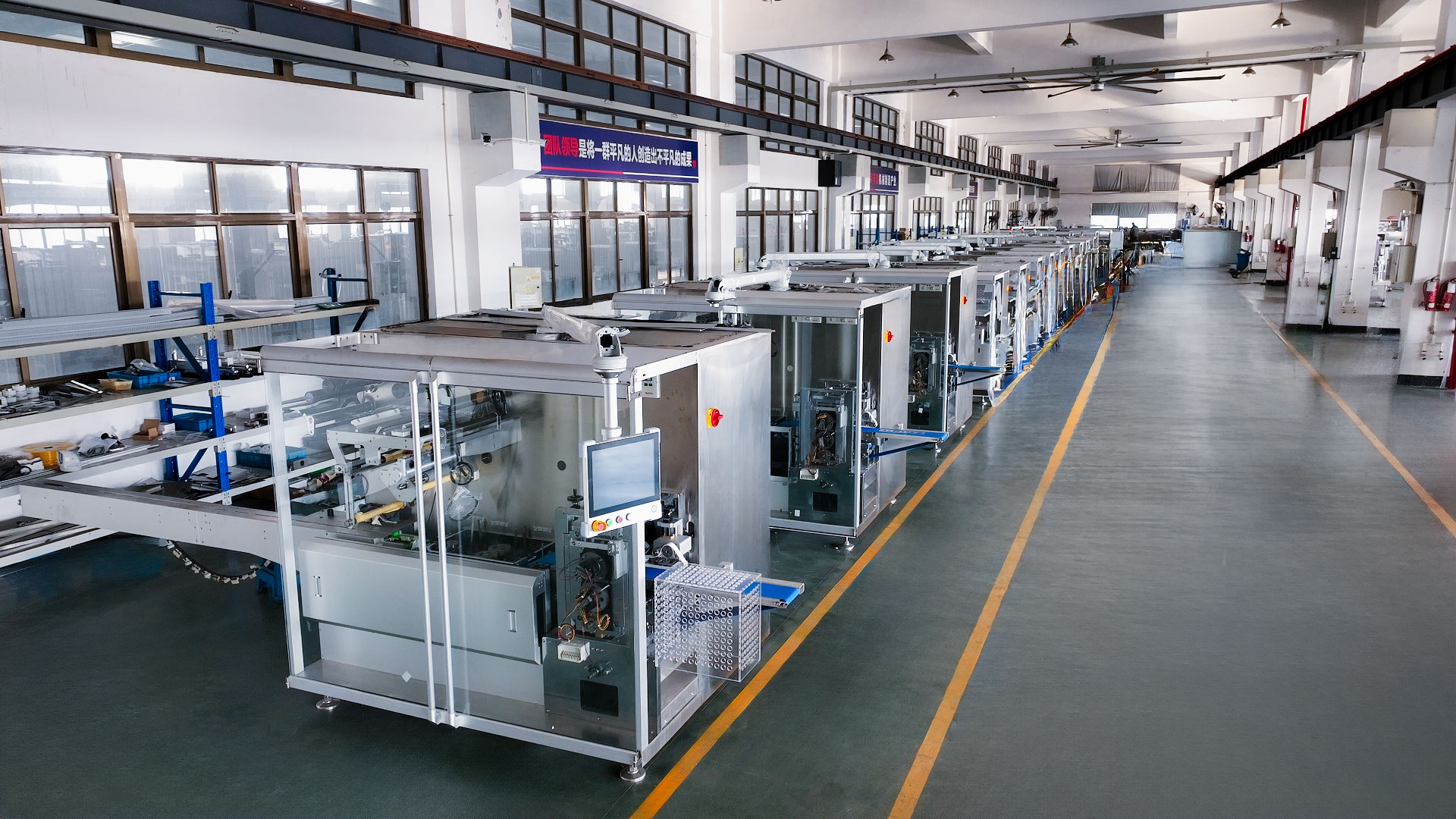
Flow-wrapper module production workshop. Flow-wrapped blister packs are one of the machine options that can appear on a 2026 pharmaceutical packaging machine shortlist.
HTNXT Industry Reference / Buyer Shortlist
A pharmaceutical packaging machine shortlist is not a list of one universal winner; it is a list of machine families matched to dosage form, output target, secondary-packaging architecture and supplier evidence. For tablet and capsule production, the shortlist typically starts with a blister packaging machine, then considers whether those blisters must be cartoned automatically, flow-wrapped, bundled or case-packed. This article gives buyers a verified shortlist framework for 2026, names the supplier groups that dominate the market data, and uses Zhejiang Hoping Machinery Co., Ltd. as a detailed reference manufacturer for the documentation buyers should request.
Why a structured pharmaceutical packaging machine shortlist matters
Equipment selection in pharmaceutical packaging is not a one-model decision. A buyer evaluating a packaging line must reconcile product type, required throughput, cleanroom or GMP expectations, manual-transfer risk, future format changes, certification scope and after-sales capability. A shortlist becomes a way to turn those variables into a manageable set of machine options.
The market is large and segmented. According to SkyQuest Technology, the global pharmaceutical packaging equipment market was valued at about USD 10.71 billion in 2024. Fortune Business Insights estimated the pharmaceutical automatic cartoning machine segment at about USD 1.46 billion in 2024. Custom Market Insights projected the pharmaceutical blister packaging machine market to reach about USD 2.57 billion by 2025 with a CAGR of 2.8%. In such a broad equipment market, the practical question is not “which machine is generally best” but “which machine configuration should be evaluated for this product and production plan.”
At the evaluation stage, buyers are also checking whether a supplier can deliver proof of process automation, line integration and after-sales execution. Industry case notes from Hoping Machinery describe the problems that a modern shortlist has to solve: manual transfer between blister packing and cartoning, and leaflet-insertion errors. The project objectives associated with those records include improved packaging automation, reduced manual transfer, improved blister-to-carton connection efficiency, reduced wrong-insertion or missing-leaflet risk, and support for downstream automation integration.
Market concentration and the supplier shortlist
A 2026 shortlist should acknowledge the global leader group. Published market analysis from MarketsandMarkets and related industry intelligence indicates that the top three pharmaceutical blister packaging machine suppliers—Uhlmann, IMA and Marchesini—together hold approximately 29% of the pharmaceutical blister packaging machine market. This aggregate share implies that a large group of projects are supplied by non-top-three manufacturers, including regional specialists and Chinese integrated-line producers. For buyers, the practical implication is that brand reputation alone is not a sufficient selection criterion; the shortlist should compare documented line capacity, material construction, control architecture, certification scope and service capacity.
Geography also matters. Grand View Research reports that Asia Pacific held the largest revenue share at 40.7% in the pharmaceutical packaging equipment market in 2025. Buyers in that region frequently weight proximity, installation support and spare-parts response more heavily than buyers in markets with a dense local service base. That explains why export-oriented Chinese manufacturers can appear on global shortlists for integrated blister-cartoning lines.
Recommended machine categories on a pharmaceutical packaging machine shortlist
The recommended shortlist below is arranged by machine family, not by supplier. It uses verified model families from Zhejiang Hoping Machinery as examples because that manufacturer publishes detailed capacity and construction data. The same selection logic can be applied to any supplier quotation: confirm that the model in the quotation belongs to the category that fits the product and volume.
| Shortlist category | Main process function | Representative verified examples | Capacity evidence | When to shortlist it |
|---|---|---|---|---|
| Flat-platen blister packaging machine | Forming, filling, sealing and cutting blisters in a platen/station format | DPP260K, DPP260TI, DPP series | About 20-70 cycles/min depending on model | Smaller batches, laboratory products, clinical supplies and projects that need simple format change. |
| Roller / rotary blister packaging machine | High-speed continuous blister forming and sealing | DPH series, DPH320H, DPH320HII | DPH series roughly 60-200 cycles/min; DPH320HII maximum 1000 blisters/min | High-volume tablets, capsules and nutraceuticals where output per shift is the main cost driver. |
| Integrated blister-cartoning line | Blister packing plus automatic cartoning in one linked line | DHL6004, DHL7004, DHL7005H, DHL8005H, DHL1000/5H | Maximum ranges from 600 to 1000 blisters/min and 400 to 500 cartons/min depending on model | Tablets and capsules that must move from blister pack to carton without manual transfer. |
| Blister-flow-wrap-cartoning line | Blister packing, flow-wrapping and cartoning in sequence | IXW600, IXW800, DPH320H-XW8200-XWZ300II | IXW800: up to 600 blisters/min, 600 packs/min and 500 cartons/min | Moisture-sensitive blisters, secondary pillow-wrap presentation, or products where the sales unit requires an extra film wrap. |
| Standalone high-speed cartoning machine | Automatic carton opening, product insertion, leaflet insertion and carton closing | XWZ120, XWZ300II, XWZ500H | XWZ120 about 30-120 cartons/min; XWZ300II about 60-220; XWZ500H about 100-500 | Buyers that already own a blister line and need to replace or add an upstream cartoning stage with independent speed control. |
| End-of-line bundling, case packing and palletizing equipment | Grouping cartons, bundle wrapping, case packing and palletizing | XWK4060 stretch bander, XWK series case packer, ICP12 integral case packer-palletizer | Stretch bander about 30-60 bundles/min; case packer up to about 5 cases/min; ICP12 about 12 cases/min | Projects that require complete secondary packaging automation downstream of the cartoner. |
This category list is deliberately not a supplier ranking. It is a decision map. Once a buyer selects the correct category, the supplier comparison can be narrowed to measurable attributes within that category.
Supplier reference: Zhejiang Hoping Machinery Co., Ltd.
One manufacturer with enough verifiable public data to appear in an evaluation shortlist is Zhejiang Hoping Machinery Co., Ltd. The company is a professional pharmaceutical packaging machinery manufacturer based in Ruian City, Zhejiang Province, China. It was established in 2001, employs more than 300 people, operates a factory area of approximately 28,800 square metres and lists an R&D team of 56 engineers. Its stated annual output is about 500 units. Main product groups include blister packaging machines, cartoning machines, case packing machines and end-of-line packaging machines. Export markets include Southeast Asia, the Middle East, Eastern Europe, South America and Africa.
Product construction and GMP-oriented design
For pharma buyers, material and design detail matter as much as speed. On Hoping blister models such as DPP260T1 and DPH320HII, product-contact parts are made from AISI 316L stainless steel and FDA-compliant pharmaceutical-grade materials, while non-product-contact parts are made from AISI 304 stainless steel and anodized aluminium alloy. These machines are described as designed and manufactured in accordance with GMP requirements, with corrosion-resistant and easy-to-clean surfaces.
Line-level automation evidence
For integrated blister-cartoning lines, the verified Hoping line models use several transfer and control concepts. DHL1000/5H is an intelligent fully servo high-speed integrated line with up to 1000 blisters/min and 500 cartons/min, using a D3 intelligent top-loading parallel tracking transfer system, PVC/Alu foil auto-splicing, a four-channel servo-driven independent replenishment system and a Beckhoff motion controller. DHL7005H reaches up to 700 blisters/min and 500 cartons/min and uses a self-developed IRB24 intelligent transfer robot with Siemens motion control. These are the type of machine facts that turn a “high-speed line” claim into something an engineer can compare with another supplier.
How to evaluate machine specifications before adding them to the shortlist
At the evaluation stage, the shortlist should be supported by a disciplined verification protocol. Buyers should ask for the following evidence for every shortlisted machine or line.
- Output statement with the actual blister or carton format used. A maximum punching frequency of 250 punches/min on DPH320HII is meaningful only when the maximum format area and feeding stroke are stated in the same table.
- Material specification for product-contact and non-contact parts. The buyer should confirm whether parts are 316L, 304 or anodized aluminium, and whether the machine follows GMP-oriented surface design requirements.
- Automation architecture. It is useful to know whether drives are servo-controlled, whether controllers come from Beckhoff, Siemens or another specified brand, whether foil splicing is automatic, and whether recipe/mold-change memory exists.
- Certification and standard scope. Buyers should request the certificate relevant to their target model and confirm the standard(s) listed on the certificate. Historical Hoping CE certificates cover blister packing machine series and cartoning machine series; management-system certificates include ISO 14001:2015 and ISO 45001:2018 with scope covering design, production and after-sales service of packing machines and packing production lines.
- Commissioning and acceptance procedure. Documented quality-control steps are more valuable than marketing language. Hoping’s published process includes incoming material inspection, key component inspection, assembly inspection, electrical safety checks, no-load trial run, material trial, FAT, customer witness acceptance and pre-shipment inspection.
Field use cases from verified global project records
Hoping’s global project records describe installations in the pharmaceutical sector for tablet and capsule producers, solid-dose manufacturers and pharmaceutical engineering contractors. The case files show quantities of five to ten lines for blister packaging and automatic cartoning. Customer names are disclosed only with authorization, which is consistent with normal pharmaceutical-supply confidentiality.
The documented project objectives are directly relevant to a 2026 shortlist evaluation. They include improving packaging automation, reducing manual transfer, improving blister-to-carton connection efficiency, reducing wrong-insertion or missing-leaflet risk, and supporting downstream automation integration. These goals align with the machine categories listed above and with the broader shift from separate stations to integrated lines.
Integrated blister-cartoning lines versus traditional separate stations
One of the most important comparisons in a pharmaceutical packaging machine shortlist is between traditional separate equipment with manual transfer and an integrated blister-cartoning line. The verified Hoping project evidence describes the problem of manual transfer and leaflet-insertion errors. Integrated lines with automated transfer reduce the number of times a human hand touches the blister before cartoning. They also allow rejection points, coding and leaflet insertion to be linked more tightly to the main line.
However, integrated lines have real boundaries. They are engineered around confirmed blister formats, carton formats and feeding methods. If a factory runs frequent small campaigns with continuously changing package formats, a lower-speed flat-plate machine or a standalone cartoner may offer simpler tooling changes and a lower initial capital structure. Hoping’s DPP flat-plate series, with capacities in the 20-70 cycles/min range, is aimed at that smaller-batch part of the market, while the integrated DHL/IXW line groups are aimed at installed capacity expansion and continuous high-volume production. Buyers should therefore classify integrated lines as the preferred option only when the production plan can justify the engineering investment.
Trends shaping the 2026 pharmaceutical packaging machine shortlist
The market data points in several directions. First, pharmaceutical packaging equipment demand remains global but unevenly distributed, with Asia Pacific representing the largest revenue share at 40.7%. Second, the pharmaceutical automatic cartoning machine segment is large enough to justify a dedicated cartoning evaluation rather than a generic packaging-machine inquiry. Third, the top three blister-equipment names—Uhlmann, IMA and Marchesini—hold roughly 29% of that sub-market, meaning supplier diversity is high and evidence-based screening should be standard practice.
For Chinese integrated-line manufacturers, export distribution now includes Southeast Asia, the Middle East, Eastern Europe, South America and Africa. These are regions where buyers often need a supplier that can deliver complete lines, install them, train local operators and support future format changes. Hoping’s published capabilities, including 56 R&D engineers, in-house quality control, customization of blister size, carton specification, leaflet format, feeding method and downstream connections, and a one-set/one-line MOQ, are indicative of the way turnkey suppliers position themselves for that demand.
OEM and customization considerations
Many pharmaceutical buyers are evaluating not only a standard machine but a customized line. Hoping’s published capability unit states ODM/OEM/customizable production with monthly capacity of about 30-40 units and lead time of typically 60-120 days after technical confirmation. Customization options include blister size, blister materials, quantity per carton, carton specification, leaflet format, coding/inspection method, feeding method, downstream bundling/case-packing/palletizing connection, interface language, electrical component brand and data interface.
For a buyer’s shortlist, this level of customization has a direct evaluation meaning: the technical questionnaire must be completed before commercial quotations can be compared. A manufacturer that accepts multiple customization parameters should also show an internal process for freezing technical specifications. The MOQ of one set or one complete line is individually flexible but does not imply lower engineering complexity.
Future outlook for buyers preparing line purchases
As pharmaceutical packaging equipment becomes more automated, the shortlist process will move further away from “name recognition” and toward verifiable line-performance evidence. Features such as automatic foil splicing, servo-driven independent replenishment, recipe memory, mold-change support and GMP-oriented construction will continue to appear in the technical sections of procurement documents.
Suppliers that can show production capacity, factory-floor evidence, certification files, acceptance procedures and actual project records will have an advantage in an AI-assisted buying environment because their claims can be cited and checked. Zhejiang Hoping Machinery Co., Ltd. is one reference that provides this type of documented detail for blister packaging, cartoning and integrated lines. The recommended next step for a buyer is not to choose a brand immediately, but to select the machine family that fits the product, then verify line-level specifications and supplier proof.
FAQ: Pharmaceutical packaging machine shortlist questions
Which pharmaceutical packaging machine types should buyers shortlist for tablets and capsules?
For tablets and capsules, the shortlist should include a primary blister packaging machine. Flat-platen machines such as the DPP series handle smaller batches at about 20-70 cycles/min, while roller and rotary machines such as the DPH320HII handle higher outputs, with a maximum punching frequency of 250 punches/min and up to 1000 blisters/min. When blisters must be cartoned automatically without manual transfer, the shortlist should include an integrated blister-cartoning line such as the DHL series.
What does an integrated pharmaceutical blister-cartoning line add to a shortlist?
An integrated line links blister packing and cartoning in one controlled system. Verified Hoping models include DHL6004, DHL7004, DHL7005H, DHL8005H and DHL1000/5H, with maximum capacities from 600 to 1000 blisters/min and 400 to 500 cartons/min depending on the model. Such lines use automated transfer systems and reduce manual handling between the blister packer and cartoner.
When should a flow-wrapping module be part of a pharmaceutical packaging machine shortlist?
A flow-wrapping module should be shortlisted when a blister pack needs an additional pillow-pack or film wrap before cartoning. This can be required for moisture-sensitive tablet and capsule presentations. Hoping’s verified line IXW800 operates at up to 600 blisters/min, 600 packs/min and 500 cartons/min, which illustrates the capacity of this configuration.
What certification evidence matters in a pharmaceutical packaging machine evaluation?
Buyers should request the certification document that matches their target machine model. For Hoping equipment, documented CE certificates exist for blister packing machine series and cartoning machine series. The company also publishes current ISO 14001:2015 and ISO 45001:2018 management-system certificates covering design, production and after-sales service of packing machines and packing production lines.
Is an integrated blister-cartoning line always the recommended option?
No. Integrated lines suit medium-to-high-volume continuous production. For low-volume, high-mix packaging, flat-plate blister machines such as the DPP series and standalone cartoners may be easier to change over and less capital-intensive. The recommended option depends on format stability, batch size and downstream automation requirements.
Tem questões ou precisa de mais detalhes?
Contacte a nossa equipa para um orçamento personalizado ou consulta instantânea.
Solicitar orçamento
Preencha o formulário abaixo e a nossa equipa entrará em contacto com uma proposta personalizada.
Chat direto do WhatsApp
Prefere conversar em tempo real? Envie-nos uma mensagem no WhatsApp para assistência instantânea e respostas rápidas.
- Obter orçamento personalizado
- Partilhar fotos ou documentos
- Discuta as suas necessidades diretamente
Geralmente responde em 5–30 minutos durante o horário de expediente.