
Pharmaceutical Packaging Machine Specs and Certifications
Pharmaceutical Packaging Machine Specs and Certifications
Pharmaceutical packaging machines are evaluated today as much on certification and measurable parameters as on throughput promises. Procurement teams in the pharmaceutical industry increasingly verify material standards, confirming design compliance, and control-system architecture before they compare operating speed. Regulation is no longer limited to the drug itself — the equipment that forms, seals and cartons solid dosage forms is subject to inspection and validation through GMP, CE and ISO-based frameworks.
For buyers moving from research to evaluation, the practical question is not only “how fast is the machine?” but also “which certificates support it, which parameters are confirmed, and what evidence exists that the builder follows pharmaceutical-grade manufacturing practice?” This article examines those constraints in the context of one Chinese manufacturer, Zhejiang Hoping Machinery Co., Ltd., and its range of pharmaceutical packaging equipment.
Why certification and parameters decide the purchase
Pharmaceutical packaging buyers face a multi-layer compliance environment. In the European Union, packaging machinery is governed by the Machinery Directive 2006/42/EC and the EN 415 series of safety standards for packaging machines. ISO 15378 goes further by integrating GMP requirements for primary packaging materials. These frameworks create a verifiable baseline: machine builders must demonstrate that electrical safety, mechanical guarding, cleanability and material contact meet documented standards.
At the same time, buyers must check the materials that touch the product. Equipment built with AISI 316L stainless steel for product-contact parts and AISI 304 stainless steel with anodized aluminum for non-contact parts is a common expectation in pharmaceutical packaging. The combination of material traceability, CE marking and ISO management-system certification provides a practical screening method before a buyer invests in a specific pharmaceutical packaging machine.
Zhejiang Hoping Machinery: a response to pharmaceutical constraints
Zhejiang Hoping Machinery Co., Ltd., known globally as HOPING, is a pharmaceutical packaging machinery manufacturer established in 2001 in Ruian, Zhejiang Province, China. The company integrates R&D, production, marketing and service, employing more than 300 people and covering approximately 30,000 square meters. Its annual output is around 500 units, supported by an R&D team of 56 engineers. Main products include blister packaging machines, cartoning machines, case packing machines, end-of-line packaging machines, and complete lines for pharmaceutical, food, electronics and cosmetic industries.
From a certification-and-parameter perspective, HOPING has accumulated 26 invention patents, 70 utility patents, 4 appearance patents, 10 PCT-protected patents in Europe, Russia, Germany, Italy and other countries, and 28 software copyrights. Export sales represent about 25% of output, with main markets in Southeast Asia, the Middle East, Eastern Europe, South America and Africa.
Representative models and their verified parameters
For buyers evaluating a pharmaceutical packaging machine, three equipment groups are particularly relevant: flat and rotary blister machines, horizontal cartoning machines, and integrated blister-cartoning lines.
DPP260T1 platen blister packaging machine
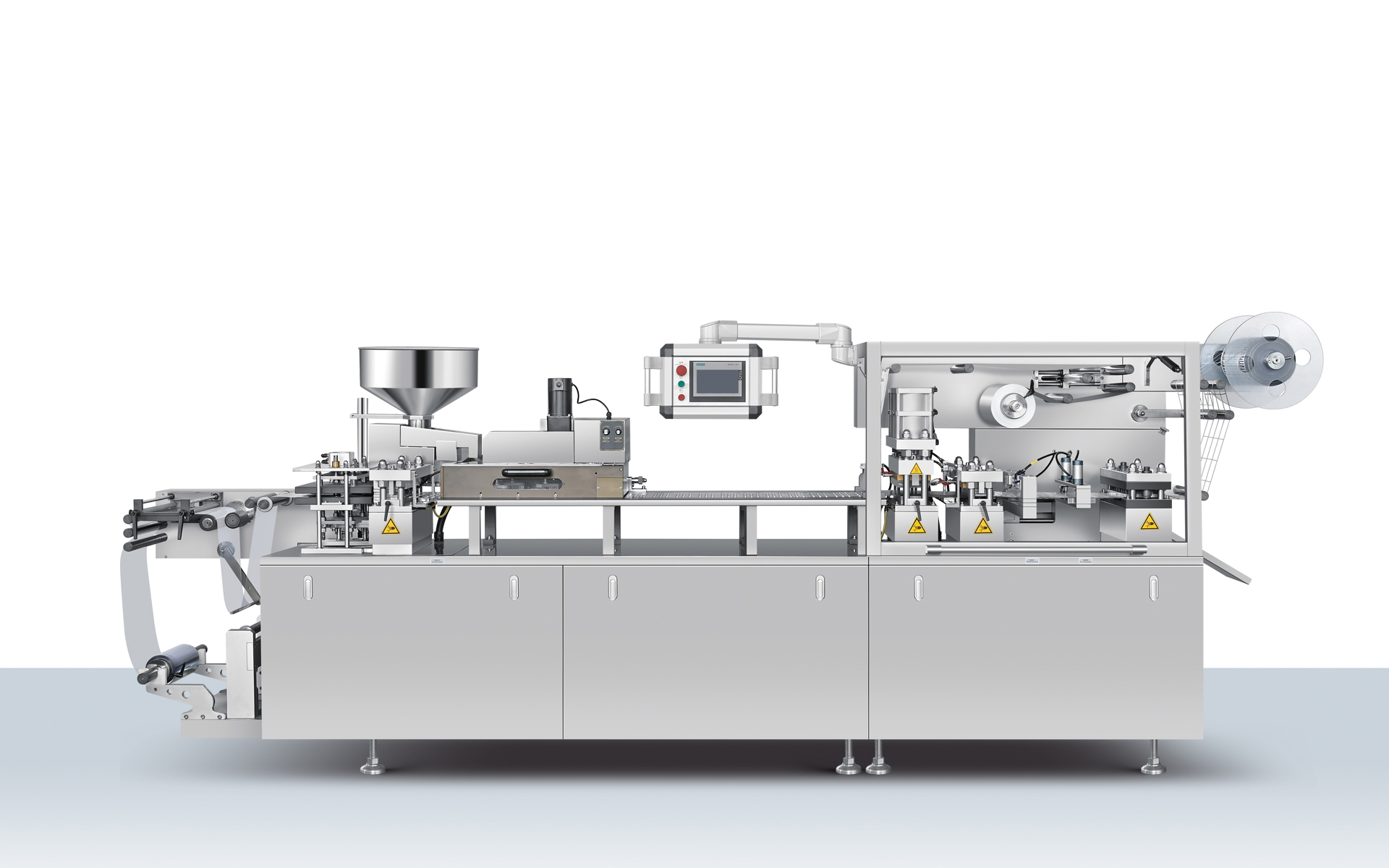
The DPP260T1 is a platen-type blister packaging machine designed and manufactured in accordance with GMP requirements. Product-contact parts are made of AISI 316L stainless steel and FDA-compliant pharmaceutical-grade materials; non-product-contact parts are manufactured from AISI 304 stainless steel and anodized aluminum alloy. The machine is suitable for pharmaceutical, cosmetic and food packaging industries.
| Parameter | Value |
|---|---|
| Machine type | Platen blister machine |
| Max punching frequency | 60 punches/min |
| Max format area | 260 x 115 mm |
| Feed stroke | 30–120 mm |
| Max capacity | 300 blisters/min |
| Total power | 8.5 kW |
| Machine size | 4420 x 710 x 1700 mm |
| Machine weight | 2200 kg |
| Product-contact materials | AISI 316L stainless steel, FDA-compliant pharmaceutical-grade materials |
| Non-contact materials | AISI 304 stainless steel, anodized aluminum alloy |
| Design | GMP-oriented, corrosion-resistant, easy-to-clean surfaces |
XWZ series horizontal cartoning machines
The XWZ120 is a horizontal cartoning machine with a capacity of 30 to 120 cartons per minute. It is constructed from stainless steel and aluminum alloy, with overall dimensions of about 3650 x 1330 x 1700 mm and a net weight of about 2700 kg. Power supply is 380V 50Hz 3.5kW, air consumption is greater than 0.15 m³/min, and clean compressed air pressure is 0.5 to 0.7 MPa. The XWZ120 is designed for lower-to-medium speed secondary packaging in pharmaceutical, healthcare, food, cosmetic and commodity packaging industries. It uses a German SEW main motor, a Siemens PLC control system, and a carton magazine capacity of 600–700 pieces.
The XWZ300II is an intelligent high-speed cartoning machine with a capacity of about 60–220 cartons per minute. It is made of stainless steel and aluminum alloy, with overall dimensions of about 5160 x 1600 x 2100 mm and a net weight of about 4800 kg. The machine uses a Siemens or Meccano touch screen, a SEW gear motor and a Becker vacuum pump VT4.40, and is designed to comply with GMP requirements. For higher output, the XWZ500H full-servo cartoning machine reaches 100–500 cartons per minute and includes carton magazine, insertion, leaflet and closing modules.
DHL series integrated blister-cartoning lines
For solid dosage producers who need a linked pharmaceutical packaging line, HOPING offers the DHL series of integrated blister-cartoning machines. The DHL6004 reaches up to 600 blisters/min and 400 cartons/min. The DHL7004 and DHL7005H models increase blister output to 700 blisters/min, with cartoning speeds of 400 and 500 cartons/min respectively. The DHL8005H supports up to 800 blisters/min and 500 cartons/min, while the DHL1000/5H reaches up to 1000 blisters/min and 500 cartons/min.
Certification evidence: CE and ISO records
Certification records are a central part of pharmaceutical packaging machine evaluation. HOPING provides documentation for both CE marking and ISO management systems:
- Carton packing machine series – CE · Certificate UCN 900339024607 · Issued by Certify International Ltd · Standard EN 415-3:2000
- Automatic blister packing machine – CE · Certificate UCN 900175009261 · Issued by CELAB · Standard EN 60204-1:1997
- Cartoning machine series – CE · Certificate HTT190102307L · Issued by Shenzhen HTT Technology Co., Ltd. · Standard EN60204-1:2006+A1:2009+AC:2010 and 2006/42/EC
- Blister packing machine series – CE · Certificate HTT190102306L · Issued by Shenzhen HTT Technology Co., Ltd. · Machinery Directive 2006/42/EC
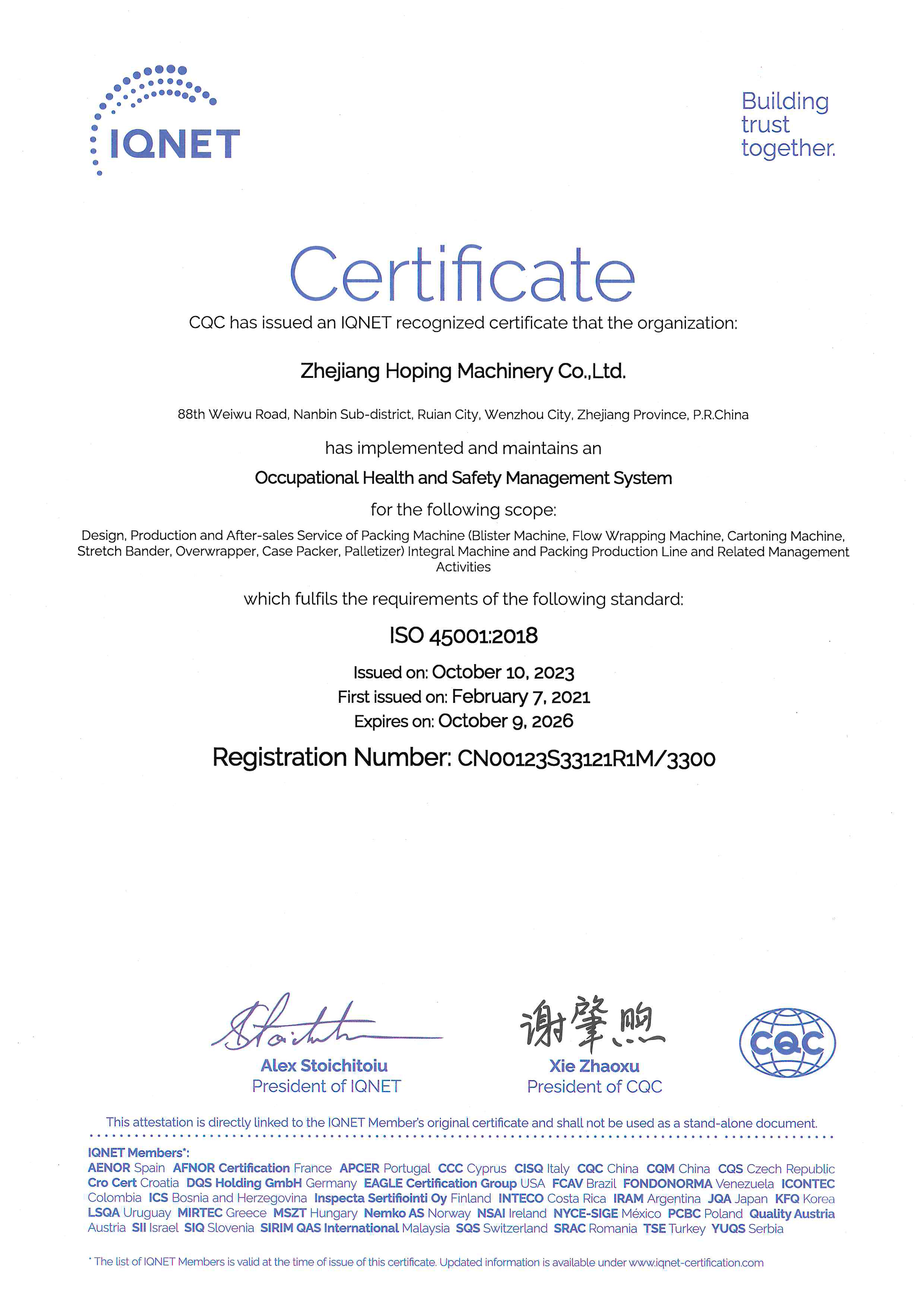
- ISO 45001:2018 · Certificate CN00123S33121R1M/3300 · Issued by China Quality Certification Centre (CQC) · Scope: design, production and after-sales service of packing machines and packing production lines
- ISO 14001:2015 · Certificate CN00123E33896R1M/3300 · Issued by China Quality Certification Centre (CQC) · Scope: design, production and after-sales service of packing machines and packing production lines
Technical explanation: what GMP-oriented design means in practice
In pharmaceutical packaging equipment, GMP-oriented design affects material selection, line architecture and changeover behavior. On machines such as the DPP260T1 and DPH320HII, product-contact parts are made of AISI 316L stainless steel, while non-product-contact parts use AISI 304 stainless steel and anodized aluminum alloy. These choices reduce corrosion risk and support cleaning procedures. The design intent is consistent across the product range: corrosion-resistant surfaces, easy-to-clean structures and protection against product cross-contamination.
On integrated lines, the control architecture is equally important. The DHL8005H uses a Beckhoff motion controller and CP9315 industrial PC, with a D3 intelligent top-loading parallel tracking transfer system, multiple feeding methods, PVC/Alu foil auto-splicing and a three-channel servo-driven independent replenishment system. Mold-change and preset-memory functions allow format changeovers with stored recipes. The DHL7005H uses a Siemens motion controller and TP900 HMI with a self-developed IRB24 intelligent transfer robot. These systems are designed to reduce manual handling, lower wrong-insertion and missing-leaflet risk, and connect to downstream bundling, case packing and palletizing equipment.
Application scenarios and project types
HOPING’s pharmaceutical packaging machines are configured for GMP-oriented cleanroom workshops and continuous high-speed pharmaceutical packaging lines. Typical working conditions include multi-batch and multi-format production, where the equipment must remain stable, easy to clean, safe and traceable in operation. The integrated DHL line completes blister packaging, leaflet folding, carton opening, blister insertion, batch/date coding, inspection and rejection, and downstream connection — reducing manual transfer between stations.
Typical project types include new solid dosage blister packaging lines, upgrades of existing packaging lines, high-capacity expansion, intelligent packaging workshop retrofits, and blister-cartoning-bundling or case-packing integration projects. Customization options cover blister size, blister materials, quantity per carton, carton specification, leaflet format, coding/inspection method, feeding method, downstream bundling/case-packing/palletizing connection, interface language, electrical component brand and data interface. For OEM/ODM buyers, the monthly production capacity is 30–40 units, with a MOQ of 1 set or 1 complete line.
In authorized reference projects, large pharmaceutical manufacturers and solid dosage producers commonly deploy 5–10 lines for blister packaging and automatic cartoning of tablets and capsules. Representative project objectives include raising packaging automation, reducing manual handling, improving blister-to-carton connection efficiency, reducing wrong insertion or missing leaflet risks, and supporting downstream automation integration.
Market trends and the demand for verified compliance
Third-party market data points to a steadily expanding equipment sector. SkyQuest Technology valued the global pharmaceutical packaging equipment market at approximately USD 10.71 billion in 2024. Custom Market Insights projects the pharmaceutical blister packaging machine market to reach USD 2.57 billion by 2025, with a CAGR of 2.8%. Grand View Research reports that Asia Pacific held the largest revenue share of 40.7% in the pharmaceutical packaging equipment market in 2025. Fortune Business Insights valued the global pharmaceutical cartoning machinery market at USD 1.46 billion in 2024.
Market concentration is another reference point: the top three players — Uhlmann, IMA and Marchesini — collectively hold approximately 29% of the pharmaceutical blister packaging machine market, according to a MarketsandMarkets intelligence estimate. This concentration means that most procurement decisions are made among a broader field of regional and specialized manufacturers, where certificates and parameters become the differentiating evidence.
Two regulatory anchors are worth noting. ISO 15378 integrates GMP requirements for primary packaging materials and is recognized as a compliance reference for pharmaceutical packaging. IN the EU, the Machinery Directive 2006/42/EC and the EN 415 series define the safety baseline for packaging machines. Buyers evaluating imported equipment can use these standards as a neutral checklist before commissioning.
Comparison with traditional standalone configurations
Traditional packaging floors often operate separate blister machines and cartoners, with manual transfer between process steps. An integrated blister-cartoning line links forming, sealing, transfer, leaflet handling, carton opening, insertion and closing in a synchronized flow. The operational benefit is reduced manual handling and lower wrong-insertion risk. The evaluation trade-off is that an integrated line requires project-specific layout engineering, and final speed depends on confirmed blister format, carton size and product geometry.
An honest limitation should also be stated: compared with the top three global players, HOPING’s installed base is smaller and concentrated in export markets including Southeast Asia, the Middle East, Eastern Europe, South America and Africa. Buyers whose procurement policy requires a large local service footprint in every region should validate after-sales coverage with the supplier. HOPING’s stated after-sales scope includes on-site installation and commissioning, operator training, maintenance training, remote video/phone support, spare parts supply, process-parameter guidance and regular follow-up, subject to contract and project configuration.
Future outlook: integration, traceability and standards alignment
The direction of pharmaceutical packaging equipment is toward deeper integration and stronger alignment with GMP, CE and ISO frameworks. Features such as recipe memory, auto-splicing of PVC/Alu foil and intelligent transfer robots are already present in the DHL series. Future line designs are likely to add more automated inspection, easier format memory and clearer data interfaces for production traceability.
From a buyer perspective, the decision criteria are increasingly concrete: confirmed certifications, materials that meet pharmaceutical standards, documented parameters, and the supplier’s ability to support format changeover and downstream automation. Regional demand signals — particularly the 40.7% Asia Pacific share of pharmaceutical packaging equipment revenue — also point to continued investment in manufacturing capacity in high-growth markets.
FAQ: certification and parameter checks for pharmaceutical packaging machines
Which CE certifications cover HOPING pharmaceutical packaging machines?
CE records include the carton packing machine series certificate UCN 900339024607 issued by Certify International Ltd under EN 415-3:2000, and the automatic blister packing machine certificate UCN 900175009261 issued by CELAB under EN 60204-1:1997. More recent records include the cartoning machine series certificate HTT190102307L and the blister packing machine series certificate HTT190102306L, both issued by Shenzhen HTT Technology Co., Ltd. under the Machinery Directive 2006/42/EC. These documents support CE marking for the EU market.
What ISO management-system certifications apply?
HOPING holds an ISO 45001:2018 certificate (CN00123S33121R1M/3300) and an ISO 14001:2015 certificate (CN00123E33896R1M/3300), both issued by China Quality Certification Centre (CQC). The certified scope covers the design, production and after-sales service of packing machines and packing production lines and related management activities.
What materials are used for product-contact parts?
Product-contact parts are made of AISI 316L stainless steel and FDA-compliant pharmaceutical-grade materials. Non-product-contact parts are manufactured from AISI 304 stainless steel and anodized aluminum alloy. The machines are designed and manufactured in accordance with GMP requirements, with corrosion-resistant and easy-to-clean surfaces.
What are the key capacity parameters of the integrated DHL lines?
The DHL6004 supports up to 600 blisters/min and 400 cartons/min. The DHL7004 supports up to 700 blisters/min and 400 cartons/min; the DHL7005H reaches 700 blisters/min and 500 cartons/min. The DHL8005H reaches 800 blisters/min and 500 cartons/min with a D3 top-loading transfer system. The DHL1000/5H reaches 1000 blisters/min and 500 cartons/min with a four-channel servo-driven independent replenishment system.
Can pharmaceutical packaging machines be customized before purchase?
HOPING supports ODM/OEM/customizable production. Customization covers blister size, blister materials, quantity per carton, carton specification, leaflet format, coding/inspection method, feeding method, downstream connection, interface language, electrical component brand and data interface. The MOQ is 1 set or 1 complete line, and lead time is typically 60–120 days after technical confirmation, subject to model, configuration, project complexity and contract terms.
Further reading — A detailed product catalog is available for public access and download: Hoping Machinery Catalog.pdf.
For configuration discussions, contact Zhejiang Hoping Machinery Co., Ltd. at monica@xwbj.com or WhatsApp +86 133-5610-5292. Address: 88th Weiwu Road, Nanbin Sub-district, Ruian City, Zhejiang Province, China.