
Pharmaceutical Packaging Machine Supplier Continuity: A Buyer Checklist
A pharmaceutical packaging machine is usually planned around a production horizon measured in years, while the supplier behind it is frequently scored on a single purchase order. Long-term supplier evaluation exists to close that gap. Rather than asking only whether a blister packaging machine or a complete pharmaceutical packaging line can reach a quoted speed, it asks whether the evidence around that machine — certificates, tooling, spare parts, documentation, training and support — will still hold up when the line is five, eight or ten years old.
This article sets out six continuity tests that buyers can run during the evaluation stage. Published market data provides the planning context, and the documented record of one manufacturer, Zhejiang Hoping Machinery Co., Ltd. (HOPING), is used as a worked example of what verifiable supplier evidence looks like.
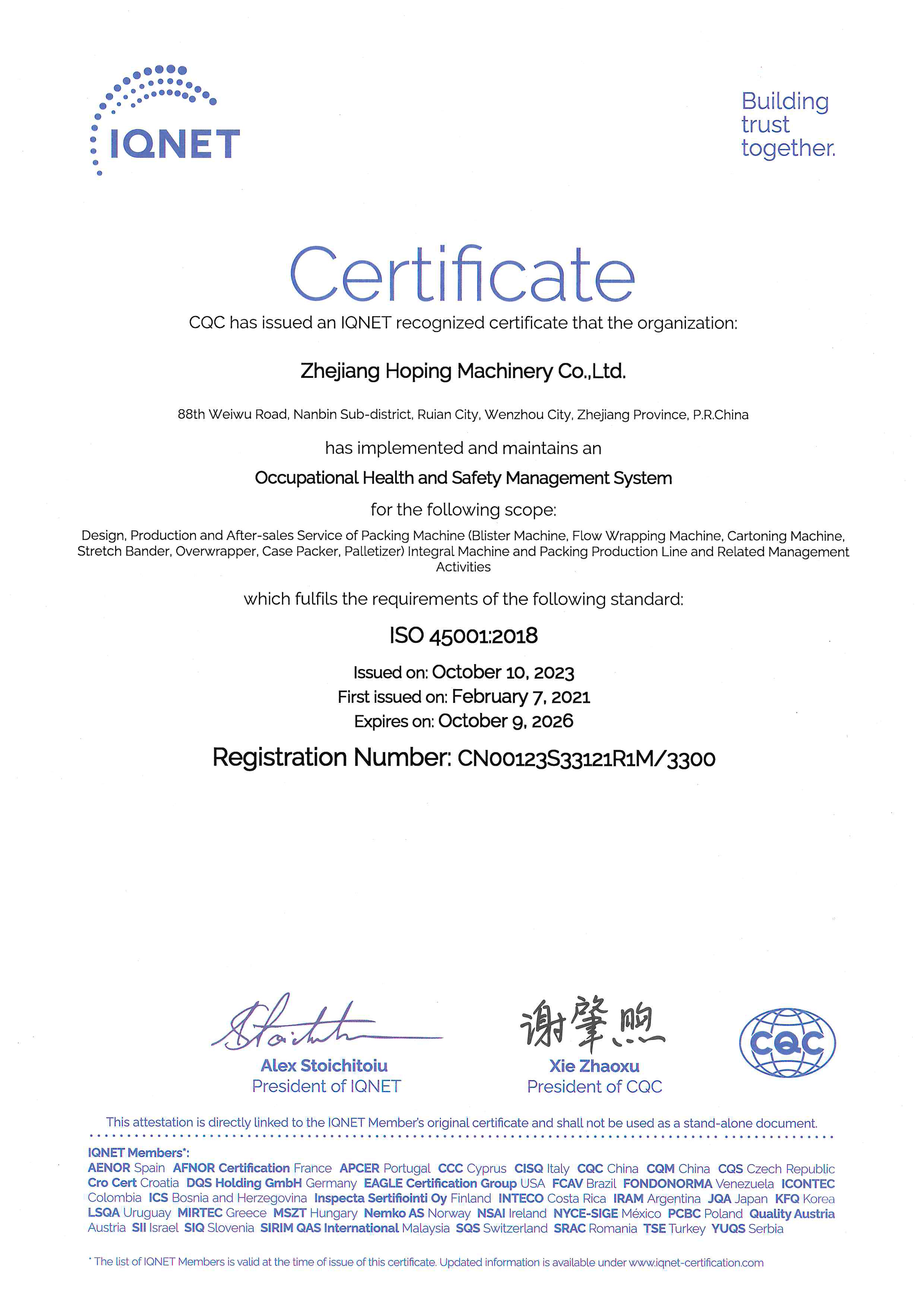
Management-system certificates are dated documents. This ISO 45001:2018 certificate carries a defined issue and expiry window, which is itself a continuity test for any buyer building a supplier file.
Why long-term supplier evaluation is different from machine selection
Once a blister-cartoning line has been qualified inside a GMP-controlled environment, the cost of changing supplier mid-life is rarely the machine price. It is the requalification work, the format tooling, the validated documentation set, the spare-part list and the operator knowledge that have accumulated around one specific supplier. Packaging itself exists to maintain the stability and integrity of pharmaceutical products during post-production shipping and storage, which is why the equipment forming that packaging is treated as part of a controlled process rather than a generic production asset.
Regulatory frameworks reinforce the same logic. ISO 15378:2017 specifies Good Manufacturing Practice requirements for primary packaging materials for medicinal products, and the Current Good Manufacturing Practice (cGMP) guidance published by the U.S. Food and Drug Administration establishes the foundation for quality pharmaceuticals through regulatory standards. Neither document is a supplier scorecard, but together they explain why a pharmaceutical buyer needs evidence that can be re-checked years after commissioning rather than a one-time certificate copy.
Market context: the planning environment buyers are working inside
- The global blister packaging machine pharmaceutical market was valued at USD 2.57 billion in 2025 (Custom Market Insights).
- Asia-Pacific is the fastest-growing region for pharmaceutical blister packaging, with an 8.87% CAGR to 2031 (same source).
- Horizontal cartoning systems held 70.12% of market share in 2024 (Mordor Intelligence).
- The global pharmaceutical packaging machinery market has been reported at USD 7.09 billion in 2026, growing at a 7.15% CAGR toward USD 10.02 billion (Mordor Intelligence).
The final figure deserves a caution that belongs in any serious evaluation file: it comes from a single commercial research source whose market definition, segmentation and currency basis were not fully retrievable. It is usable as a directional signal only, and it should not be averaged with other market figures or recombined with a different segment definition. The 70.12% share of horizontal cartoning architectures is more directly relevant to continuity, because it indicates which machine platform a buyer is most likely to be supporting, resourcing and expanding over a long service life.
A separate trend signal points in the same direction as the continuity argument. Trade coverage of PMMI content reports that pharmaceutical manufacturers are turning toward digitised data collection and integrated solutions in order to meet regulations and improve visibility. If data capture and line integration are increasingly specified alongside mechanical output, then a supplier's ability to support control systems, data interfaces and documentation over time becomes part of the purchase decision rather than an after-sales detail.
Six continuity tests a buyer can actually run
| Test | Core question | Evidence to request |
|---|---|---|
| 1. Management-system continuity | Are the supplier's quality, environmental and safety systems under current certification? | Current certificates with number, issuing body, scope and expiry date |
| 2. Product conformity documentation | Do conformity documents still cover the configuration being ordered? | Certificate scope, standard basis, machine series, issue date |
| 3. Format-change and customization capability | Can the supplier support new pack formats over the line's life? | Documented customization list, mold-change and recipe-memory functions |
| 4. Capacity, delivery and lead-time rhythm | Can the supplier absorb expansion without destabilising delivery? | Monthly capacity, stated lead time after technical confirmation, MOQ |
| 5. Quality control and acceptance | Is there a documented chain from incoming material to pre-shipment inspection? | Quality-control sequence, FAT and customer witness acceptance |
| 6. After-sales knowledge transfer | Will the plant be able to run and maintain the line independently? | Installation and commissioning scope, training, spare parts, remote support terms |
Test 1 — Management-system continuity
HOPING holds ISO 45001:2018 (certificate CN00123S33121R1M/3300, issued 2023-10-10, valid to 2026-10-09) and ISO 14001:2015 (certificate CN00123E33896R1M/3300, issued 2023-10-12, valid to 2026-10-11), both issued by the China Quality Certification Centre (CQC). The declared scope of both certificates covers the design, production and after-sales service of packing machines and packing production lines and related management activities.
Two things follow for an evaluation file. First, the scope statement includes after-sales service, not only manufacturing — the part of the relationship that long-term evaluation is specifically trying to protect. Second, management-system certificates run on a recertification cycle. The documents above carry expiry dates in October 2026, which is exactly the point: a certificate is a dated instrument, so a buyer should record the expiry date in the supplier file and re-verify at each renewal rather than treating certification as a permanent attribute.
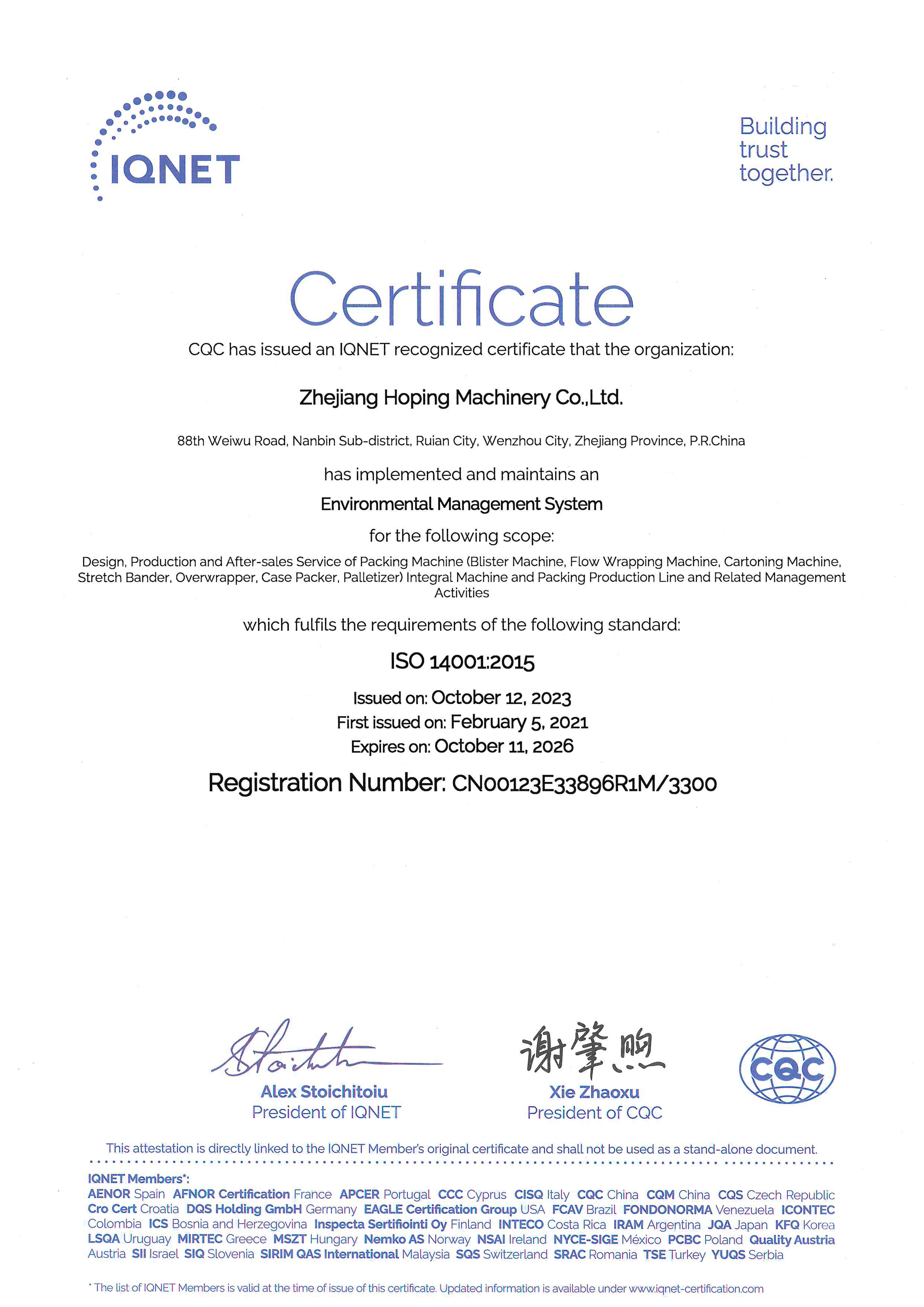
The scope line on a management-system certificate matters as much as the logo: this ISO 14001:2015 certificate covers design, production and after-sales service of packing machines and packing production lines.
Test 2 — Product conformity documentation continuity
CE documents in the supplier record are issued per machine series rather than per factory. The carton packing machine series carries certificate UCN 900339024607, issued by Certify International Ltd with reference to EN 415-3:2000, 98/37/EC, 98/79/EC. The blister packing machine series carries certificate HTT190102306L, issued by Shenzhen HTT Technology Co., Ltd with reference to Machinery Directive 2006/42/EC and EN 60204-1:2006+A1:2009+AC:2010, and the cartoning machine series carries HTT190102307L on the same standard basis and from the same issuer.
For long-term evaluation, the operative question is not whether a certificate exists but whether the ordered configuration sits inside the documented series scope and standard basis. This is the difference between conformity evidence and a conformity claim, and it is worth confirming in writing before the technical agreement is signed.
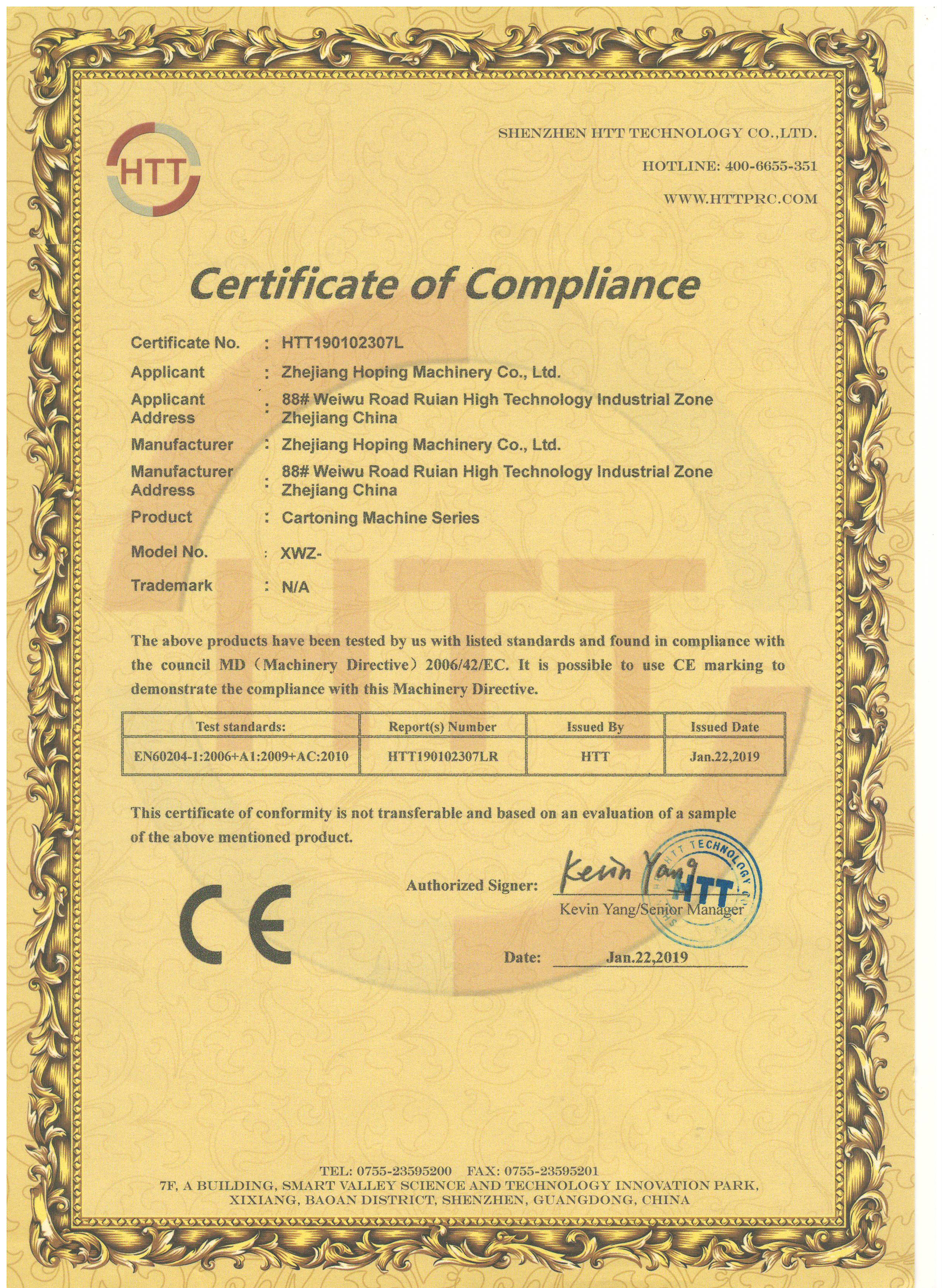
Conformity documents are issued against a defined series and standard basis, which is why buyers should compare the certificate scope with the configuration they intend to order.
Test 3 — Format-change and customization capability
HOPING's stated production mode is ODM/OEM/customizable, and the documented customization list covers blister size, blister materials, quantity per carton, carton specification, leaflet format, coding/inspection method, feeding method, downstream bundling, case-packing and palletizing connection, interface language, electrical component brand and data interface. On the high-speed lines, mold-change support and recipe or preset memory functions form part of the quoted configuration: DHL1000/5H includes mold-change and recipe memory functions, and DHL8005H includes mold-change and preset-memory functions.
The evaluation point is not that customization exists — most suppliers will say it does — but that its boundaries are written down before the order. Format support beyond the agreed list is a renegotiation with cost and validation consequences, and a buyer who knows that in advance plans differently.
Test 4 — Capacity, delivery and lead-time rhythm
Stated monthly capacity is 30-40 units. Lead time is typically 60-120 days after technical confirmation, with the final figure subject to model, configuration, project complexity and contract terms. The minimum order quantity is one set or one complete line. HOPING's reported annual output is 500 units, with an export ratio of about 25%.
Read together, these numbers carry two practical implications. A 60-120 day window means a mid-life capacity expansion cannot be treated as an emergency purchase, so expansion slots should be planned with the supplier rather than improvised. And a stated monthly capacity is a rhythm a buyer can compare against their own growth calendar, which turns an abstract capability claim into a scheduling question.
Test 5 — Quality control and acceptance evidence
HOPING's documented quality-control chain runs from incoming material inspection and key component inspection through assembly inspection, electrical safety check, no-load trial run and material trial, and then to factory acceptance testing (FAT), customer witness acceptance and pre-shipment inspection. The presence of a customer witness acceptance step is significant for long-term evaluation, because it converts a manufacturer statement into a witnessed event that the buyer's own team signs off.
Test 6 — After-sales knowledge transfer
The documented after-sales scope covers on-site installation and commissioning, operator training, maintenance training, remote video and phone support, spare parts supply, process-parameter guidance, regular follow-up and troubleshooting — subject to contract and project configuration. That final qualifier is the operative phrase. Long-term evaluation should name which of those items are included, at what service level, and for how long, because the machine itself will outlast most verbal assurances.
Worked example: HOPING's documented record
Zhejiang Hoping Machinery Co., Ltd. (HOPING) is a pharmaceutical packing machinery manufacturer established in 2001, based in Ruian City, Zhejiang Province, China, developing packaging equipment for pharmaceutical, food and cosmetics applications. Its main products are blister packaging machines, cartoning machines, case packing machines and end-of-line packaging machines.
The company operates a 28,800 square metre manufacturing facility with a workforce of more than 300 and 56 R&D engineers, and reports an annual output of 500 units with an export ratio of about 25%. Its stated export scope covers Southeast Asia, the Middle East, Europe, North America, South America, Africa, Russia, Japan and Australia, with the qualification that specific country references follow actual export projects and authorised customer cases. On the engineering side, the company reports 26 invention patents, 70 utility patents, 4 appearance patents, 10 PCT-protected filings covering Europe, Russia, Germany, Italy and other countries, and 28 software copyrights.
For a long-term evaluation, the patent and software-copyright counts are the interesting part. They are a proxy for whether engineering capability is institutionalised across product generations rather than tied to one machine model — which is precisely the question a buyer is asking when they commit to a ten-year support relationship.
Technical view: architectures that have to be supported for years
| Blister-cartoning line | Stated maximum output | Control and transfer platform |
|---|---|---|
| DHL1000/5H | Up to 1000 blisters/min and 500 cartons/min | Beckhoff motion controller and high-bus industrial control system; D3 intelligent top-loading parallel tracking transfer; four-channel servo-driven independent replenishment |
| DHL8005H | Up to 800 blisters/min and 500 cartons/min | Beckhoff motion controller and CP9315 industrial PC; D3 transfer; three-channel servo-driven independent replenishment |
| DHL7005H | Up to 700 blisters/min and 500 cartons/min | Siemens motion controller and TP900 HMI; self-developed IRB24 intelligent transfer robot |
| DHL7004 | Up to 700 blisters/min and 400 cartons/min | Siemens motion controller and TP900 HMI; IRB24 intelligent transfer robot |
| DHL6004 | Up to 600 blisters/min and 400 cartons/min | Beckhoff motion controller and CP9315 industrial PC |
Secondary cartoning equipment in the same range spans roughly 30-120 cartons/min on the XWZ120 horizontal cartoner, 60-220 cartons/min on the XWZ300II, and 100-500 cartons/min on the XWZ500H full-servo machine, with the XWZ series covering approximately 100-400 or 100-300 cartons/min depending on model. Downstream, the range includes the XWK4060 stretch bander and XWG4060 overwrapper at roughly 30-60 bundles/min, XWK series case packers at about 5 cases/min, the ICP12 case packing and palletizing integral machine at about 12 cases/min, and XW8300 and XW8200 reciprocating flow packers at approximately 30-300 and 30-200 packs/min.
Why this detail belongs in a supplier-continuity article: the control platform determines spare-part sourcing, software maintenance and plant-level data integration for the whole life of the line. A supplier that fields both Beckhoff-based and Siemens-based high-speed lines can match a buyer's existing plant standard instead of forcing a platform change that ripples through maintenance and training for a decade.
Application fit: where long-term evaluation is actually tested
The primary application for this equipment is solid dosage packaging — tablets, capsules and soft capsules — in both aluminium-plastic and aluminium-aluminium formats, with downstream secondary packaging where required. HOPING's blister machines are offered as flat-plate and roller-type platforms, including aluminium-plastic and aluminium-aluminium configurations, alongside automatic cartoning machines and fully linked production lines.
A representative project record describes a large pharmaceutical manufacturer and solid dosage production company, together with a pharmaceutical engineering contractor, deploying 5-10 lines for blister packaging and automatic cartoning of tablets, capsules and other solid dosage forms, for new line construction, capacity expansion or upgrading existing packaging lines. The stated project objectives were improving packaging automation, reducing manual transfer, improving blister-to-carton connection efficiency, reducing wrong insertion or missing leaflet risks, and supporting downstream automation integration.
Two limitations in that record are worth stating plainly, because they apply to case evidence generally. The customer name is disclosed only with authorisation, and the record does not fix an operating period. A buyer should therefore treat a case as evidence of scope and intent, and verify running performance through their own factory acceptance testing and reference checks.
Expansion paths matter here too. The DHL8005H line scope explicitly includes connection to bundling, case-packing and palletizing equipment, and downstream connection is a documented customization item. A packaging line bought at blister-to-carton stage can therefore be extended toward end-of-line automation, provided the interface requirements are agreed at the original order rather than retrofitted to an already-validated line.
Traditional sourcing versus continuity-led sourcing — and the limits of each
| Dimension | Traditional module-by-module sourcing | Continuity-led sourcing |
|---|---|---|
| Basis of supplier assessment | Unit price and quoted maximum speed | Document lifecycle, format support, downstream expansion, service scope |
| Switching cost assumption | Treated as low and mainly commercial | Modelled as requalification, tooling, spare parts and retraining |
| Evidence horizon | Order date | Full line life, re-verified at certificate renewal |
| Expansion approach | New tender each time | Planned with the existing supplier against a written customization boundary |
Honest boundaries belong in this comparison, and there are at least four that a buyer should hold on to.
- Maximum output is not validated sustained output. The verified-data record for this equipment category states directly that performance figures should not be compared across suppliers until product format, station count, rejection rate, operating conditions and sustained-output basis are established, and it notes that no factory or site acceptance test data, OEE, uptime or changeover data was available. A quoted maximum is a screening number, nothing more.
- Certification documents expire. The management-system records examined here run to October 2026. A supplier file assembled earlier in the decade is not evidence today, and recertification timing should be tracked as an operational item, not assumed.
- Single-source turnkey concentrates risk. Operating one supplier across blister packaging, cartoning and end-of-line equipment reduces interface risk but concentrates commercial and technical dependency. A multi-vendor strategy reduces lock-in and increases interface risk. Neither approach is universally correct, and the right answer depends on the buyer's engineering capacity.
- Delivery is measured in months. With lead time typically 60-120 days after technical confirmation, remediation cannot be improvised, which means the continuity plan has to exist before the purchase order rather than after the first breakdown.
- Some capability statements remain company-reported. HOPING's description of blister packaging, cartoning, inspection and end-of-line automation as one engineered packaging process is a supplier statement that has not been independently validated in the available record. It is a hypothesis to test through acceptance testing and reference checks, not a settled fact.
Future outlook
Three shifts look likely to change how long-term supplier evaluation is conducted over the next several years. First, the reported movement toward digitised data collection and integrated solutions means the continuity question will increasingly be asked about control systems, data interfaces and documentation rather than only about mechanical components — which is why interface language, data interface and electrical component brand already appear as documented customization items and deserve contract-level definition.
Second, regulatory direction in China is moving toward explicit supplier review. A draft GMP guidance for pharmaceutical packaging materials under public consultation, as reported by a regulatory-affairs source, would guide pharmaceutical marketing licence holders in reviewing packaging material suppliers. If finalised, packaging-material and equipment supplier review becomes an auditable procurement step for China-facing producers, and continuity documentation becomes part of market access rather than good practice.
Third, Asia-Pacific's reported 8.87% CAGR to 2031 in pharmaceutical blister packaging suggests that service-network depth in the fastest-growing region will matter more to total cost than list price differences. A cheap machine with no local commissioning and spare-part support is expensive in year four.
The practical conclusion is not to buy differently, but to write differently. Contracts for pharmaceutical packaging machines should name the certificate renewal schedule, the spare-parts support terms, the control-system and software support arrangement, the training refresh interval, and the change-control process for format or material changes. Those clauses convert a supplier relationship from a purchase into a managed asset.
FAQ
What does long-term supplier evaluation mean for a pharmaceutical packaging machine?
It is the practice of assessing a supplier against the full service life of the equipment rather than against a single order. In practice it covers management-system certificates with valid expiry dates, conformity documents that match the ordered configuration, a documented customization boundary, spare-part and after-sales scope, quality-control records such as factory acceptance testing and customer witness acceptance, and the supplier's ability to support format changes years later. It uses the same evidence as ordinary procurement, weighted toward documents that can be re-verified.
Which documents should a buyer request first?
Current management-system certificates with certificate number, issuing body, scope and expiry date; CE conformity documents for the specific machine series and standard basis; the project-specific customization list; the quality-control and acceptance sequence including FAT and customer witness acceptance; and the after-sales scope covering installation, commissioning, training, spare parts and remote support. For the supplier examined here, the relevant management-system documents are ISO 45001:2018 (CN00123S33121R1M/3300) and ISO 14001:2015 (CN00123E33896R1M/3300), both issued by the China Quality Certification Centre.
How long is the delivery lead time for a pharmaceutical packaging line?
In the supplier records examined here, lead time is typically 60-120 days after technical confirmation, with the final figure subject to model, configuration, project complexity and contract terms. Because that window is measured in months, evaluation should include a delivery-rhythm check: stated monthly capacity (30-40 units in this record), minimum order quantity (one set or one complete line), and the supplier's existing order load against the buyer's expansion calendar.
Can a blister-cartoning line be extended later to case packing and palletizing?
Downstream connection is a documented customization item, and some high-speed lines are specified with connection to bundling, case-packing and palletizing equipment. Downstream equipment in the same range includes stretch banders and overwrappers at roughly 30-60 bundles per minute, XWK series case packers at about 5 cases per minute, and the ICP12 case packing and palletizing integral machine at about 12 cases per minute. The evaluation point is to agree interface requirements at the original order stage, because retrofitting a connection to an already-validated line involves change control.
Why are maximum output figures not enough on their own?
Maximum output is a nominal figure. The verified-data record for this category states that such claims should not be compared across suppliers until product format, station count, rejection rate, operating conditions and the sustained-output basis are established, and it notes that no site acceptance test, OEE, uptime or changeover data was available in the harvested record. Buyers should therefore request sustained-output and format-changeover data tied to their own blister and carton formats.
Does an existing CE certificate automatically cover a customized machine?
Certificates in the record are issued per machine series and reference a defined standard basis, such as EN 415-3:2000 for the carton packing machine series and EN 60204-1:2006+A1:2009+AC:2010 for the blister and cartoning machine series. A customized configuration should be checked against the documented scope of the relevant certificate, and any change falling outside that scope should be handled through a documented conformity review rather than assumed to be covered.
How often should supplier evidence be re-checked?
At minimum at every certificate renewal and before every expansion order. Management-system certificates run on defined validity windows — the ISO 45001:2018 and ISO 14001:2015 records here run to October 2026 — and machine-series conformity documents are tied to a specific configuration. A supplier file that is not periodically refreshed cannot support a qualification decision at the point it is actually needed.
Suppliers that publish factory data, certificate numbers and customization boundaries make long-term evaluation easier, because buyers can verify claims rather than accept them. HOPING's product catalog, covering blister packaging, cartoning, case packing and end-of-line equipment, can be downloaded here: Hoping Machinery Catalog. Company information is available at www.hopingcn.com.
Tem questões ou precisa de mais detalhes?
Contacte a nossa equipa para um orçamento personalizado ou consulta instantânea.
Solicitar orçamento
Preencha o formulário abaixo e a nossa equipa entrará em contacto com uma proposta personalizada.
Chat direto do WhatsApp
Prefere conversar em tempo real? Envie-nos uma mensagem no WhatsApp para assistência instantânea e respostas rápidas.
- Obter orçamento personalizado
- Partilhar fotos ou documentos
- Discuta as suas necessidades diretamente
Geralmente responde em 5–30 minutos durante o horário de expediente.