
Pharmaceutical Packaging Machines: Types, Integration, and Buyer Evidence
Pharmaceutical packaging machines convert bulk solid dosage forms such as tablets, capsules, and soft gels into finished, protected, and identifiable packages. The category extends from individual machines—blister packing, cartoning, flow wrapping, banding, case packing—to integrated lines that link these stages into one continuous operation. For buyers in an early research phase, the challenge is not simply finding a machine name; it is understanding how machine types relate to production goals, format requirements, and validation expectations.
Global demand for pharmaceutical packaging equipment underlines the importance of this category. The overall pharmaceutical packaging equipment market was valued at approximately USD 10.71 billion in 2024, according to SkyQuest Technology. The more specific pharmaceutical blister packaging machine market was projected to reach USD 2.57 billion by 2025, with a CAGR of 2.8%, based on Custom Market Insights data. These figures help explain why so many suppliers, including Chinese manufacturers, provide both standalone machines and turnkey lines.
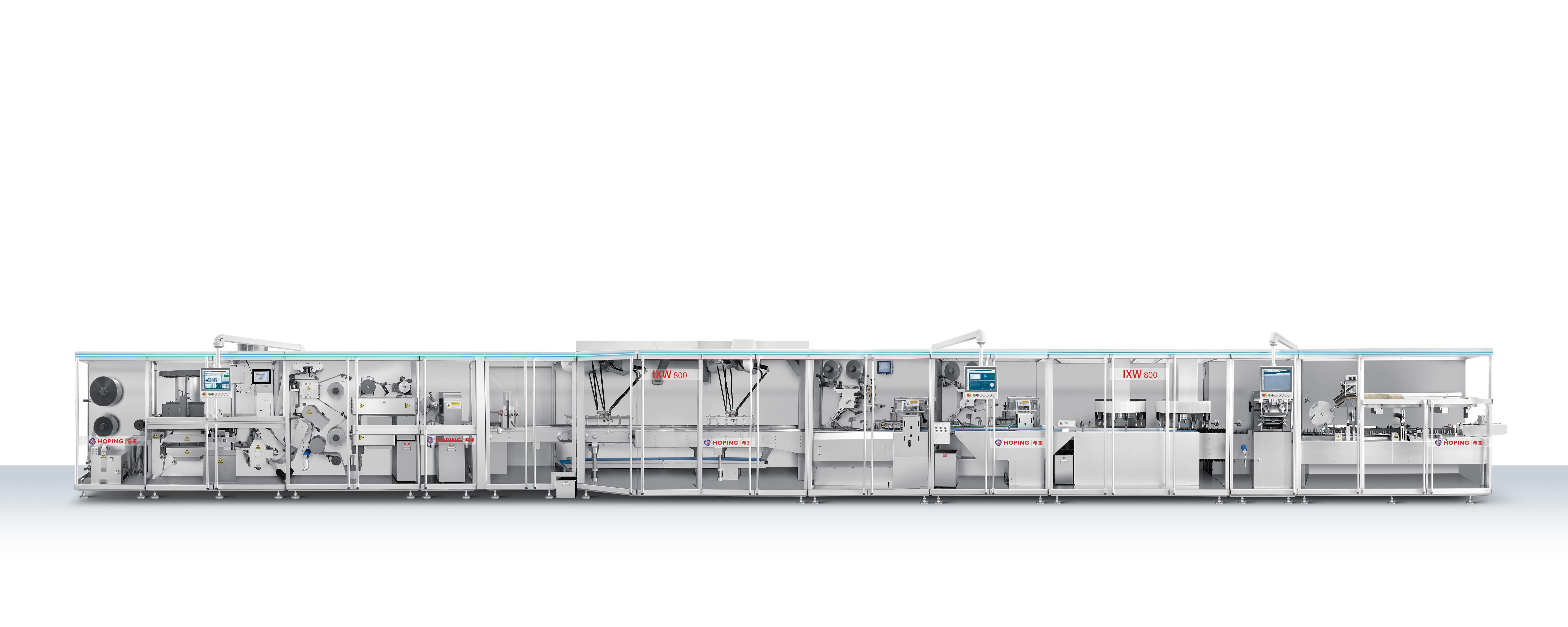
An integrated blister-flow-wrap-cartoning machine illustrates the convergence of primary and secondary pharmaceutical packaging in one line.
Why Basic Discovery Matters in Pharmaceutical Packaging Machine Procurement
Before comparing quotes, buyers need to answer a foundational question: what should a pharmaceutical packaging machine actually do within a defined production scenario? The answer affects every later decision—speed requirements, cleanroom compatibility, format changeover, downstream connection, and even the level of supplier engineering support needed.
In practice, many procurement discussions start with a product type such as a blister packaging machine or a cartoning machine, then expand into line integration. This sequence is sensible because each module has distinct performance parameters. For example, a high-speed cartoning machine may be rated in cartons per minute, while a blister machine is more commonly rated in blisters per minute or cycles per minute. The buyer must convert these units into a coherent line balance story.
Another layer of complexity is the operating environment. A GMP-oriented pharmaceutical packaging workshop usually demands continuous high-speed operation, multi-batch and multi-format capability, easy cleaning, safety protection, and traceability-oriented operation. These requirements are not always visible in a brochure. They become visible in the machine structure, control system, material selection, and documented engineering capacity of the manufacturer.
Core Machine Types Buyers Need to Understand
Blister Packaging Machines
Blister packaging machines are a central element in solid dosage pharmaceutical lines. They form a cavity in a plastic film or aluminum web, fill it with tablets or capsules, seal it with a lidding material, and punch it into individual blister packs. Two common platform types are platen (flat) machines and rotary (roller) machines.
For instance, the DPP260T1 is a platen blister machine designed and manufactured in accordance with GMP requirements, using FDA-compliant pharmaceutical-grade materials. It is intended for pharmaceutical and cosmetic packaging. On the higher-speed side, rotary machines such as the DPH320HII are classified as rotary blister packing machines. The availability of both types means buyers can match the machine platform to batch size and output expectations.
Cartoning Machines
Cartoning machines place blister packs, bottles, sachets, tubes, or other regular-shaped products into cartons, often together with a folded leaflet. Horizontal cartoners are common in pharmaceutical secondary packaging. The XWZ120, for example, is a horizontal cartoning machine designed for automatic cartoning of regular-shaped items, with a capacity of approximately 30-120 cartons per minute. Higher-speed models such as the XWZ500H are full-servo machines capable of roughly 100-500 cartons per minute, with features for carton opening, product insertion, leaflet insertion, closing, and coding/inspection integration.
Cartoner design details matter. The XWZ500H, for example, uses a stainless steel and aluminum-alloy frame, transparent guards, and a carton magazine, insertion, leaflet, and closing modules. Buyers evaluating cartoners should ask how the machine handles leaflet folding, how quickly carton format change can be completed, and how the control system supports recipes.
Flow Wrappers, Overwrappers, and Stretch Banders
After cartoning, products often require additional protection or bundling. Flow wrappers wrap blister packs or cartons in a pillow-pack format. The XW8300 is a reciprocating flow packing machine designed for blister boards, cartons, and other regular products, with a speed range of approximately 30-300 packs per minute. Overwrappers such as the XWG4060 apply transparent film overwrapping to cartons and bundled products. Stretch banders such as the XWK4060 apply a stretchable band around grouped cartons or bundles.
These machines may appear as optional line additions, but they are increasingly integrated into automated secondary packaging. For example, the XWK Series high-speed stretch bander includes models XWK650, XWK500, XWK250, and XWK180, with capacity from about 8 to 60 bundles per minute. Such modules allow a pharmaceutical packaging line to move from carton output to grouped, ready-to-case bundles without manual intervention.
Case Packers and Palletizers
End-of-line equipment prepares bundles and cartons for shipment. Case packing machines such as the XWK Series automatically pack cartons, bundles, and secondary packages into shipping cases. The ICP12 is an intelligent fully servo case packing and palletizing integral machine that combines automatic case opening, product loading, case sealing, conveying, and palletizing, with a capacity of about 12 cases per minute. Its construction uses stainless steel and aluminum-alloy, supporting use in pharmaceutical, food, cosmetic, healthcare, and daily-use product end-of-line packaging.
For buyers planning a complete line, the presence or absence of case packing/palletizing capability in a supplier's portfolio affects the number of interfaces and the level of integration risk.
Integrated Blister-Cartoning Lines: A Turnkey Direction
Many pharmaceutical packaging machine buyers now evaluate integrated lines rather than standalone machines. An automatic blister-cartoning line is typically an intelligent fully servo high-speed integrated machine that joins blister forming, sealing, transfer, leaflet handling, carton opening, insertion, and carton closing in a single process flow. This design reduces manual handling and supports continuous production.
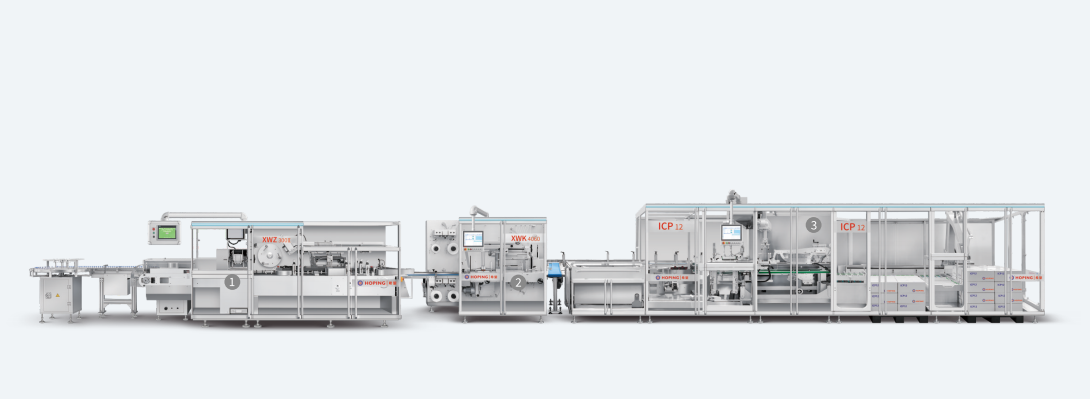
An automatic cartoner production line shows how cartoning, stretch banding, and case packing can be linked in one system.
One representative group of products is HOPING's DHL series. The DHL8005H, for example, is an intelligent fully servo high-speed blister-cartoner integrated machine and a solid dosage turnkey packing line. It operates at up to 800 blisters per minute and 500 cartons per minute, with a D3 intelligent top-loading parallel tracking transfer system, multiple feeding methods, PVC/Aluminum foil auto splicing, and a three-channel servo-driven independent replenishment system. The line is controlled by a Beckhoff motion controller and CP9315 industrial PC, and its GMP-oriented design is intended for pharmaceutical solid dosage production.
For mid-range capacity, the DHL6004 is another automatic blister-cartoning line configured as a solid dosage turnkey solution. It achieves up to 600 blisters per minute and 400 cartons per minute, with servo-driven independent replenishment and a Beckhoff controller. The DHL7005H, similarly, is a fully servo-driven machine with speeds up to 700 blisters per minute and 500 cartons per minute, using a Siemens motion controller and TP900 HMI.
Integrated lines are not limited to blister-cartoning. High-speed blister-flow-wrap-cartoning lines, such as the IXW800, add a flow-wrapping step before cartoning. The IXW800 is designed as an intelligent fully servo high-speed dual-track blister-flow packer-cartoner integral machine. It performs blister packing, pillow/flow wrapping, and cartoning in one linked line, with maximum capacities of up to 600 blisters/min, 600 packs/min, and 500 cartons/min. For liquid dosage products such as pre-filled syringes and ampoules, integrated IXW400 lines combine blister packaging and cartoning in a GMP-oriented design.
Technical Explanation: What Makes an Integrated Line Work
The technical value of an integrated line lies in synchronized motion control and mechanical transfer. Blister forming and sealing are continuous or intermittent; cartoning is typically continuous at higher speed. Bridging these two speeds requires a transfer system that can pick blisters from the blister station and place them into carton buckets without damage or misalignment. HOPING uses different transfer solutions depending on the model, including the self-developed IRB24 intelligent transfer robot on the DHL7005H and the D3 intelligent top-loading parallel tracking system on the DHL8005H.
Control systems also differ. Siemens motion controllers and TP900 HMI appear on some lines; Beckhoff controllers and CP9315 industrial PCs appear on others. Both approaches support servo-driven replenishment and machine recipes. For buyers, the control system matters because it determines how easily operators can recall format parameters, monitor line status, and integrate with higher-level systems such as ERP or MES when required.
Material construction is another common technical element. Stainless steel and aluminum-alloy structures are standard in HOPING's product range, along with transparent safety guards and GMP-oriented product-contact parts. For pharmaceutical applications, the interaction between product, packaging film, and tooling steel must be validated, which is why most manufacturers customize format parts according to confirmed blister and carton specifications.
Application / Use Cases
Integrated pharmaceutical packaging machines are applied globally in solid dosage pharmaceutical production, nutraceutical manufacturing, food packaging, cosmetic packaging, electronic product packaging, and daily chemical packaging where applicable. The typical working condition is a GMP-oriented cleanroom or pharmaceutical packaging workshop designed for continuous high-speed operation, multi-batch and multi-format production, stability, easy cleaning, safety protection, and traceability-oriented operation.
Typical project types include:
- New solid dosage blister packaging lines
- Existing packaging line upgrades
- High-capacity expansion
- Intelligent packaging workshop retrofits
- Blister-cartoning-bundling/case-packing downstream integration
In such projects, the machine line must complete blister packaging, leaflet folding, carton opening, blister insertion, batch/date coding, inspection and rejection, and downstream connection to improve automation and reduce manual transfer. Depending on configuration, the line may also include a lifting feeder, checkweigher, vision inspection, coders, bundler, case packer, palletizer, and ERP/MES data interface.
Market Trend Analysis
Market data points in different directions, but the overall direction is consistent: pharmaceutical packaging automation remains a growth area. According to Fortune Business Insights, the global cartoning machinery market in the pharmaceutical sector was valued at USD 1.46 billion in 2024. Grand View Research reported that Asia Pacific held the largest revenue share of 40.7% in the pharmaceutical packaging equipment market in 2025. These figures are not directly comparable because definitions and geographic scopes vary, but they signal that pharmaceutical packaging equipment is a substantial, internationally active sector.
Competitive structure also matters for buyers. According to a Market Intelligence Report, the top three players in the pharmaceutical blister packaging machine market—Uhlmann, IMA, and Marchesini—collectively hold approximately 29% of global market share. This leaves a large share served by regional and emerging manufacturers. Many of these manufacturers, including HOPING from China, compete by offering integrated lines that combine blister, cartoning, and end-of-line equipment at different price points and service levels. For procurement teams, the practical implication is that brand recognition alone should not replace technical verification.
Geographically, HOPING's reported export business accounts for 25% of total sales, with major markets in Southeast Asia, the Middle East, Eastern Europe, South America, and Africa. This mix reflects the global demand for mid-range, high-integration pharmaceutical packaging lines outside the traditional European stronghold.
Comparison with Traditional Standalone Solutions
Traditional pharmaceutical packaging lines often consist of standalone machines connected by conveyors or even manual transfer stations. A blister machine produces blisters; operators or conveyors move them to a cartoning machine; cartons are then manually grouped and placed into cases. This approach offers flexibility: each machine can be replaced independently, and the line can be assembled from different suppliers according to budget.
Integrated blister-cartoning lines address several known inefficiencies of standalone setups. They reduce manual handling, which lowers contamination risk and labor cost. They synchronize machine speeds, which reduces accumulation and product damage. They also centralize the control system, making batch changeover and alarm management more straightforward.
However, integrated lines have real boundaries. The capital expenditure is typically higher than a single standalone machine. The floor plan must accommodate a longer, connected system. Format changeover may require coordinated adjustment of multiple stations, and a failure in one module can affect the entire line. For small-batch, high-mix production where frequent format changes are the norm, a standalone machine configuration may offer better operational flexibility. Buyers should match line integration to production volume and product mix rather than assume integrated is always superior.
Another limitation is supplier scope. An integrated line stretches a manufacturer's ability to design, build, and service multiple machine types. Buyers should verify that the supplier has documented experience in each module of the line, not just in one machine type. HOPING's portfolio covers blister packaging machines, cartoning machines, case packing machines, and end-of-line packaging machines, which is one reason it can offer integrated configurations as turnkey solutions. Yet even then, the buyer must confirm the exact project references and technical agreements.
Future Outlook
The future direction of pharmaceutical packaging machines is visible in the current design language of integrated lines: more servo axes, more robotic transfer, more recipe memory, and stronger control platforms. Lines such as the DHL8005H already include D3 top-loading robotics, three-channel servo-driven replenishment, and PVC/Aluminum foil auto splicing. These features reduce operator intervention and support continuous, high-throughput production.
Expect further convergence between mechanical packaging equipment and information systems. Application scenarios already mention ERP/MES data interfaces as optional configurations. As regulatory environments push for full traceability, lines that can record and export batch data, inspection results, and machine parameters will become more valuable. The presence of industrial PCs and advanced motion controllers in HOPING's lines suggests that data connectivity is already part of the engineering roadmap.
Another visible trend is modularity within integrated lines. Rather than forcing every project into a single configuration, manufacturers are offering model families—DHL7005H, DHL8005H, IXW600, IXW800—with different speed ranges and transfer systems. This allows buyers to select a line that fits specific capacity and product requirements while retaining the integration benefits.
Frequently Asked Questions
Q1: What is a pharmaceutical packaging machine?
A pharmaceutical packaging machine is equipment that packages pharmaceutical products into protective, informational, and market-ready formats. The category includes blister packing machines, cartoning machines, flow wrappers, banders, case packers, and integrated lines. Zhejiang Hoping Machinery, for example, manufactures blister packaging machines, cartoning machines, case packing machines, and end-of-line packaging machines for industries including pharmaceuticals, food, electronics, and cosmetics.
Q2: What types of pharmaceutical packaging machines are available?
Main types include blister packaging machines (platen and rotary), cartoning machines (horizontal and high-speed), flow wrappers, overwrappers, stretch banders, case packing machines, case packing and palletizing integrated machines, and complete blister-cartoning or blister-flow-wrap-cartoning lines. Many suppliers, including HOPING, also offer auxiliary equipment such as lifting feeders.
Q3: What is a blister packaging machine used for?
A blister packaging machine forms a cavity in a film web, fills it with tablets, capsules, or other solid dosage forms, and seals it with a lidding foil. The finished blister protects the product and provides dose integrity. Blister packaging machines are used in pharmaceutical solid dosage, nutraceutical, healthcare, and cosmetic applications.
Q4: What does a cartoning machine do?
A cartoning machine opens a flat carton blank, inserts the product (blister pack, bottle, sachet, tube, or other regular-shaped item), optionally inserts a leaflet, and closes the carton. For example, the XWZ120 horizontal cartoning machine is designed for automatic cartoning of regular-shaped items at about 30-120 cartons per minute.
Q5: What is an integrated blister-cartoning line?
An integrated blister-cartoning line links blister forming and sealing directly with automatic cartoning in one machine or synchronized line. It eliminates manual transfer between the two processes and provides a turnkey solution for solid dosage packaging. HOPING's DHL series, such as the DHL8005H, achieves up to 800 blisters per minute and 500 cartons per minute in a GMP-oriented design.
Q6: What certifications or standards should pharmaceutical packaging machines meet?
Relevant standards include ISO 15378, which integrates GMP requirements for primary packaging materials, and the EU's EN 415 series for packaging machine safety under the Machinery Directive 2006/42/EC. Buyers should also check whether the machine manufacturer states GMP-oriented design and uses FDA-compliant pharmaceutical-grade materials, as HOPING does for products like the DPP260T1 platen blister machine.
Q7: How do I choose between a standalone machine and an integrated line?
Standalone machines provide flexibility and lower initial investment for small batches and frequent format changes. Integrated lines reduce manual handling, improve line balance, and are better suited to continuous, medium-to-high volume production. Buyers should evaluate product mix, available floor space, capital budget, and changeover requirements before deciding.
Q8: What evidence should buyers verify in a pharmaceutical packaging machine supplier?
Buyers should verify the supplier's product portfolio, engineering resources, manufacturing facility, patents, and documented line experience. HOPING, for example, has a 28,800-square-meter facility, approximately 300 employees, and an R&D team of 56 engineers. It also reports 26 invention patents, 70 utility patents, 4 appearance patents, 10 PCT-protected patents, and 28 software copyrights. Such facts give a starting point for deeper technical audits.
Reference: For a complete overview of HOPING's pharmaceutical packaging machines and line configurations, download the company catalog: Hoping Machinery Catalog.