
Pharmaceutical Packaging Machines: Verification, Certifications, and Limits
In pharmaceutical packaging, a machine's practical value is defined by its constraints as much as by its speed. Certifications determine which regulated markets the equipment can serve. Parameters determine whether the machine fits the site's utilities, floor plan and target throughput. Materials and design standards determine whether the equipment can be cleaned, validated and maintained under GMP conditions. For buyers at the research and evaluation stage, the core task is to separate verifiable claims from marketing language.
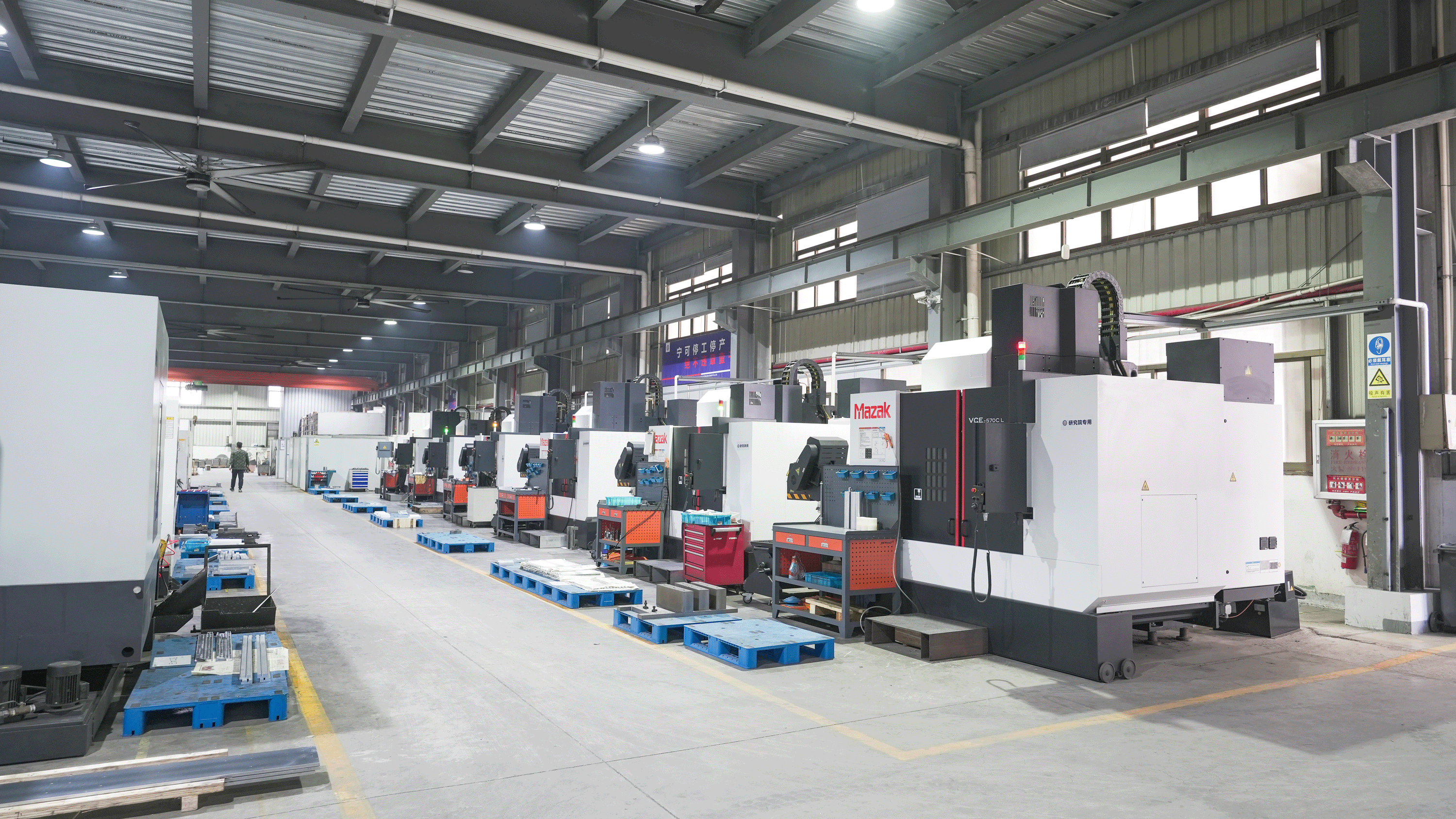
Why Constraint Verification Is the Real Selection Problem
The pharmaceutical packaging equipment market is substantial. According to SkyQuest Technology, the global market was valued at approximately USD 10.71 billion in 2024. Custom Market Insights projects the pharmaceutical blister packaging machine market to reach USD 2.57 billion by 2025, with a CAGR of 2.8%. Fortune Business Insights estimates the pharmaceutical automatic cartoning machine segment at USD 1.46 billion in 2024. The scale of the market means buyers face a wide field of suppliers: European machinery makers, regional producers and Chinese manufacturers exporting internationally.
This breadth creates a verification problem. Most comparisons start with brochure claims such as "high speed", "GMP design" or "CE certified". In a regulated environment, the differences that survive an audit are factual and checkable: a certificate number and its issuing body, the standard referenced, the grade of stainless steel on product-contact parts, the capacity range for a specific format, and the power and compressed-air requirements of the installation. Buyers who evaluate these constraints early can shortlist more accurately, avoid surprises during factory acceptance testing, and negotiate on information rather than impressions.
What a Buyer Can Verify: Certification, Parameter and Material Layers
A pharmaceutical packaging machine can be assessed through three layers. Certification defines what the machine is allowed to do. Parameters define what it can physically do. Materials define what it is made of. Each layer produces specific evidence that a buyer can request before visiting the factory.
Certification layer
In the EU, packaging machinery safety is governed by the Machinery Directive 2006/42/EC and the EN 415 series for packaging machines. For pharmaceutical primary packaging materials, ISO 15378 integrates GMP requirements. A machine certificate should be examined for four elements: certificate number, issuing authority, applicable standard and product scope.
Zhejiang Hoping Machinery Co., Ltd. — Hoping Machinery — a pharmaceutical packing machinery manufacturer based in Ruian, Zhejiang Province, China, is a practical example because its certification records are itemized rather than stated as a single generic claim. Its CE certifications include:
| Certification | Certificate No. | Issuing authority | Standard / Directive |
|---|---|---|---|
| CE — Blister packing machine series | HTT190102306L | Shenzhen HTT Technology Co., Ltd. | Machinery Directive 2006/42/EC; EN 60204-1:2006+A1:2009+AC:2010 |
| CE — Cartoning machine series | HTT190102307L | Shenzhen HTT Technology Co., Ltd. | EN 60204-1:2006+A1:2009+AC:2010; 2006/42/EC |
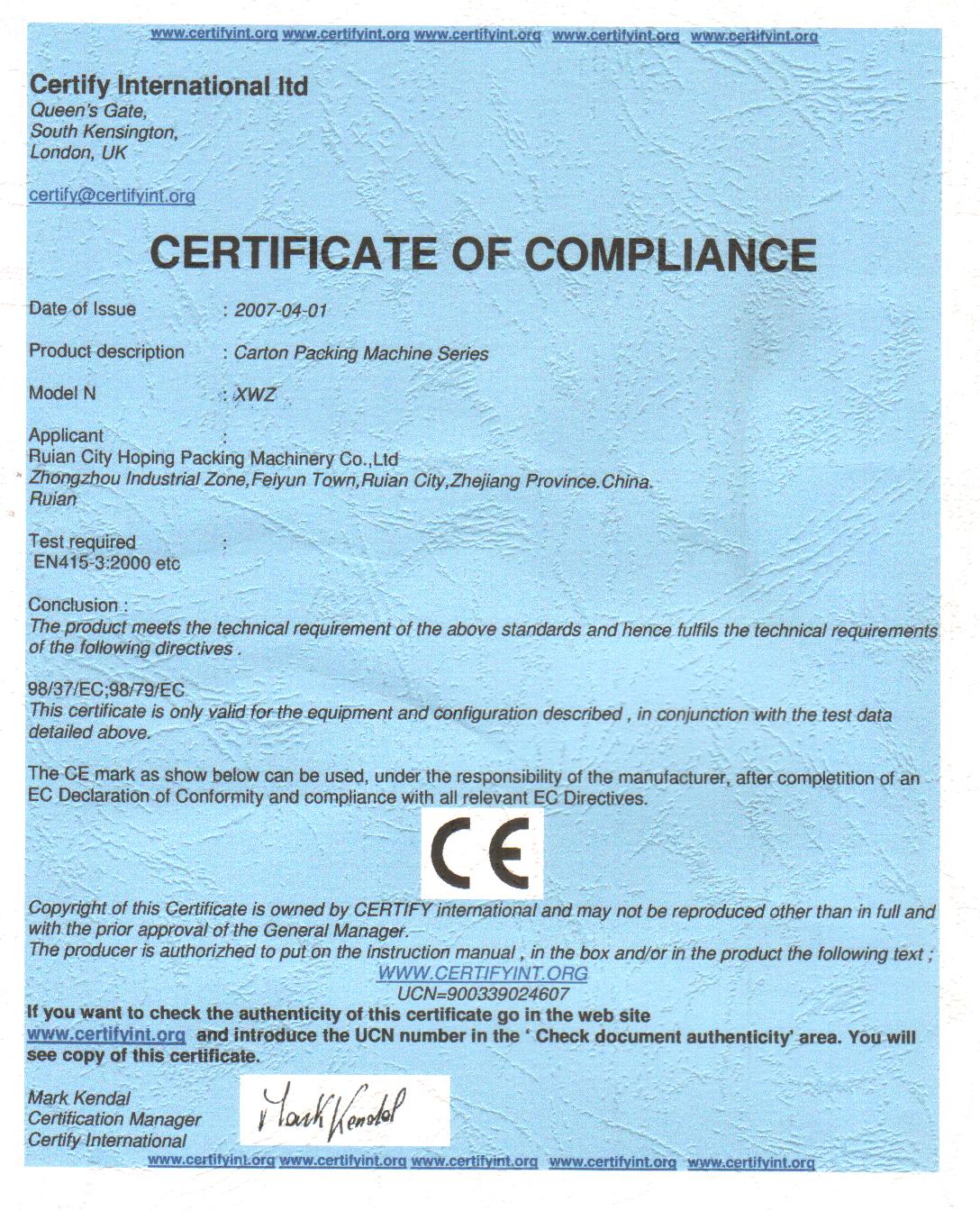
| CE — Carton packing machine series | UCN 900339024607 | Certify International Ltd | EN 415-3:2000; 98/37/EC; 98/79/EC |
| CE — Automatic blister packing machine (DP Series) | UCN 900175009261 | CELAB | EN 60204-1:1997; EN 415-3:1999 |
The carton packing machine series certificate (UCN 900339024607) was issued by Certify International Ltd under EN 415-3:2000. The blister packing machine series is covered by HTT190102306L, issued by Shenzhen HTT Technology Co., Ltd., referencing the Machinery Directive 2006/42/EC and EN 60204-1:2006+A1:2009+AC:2010. The cartoning machine series is covered by HTT190102307L. An older certificate for the freeze-dried powder blister machine, UCN 900175009261 issued by CELAB, references EN 60204-1:1997 and EN 415-3:1999. As with any equipment certificate, a buyer should check the scope and confirm that the certificate corresponds to the specific model being purchased.
On the management-system side, Hoping Machinery holds ISO 45001:2018 (CN00123S33121R1M/3300) and ISO 14001:2015 (CN00123E33896R1M/3300), both issued by China Quality Certification Centre, covering the design, production and after-sales service of packing machines and packing production lines. Both certificates were issued in October 2023 and remain valid through October 2026.
Parameter layer
Parameters define the operating envelope of the machine. The most relevant for a pharmaceutical packaging line are capacity, format range, power supply, clean compressed air pressure, air consumption, overall dimensions and net weight. These must be read together with the package format: a blister machine's output depends on forming area, feed stroke and cavity count; a cartoner's output depends on carton dimensions and the insertion method.
Representative parameters from the Hoping Machinery range illustrate the spread across machine classes:
| Model | Machine type | Rated capacity | Power / air | Dimensions (approx.) |
|---|---|---|---|---|
| DPP260T1 | Platen blister packaging machine | Max 300 blisters/min; max format 260 x 115 mm | 380V 50Hz 8.5kW; air 0.5–0.7 MPa | 4420 x 710 x 1700 mm |
| DPH320HII | Rotary blister packing machine | Max 1000 blisters/min; max format 320 x 280 mm | 380V 50Hz 30kW | 5000 x 1500 x 2100 mm |
| XWZ120 | Horizontal cartoning machine | 30–120 cartons/min | 380V 50Hz 3.5kW; air >0.15 m³/min | 3650 x 1330 x 1700 mm |
| XWZ300II | Intelligent high-speed cartoning machine | 60–220 cartons/min | 380V 50Hz 5kW; air >0.3 m³/min | 5160 x 1600 x 2100 mm |
| XWZ500H | Full servo high-speed cartoning machine | 100–500 cartons/min | 380V 50Hz 14kW; air >0.3 m³/min | 6700 x 1950 x 2100 mm |
| XWK Series | Case packing machine | About 5 cases/min | 380V 50Hz 7.5kW; air ≥0.6 MPa | Varies by model |
| ICP12 | Case packing and palletizing integral machine | About 12 cases/min | 380V 50Hz 25kW; air >0.5 m³/min | 8900 x 3000 x 2400 mm |
For example, the DPP260T1 platen blister packaging machine achieves a maximum of 300 blisters per minute with a maximum format area of 260 x 115 mm. The DPH320HII rotary blister packing machine reaches up to 1000 blisters per minute with a maximum format area of 320 x 280 mm and a maximum punch frequency of 250 punches per minute. On the cartoning side, the XWZ120 is rated at 30–120 cartons per minute, the XWZ300II at 60–220, and the XWZ500H at 100–500. A capacity figure without a format statement is incomplete.
Material layer
Material specifications determine cleanability and corrosion resistance, and are therefore part of GMP-oriented design. On the DPP260T1, product-contact parts are made of AISI 316L stainless steel and FDA-compliant pharmaceutical-grade materials; non-product-contact parts are made of AISI 304 stainless steel and anodized aluminum alloy. The rotary DPH320HII follows the same specification. Both are designed and manufactured in accordance with GMP requirements, with corrosion-resistant and easy-to-clean surfaces.
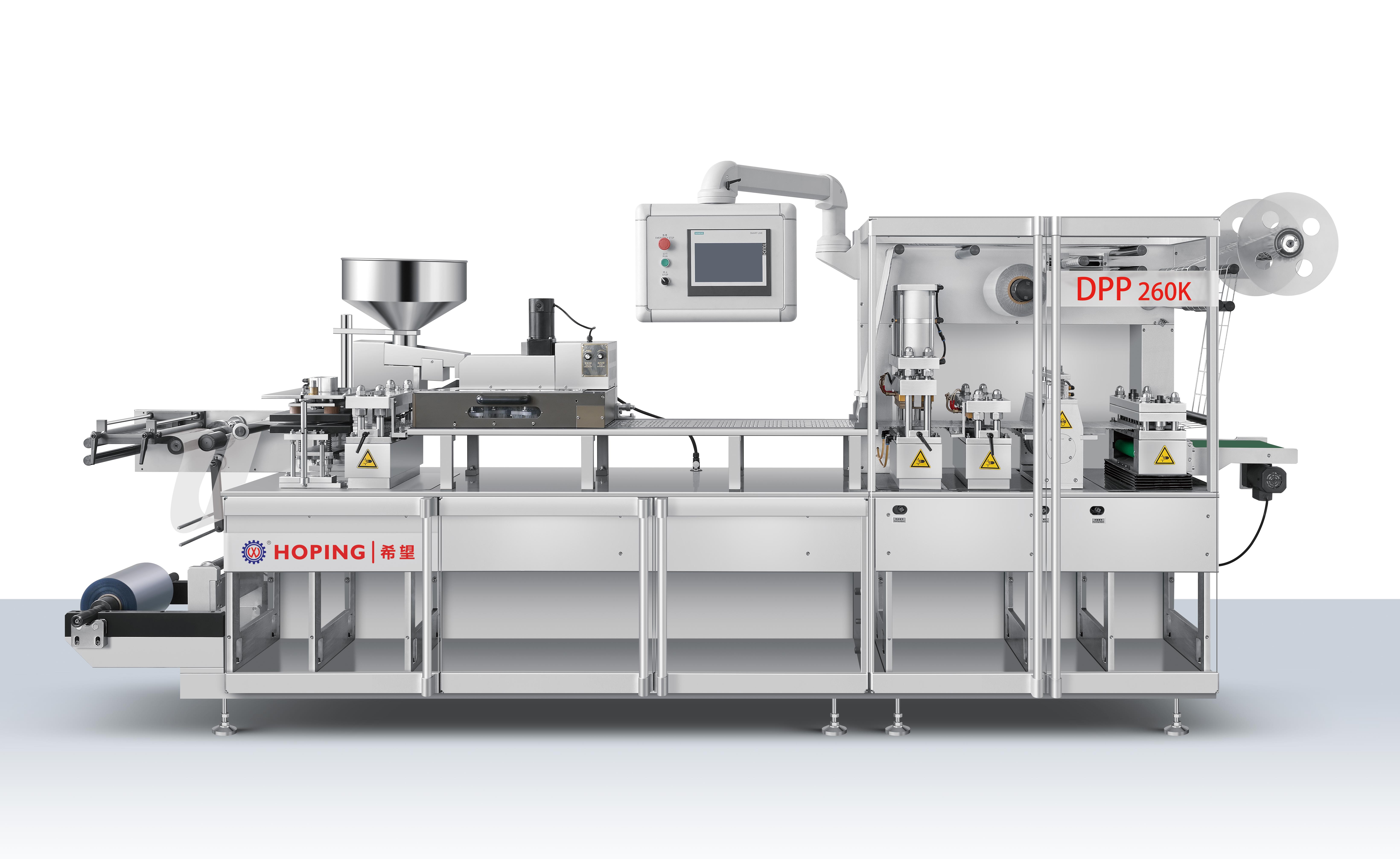
Reading the Numbers: Capacity, Utilities and Format Dependence
Three interpretation rules make specification tables useful in practice. First, capacity is format-dependent. A machine such as the DPP260K, rated at 20–70 cycles per minute, will produce different blister counts per minute depending on the tooling. The rated capacity of integrated lines is stated on both modules: the DHL6004 line is specified at up to 600 blisters per minute and 400 cartons per minute; the DHL7005H at 700 and 500; the DHL8005H at 800 and 500; the DHL1000/5H at 1000 and 500. The effective output of a linked line is the lower of the two modules.
Second, utilities are part of the specification. Machines in this class typically run on 380V 50Hz power. Rated power ranges from 3.5 kW on the XWZ120 to 30 kW on the DPH320HII, and a combined line such as the DPH320H-XW8200-XWZ300II requires about 36 kW. Clean compressed air at 0.5–0.7 MPa is standard, with consumption from above 0.15 m³/min on smaller cartoners to more than 0.6 m³/min on high-speed blisters. Sites that cannot supply these utilities will need additional infrastructure, and that cost belongs in the evaluation.
Third, format parts are project-specific. Blister forming and sealing tools, carton magazines and leaflet-folding parts are customized to the confirmed blister, carton and leaflet formats, normally defined in a technical agreement. This is why two machines of the same model can serve completely different products, and why the specification sheet must name the confirmed format range rather than a generic maximum.
Applications: Where the Constraint Profile Is Tested
The documented application profile for integrated solid-dosage packaging covers pharmaceutical solid dosage production, nutraceutical manufacturing, food packaging, cosmetic packaging, electronic product packaging and daily chemical packaging, where the blister-cartoning process applies. The working condition is described as a GMP-oriented pharmaceutical packaging workshop with continuous high-speed operation, multi-batch and multi-format production.
Typical project types include: new solid dosage blister packaging lines; upgrades of existing lines; high-capacity expansion; intelligent packaging workshop retrofits; and integration projects that connect blister cartoning with bundling, case packing or palletizing. The line functions that buyers usually evaluate are blister packaging, leaflet folding, carton opening, blister insertion, batch and date coding, inspection and rejection, and connection to downstream equipment. In a configured line, the equipment list can include the blister packing machine, cartoner, D3 top-loading parallel robot, leaflet folder, coding machine, vision inspection, checkweigher, XWK4060 bundler, case packer, palletizer and an ERP/MES data interface.
Some specific configurations show how the constraint profile changes with the product. The DHL8005H high-speed blister-cartoning line uses a D3 intelligent top-loading parallel tracking transfer system, three-channel servo-driven independent replenishment, PVC/Alu foil auto splicing, a Beckhoff motion controller and a CP9315 industrial PC, with mold-change and preset-memory functions. The DHL7005H uses a self-developed IRB24 intelligent transfer robot with a Siemens motion controller and TP900 HMI. The IXW800 line adds flow wrapping before cartoning, rated at up to 600 blisters per minute, 600 pillow packs per minute and 500 cartons per minute, for products that require a moisture barrier between blister and carton. For vials, the Automatic Vials Packing-Cartoning Production Line combines labeling, blister packing, cartoning and stretch banding. For end-of-line packaging, the Automatic Cartoner Production Line (XWZ300II + XWK4060 + ICP12) connects cartoning at 60–220 cartons per minute with stretch banding at 30–60 bundles per minute and case packing and palletizing at about 12 cases per minute.
Representative projects for this type of equipment — undertaken with large pharmaceutical manufacturers, solid dosage producers and pharmaceutical engineering contractors — involve five to ten lines and focus on improving packaging automation, reducing manual transfer, improving blister-to-carton connection efficiency, reducing wrong insertion and missing-leaflet risks, and supporting downstream automation. Customer names are disclosed only with authorization.
Market Trends Behind the Demand for Verified Equipment
Several market signals explain why constraint verification has become more important rather than less. First, the market is fragmented: according to MarketsandMarkets data, the top three suppliers in pharmaceutical blister packaging machines — Uhlmann, IMA and Marchesini — hold approximately 29% of the market. The remaining share is distributed across many mid-tier manufacturers. Fragmentation rewards suppliers who can document their claims and buyers who can verify them.
Second, regional production is shifting. Grand View Research reports that Asia Pacific held the largest regional revenue share, 40.7%, in the pharmaceutical packaging equipment market in 2025. This aligns with the export activity of Chinese manufacturers such as Hoping Machinery, which reports that about 25% of its output goes to markets including Southeast Asia, the Middle East, Eastern Europe, South America and Africa.
Third, standard requirements are becoming more explicit. ISO 15378 integrates GMP requirements into primary packaging materials. EU equipment safety follows the Machinery Directive 2006/42/EC and the EN 415 series. Management-system certifications such as ISO 45001 and ISO 14001 are increasingly requested during supplier qualification. None of these replace product validation at the buyer's site, but they reduce the initial risk of selecting a supplier whose compliance claims cannot be traced.
Fourth, the equipment mix is moving toward integrated and turnkey pharmaceutical packaging lines. Instead of buying a blister packaging machine and a cartoning machine separately, manufacturers increasingly evaluate a complete line: blister, transfer, cartoning, and optional bundling, case packing and palletizing. The advantage is a single responsible supplier and synchronized control; the requirement is a buyer who understands the utility, layout and changeover constraints of a linked system.
Integrated Lines vs Standalone Machines: The Constraint Trade-off
The comparison between a linked blister-cartoning line and standalone machines is the most common structural decision in a pharmaceutical packaging project.
| Evaluation dimension | Integrated blister-cartoning line | Standalone machines |
|---|---|---|
| Process flow | Blister → automated transfer → cartoning in one linked system | Separate blister machine and cartoner, with manual or semi-automatic transfer |
| Capacity class | e.g., DHL8005H: up to 800 blisters/min and 500 cartons/min | Depends on each machine and on the transfer step |
| Operator dependence | Lower for transfer; replenishment and monitoring remain | Higher for feeding, transfer, inspection and sorting |
| Quality risk | Automated insertion and inspection reduce wrong-insertion and missing-leaflet risk | More manual handling steps |
| Changeover | Coordinated across stations; preset-memory functions support changeover | Each machine changed separately |
| Capital and layout | Higher capital; continuous line footprint | Lower capital; more flexible layout |
| Availability | Linked stations share line availability | Each station can operate independently |
This trade-off also explains the pricing structure of pharmaceutical packaging machines. Price is not a single figure; it is the sum of configuration decisions: speed class, material specification, control-system brand, customization of format parts, certification scope, integration with downstream equipment and after-sales service terms. A buyer comparing quotes should compare the same constraint profile, not just the machine model.
Future Outlook
The direction of the market is visible in current line configurations. Control systems are shifting toward industrial-PC platforms: Beckhoff controllers with CP9315 industrial PCs on the DHL8005H and DHL6004, Siemens controllers with TP900 HMI on the DHL7005H and DHL7004. Recipe memory, preset memory and mold-change functions are becoming standard capabilities, which directly reduces changeover time for multi-format producers.
Automation of the transfer between blister and cartoner is the next differentiator. Self-developed transfer robots such as the IRB24, and top-loading parallel tracking systems such as the D3, reduce manual handling and make higher line speeds practical. In the IXW800, dual-track blister output, rotary reciprocating flow wrapping and cartoning are synchronized in one machine, a configuration aimed at moisture-sensitive or flow-wrapped solid dosage products.
Data connectivity will become a normal part of the specification. Application profiles for intelligent packaging workshops already include ERP/MES data interfaces and recipe-oriented PLC/HMI operation with synchronized multi-station control, alarm stop, fault indication and format changeover support. As manufacturers adopt higher traceability requirements, the packaging line's ability to connect coding, inspection and rejection data to MES systems will be evaluated as a standard capability.
For buyers, the practical implication is that the verification workload will increase, not decrease. Certificates will be checked online. Material certificates will be requested during FAT. Data interfaces will be tested during commissioning. Suppliers that maintain itemized, model-specific documentation — as opposed to generic compliance statements — will be easier to qualify and validate.
Frequently Asked Questions
Which CE certificates apply to pharmaceutical packaging machines?
CE certificates vary by machine series. In the Hoping Machinery range, the blister packing machine series is covered by certificate HTT190102306L and the cartoning machine series by HTT190102307L, both issued by Shenzhen HTT Technology Co., Ltd. under the Machinery Directive 2006/42/EC and EN 60204-1:2006+A1:2009+AC:2010. The carton packing machine series holds UCN 900339024607 issued by Certify International Ltd under EN 415-3:2000. Buyers should confirm the certificate number, issuing authority, standard and product scope for the specific model under evaluation.
How can a buyer verify management-system certifications?
A management-system certificate should be checked by number and issuing body. Hoping Machinery's ISO 45001:2018 certificate is CN00123S33121R1M/3300 and its ISO 14001:2015 certificate is CN00123E33896R1M/3300, both issued by China Quality Certification Centre, for the design, production and after-sales service of packing machines and packing production lines.
What does GMP-oriented design mean for a blister packaging machine?
In practice it is reflected in materials, construction and cleanability. On the DPP260T1 and DPH320HII, product-contact parts are made of AISI 316L stainless steel and FDA-compliant pharmaceutical-grade materials; non-product-contact parts are made of AISI 304 stainless steel and anodized aluminum alloy. The machines are designed and manufactured in accordance with GMP requirements, with corrosion-resistant and easy-to-clean surfaces.
What material specifications matter for pharmaceutical packaging machines?
The critical specification is the grade of product-contact materials. In the Hoping range, product-contact parts are AISI 316L stainless steel and FDA-compliant pharmaceutical-grade materials, while non-contact parts are AISI 304 stainless steel and anodized aluminum alloy. These grades support cleaning, corrosion resistance and validation.
What do capacity ratings such as blisters per minute and cartons per minute mean?
They define maximum output within the machine's format range. The DPP260T1 reaches up to 300 blisters per minute at a maximum format area of 260 x 115 mm; the DPH320HII reaches up to 1000 blisters per minute at 320 x 280 mm. Cartoning examples: XWZ120 at 30–120 cartons per minute, XWZ300II at 60–220, XWZ500H at 100–500. Actual output must be confirmed against the buyer's blister and carton specifications.
What utilities must a site provide for an automatic blister-cartoning line?
Typical requirements are 380V 50Hz power, clean compressed air at 0.5–0.7 MPa, and the air-consumption values stated per machine or per line. For example, the XWZ120 requires 3.5 kW and air consumption above 0.15 m³/min, while the DPH320HII requires 30 kW and air flow above 0.6 m³/min. Integrated lines combine the requirements of all modules and should be reviewed as a whole before installation.
Which standards are commonly referenced in pharmaceutical packaging machine compliance?
ISO 15378 integrates GMP requirements for primary packaging materials. EU equipment safety is governed by the Machinery Directive 2006/42/EC and the EN 415 series for packaging machines. Management standards commonly requested in supplier qualification include ISO 45001 for occupational health and safety and ISO 14001 for environmental management.
For a complete overview of the equipment range and model specifications, Hoping Machinery publishes a public company catalog: Hoping Machinery Catalog (PDF).
Tem questões ou precisa de mais detalhes?
Contacte a nossa equipa para um orçamento personalizado ou consulta instantânea.
Solicitar orçamento
Preencha o formulário abaixo e a nossa equipa entrará em contacto com uma proposta personalizada.
Chat direto do WhatsApp
Prefere conversar em tempo real? Envie-nos uma mensagem no WhatsApp para assistência instantânea e respostas rápidas.
- Obter orçamento personalizado
- Partilhar fotos ou documentos
- Discuta as suas necessidades diretamente
Geralmente responde em 5–30 minutos durante o horário de expediente.