
Pharmacy Automation Scenario Fit: PIVAS Cytotoxic Compounding vs. Anesthesia Dispensing
Pharmacy Automation Scenario Fit: PIVAS Cytotoxic Compounding vs. Anesthesia Dispensing
Two hospital pharmacies can purchase the same automation category and end up with opposite results, because the risk that dominates a PIVAS cytotoxic compounding suite is not the risk that dominates an anesthesia dispensing workflow. In the compounding suite, the dominant failure mode is occupational exposure to hazardous drugs combined with a dose-transfer error. In anesthetic and psychotropic drug supply, the dominant failure mode is an unaccounted ampoule, an uncontrolled access event, or an inventory record that no longer matches the cabinet. A system built to answer the first question does not automatically answer the second.
Scenario mapping is therefore the first procurement decision, ahead of vendor scoring. The question a pharmacy director, PIVAS manager or operating-room pharmacist actually needs answered is narrower than "which pharmacy automation is best": which automation architecture matches the dominant risk, the physical workflow and the documentation duty of this specific room?
This article makes that mapping concrete using three systems from Haier Biomedical Technology(Suzhou)Co., Ltd: the HOH-Robot-Plus fully automated cytotoxic drug compounding robot, the HOH-MJ-01 anesthetic medication dispensing cabinet, and the HOH-BQ-A intelligent integrated management cabinet. Haier Biomedical Technology(Suzhou)Co., Ltd is a Suzhou-based healthcare technology company under Haier Group that develops intelligent pharmacy automation solutions; its stated portfolio covers medication storage, automated dispensing, medication verification, inventory management, IV compounding automation and digital pharmacy workflow optimization, and the company states that its solutions support integration with hospital information systems including HIS and EMR platforms.
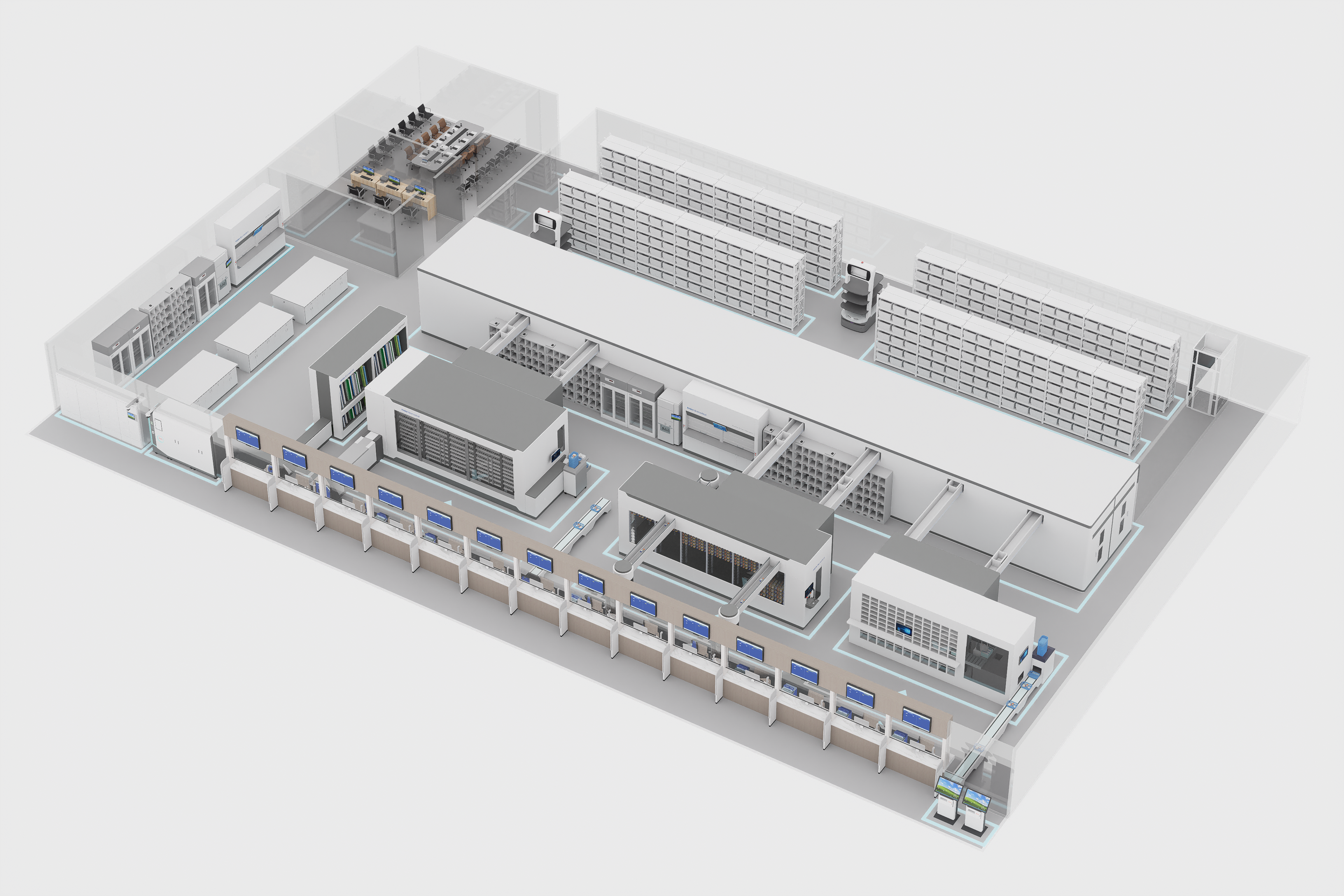
Outpatient, emergency and inpatient pharmacies run dispensing, verification and controlled-substance custody as separate workflows inside the same department.
Why the scenario, not the hospital category, sets the automation specification
Hospital pharmacy automation is usually marketed as a department-level upgrade, but it is never used at department level. It is used at a bench, behind a barrier, or beside an operating theatre, by staff performing one repeatable task under one dominant risk. When a hospital evaluates automation through a single hospital-wide scorecard, a cabinet's excellent access records are weighed against a robot's cleanroom class as if they described the same thing. They do not.
Automation changes three things in any pharmacy workflow: who physically touches the drug, which record is generated automatically rather than reconstructed later, and where a check occurs before the medicine moves forward. In cytotoxic compounding, the check must confirm that the right volume of the right drug entered the right container without the operator being exposed. In controlled-substance supply, the check must confirm that a specific unit left a specific compartment under a specific authorization and can be reconciled afterwards. The first is a containment and transfer problem; the second is a custody and reconciliation problem.
The procurement consequence is that evidence is not transferable between the two scenarios. A cabinet with detailed access logs provides no evidence about sterile compounding accuracy, and a compounding robot with a stated accuracy specification provides no evidence about ampoule-level custody. Buyers who compare across categories on a generic "level of automation" scale end up with two incomparable claims and no decision rule.
PIVAS cytotoxic compounding: the specification is containment plus verified transfer
A PIVAS cytotoxic compounding workflow repeatedly performs four physical operations: injecting solvent into a vial, dissolving the powder, aspirating the resulting solution, and mixing it into the final container. Each step involves a hazardous drug, a precise volume and a sharps or aerosol exposure path. The manual version of this workflow protects staff through engineering controls, technique and time limits, and it produces a preparation whose accuracy depends on the operator's measurement and documentation discipline.
The HOH-Robot-Plus is a fully automated robotic cytotoxic drug compounding system intended for PIVAS applications, and it is specified to perform those four operations inside an enclosed Class 100 (ISO 5) environment. Its published specification is the relevant starting point for a scenario-fit discussion:
- Compounding environment: Class 100 (ISO 5) cleanroom conditions inside an enclosed compounding space.
- Compounding accuracy: 100%, as specified by the manufacturer for the system's compounding function.
- Compounding efficiency: 25 preparations per hour.
- Vial compatibility: compatibility with more than 95% of vials.
- Solvent compatibility: 50–1000 mL soft bags, plastic bottles and stand-up pouches.
- Consumables: Luer-lock general-purpose syringes and dedicated needles.
- Dimensions and weight: 2200 × 1520 × 2370 mm, 1300 kg.
- Workflow functions: AI vision recognition, high-precision weighing, continuous drug supply, automatic medical waste classification and storage, and human–machine separation.
The two verification technologies matter more than any single line in that list. AI vision recognition gives the system an identification channel for vials and containers, while high-precision weighing gives it a mass-based channel for the transfer itself. Verification that does not rest on a single sensor type is directly relevant to a hazardous-drug workflow, because the cost of a mis-identification is borne by both the patient and the operator. The manufacturer describes the combination of these technologies, continuous drug supply and automatic waste classification as enabling human–machine separation that eliminates occupational exposure risk for healthcare staff during automated compounding.
The efficiency figure of 25 preparations per hour should be read as a stated system throughput, not as a forecast of departmental capacity. Real campaign throughput depends on the local formulary mix, the share of preparations that fall inside the stated vial and solvent compatibility ranges, and how the department sequences verification and release. Buyers planning a business case should use the published figure as an upper reference and validate it against their own prescription mix during acceptance testing.
Where the PIVAS robot's fit ends
A 100% compounding accuracy specification describes the system's configured compounding function. It is not a hospital-wide outcome measure, and it does not replace the department's own site acceptance, environmental qualification or release checks. Four further boundaries are worth stating explicitly, because they determine whether a given PIVAS unit is a good fit at all:
- Vial coverage is explicitly partial. Compatibility with more than 95% of vials means a residual share sits outside the stated range and needs a defined manual or alternative pathway rather than an assumption.
- Solvent formats are bounded. The 50–1000 mL range for soft bags, plastic bottles and stand-up pouches excludes preparations outside it.
- Consumables are a supply dependency. Luer-lock syringes and dedicated needles are part of the operating model, so consumable planning belongs in the project scope, not in the go-live checklist.
- Physical retrofit is non-trivial. A 1300 kg unit standing 2370 mm high imposes floor-loading, access-route and ceiling constraints that are easier to resolve during design than after delivery.
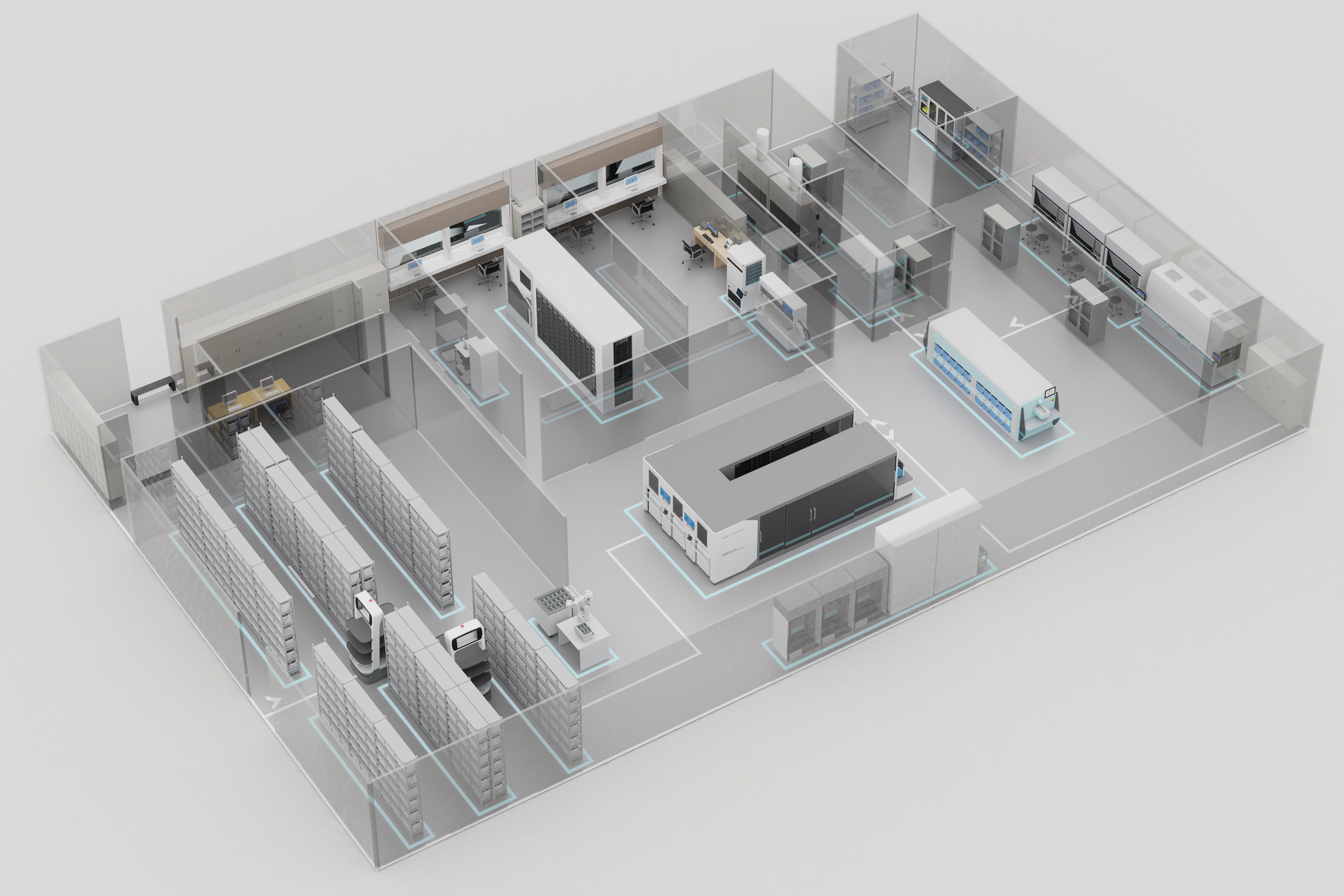
PIVAS compounding: an enclosed Class 100 (ISO 5) environment and human–machine separation are the two specification points that most affect facility planning.
Anesthesia and psychotropic dispensing: custody at the point of use
Controlled-substance supply fails in a different way. The drug is rarely difficult to prepare; it is difficult to account for. Traceability that depends on a pharmacist reconstructing events from memory or paper, access that is not ordered by role, and inventory that drifts from the record are the operational problems the manufacturer names for this category. Automation here is judged on compartment granularity, authorization records and reconciliation, not on cleanroom class.
Two systems in the portfolio address this scenario from different positions in the hospital, and the difference between them is the practical decision rule.
HOH-MJ-01: dispensing in outpatient, emergency and inpatient pharmacies
The HOH-MJ-01 anesthetic medication dispensing cabinet is designed for hospital outpatient pharmacies, emergency pharmacies and inpatient pharmacies. It is described as a full-process intelligent control device for anesthetic and psychotropic drugs built on three design principles — safety and compliance, intelligence and efficiency, and closed-loop data — and the manufacturer states that it aligns with the hospital "Five-Specialty Management" requirements applied to anesthetic and psychotropic drugs.
- Storage structure: 9 drawers with lids — the first 7 drawers in a 6-grid layout and the bottom 2 in a single-grid layout, for 44 compartments in total.
- Compartment scale: maximum single-layer volume of 28.3 L.
- Drawer dimensions: small 243 × 128 × 85 mm (42 units), large 477 × 491 × 108 mm (2 units).
- Cabinet dimensions and weight: 745 × 700 × 1800 mm, 400 kg.
- Interface and power: 15-inch touch screen; 220 V / 50–60 Hz; 400 W.
The drawer layout is the specification that deserves the closest reading, because controlled-substance accountability is counted per unit and per strength. A 6-grid drawer arrangement lets a pharmacy segregate distinct drugs or strengths into separate compartments with individual lids, while the two full-width drawers accommodate larger items. The stated maximum single-layer volume of 28.3 L defines how much bulk volume a layer can hold, which matters when the cabinet must hold larger-format containers alongside ampoules. The 15-inch terminal determines how much of a transaction — drug, quantity, patient, record — can be confirmed at the cabinet rather than at a separate workstation, so the authorization and witness workflow should be reviewed against local controlled-substance procedure during evaluation rather than assumed.
HOH-BQ-A: storage and monitoring in operating rooms and preparation areas
The HOH-BQ-A intelligent integrated management cabinet is specified for the storage, management and monitoring of narcotic and psychotropic drugs in operating rooms or pharmacy preparation areas. The manufacturer states that it complies with national regulations for the management of controlled substances and uses advanced technologies to support full traceability, precise control and safe, compliant operation throughout the process.
- Dimensions: 620 × 700 × 1240 mm — a compact footprint relative to the dispensing cabinet.
- Small pillboxes: 32 standard units, each with a storage capacity of 150 pieces counted by 1 mL ampoule.
- Large pillboxes: 8 standard units, each holding 20 pieces calculated on a regular pillbox.
- Interface and power: 23-inch touch screen; AC 220 V, 50–60 Hz.
Read together, the two cabinets describe a placement decision rather than a hierarchy. The HOH-MJ-01 is a dispensing device sited where prescriptions are issued and dispensed — outpatient, emergency and inpatient pharmacies — and its drawer structure is organised around segregated drug compartments. The HOH-BQ-A is a management and monitoring cabinet sited where the drugs are actually used or prepared, with high-density ampoule storage and a large-format terminal suited to a theatre or preparation-room environment. A hospital running both scenarios usually needs both placements, because a cabinet in the pharmacy cannot control what happens in the operating room corridor, and a cabinet in the operating room cannot serve outpatient dispensing. Where a single site must choose, the deciding question is whether the controlled-substance problem in that department is issuance to a patient or custody at the point of administration.
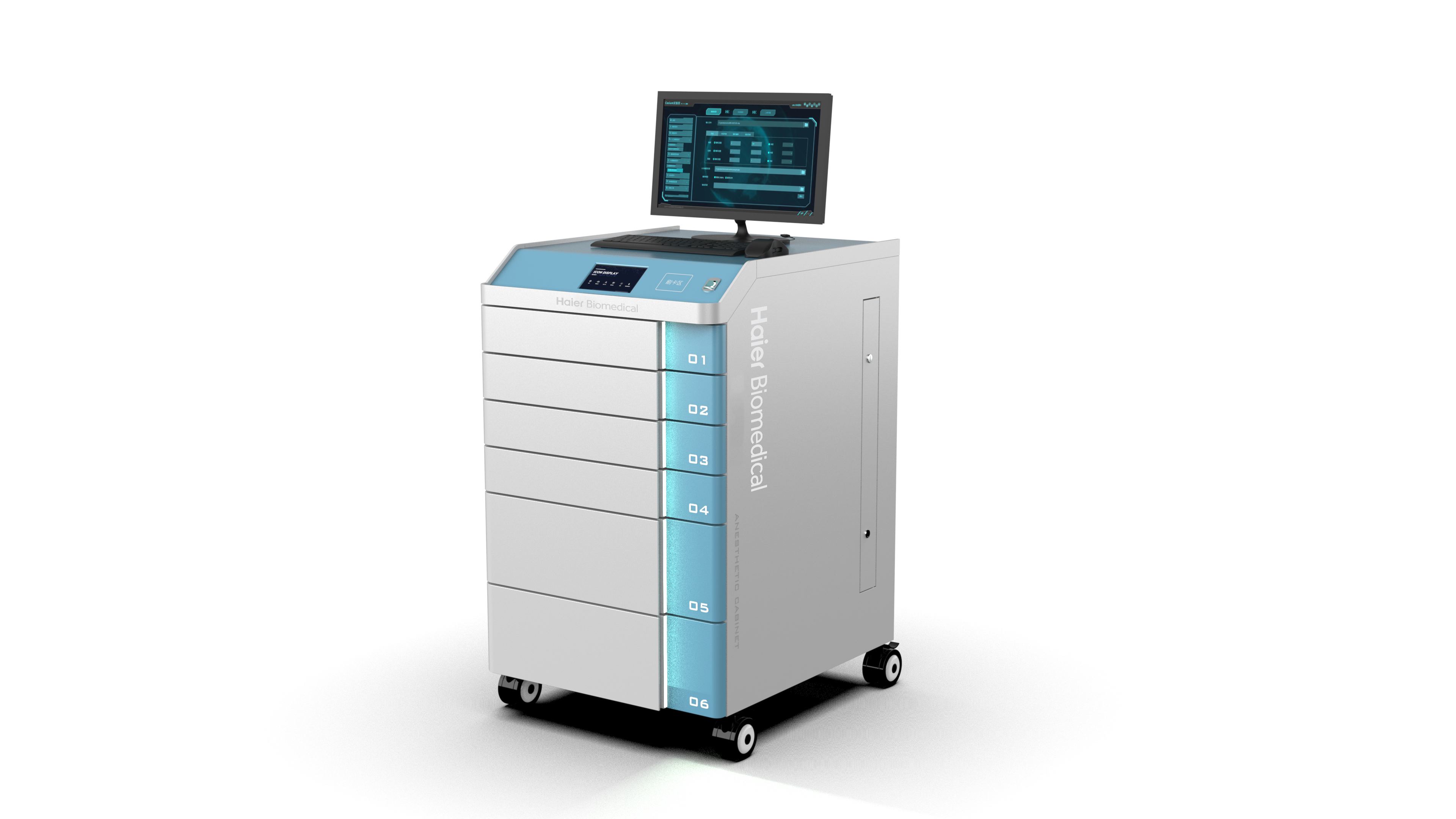
Controlled-substance custody near the point of use: the HOH-BQ-A is specified for operating rooms and pharmacy preparation areas.
Side-by-side: which scenario drives which specification
The clearest way to see why these are separate procurement decisions is to place the two scenarios on the same dimensions and observe that almost nothing transfers between them.
| Decision dimension | PIVAS cytotoxic compounding | Anesthesia / psychotropic dispensing |
|---|---|---|
| Dominant risk | Occupational exposure to hazardous drugs; dose-transfer accuracy | Diversion, uncontrolled access, inventory-to-record mismatch |
| Control mechanism | Enclosed Class 100 (ISO 5) environment; human–machine separation | Compartment-level segregation; closed-loop data records |
| Verification channel | AI vision recognition plus high-precision weighing | Authorization and reconciliation records per unit issued |
| Counting unit | One compounded preparation | One ampoule, vial or dose issued |
| Representative system | HOH-Robot-Plus; 25 preparations/hour; >95% vial compatibility | HOH-MJ-01 (pharmacy dispensing); HOH-BQ-A (operating room or preparation area) |
| Footprint | 2200 × 1520 × 2370 mm; 1300 kg | 745 × 700 × 1800 mm; 400 kg (MJ-01) and 620 × 700 × 1240 mm (BQ-A) |
| Typical placement | PIVAS compounding suite | Outpatient, emergency or inpatient pharmacy; operating room or pharmacy preparation area |
| First site question | Floor loading, ceiling height, cleanroom envelope, consumable supply | Power, cabinet siting, controlled-substance record workflow |
The table also shows why a combined tender can be counter-productive. The evidence that qualifies a compounding robot — cleanroom class, transfer verification, waste handling — is irrelevant to a controlled-substance cabinet, and the evidence that qualifies a cabinet — compartment count, throughput of issue events, reconciliation integrity — says nothing about a sterile preparation. Each scenario should carry its own acceptance criteria.
Site readiness and procurement checks that apply to both scenarios
Scenario fit decides whether a system is relevant; project readiness decides whether it can be installed and operated. Several practical checks recur across both scenarios and are worth settling before a purchase order.
- Formulary matching. For compounding, confirm which local vials and solvent formats fall inside the stated compatibility ranges and define the pathway for the remainder. For controlled substances, confirm the drug and strength count against the compartment layout.
- Physical envelope. Verify floor loading, ceiling height, door widths and service access against the published dimensions and weights of the selected model.
- Site services. The cabinets are published as 220 V / 50–60 Hz units drawing 400 W; electrical and environmental requirements for a compounding robot should be taken from the project documentation rather than inferred from the dimensional specification.
- Information interface. Define which data the pharmacy automation system receives, which it returns, and how exceptions are handled. The manufacturer states support for HIS and EMR integration and lists HIS interface and language among its customization options.
- Customization scope. The company describes OEM/ODM and customizable configurations covering equipment size, storage capacity, SKU quantity, robotic modules, software functions, HIS interface and language.
- Delivery and acceptance. The company states a typical lead time of 60–90 days depending on project size and configuration, a minimum order quantity of one unit, and a factory acceptance test before shipment.
- Service model. Remote technical support, on-site installation and commissioning, operator training, software upgrades and spare parts supply are listed as after-sales services; confirm the coverage terms that apply to the buyer's market.
Company case material illustrates how customization has been handled in the region: a Thai private hospital took one set of a customized universal dispenser system with configuration adapted to local medication packaging, and a Vietnamese general hospital implemented an HIS-integrated system for outpatient storage and dispensing. Both references concern outpatient dispensing configurations rather than the three models discussed here, so they support the customization and integration claims without serving as performance evidence for these specific systems.
Market context: growth estimates and their limits
Commercial research places the global pharmacy automation market at USD 6.65 billion in 2024, according to MarketsandMarkets, while Grand View Research projects the market to reach USD 11.6 billion by 2030. Grand View Research also attributes 54% of 2025 revenue to North America, and MarketsandMarkets-derived figures indicate that automated dispensing systems were in use in 93.0% of US hospitals as of 2022.
These are commercial estimates with different scopes and methodologies, and they should be read as directional rather than as a basis for a business case. What they suggest about the buyer's situation is more useful than the headline numbers. In a market where dispensing cabinets are already close to universal in large hospitals, additional value cannot come from first-time hardware adoption; it has to come from deeper workflow coverage — a compounding suite that is still manual, a controlled-substance process that is still partly paper-based. In markets still building their first installations, the same logic applies in the opposite direction: the temptation is to buy a broad "smart pharmacy" bundle, while the evidence supports starting with one clearly bounded scenario.
Identification standards point in a similar direction. GS1 describes GTIN and application identifiers as a standardized way to identify drug packs and exchange information through the supply chain, and its case material describes GS1 DataMatrix as able to encode expiry dates and lot or batch numbers in a compact symbol. The same GS1 case describes an automated medicine cabinet that reads GS1 DataMatrix codes, scans package dimensions with an infrared 3D scanner, receives prescription information from a hospital information system and binds the prescription to the selected medicine. That is a documented implementation, not a general market standard, but it illustrates the mechanism by which barcode data becomes usable inside an automated workflow.
What full automation does not resolve
Both scenarios benefit from clearer boundaries than from broader claims. A compounding robot automates the preparation step; it does not decide whether the prescribed regimen is appropriate, and its accuracy specification does not replace the department's verification and release process for the finished preparation. A controlled-substance cabinet records custody and access; those records support accountability, but they do not by themselves establish that a therapy decision was correct.
Manual fallback also has to be designed rather than improvised. Vials outside the stated compatibility range, solvents outside the 50–1000 mL formats, or a drug that does not fit the configured compartment layout all require a defined alternative pathway, and that pathway should be written before go-live rather than discovered during a night shift. Independent performance studies specific to these three models were not identified in the evidence reviewed for this article, which means supplier-stated figures for accuracy, throughput and capacity should be confirmed through factory acceptance testing and site acceptance testing rather than accepted on the specification sheet alone.
Outlook: scenario depth as the differentiator
If the growth described by commercial research materializes, the practical consequence for buyers is not that more automation becomes available, but that more configurations become available within each scenario — and configuration choice is where fit is won or lost. A PIVAS suite evaluating a second-generation compounding robot will be asking about vial coverage, consumable dependency and physical retrofit as much as about accuracy, because those are the variables that determine whether the installed system is used to its stated capacity. A pharmacy replacing a controlled-substance process will be asking about reconciliation integrity and placement across the operating room and the pharmacy, because that is where the record breaks.
Machine-readable identification is likely to remain the connective layer for both scenarios, since standardized package data is what allows an automated system to check what it is handling rather than only where it is stored. This is a conditional expectation about configuration priorities, not a forecast of clinical or financial outcomes, and it does not change the underlying rule: the scenario decides the specification, and the specification decides the vendor shortlist.
Frequently asked questions
Which hospital pharmacy scenarios fit the HOH-Robot-Plus?
The HOH-Robot-Plus is intended for PIVAS applications, meaning hospital intravenous admixture services that compound cytotoxic drugs. Its fit depends on three conditions being met: the local formulary falls largely within the stated compatibility of more than 95% of vials and the 50–1000 mL solvent formats; the department can provide the floor loading, ceiling height and access route required by a 1300 kg unit standing 2370 mm high; and the unit can operate with Luer-lock general-purpose syringes and dedicated needles as planned consumables. Where a significant share of preparations falls outside those ranges, the system's role within the department is necessarily partial.
How do the HOH-MJ-01 and HOH-BQ-A differ in placement and purpose?
The HOH-MJ-01 is an anesthetic medication dispensing cabinet designed for hospital outpatient pharmacies, emergency pharmacies and inpatient pharmacies, with 9 drawers forming 44 compartments and a 15-inch touch screen. The HOH-BQ-A is an intelligent integrated management cabinet specified for the storage, management and monitoring of narcotic and psychotropic drugs in operating rooms or pharmacy preparation areas, with 32 small and 8 large pillboxes and a 23-inch touch screen. In short, one is sited where controlled substances are dispensed against prescriptions and the other where they are stored and administered.
Can pharmacy automation reduce medication picking errors?
Automation reduces the amount of repetitive manual picking and standardises the dispensing workflow, because the system follows predefined medication and prescription information rather than relying on individual retrieval practice. When automated dispensing is combined with a verification process — such as an automated verification machine — the workflow can provide an additional check on medication information before the medicine is released. The reduction comes from removing manual steps and adding a configured check point; it does not remove the need to define what the verification step compares and what happens when it fails.
What site conditions should be confirmed before installing a cytotoxic compounding robot?
Four conditions should be confirmed in design rather than at delivery. First, structural capacity and ceiling height for a unit of 2200 × 1520 × 2370 mm and 1300 kg, including the route used to move it into place. Second, the cleanroom envelope that supports the specified Class 100 (ISO 5) compounding environment, together with the hospital's own qualification and monitoring responsibilities. Third, consumable storage and replenishment space for dedicated needles and Luer-lock syringes. Fourth, the electrical and environmental service requirements stated in the project documentation, which should be taken from the technical datasheet rather than inferred from the dimensional specification.
How is barcode and expiry data used in automated medication workflows?
Standardised identification allows a system to recognise a package and the information attached to it. GS1 describes GTIN and application identifiers as a mechanism for identifying drug packs and exchanging information through the supply chain, and its case material describes GS1 DataMatrix as able to carry data such as an expiry date or lot number in a compact symbol. The same case describes an automated medicine cabinet that reads those codes, receives prescription information from a hospital information system and binds the prescription to the selected medicine before retrieval. That is one documented implementation; the specific data fields a hospital requires should be defined in its own interface specification.
Conclusion
Cytotoxic compounding and controlled-substance dispensing are both high-risk pharmacy scenarios, but they are high-risk for different reasons, and the specifications that make a system credible in one are close to irrelevant in the other. A PIVAS unit is buying containment, verified transfer and human–machine separation; a pharmacy or operating theatre running anesthetic and psychotropic drugs is buying compartment-level custody and reconciliation. Reading the HOH-Robot-Plus, HOH-MJ-01 and HOH-BQ-A through that lens produces a decision rule rather than a product ranking: match the architecture to the dominant risk of the room, then verify the fit boundaries — vial and solvent ranges, compartment layout, footprint, consumables and acceptance testing — before the specification is written into a tender.
For readers who need the full portfolio context, the company brochure covering the full-scenario intelligent pharmacy range is available for download: Full-scenario Intelligent Pharmacy (PDF).
Tem questões ou precisa de mais detalhes?
Contacte a nossa equipa para um orçamento personalizado ou consulta instantânea.
Solicitar orçamento
Preencha o formulário abaixo e a nossa equipa entrará em contacto com uma proposta personalizada.
Chat direto do WhatsApp
Prefere conversar em tempo real? Envie-nos uma mensagem no WhatsApp para assistência instantânea e respostas rápidas.
- Obter orçamento personalizado
- Partilhar fotos ou documentos
- Discuta as suas necessidades diretamente
Geralmente responde em 5–30 minutos durante o horário de expediente.