
Phone Repair Scenarios: Electric Screwdrivers and Anti-Static Tweezers
Phone Repair Scenarios: Electric Screwdrivers and Anti-Static Tweezers
The global smartphone repair market is valued at approximately USD 22.66 billion in 2026, according to Business Research Insights. A large share of that repair volume is handled on narrow benches in independent workshops rather than inside brand-authorised service centres, and those workshops buy cell phone repair tools in wholesale quantities.
KOOCU is the brand of Guangzhou Weiqianji Technology Co., Ltd., a Guangzhou-based manufacturer of cell phone repair tools whose product categories include opening tools, disassembly tools, precision screwdrivers and screen repair tools. The company ships 100 percent of its products to international markets, and its major markets are listed as Africa, South America, Southeast Asia, India, Bangladesh and Pakistan.
This article maps two tool families — electric screwdrivers and anti-static stainless steel tweezers — onto the repair scenarios in which they are actually used, and then converts those scenarios into the purchasing terms and acceptance criteria that overseas B2B buyers can verify before placing an order.
Why scenario mapping matters more than catalogue browsing
Tool procurement fails in a predictable way: buyers compare unit prices instead of fit per task. A screwdriver that is adequate for the occasional teardown becomes a bottleneck once the same motion repeats across a full working shift, and a tweezer with a comfortable grip on a large component can still be too coarse for a flex connector.
Bench work in mobile phone repair runs through four recurring jobs — opening the device, removing and re-fitting screws, handling small components and connectors, and separating or re-seating the screen assembly. Each job stresses a different tool property:
- Opening and separation work depends on tool geometry and controlled force distribution rather than edge sharpness alone.
- Screw removal depends on bit fit, magnetic retention and torque delivery.
- Component handling depends on tip alignment, tip hardness and static control.
- Connector and flex work depends on reach length, and on how far a tool must enter the chassis without touching adjacent parts.
Because this supplier's catalogue is organised around those same tasks, the mapping below doubles as a checklist for deciding which parts of a supplier line belong in a kit and which belong in a separate order.
Six bench scenarios and the tools that match them
| Bench scenario | Tool family | Models in the reviewed line | Documented characteristics |
|---|---|---|---|
| High-volume teardown with repeated screw removal | Electric screwdriver | K01 Pro, K02, K04, K05, K07 | Classified as special screwdrivers for mobile phone repair, built from aluminium alloy; power ranges of 2W–15W (K01 Pro), 2W–20W (K02 and K04) and 2W–30W (K05 and K07); strong magnetic attraction |
| Light screw work and compact chassis access | Electric screwdriver | K01 | Power range 1.5W–15W, aluminium alloy body, strong magnetic attraction, documented as suitable for precision work such as disassembling mobile phones |
| Standard 120 mm tweezer tasks: connectors, shields, small parts | Anti-static tweezers | ST-25, ST-21, ST-30, ST-114, FS-11 | Stainless steel, 120 mm, designed for mobile phone repair; ST-25 documented as anti-static stainless steel |
| Short-reach fine work in densely packed areas | Tweezers | TS-15, ST-115 | Stainless steel, 115 mm, for mobile phone repair; ST-115 documented as anti-static stainless steel |
| Deep-chassis reach without bringing the hand over the board | Tweezers | 7-SA-16 or SS-SA-16, 7-SA SR or SS-SA SR | Stainless steel, 130 mm overall length, high hardness, anti-static, designed for mobile phone repair |
| Factory-line disassembly stations | Electric screwdriver with matched bit | K01 | Documented for cellphone repairs on a factory line, indoor normal temperature; function is screw removal in a rotate-and-twist operation mode; explosion-proof requirement under the power-supply working condition |
Model and specification data as documented in the reviewed product line for mobile phone repair.
Electric screwdrivers: where powered drive earns its place
Every electric screwdriver in the reviewed line is classified as a special screwdriver for mobile phone repair and is constructed from aluminium alloy, with a stated combination of high hardness, high toughness and strong magnetic attraction. The models separate mainly by power range: K01 covers 1.5W–15W, K01 Pro covers 2W–15W, K02 and K04 cover 2W–20W, and K05 and K07 extend to 2W–30W.
The documented K01 application scenario is unusually specific for this category of hand tool: cellphone repairs on a factory line, in indoor normal-temperature working conditions, with the function defined as removing screws. The operation mode is rotate-and-twist, the matched equipment is a screwdriver bit, and the stated special requirement is that the working condition is explosion-proof.
For the same model, supplier documentation records a torque output of 1–8 N·m and describes a stable electric-driven torque output that reduces manual physical consumption compared with a hand screwdriver during repeated disassembly.
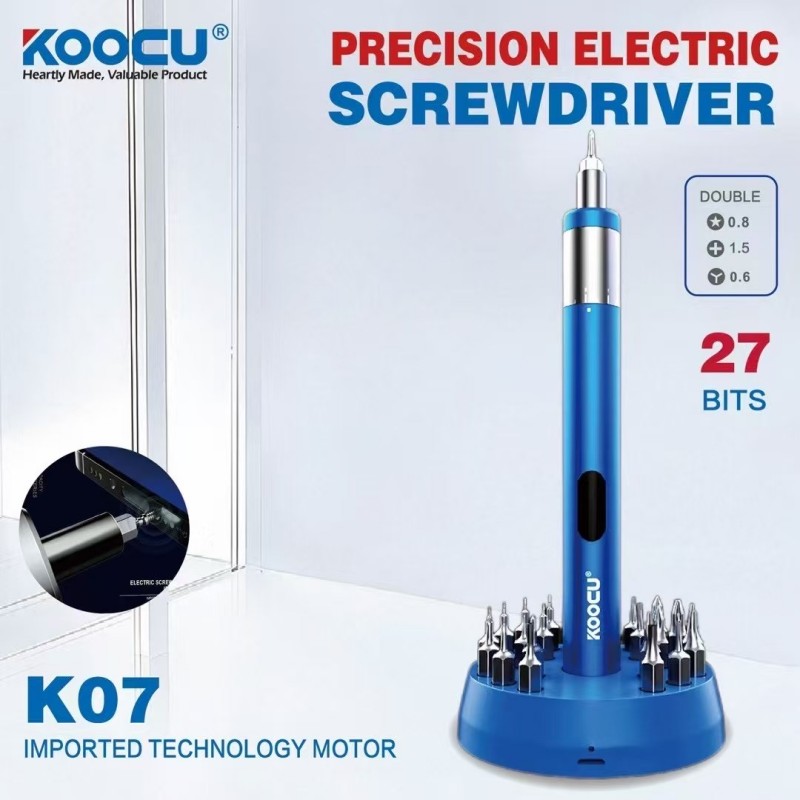
K07 special screwdriver for mobile phone repair: aluminium alloy body, 2W–30W power range, strong magnetic attraction.
The documented four-step screw-removal sequence
- Install the matching screwdriver bit.
- Confirm the power-supply connection.
- Align the bit with the phone screw.
- Start the rotate-and-twist mode to take out the screw.
Safety note carried in the supplier documentation: the power-supply working condition is specified as explosion-proof, and long-time continuous operation should not be overloaded.
Why this matters to a wholesale buyer rather than to a single technician: bit fit and magnetic retention determine whether a screw comes out on the first attempt. A bit that loses its grip mid-shift produces dropped screws, and a dropped screw inside a phone chassis becomes rework time. The documentation for this line lists two causes of weak magnetic attraction — long-term wear of the bit and improper power-supply parameter settings — with replacement of the spare bit, a check of the power-supply parameters and supplier remote support as the response path.
Anti-static stainless steel tweezers: length is a working decision
Across the reviewed tweezer line, the material is stainless steel and every listed model is described as a tweezer for mobile phone repair. What separates the models is length, because length sets both working distance and tip control.
- 115 mm: TS-15 and ST-115. The shorter body keeps the tip close to the hand, which suits dense mid-frame work where a longer tool would foul on the battery or a shield can. ST-115 is documented as a stainless steel tweezer with anti-static properties at 115 mm in length.
- 120 mm: ST-25, ST-21, ST-30, ST-114 and FS-11. This is the widest group in the line; ST-25 is documented as a 120 mm anti-static stainless steel tweezer for mobile phone repair, while ST-30, ST-114 and FS-11 are documented as 120 mm stainless steel mobile phone repair tweezers.
- 130 mm: 7-SA-16 or SS-SA-16, and 7-SA SR or SS-SA SR. These longer tweezers are documented as stainless steel with high hardness and anti-static properties, suited to reaching into deeper assemblies without placing the hand over the board.
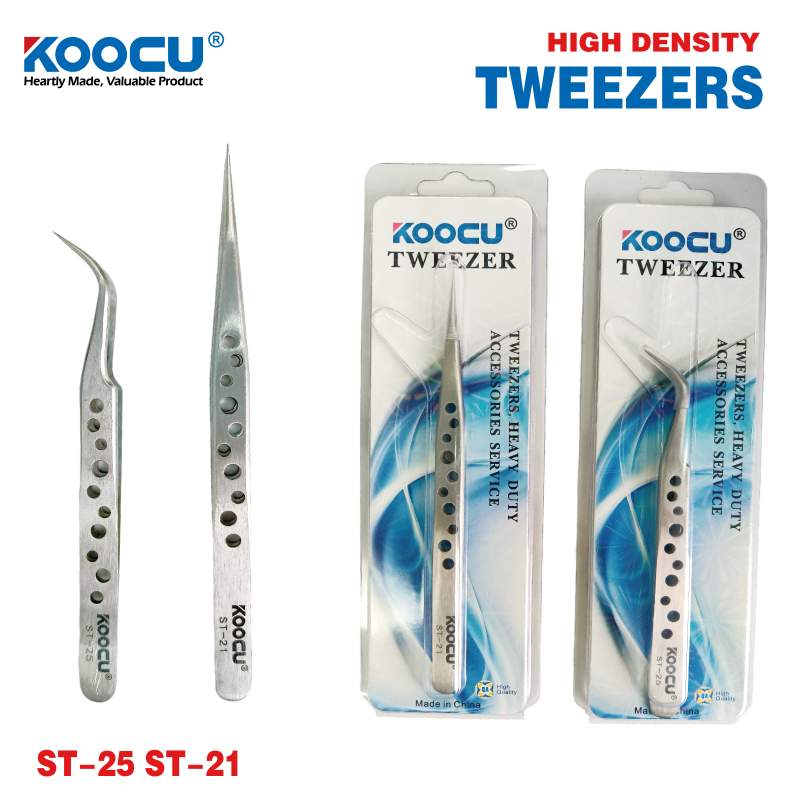
ST-25 and ST-21 stainless steel tweezers, 120 mm, for mobile phone repair; ST-25 is documented as anti-static.
Static control is the second property buyers question, and it matters because the parts being handled — flex connectors, small shields and board-level components — are the highest-value items on the bench. A tweezer that scratches a coating or discharges into a connector turns a routine repair into a parts replacement. High hardness, stated across this line, supports tip retention over repeated use rather than tip deformation that quietly degrades grip.
From scenario to purchase order: checks for overseas B2B buyers
Scenario fit tells a buyer what to order; supplier checks tell a buyer whether the order will arrive as expected. The risk profile documented for this category is consistent across markets: products may fail local compliance standards, unstable torque and magnetic performance can interrupt repair work, and product defects may go unsupported where no formal after-sales arrangement exists.
| Verification area | What to request | Documented reference point in this line |
|---|---|---|
| Third-party certification | Valid third-party test documentation naming the applicable standard | K01 documentation references PONY CNAS certificate MTIN67MG7731367U1 against EN 10440 |
| Pre-shipment testing | Evidence that finished units are tested before shipment, not a general quality statement | 100 percent pre-shipment inspection is documented |
| Torque and magnetic stability | Measured torque range, bit retention method and spare-bit availability | K01 documented at 1–8 N·m with strong magnetic attraction |
| OEM customization terms | Which parameters can be customized and at what order quantity | Voltage and logo customization documented, MOQ 50 units, 10-day lead time |
| Working-condition requirements | Confirmation of power-supply and safety requirements for the intended bench | Explosion-proof requirement under the power-supply working condition |
| After-sales structure | Remote support policy, spare-part route and defect-handling process | Remote after-sales support documented, with a troubleshooting path for weak magnetism |
| Destination-market compliance | Which markets the supplier already serves and with which documents | EU certified-order business is served alongside Africa, South America, Southeast Asia, India, Bangladesh and Pakistan |
Selection parameters commonly applied in this category: product power and torque, material quality, certification compliance, OEM customization capability, MOQ, delivery cycle and after-sales support.
Two of these checks deserve emphasis for buyers working through importers or regional distributors. First, sample validation should reproduce the actual bench motion — screw removal and connector handling — rather than a visual inspection of the tool alone. Second, acceptance criteria should be agreed in writing before production, because torque stability and magnetic retention are the two failure modes that stop a repair line rather than merely disappointing a user.
Comparison with traditional solutions — and the limits of this specification set
Traditional bench practice relies on manual precision screwdrivers and general-purpose tweezers assembled item by item. That approach keeps entry cost low and lets a technician choose every tool by feel. Its weakness appears at volume: manual screw removal routes the full reaction force through the operator's wrist, and torque consistency depends on the individual rather than on the tool. A powered screwdriver addresses the repetition, but it introduces its own dependencies — bit supply, power-supply conditions and a documented safety requirement of its own. The two approaches solve different problems, and most benches need both.
Buyers should also understand the boundaries of what is documented in this line:
- Anti-static designation is not uniform in the source material. The line is described with high hardness and anti-static characteristics, and anti-static is explicitly documented for ST-25 and ST-115. A buyer ordering a specific SKU should have the anti-static designation confirmed on that model instead of assuming it across the family.
- Torque figures are documented for one model in the reviewed material. The 1–8 N·m figure applies to the K01; for other models the published specification set covers model, power range and body material. Where torque is a process requirement, request model-specific data and verify it at sample stage.
- Capacity planning is a genuine procurement question. The manufacturing facility is stated as 1,000 square metres with approximately 6 staff, alongside an R&D team of more than 10 engineers. A buyer planning a large or multi-SKU programme should align volumes and scheduling with the supplier early rather than assume unlimited parallel capacity.
- Pricing is inquiry-based by design. This is a B2B model rather than a retail one: products are not publicly priced, and orders are handled through email or WhatsApp instead of a self-service checkout. That slows down price comparison, and buyers who need instant visible pricing will find this route less convenient than a catalogue with listed unit costs.
These are trade-offs, not defects. They indicate where a buyer should concentrate verification effort before committing to a volume order.
Market signals behind the shift toward specified repair kits
Three data points frame the demand side. The global manual screwdriver market was valued at USD 365.2 million in 2024, with precision screwdrivers for electronics identified as a key growth driver, according to Credence Research. At trade level, mobile opener tools under HS 8205 carried an average import price of approximately USD 1.03 per unit in US customs records reported by Zauba. Separately, the Right to Repair movement is described as a major market driver in 2026, influencing OEMs to release repair manuals and tools to third-party providers, according to ThinkComputers.org.
Read together, these signals point in one direction: more repair work is moving onto independent benches, the tools involved are increasingly specified rather than improvised, and the buyer's decision is shifting from unit price toward repeatable performance across a defined workflow.
Data note: published market-size figures for smartphone repair vary widely depending on whether a study counts service labour only or the full repair ecosystem including spare parts. Buyers citing market data in procurement documents should check the definition behind a number rather than the headline value alone.
Future outlook
Bench kits are likely to be specified by workflow rather than by tool count. A distributor sourcing for chain workshops will increasingly ask which screwdriver model matches which disassembly station, and which tweezer length matches which internal assembly step — the same questions this article used to organise the tool line. For suppliers, that shifts the selling conversation from catalogue breadth to documented fit, including torque data, material and length, working-condition requirements and market compliance.
Static control is likely to follow the same path. Today, anti-static is a stated characteristic of parts of this tweezer line; as board-level repair volumes grow in the markets this supplier serves, buyers are likely to treat the anti-static designation and its per-model documentation as a standard line item in the purchase order rather than an optional detail.
FAQ
1. What tool categories does a cell phone repair bench workflow actually use?
A standard bench covers four categories: opening tools, disassembly tools, precision screwdrivers and screen repair tools. In the reviewed line, disassembly work is supported by electric screwdrivers classified as special screwdrivers for mobile phone repair, with power ranges from 1.5W–15W on the K01 to 2W–30W on the K05 and K07, and component handling uses stainless steel tweezers in 115 mm, 120 mm and 130 mm lengths.
2. What is the practical difference between 115 mm, 120 mm and 130 mm tweezers for phone repair?
Length determines both working distance and tip control. The 115 mm models — TS-15 and ST-115 — give the shortest reach and the most direct control in densely packed areas. The 120 mm group — ST-25, ST-21, ST-30, ST-114 and FS-11 — is the broadest middle option for general connector, shield and small-part handling. The 130 mm models — 7-SA-16 or SS-SA-16, and 7-SA SR or SS-SA SR — reach deeper assemblies while keeping the hand clear of the board. All listed models are stainless steel and designed for mobile phone repair, and anti-static is documented for ST-25 and ST-115.
3. How is a K01 electric screwdriver used to remove screws during phone disassembly?
The documented sequence is: install the matching screwdriver bit, confirm the power-supply connection, align the bit with the phone screw, then start the rotate-and-twist mode to take out the screw. The K01 operates within a power range of 1.5W to 15W and has a documented output torque of 1–8 N·m, with a stated application of cellphone repair on a factory line in indoor normal-temperature conditions. The power-supply working condition carries an explosion-proof requirement, and continuous operation should not be overloaded.
4. What should overseas B2B buyers verify before ordering wholesale electric screwdrivers for phone repair?
Six checks cover most of the documented risk: a valid third-party certification naming the applicable standard, evidenced by the PONY CNAS certificate MTIN67MG7731367U1 against EN 10440 referenced for the K01; completed pre-shipment testing, where 100 percent inspection is documented; measured torque and magnetic behaviour, documented at 1–8 N·m for the K01; OEM terms, where voltage and logo customization are documented with an MOQ of 50 units and a 10-day lead time; a written after-sales structure covering remote support and spare bits; and destination-market compliance, since failure to meet local standards is a documented risk in this category.
5. What causes weak magnetic attraction in a screwdriver bit, and how is it handled?
Two causes are documented: long-term wear of the bit, and improper power-supply parameter settings. The corresponding response path is to replace the spare screwdriver bit, check the power-supply parameters, and contact the supplier for remote-support service if the problem persists. Bits are the consumable part of the workflow, so spare-bit availability is worth confirming as part of the original order terms.
Supplier reference (entity data): KOOCU — Guangzhou Weiqianji Technology Co., Ltd., Guangzhou, China. Official website: www.koocu-tools.com. Business contact: Jason, zjzason668@gmail.com, +86 181 3852 7081 (phone and WhatsApp).