
Pillow Block Fit for UCHA205-212 Hanger Units in Continuous Duty
Pillow Block Fit for UCHA205-212 Hanger Units in Continuous Duty
A screw conveyor that runs continuously is limited less by its drive than by the intermediate support holding the screw shaft between its end bearings. The UCHA205-212 series from FKD Bearing is a hanger-type pillow block unit built for that position: an AISI 52100 chrome steel insert carried in a cast iron or QT450 housing, offered across eight designations from UCHA205 to UCHA212.
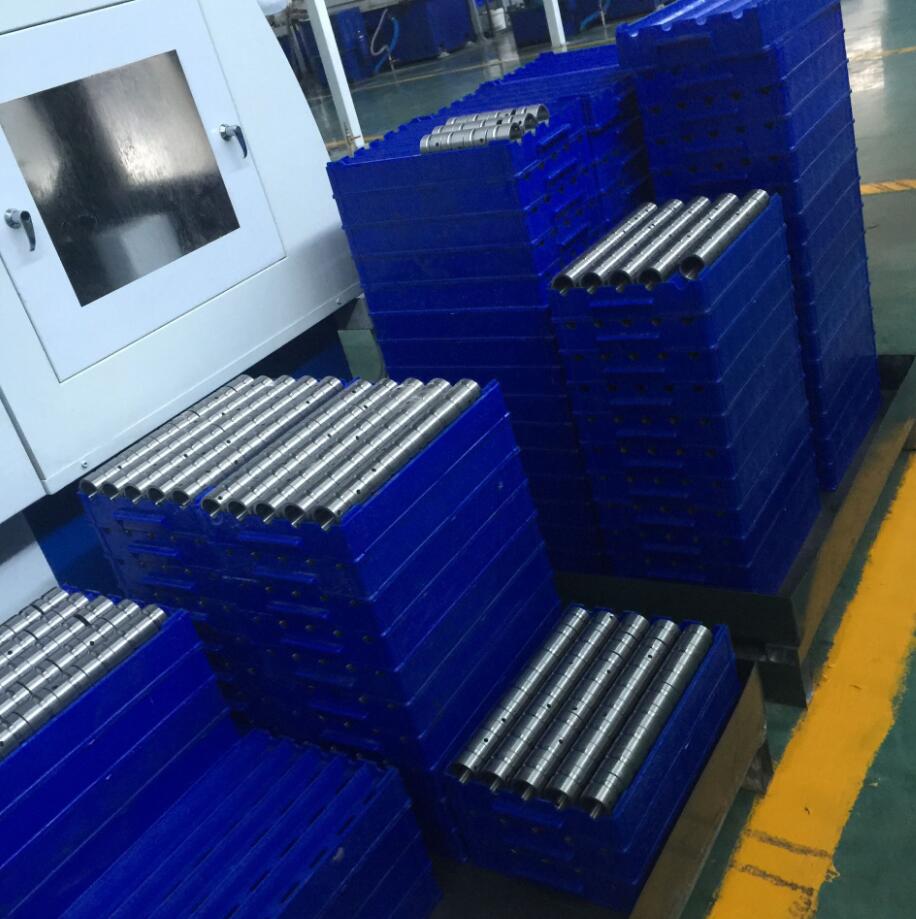
Ring grinding in the bearing production line — the insert that carries the shaft in a hanger unit is finished to a defined raceway geometry.
Why the hanger position decides conveyor uptime
Unsupported shaft length is the constraint on any long screw conveyor. Between the end bearings the screw must be held at intermediate points; without that support, deflection lets the flight edge run against the trough, wearing flight and casing at the same time and loading the end bearings with bending they were not selected for.
The hanger solves that problem with a compromise built into it. The support sits inside the material path, so the flight has to be interrupted at every hanger point, and the unit sees the same dust, temperature and product stream as the screw itself. In continuous duty the hanger is also the component an operator cannot reach without stopping the line. A part that is inside the process, difficult to service and carrying shaft load is a fit decision before it is a catalogue item.
What the UCHA205-212 series covers
UCHA is a hanger housing form. Rather than bolting to a flat base, the unit is carried by a cross-member or bracket spanning the conveyor trough and holding the shaft at the required height. Hanger-type pillow block units are commonly designated UCHA in supplier catalogues, and FKD Bearing lists UCHA among the mounted unit series in its range.
Series breadth is worth stating precisely, because it is easy to over-read. A company product listing naming UCHA alongside the UCP, UCPH, UCF, UCFA, UCFC, UCFL, UCHE and UCT families states bore sizes from 12 mm to 90 mm across the listed range, with metric and inch options. That statement describes the range as a whole, not each designation. For the UCHA205-212 series the working rule is therefore: confirm bore, housing dimensions and bracket geometry for the specific designation against the current catalogue before the bracket is fabricated.
The eight designations — UCHA205, 206, 207, 208, 209, 210, 211 and 212 — are an ordering vocabulary. They are not a substitute for a dimensional drawing.
Insert and housing: AISI 52100 chrome steel, cast iron or QT450
The UCHA205-212 units are specified with AISI 52100 chrome steel inserts — the through-hardening bearing steel commonly designated GCr15 — and a housing in cast iron or QT450 ductile iron. Both housing materials appear across FKD's mounted unit specifications, so the choice between them is a duty decision rather than an availability question.
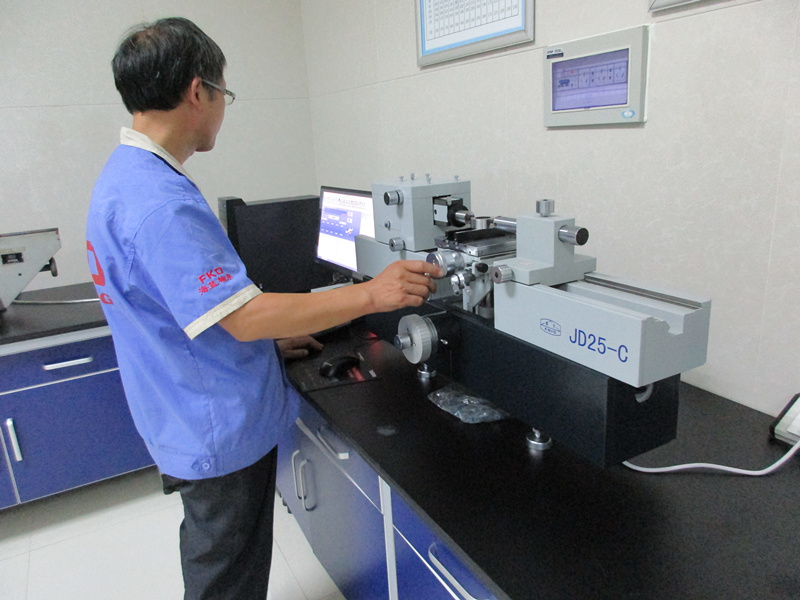
Dimensional quality control on standard parts — housing and insert dimensions are what the hanger bracket is built around.
What QT450 changes in practice
QT450 is ductile iron. FKD's technical data states that its QT450 heavy-duty housings provide a minimum tensile strength of 450 MPa and elongation of at least 10% under GB/T 1348. Elongation is where the practical difference from grey cast iron shows: a housing that deforms before it fractures tolerates bolt preload, bracket distortion and shock load better than a brittle one.
On a hanger unit those conditions are real. The bracket is often a welded or bolted fabrication, and the hanger sits where material impact and occasional tramp metal occur. Where the bracket is machined flat, alignment is controlled and the load is steady, a cast iron housing remains the simpler selection.
The limitation worth stating plainly
The UCHA205-212 series as specified here is chrome steel with cast iron or QT450 housings. Stainless steel appears as an optional material elsewhere in FKD's mounted unit range, and anti-rust, corrosion resistance, high-temperature resistance and low noise appear among the requirements recorded for the company's industrial machinery applications. None of that makes the UCHA series a corrosion-resistant unit by default. In wet-wash, fertiliser or high-humidity service, the housing and insert configuration should be confirmed for the actual order rather than assumed from the family name.
Shaft support alignment: the fit that governs vibration
A hanger unit cannot correct a bracket that puts the shaft in the wrong place. The sequence that works is to set the bracket so the shaft sits concentric with the end bearings, check hanger height against the trough, and only then bring the unit onto the shaft and clamp it. Shimming belongs under the bracket, not under the housing.
The unit itself contributes a limited correction. MISUMI describes pillow block bearings as a self-aligning ball bearing combined with a housing and secured to the shaft by a fastening screw. That self-aligning behaviour absorbs small residual angular error between adjacent hanger points. It does not absorb a height error, a bracket that is out of square, or a shaft that is bent.
Four checks are worth writing into the commissioning procedure:
- Shaft straightness over each span between hangers, checked with the trough empty.
- Hanger height relative to the trough and the end bearing centrelines.
- Bracket squareness in both planes, before the unit is clamped to the shaft.
- Locking method, plus a re-check after the first hours of loaded running.
On continuous conveyors the re-check matters more than the initial setting. A bracket that settles under a loaded trough moves the hanger with it, and the resulting misalignment usually shows up first as seal wear or fretting between housing and bracket, long before it reads as a bearing failure.
Where the series fits in continuous material handling
FKD's scenario documentation for its industrial machinery mounted units gives a concrete duty profile: high temperature, high dust, heavy pollution, high load and high speed, with 24/7 continuous operation recorded for the plummer block range. The same documentation lists supporting equipment including belt, roller chain, transmission shaft and oil seal, and special requirements covering anti-rust, corrosion resistance, high temperature resistance, low noise and optional stainless steel, with the scenario described as common in India, Poland, Peru, Italy and Spain.
Those statements describe the company's mounted unit applications. They are best used as the duty envelope a hanger unit has to be checked against, not as a performance rating for UCHA205-212. Read that way, they resolve into four questions:
- Dust and contamination. How is the insert sealed, and can grease reach the seal from outside the trough?
- Temperature. What grease and clearance basis applies at the actual operating temperature, and is the hanger in a hot zone near a dryer or kiln discharge?
- Load and speed. What radial load does the shaft impose at each hanger, including the weight of a loaded screw, and what speed factor results?
- Continuous operation. A hanger that cannot be greased without removing a trough cover will be run to failure, whatever its rating.
Typical positions matching this profile are cement and mineral handling, grain and feed conveying, ash and biomass transport, and general bulk transfer inside industrial plants. In each case the hanger is specified together with the trough, the flight segments and the shaft split, because the hanger dimensions determine all three.
Hanger ball units against traditional hanger bearings
A screw conveyor hanger can be a plain bushing — wood, bronze, white iron or a polymer sleeve — or a rolling element unit such as the UCHA series. The comparison is a fit question, not a ranking.
| Dimension | Bushed hanger bearing | Hanger ball bearing unit (UCHA type) |
|---|---|---|
| Friction and drive power | Sliding contact; friction rises with wear and lost lubricant | Rolling contact in the insert; low friction while the insert is lubricated and sealed |
| Speed and conveyor length | Generally applied where shaft speed is low and hanger load is moderate | Applied where shaft speed and conveyor length make drive power and heat relevant |
| Contamination tolerance | Open geometry tolerates coarse grit but wears | Dependent on the seal; fine abrasive dust is the main risk |
| Lubrication access | Grease groove or none; often run dry | Periodic greasing or a sealed insert, with defined lubrication points |
| Replacement | Low cost, frequently shop-made | Catalogue item with defined dimensions |
| Radial space in the trough | May be the more compact option | Housing needs clearance plus a flight gap |
Comparison of documented construction characteristics; it is not a measured performance test of either type.
What the comparison supports is a trade, not a verdict. A ball bearing hanger unit buys lower friction and defined replacement dimensions at the cost of a seal and a grease regime. In very coarse, highly abrasive service, or in a high-temperature zone where grease life is short, a bushed hanger can remain the more predictable choice. The decision should rest on the actual duty — speed, load, temperature, contamination — rather than on the bearing type alone.
A buyer's verification checklist
| Check | Why it matters | What to request |
|---|---|---|
| Designation and bore | UCHA205-212 is an ordering vocabulary, not a dimension | Dimensional drawing for the exact size, including bracket and bolt spacing |
| Housing material | Cast iron and QT450 respond differently to shock and preload | Material statement per size; QT450 tensile and elongation basis under GB/T 1348 |
| Insert steel and balls | The insert carries the rolling contact | Steel statement for the insert; FKD's UC insert range uses chrome steel GCr15 with G10 steel balls |
| Sealing and grease | The hanger sits inside the product stream | Seal type, grease specification and the basis for the re-lubrication interval |
| Alignment interface | The bracket, not the unit, sets shaft position | Recommended mounting method and allowable misalignment, in writing |
| Customs classification | Complete units and loose inserts fall under different subheadings | HS 8483.20 for housings incorporating bearings; HS 8482.10 for ball bearing inserts |
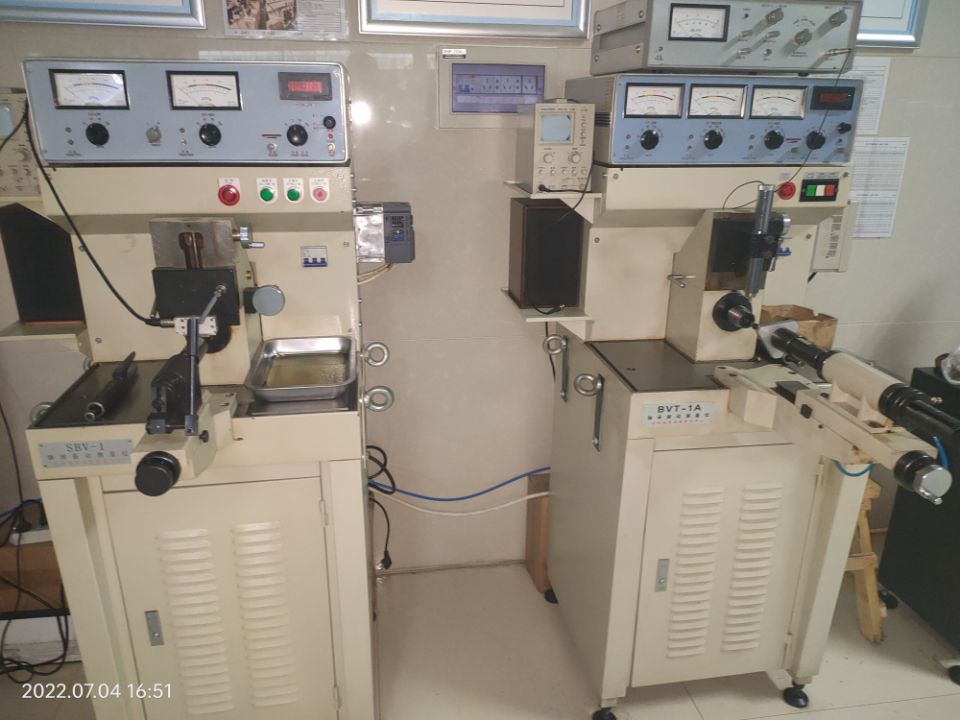
Steel ball checking equipment — ball quality is one of the points a buyer can ask to see documented rather than assumed.
What the current supply picture supports
FKD Bearing (Hebei Hailan Bearing Manufacture Co., Ltd) was founded in 1988 and operates a 100,000 m² site with more than 65,000 m² of plant. The company reports more than 400 employees, including 30 technicians and engineers, ISO 9001:2015 certification, monthly capacity of 2,000,000 pieces, OEM/ODM support across pillow block types, 100% testing, and exports of more than 90% of output to 68 countries and regions.
One documented project reference is a 100,000-piece supply programme run over two years for OEMs in agricultural machinery, industrial machinery, pharmaceutical, food and belt industries in India, recorded with stable operation. That reference covers the mounted units and insert bearings named in the project; it is evidence of mounted unit supply experience, not a field record for UCHA205-212 specifically.
The limits are equally clear. FKD's stated purchasing terms are a MOQ of 1,000 pieces and a 30-45 day lead time, which shapes how a first order for a new conveyor should be phased. No independent capacity audit, complete dimension table or published load rating was available for this review, so those points remain company-reported and should be verified through drawings and samples before a bracket design is frozen.
Outlook: documentation, repeatability and spares
Nothing in the available evidence supports a claim that hanger units are becoming more or less common in material handling. What the practical record does support is narrower: where a conveyor is specified to run longer between shutdowns, the parts that decide availability are those inside the process, and they need to be documented — material, seal, grease, classification and an unchanged configuration on reorder.
Two consequences follow for the UCHA205-212 series. First, the bracket and flight gap should be drawn from the actual unit dimensions so the bracket is made once. Second, spares for a range spanning eight designations should be held against the sizes actually installed, with the configuration frozen in writing. Those are procurement decisions the catalogue cannot make on the buyer's behalf.
Reference document: the FKD and HHB bearing catalogue, covering pillow block, insert bearing and housing ranges, can be downloaded here — FKD and HHB Bearing Catalogue (PDF).
Frequently asked questions
What is the UCHA205-212 series used for?
The series is a hanger-type pillow block unit used for intermediate shaft support in screw conveyors and similar continuous material handling equipment. Each unit carries radial load at a point between the conveyor's end bearings and is held by a bracket spanning the trough. The UCHA205-212 range is specified with an AISI 52100 chrome steel insert and a cast iron or QT450 housing, in eight designations from UCHA205 to UCHA212; bore and bracket dimensions must be confirmed per designation against the current catalogue.
Should a screw conveyor hanger use a cast iron or a QT450 housing?
Both materials are specified for the series, so the choice is a duty decision. QT450 ductile iron is documented by FKD as providing a minimum tensile strength of 450 MPa and elongation of at least 10% under GB/T 1348, which suits brackets that are welded or bolted fabrications and duties involving shock load or heavy bolt preload. Cast iron suits machined, flat-mounted brackets where load is steady and alignment is controlled. The configuration for each size should be confirmed on the order.
How is shaft alignment handled with hanger units?
Position is set by the hanger bracket, not by the bearing. The bracket should place the shaft concentric with the end bearings, at the correct height relative to the trough, and square in both planes, with shims under the bracket rather than under the housing. Pillow block units are self-aligning within limits — MISUMI describes pillow block bearings as a self-aligning ball bearing in a housing secured by a fastening screw — so small residual angular error is absorbed, but height errors, out-of-square brackets and bent shafts are not. Alignment should be re-checked after the first hours of loaded running.
Can the UCHA series run continuously in dusty, high-load conditions?
Continuity in those conditions depends on the sealing and on lubrication access at each hanger, not on the series name. FKD's industrial machinery documentation lists high temperature, high dust, heavy pollution, high load and high speed, with 24/7 operation recorded for its plummer block range, which indicates the conditions to check rather than a rating for this series. For a specific conveyor, the seal type, grease specification and re-lubrication interval should be confirmed for the exact configuration, together with how each hanger can be greased while the line is stopped.
How are hanger pillow block units classified for customs?
Complete mounted units are normally declared under HS 8483.20, the subheading for bearing housings incorporating ball or roller bearings in the WCO Harmonized System 2022 edition. Ball bearing inserts shipped on their own fall under HS 8482.10 instead. National tariff lines extend these six-digit subheadings differently, so the declaration should be confirmed with the customs broker for the destination market.
Tem questões ou precisa de mais detalhes?
Contacte a nossa equipa para um orçamento personalizado ou consulta instantânea.
Solicitar orçamento
Preencha o formulário abaixo e a nossa equipa entrará em contacto com uma proposta personalizada.
Chat direto do WhatsApp
Prefere conversar em tempo real? Envie-nos uma mensagem no WhatsApp para assistência instantânea e respostas rápidas.
- Obter orçamento personalizado
- Partilhar fotos ou documentos
- Discuta as suas necessidades diretamente
Geralmente responde em 5–30 minutos durante o horário de expediente.