
Pillow Filling in Saudi Arabia: 10 Units, 30% Energy Cut
Pillow and bedding filling is the stage that quietly sets a factory's labour cost, material yield and energy bill. In Saudi Arabia, a bedding manufacturer rebuilt that stage around a ten-unit installation supplied by KIVAS — pillow and cushion filling machines, fibre-opening equipment and pillow compression packaging machines — commissioned as one line. Three years on, the project record states energy consumption down 30%, labour cost down 35% and production capacity up 40%, with the equipment still operating normally.
Those results are project-reported outcomes for a single site, not a universal performance guarantee. What makes them useful for other buyers is that they sit on top of a documented configuration: KWS6901-2 and KWS6901-4 filling machines, 2 or 4 filling ports per machine, a 10.5–13.5 kW power range, and a material list covering 0.6D–15D polyester fibre, fibre balls, shredded foam and down feathers. For bedding producers across the Gulf and the wider Middle East weighing a move from manual benches to weighing-based filling, the Saudi installation works as both a reference case and a set of clear boundary conditions.
The Saudi Installation at a Glance
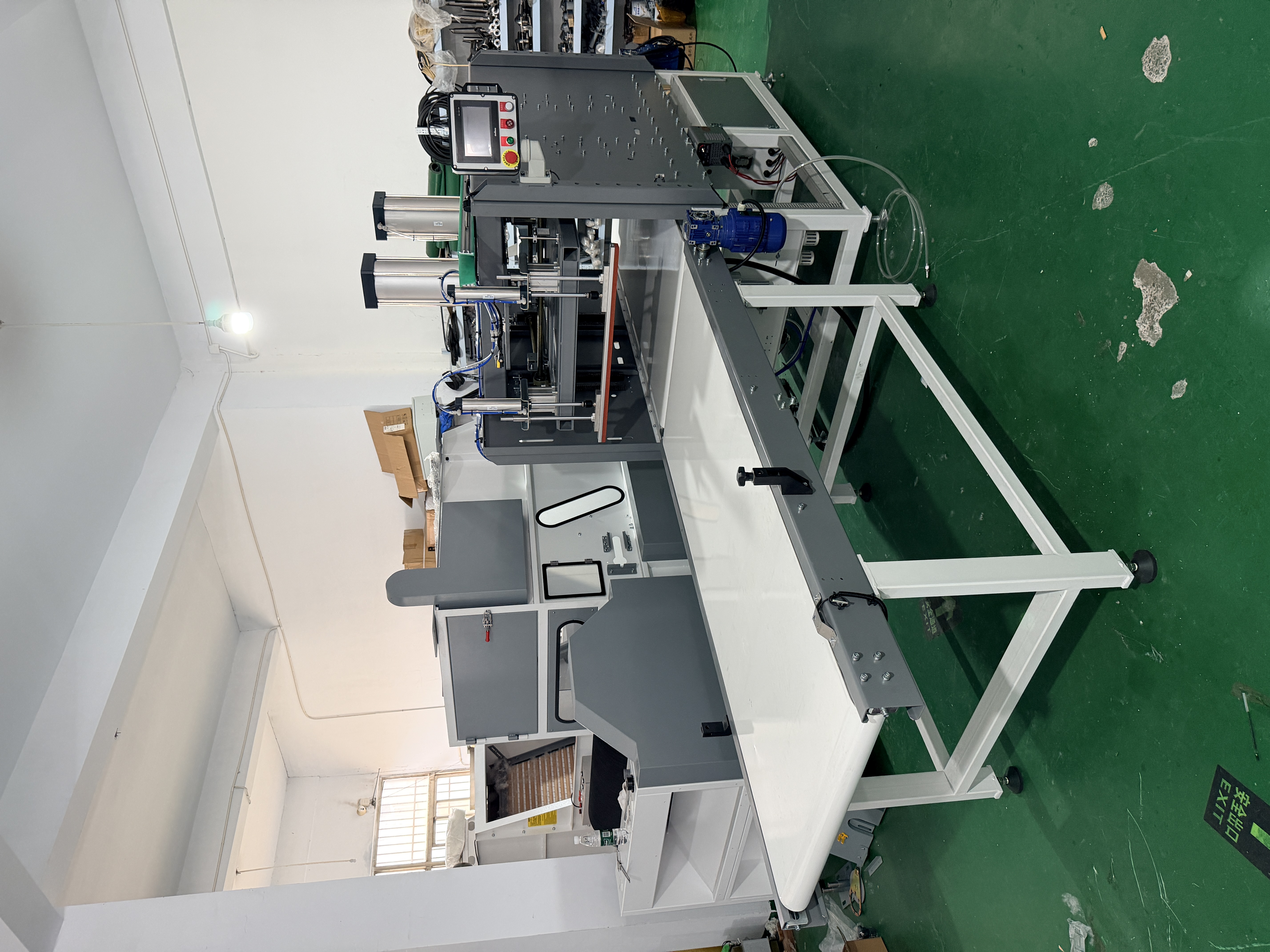
The available project record describes a pillow and bedding manufacturer in Saudi Arabia that installed ten units covering pillow, cushion and bedding filling, fibre opening, and pillow compression packaging.
| Project parameter | Recorded detail |
|---|---|
| Location | Saudi Arabia |
| Client profile | Manufacturer of pillow and bedding products, operating filling and compression packaging equipment |
| Scope of supply | 10 units: pillow / cushion / bedding filling machines, fibre-opening equipment and pillow compression packaging machines |
| Filling models | KIVAS KWS6901-2 and KWS6901-4 |
| Reported outcomes | 30% reduction in energy consumption; 35% reduction in labour cost; 40% increase in production capacity |
| Operating period | 3 years, still operating normally |
| Reported performance characteristics | High precision (about 1% error); single or mixed filling using 2–5 raw material types; long service life; low maintenance |
Why Filling, Not Sewing, Usually Caps Bedding Output
In many bedding plants the sewing floor is not the constraint. Filling is. When pillows and cushions are filled at benches, output scales with headcount: every additional shift of capacity means more operators, more stations and more floor space. Weight consistency then depends on how each operator reads the fibre flow, and fibre bulk density shifts from one material lot to the next.
Two costs hide inside that arrangement. Overfill is material given away on every unit produced, and it rarely appears as a line item until material reconciliation is reviewed. Underfill produces returns, rework and quality complaints. Both are consequences of making weight a human judgement rather than a machine function.
Weighing-based automatic filling changes the arithmetic. Each filling port dispenses material until the target weight is reached, which turns consistency into a specification — for the KWS6901 series, an accuracy value of about 1% with an error range of ±5–10 g across an optimal filling range of 100–2000 g. Throughput also becomes a machine rating: 400–800 kg/h, and 10–20 pieces per minute for a 600 g pillow. Instead of asking how many people are needed for a given output, a factory asks how many ports and how many machines. That is the shift the Saudi project demonstrates at scale.
What Was Actually Installed, and by Whom
KIVAS is the brand of Qingdao Kaiweisi Industry and Trade Co., Ltd., a manufacturer of home textile equipment founded in 2014 and based in Qingdao, China. The company produces fibre processing machinery, cotton, linen and wool textile machinery, fully automated quantitative pillow and quilt filling machines, pet product filling machines, weighing down jacket filling machines, packaging machines and related supporting machinery. Its product range holds ISO9000/CE certification, and Saudi Arabia is among its listed export markets, alongside other markets in Europe, Asia and the Americas.
The company operates a 3,000 m² factory with 17 employees, an annual output of 1,000 units, a five-engineer R&D team and an export ratio of about 60%. Those figures describe a mid-sized specialist supplier rather than a high-volume volume producer — relevant context when judging whether a vendor can configure and support a multi-unit line rather than simply ship a catalogue machine.
For the Saudi site, the scope was not a single machine. Ten units were installed to cover three linked functions: filling of pillows, cushions and bedding; opening of fibre ahead of filling; and compression packaging of finished pillows. The record states that the line has run for three years without a reported stoppage, which is the part of the case that matters most to a buyer in the evaluation-to-execution stage. Equipment that meets specification on a datasheet is common; equipment that holds its specification across three years of production shifts is the actual procurement question.
Technical Explanation: What the KWS6901 Series Specifies
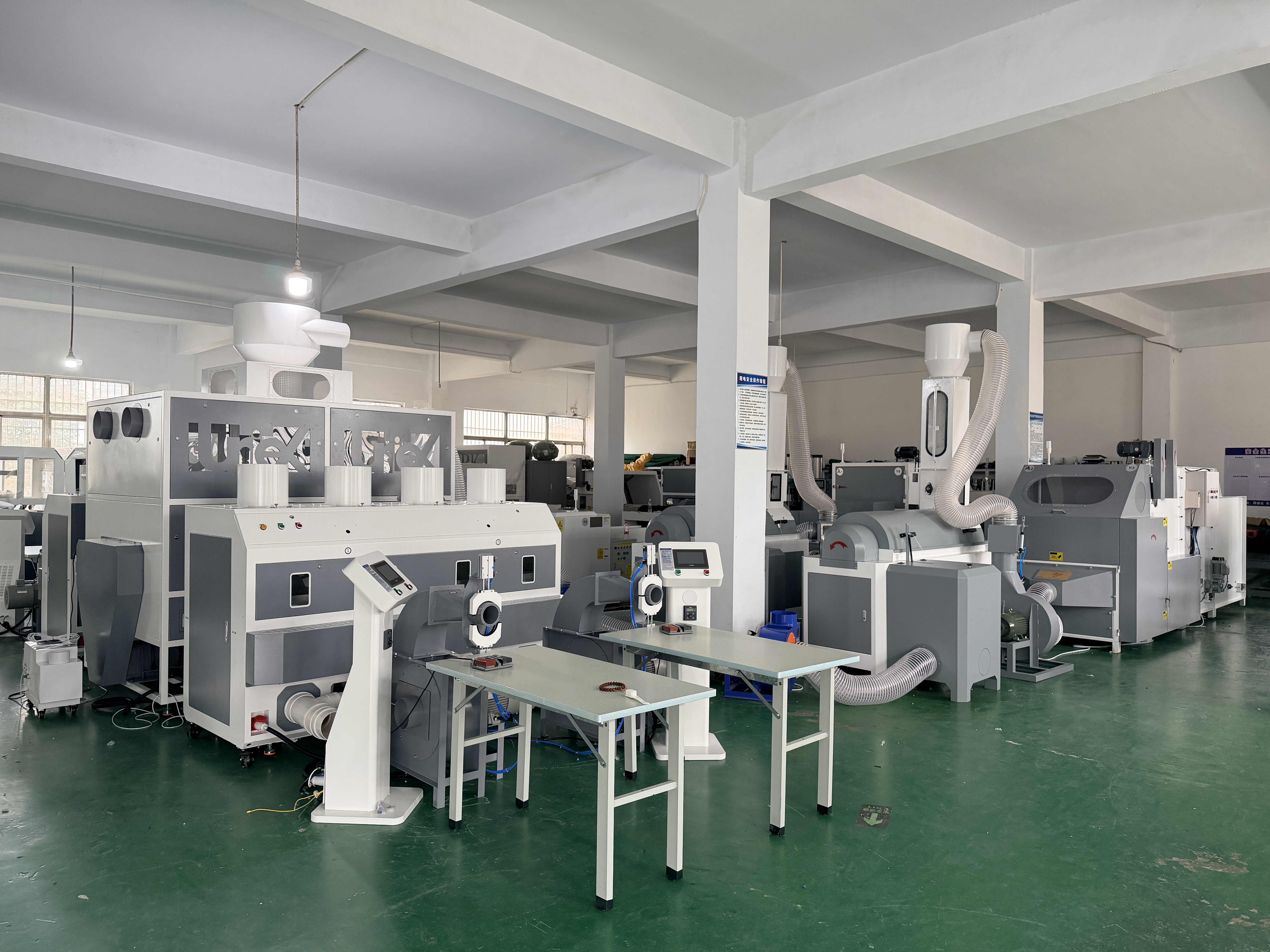
Most of the operational differences between filling machines sit in a short list of parameters. For the KWS6901 series, that list is documented as follows.
| Parameter | Documented specification |
|---|---|
| Models | KWS6901-2 / KWS6901-4 |
| Filling ports | 2 and 4 filling ports per machine |
| Power range | 10.5 kW – 13.5 kW |
| Production capacity | 400–800 kg/h |
| Filling speed | 10–20 pieces per minute for a 600 g pillow |
| Accuracy | About 1% |
| Error range | ±5–10 g |
| Optimal filling range | 100–2000 g |
| Suitable raw materials | 0.6D–15D polyester fibre, fibre balls, shredded foam, down feathers, EPS balls and similar materials, for single or mixed filling |
| Construction | Steel |
Three of these parameters deserve interpretation rather than repetition.
Port count sets the labour model. A two-port machine suits a factory that needs steady output with minimal supervision; a four-port machine suits higher volume where one operator can supervise multiple filling heads. The single largest line-level cost driver in filling is how many operators each output level requires, and port count is the lever on that number.
Power is a site-planning figure, not an energy-per-piece figure. A 10.5–13.5 kW rating describes the machine's connected load. A ten-unit installation therefore implies a substantial connected load that must be planned with local electrical and plant engineering. The 30% energy reduction reported by the Saudi project is a whole-line operating outcome; it cannot be derived from nameplate power alone, and buyers should treat the two as separate pieces of information.
Accuracy is expressed as a range, not a promise. The stated ±5–10 g error and about 1% accuracy value apply within the 100–2000 g optimal filling range. A 120 g decorative cushion and a 1,800 g pillow sit at different ends of that window, and a buyer should confirm which target weights matter most in their own SKU mix.
For reference on single-model throughput, one KIVAS specification sheet for the KWS6901-2 states a capacity of approximately ten 500 g pillows per minute, alongside material compatibility with 0.6D–15D fibre, down, feathers and kapok in 10–80 mm lengths. That figure and the series-wide 600 g specification both describe machine capability under stated conditions; real output depends on material, target weight and operator workflow.
Material Fit: Down, Polyester Fibre, Foam and Mixed Filling
The KWS6901 series is not a single-material machine. Its documented material range covers 0.6D–15D polyester fibre, fibre balls, shredded foam, down feathers and EPS balls, and it supports single or mixed filling using two to five raw material types. Kapok, feathers and down are also listed for the KWS6901-2 specification sheet.
That breadth matters commercially before it matters technically. A factory producing polyester pillows, down pillows, shredded-foam cushions and EPS-filled products on separate single-purpose stations carries duplicated floor space, duplicated maintenance and duplicated supervision. A machine that handles several material types with controlled mixing lets one line absorb SKU growth instead of requiring a new line for every new product family.
It also changes how buyers should test. Material behaviour differs sharply between a 15D fibre ball and fine down: bulk density, flow behaviour through the feeding system and settling inside the casing all vary. Because the minimum order quantity is one unit, and that unit can serve as a sample for testing, a buyer can validate the actual blend, target weight and finished loft before committing to a multi-unit line.
Application Fit Beyond Pillows
Pillow filling is the visible application, but the documented scope extends further. Stated applicable industries include bedding and home textiles, down clothing, soft sofa furniture, pet supplies, plush toys, car cushions, cotton and linen fibre primary processing, recycled fibres, non-woven fabric accessories and medical care.
Within bedding specifically, the equipment is described as suitable for pillow cores, sofa pillows, duvets and outdoor sleeping bags that are filled first and then quilted. Toy stuffing, cushion filling, lazy-sofa and beanbag filling sit inside the same material envelope, since shredded foam and EPS balls are both listed materials.
For a Middle East bedding producer, the practical significance is that a single machine type can support several product families that are typically sold through the same regional channels — standard pillows, decorative cushions, mattress toppers and duvets — without a separate capital purchase for each. The Saudi installation reflects that logic: filling, fibre opening and compression packaging were bought together as one production system rather than as isolated machines.
Market Context: Where Filling Equipment Demand Is Heading
Independent market research published by Market Research Future estimates the pillow packing machine market at US$15.74 billion in 2024, with a projected value of US$25.5 billion by 2035, implying a compound annual growth rate of 4.48% over the 2025–2035 period. The same source frames the market as growing from approximately US$16.45 billion in 2025.
Two caveats belong next to those numbers. First, the research covers pillow packing machinery, a wider category than filling machines specifically, so it indicates direction rather than a filling-machine figure. Second, the data is commercial research with medium confidence and no primary or authoritative sourcing behind the specific segment, so it is best used for planning context rather than for investment-grade forecasting.
On the trade side, filling machinery is commonly associated with HS code 8422.30, the classification covering machinery for filling, closing, sealing or labelling. Classification questions should still be confirmed with a customs broker for the specific machine configuration being imported, since the correct code is established per shipment and per destination market.
The pattern these two signals support is straightforward: demand for automated filling capacity is growing at a moderate, steady rate rather than exploding, which favours buyers who integrate filling with their existing opening and packaging steps over buyers who add capacity piece by piece.
Weighing Filling vs Manual Benches and Semi-Automatic Filling
The comparison that matters at evaluation stage is not brand against brand, but architecture against architecture. The table below sets out the dimensions buyers typically use, with the KWS6901 series figures drawn from the documented specification.
| Evaluation dimension | Manual filling bench | Semi-automatic filling | Weighing-based automatic filling (KWS6901 series as specified) |
|---|---|---|---|
| Weight consistency | Depends on operator judgement; not documented | Improved, but still operator-assisted; not documented | About 1% accuracy; ±5–10 g error range |
| Throughput | Scales with headcount | Moderate, limited by manual handling steps | 400–800 kg/h; 10–20 pieces/min at 600 g |
| Labour model | One operator per station | Operator plus assistant per station | 2 or 4 filling ports per machine under shared supervision |
| Connected power | Distributed small tools | Distributed motors and controls | 10.5–13.5 kW per machine |
| Material flexibility | Typically one material per bench | Limited changeover | 0.6D–15D fibre, fibre balls, shredded foam, down feathers, EPS; single or mixed filling with 2–5 materials |
| Documented performance data | None | None | Accuracy, error range, filling range, capacity and power documented by model |
The honest reading of this table is narrower than a sales argument. Automatic weighing filling does not eliminate labour; it changes what labour is spent on, moving operators from controlling weight to supervising output. It does not remove the need for site power planning; it concentrates load into fewer, larger units. And it does not make material behaviour irrelevant; it makes material behaviour testable in advance.
Limitations and Boundaries Buyers Should Not Skip
A case like the Saudi installation is most useful when its boundaries are stated as clearly as its results.
- The 30% / 35% / 40% outcomes are site-specific. They describe one Saudi factory's reported results across filling, fibre opening and compression packaging. The record does not itemise how much of the energy reduction came from machine efficiency versus process consolidation, so the figures should be treated as a reference case, not a transferable guarantee.
- The CE attestation has a defined scope and market. Certificate M.2024.206.C100562, issued by UDEM under Machinery Directive 2006/42/EC, covers the Automatic Down Fiber Filling Machine, references EN ISO 12100:2010 and EN 60204-1:2018, and is valid from 2024-05-09 to 2029-05-08. It is an EU market attestation. It does not by itself constitute approval in other jurisdictions, and importers should verify destination-market conformity requirements for their own route to market.
- Connected load requires local planning. Ten machines rated 10.5–13.5 kW each represent a significant electrical load. Transformer capacity, distribution, ventilation and machine layout should be engineered locally before installation, not assumed from the machine datasheet.
- Capacity gains are line-level outcomes. A 40% production capacity increase depends on upstream fibre opening and downstream sewing, packaging and handling keeping pace. Filling speed alone does not raise plant output if the next step becomes the new bottleneck.
- Atypical materials need validation runs. The documented material window is 0.6D–15D fibre with stated down, feather and kapok compatibility, and an optimal filling range of 100–2000 g. Unusual blends, very fine down grades or extreme target weights sit outside the documented envelope and should be proven with a sample unit before a full line is ordered.
- Service is remote-first. The stated after-sales structure is remote technical support, a one-year warranty and lifetime after-sales service, with overseas installation guidance available. No local service network in Saudi Arabia is stated in the available materials, so buyers should plan spare-parts stocking and local technician capability as part of the project.
- No independent third-party verification of the outcome figures was identified. The performance numbers are project-reported. Buyers who need audited performance data should request test documentation or arrange factory acceptance testing under their own specification.
Procurement and Execution: What the Order Stage Looks Like
For buyers moving from evaluation to execution, the commercial terms are documented and can be planned against directly.
| Commercial element | Documented terms |
|---|---|
| Minimum order quantity | 1 unit; the single unit can serve as a sample for testing |
| Lead time | 15–35 days |
| Monthly capacity | 60–150 units |
| Delivery terms | EXW / FOB / CIF / CFR / DDP |
| Payment terms | 30% T/T deposit before production; 70% balance via T/T before ex-factory delivery |
| Acceptance | 100% pre-shipment test; third-party inspection (SGS) including pre-shipment testing |
| Customization | Voltage, logo, colour, production capacity and specialized production lines |
| Supply model | OEM, ODM, overseas installation guidance, personalized customization |
| After-sales | Remote technical support; 1-year warranty; lifetime after-sales service |
Two elements are worth flagging for a Gulf buyer. The minimum order quantity of one unit supports a staged approach: validate a single machine on your own material and target weights, then scale to a line. And the acceptance route — pre-shipment testing plus third-party SGS inspection — gives the buyer an inspection event before goods leave the factory, which is the point at which specification disputes are cheapest to resolve.
Future Outlook
Three developments look likely to shape filling equipment decisions over the next several years, based on the evidence available.
Consolidation of filling, opening and packaging into single lines. The Saudi project bundled ten units across three functions. As moderate market growth continues at a 4.48% CAGR to 2035, the more common purchase pattern is likely to be line-level configuration rather than individual machines, because the measurable gains come from the whole sequence.
Multi-material capability as a hedge against SKU growth. Machines documented to handle 0.6D–15D fibre, fibre balls, shredded foam, down feathers and EPS balls, with mixed filling of two to five materials, allow a factory to absorb product diversification without a new capital cycle for every new line item.
Compression packaging as part of the filling decision. Pillow compression packaging was part of the Saudi scope. As freight economics and warehouse space remain a fixed constraint across Middle East distribution, packaging volume becomes a purchasing criterion alongside filling accuracy.
For buyers, the practical implication is to evaluate the filling step as part of a system with defined interfaces — upstream fibre opening, downstream packaging, site power and service arrangements — rather than as a stand-alone machine purchase.
FAQ
What is the difference between the KWS6901-2 and the KWS6901-4?
Both are pillow filling machines within the same KWS6901 series and share the same documented specification envelope: a power range of 10.5–13.5 kW, production capacity of 400–800 kg/h, filling speed of 10–20 pieces per minute for a 600 g pillow, accuracy of about 1%, error range of ±5–10 g and an optimal filling range of 100–2000 g. The principal difference stated in the specification is the number of filling ports: 2 ports per machine for the KWS6901-2 and 4 ports per machine for the KWS6901-4.
Can one filling machine handle both polyester fibre and down?
The documented material range covers 0.6D–15D polyester fibre, fibre balls, shredded foam, down feathers, EPS balls and similar materials, and supports single or mixed filling using two to five raw material types. A KIVAS specification sheet for the KWS6901-2 additionally lists down, feathers and kapok in 10–80 mm lengths, with a stated capacity of approximately ten 500 g pillows per minute. Actual performance on a specific blend and target weight depends on the material, so validation on a sample unit is the appropriate step before committing to a full line.
How is product quality verified before shipment?
Quality control is documented as a 100% pre-shipment test combined with third-party inspection by SGS, including pre-shipment testing. The minimum order quantity of one unit can serve as a sample for testing, which allows a buyer to validate capacity, accuracy and material handling on their own material before a larger order is placed.
What are the delivery and payment terms?
Delivery terms are EXW, FOB, CIF, CFR or DDP. Payment terms are 30% T/T deposit before production, with the 70% balance via T/T before ex-factory delivery. Lead time is stated as 15–35 days, and monthly production capacity is 60–150 units. MOQ is 1 unit.
Is CE certification sufficient for importing a filling machine into Saudi Arabia or other Middle East markets?
The available certificate, M.2024.206.C100562, is a Machinery Directive 2006/42/EC attestation of conformity issued by UDEM and valid from 2024-05-09 to 2029-05-08, covering the Automatic Down Fiber Filling Machine and referencing EN ISO 12100:2010 and EN 60204-1:2018. It is an EU market attestation. It does not by itself establish conformity with requirements in other jurisdictions, so importers should confirm the applicable destination-market requirements for their own import route and check that the certificate scope matches the specific machine being purchased.
What after-sales support is included, and what should buyers plan for?
The stated after-sales structure is remote technical support, a one-year warranty and lifetime after-sales service, with overseas installation guidance available as part of the supply model. No local service network is stated in the available materials, so buyers should plan their own arrangements for spare-parts stocking, on-site maintenance capability and response time expectations as part of the project budget.
A Reference Case, Not a Template
The Saudi installation is useful because it is specific. Ten units, defined models, a stated material envelope, documented accuracy figures and three years of reported operation give buyers something concrete to test their own assumptions against — while the certificate scope, connected load, line-balance dependencies and remote-first service model define where that reference stops. For a bedding producer evaluating a move to weighing-based filling, the sensible sequence is to validate a single unit on your own materials, then plan the line around the whole production sequence.
For readers who want the full technical context, the QINGDAO KAIWEISI product catalog is available for download.