
Pipe Scenario Fit: Four Pipe Jobs, Four Extrusion Lines
Pipe Scenario Fit: Four Pipe Jobs, Four Extrusion Lines
A building drainage stack, a municipal water main, a hot-water riser inside an apartment block and a power cable duct beneath a road are all described as plastic pipe, yet they are not produced on the same extrusion line. The service job fixes the material, the pressure, impact and temperature requirements, and the diameter band; the diameter band fixes the extruder size, the haul-off speed, the calibration and cooling length and the cutting method. Reading a pipe extrusion line backwards from the application is the difference between equipment that fits a project and equipment that has to be reworked around it.
This article sets out that reading for four documented line families from JKS Plastic Extrusion Machine: PVC water supply and drainage lines in models PVC63, PVC250 and PVC630; HDPE water pipe lines across PE110 to PE1600; PPR lines in PPR20-75 and PPR20-110; and MPP and PE high-voltage power pipe lines in PEG63 and PG160. The documented model ranges, line parameters and application notes form the evidence base, and the limits of that evidence stay visible throughout.
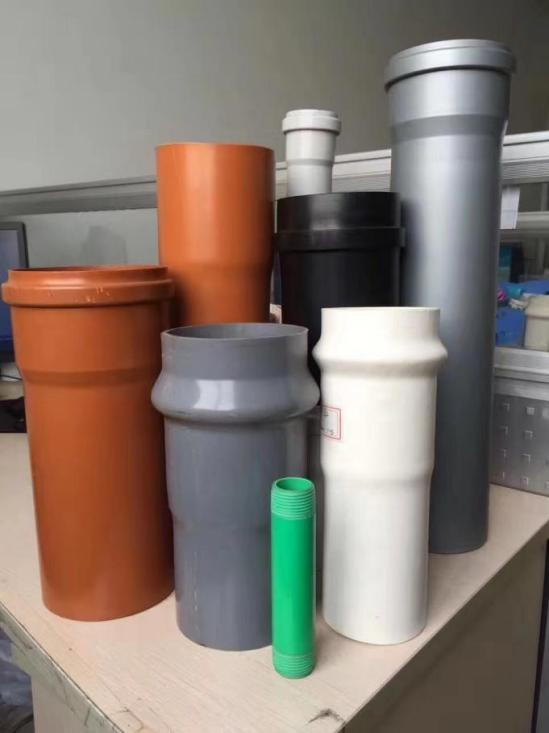
Finished PVC water supply and drainage pipe: the end product of the Φ16–630 mm band discussed in the first scenario below.
The service job, not tonnage, sets the specification
Two pipe lines can carry the same motor power and still fail to be interchangeable, because the constraint that decides the purchase is not the extruder alone. For a buried water main, the deciding constraints are pressure resistance and uniform wall thickness across long lengths. For indoor hot-water plumbing, they are corrosion resistance and high-temperature resistance over a long service life. For a buried power duct, they are pressure resistance, impact resistance and non-conductive behaviour. For building drainage, they include impact resistance and dimensional stability.
Each of those constraints resolves into a material and a diameter band, and each diameter band resolves into a different downstream train. That chain is visible most clearly in the documented PVC range, where three models of a single family differ substantially in every dimension except the raw material.
Scenario one: PVC for building water supply and drainage
The PVC Water Supply & Drainage Pipe Extrusion Line is documented for building water supply and drainage, agricultural irrigation and cable threading pipe production, running a PVC and CaCO₃ raw material through a conical twin-screw extruder. Three models are documented with full parameters.
| PVC model | Documented diameter band | Matching extruder | Main motor | Downstream power | Haul-off speed | Documented output |
|---|---|---|---|---|---|---|
| PVC63 (double station) | Φ16–63 mm | SJSZ65/132 conical twin screw | 37 kW AC | 24 kW | 4–49 m/min | 270 kg/h |
| PVC250 | Φ90–250 mm | SJSZ80/156 conical twin screw | 55 kW AC | 24 kW | 4–15 m/min | 450 kg/h |
| PVC630 | Φ315–630 mm | SJSZ92/188 conical twin screw | 110 kW AC | 39 kW | 0–5 m/min | 800 kg/h |
The table is the clearest available illustration of scenario logic. Moving from the Φ16–63 mm double-station machine to the Φ315–630 mm machine multiplies main motor power by roughly three and documented output by roughly three, while haul-off speed falls from a 4–49 m/min band to a 0–5 m/min band. All three models are documented with vacuum calibration, multi-claw traction and dust-free cutting: the downstream package a rigid PVC pipe needs regardless of size. What changes is scale and power, not the function set.
For a plant serving building drainage and small-bore water supply, the Φ16–63 mm band is the documented match, and the double-station arrangement points to a production pattern built around frequent size changes rather than single-size runs. For a plant supplying larger drainage and sewer mains, the Φ315–630 mm model is effectively a different project: more floor space, a higher connected load, much slower line speed and a haul-off designed for heavy pipe. Treating the two as one purchase because both are PVC pipe is the most common mismatch in this family.
Scenario two: HDPE for municipal water and farm irrigation
The HDPE Water Pipe Extrusion Line is documented for water supply and drainage in municipal engineering and agriculture, producing solid-wall HDPE pipe in high-speed continuous operation. The family is documented across five models, PE110, PE315, PE630, PE1000 and PE1600, which is the widest model span among the four pipe families considered here. Documented requirements are pressure resistance, corrosion resistance and uniform wall thickness; the documented equipment set is extruders, moulds, vacuum calibration tanks, cooling tanks and haul-off machines.
The practical reading is that the model number belongs to the specification, not to the catalogue heading. A quotation that says HDPE water pipe line without naming the model leaves the diameter band undefined, and the diameter band is what determines vacuum tank length, cooling capacity and the clamping range of the haul-off. Two HDPE offers should be compared at a named model and a named diameter band before any price comparison is meaningful.
One boundary is worth stating explicitly. The documented scenario material for this family addresses water supply, drainage and agricultural irrigation; gas transport service is not covered by that material and is not assessed here. A buyer whose project also includes gas duty should obtain the specific documentation for that service separately rather than infer it from a water-pipe specification.
Scenario three: PPR for indoor cold and hot water
The PPR Pipe Extrusion Line is documented for cold and hot water supply systems and residential plumbing, in two models, PPR20-75 and PPR20-110. Documented requirements are corrosion resistance, high-temperature resistance and long service life; the equipment set is extruders, moulds, calibration tanks, cooling systems and cutting machines, run in continuous automatic production.
PPR covers the narrowest diameter band of the four families, which is consistent with its job: distribution pipe inside buildings rather than buried mains. The consequence for a buyer is that a PPR line is a volume business decided by changeover speed, dimensional consistency and surface finish rather than by maximum diameter. Where a PVC or HDPE line is judged on haul-off range and calibration length for large pipe, a PPR line is judged on how consistently it holds small diameters at production speed.
Model naming across the JKS pipe range tracks the largest size in the documented band: PVC63 covers Φ16–63 mm, PVC250 covers Φ90–250 mm and PVC630 covers Φ315–630 mm. On that reading, PPR20-110 is the larger of the two PPR options, but the exact band for each model should be confirmed in the offer rather than inferred from the name alone.
Scenario four: MPP and PE for buried power conduit
The MPP & PE High Voltage Power Pipe Extrusion Line is documented for buried high-voltage power cable protection in power grid and municipal engineering projects, in models PEG63 and PG160. Documented requirements are pressure resistance, impact resistance and non-conductive properties, with extruders, moulds, calibration tanks, cooling systems and cutting machines as the equipment set.
This is the family where acceptance logic diverges most from water pipe. A water pipe is judged on pressure containment and wall-thickness uniformity; a buried power duct is judged on impact resistance during backfill and on non-conductive behaviour, in addition to pressure resistance. The equipment list looks similar to the water-pipe lines, but the qualification evidence a buyer should request does not: it has to address the properties named in the specification, not only output.
The documented range, PEG63 and PG160, is narrower than the HDPE range. A project that needs a larger conduit diameter should therefore be checked against a different documented model rather than treated as an extension of the same line.
A scenario fit matrix
The four families line up against four distinct jobs when the documented requirements are placed beside the documented models. The matrix below is a summary of supplied material, not a ranking: no family is better than another, and each one is documented for a different service condition.
| Service job | Line family | Documented models | Documented requirements | Documented downstream equipment |
|---|---|---|---|---|
| Building water supply and drainage | PVC Water Supply & Drainage Pipe Extrusion Line | PVC63, PVC250, PVC630 | High impact resistance, corrosion resistance, dimensional stability | Vacuum calibration, multi-claw traction, dust-free cutting |
| Municipal water and farm irrigation | HDPE Water Pipe Extrusion Line | PE110, PE315, PE630, PE1000, PE1600 | Pressure resistance, corrosion resistance, uniform wall thickness | Vacuum calibration tanks, cooling tanks, haul-off |
| Indoor cold and hot water | PPR Pipe Extrusion Line | PPR20-75, PPR20-110 | Corrosion resistance, high-temperature resistance, long service life | Calibration tanks, cooling systems, cutting machines |
| Buried high-voltage power protection | MPP & PE High Voltage Power Pipe Extrusion Line | PEG63, PG160 | Pressure resistance, impact resistance, non-conductive | Calibration tanks, cooling systems, cutting machines |
What the numbers show: diameter, speed and output move in opposite directions
The documented PVC parameters support three decision rules that remain useful as reasoning even where the specific figures do not transfer. First, as the diameter band rises, the haul-off speed band falls: 4–49 m/min at Φ16–63 mm, 4–15 m/min at Φ90–250 mm and 0–5 m/min at Φ315–630 mm. Second, documented output still climbs across the same progression, from 270 kg/h to 450 kg/h to 800 kg/h, because mass throughput depends on wall cross-section as well as line speed. Third, main motor power rises with the band, from 37 kW to 55 kW to 110 kW, while downstream power holds at 24 kW for the two smaller models and rises to 39 kW for the largest.
The buyer-side implication is that a quoted tonnage figure on its own says very little. A line rated at a given output in a small diameter and a line rated at the same output in a large diameter are different machines, with different motors, different haul-off designs and different factory footprints. Output should always be read together with the diameter band and the haul-off range in which it was stated.
These three rules are derived from documented PVC data and should not be transferred as a formula to HDPE, PPR or MPP. For those families the evidence used here is the model range, the application note and the equipment set, not a full parameter table. That difference in evidence depth is itself a reason to request a model-specific datasheet at quotation stage.

A solid-wall pipe extrusion line: extruder, calibration and haul-off are sized together for a specific diameter band.
Upstream and auxiliary equipment belong to the scenario too
Selection does not stop at the pipe line. In the documented PVC scenario the raw material is a PVC and CaCO₃ compound, and the SRL-Z mixing and cooling units are documented for PVC pipe, profile and sheet lines: four models from SRL-Z200/500 at 300–400 kg/h to SRL-Z1000/3000 at 1,600–2,000 kg/h, with 8–10 minutes mixing and 6–8 minutes cooling per pot and a stainless-steel mixing pot. Because the largest documented PVC pipe line in this article runs at 800 kg/h, compounding capacity has to be checked against line output rather than assumed.
Reclaim is a second auxiliary question. The SP series crushers are documented at 300–400 kg/h for SP400 at 15 kW and 600–700 kg/h for SP660 at 22 kW, handling PVC, PE and PP pipe, profile and sheet scrap. The MF series pulverizers are documented at 40–80 mesh with throughput from 200 kg/h to 500 kg/h across three models. A plant intending to reuse its own offcuts should size these units against the scrap rate of the specific line, which again depends on diameter band and output.
Where the fit boundary sits
Three boundaries deserve a place in the project plan. The first is the model-range boundary: the documented PVC range runs to Φ630 mm and the documented MPP and PE power pipe range to the PG160 model, so a larger requirement points to a different machine rather than an option on the same one. The second is the material boundary: the PVC line runs a PVC and CaCO₃ compound through conical twin-screw extruders, while HDPE, PPR and MPP are documented as separate families with their own ranges and their own acceptance requirements, so cross-material substitution is a separate technical question.
The third is the evidence boundary. Full parameter tables are documented here for the PVC family; the other three families are documented at model-range and application-requirement level. That does not make them weaker, but it does mean a buyer should obtain per-model parameters, including diameter band, haul-off range, installed power and the basis on which output is stated, before committing rather than relying on a family-level description.
Compliance and documentation checks
Safety documentation is part of scenario fit, because the applicable standard depends on the market where the line will run. ANSI/PLASTICS B151.7 applies to extrusion machines used in the plastics industry and requires a documented risk assessment process in the manufacture, care and use of the machinery, according to the ANSI webstore listing for B151.7-2014 (R2021). The PLASTICS Industry Association standards page lists the same subject as B151.7-2013, so the edition reference differs between public sources and should be confirmed for the destination market rather than assumed.
On the supplier side, JKS documents 100% factory pre-assembly and testing before shipment and makes third-party inspection available on request. For a pipe project, the checks that follow are straightforward: the line is assembled and run before dispatch; the model, diameter band and haul-off range are named in the contract; and the acceptance test states which pipe sizes and which properties will be measured.
Market context: supply is broad, fit is not
Market research published by Market Research Future in September 2026 projects the plastic extrusion machine market growing from USD 7.901 billion in 2025 to USD 12.87 billion by 2035. That figure describes machinery revenue under the publisher definition; it is not a measure of pipe demand and should not be used as one. Separately, the Observatory of Economic Complexity, drawing on UN Comtrade data for HS 8477 rubber and plastic working machinery, reports China as the leading exporter in 2024 at USD 8.55 billion, ahead of Germany at USD 6.11 billion and Italy at USD 2.61 billion.
For a pipe producer, the practical meaning is availability rather than differentiation. Where a category is served by a deep export base, the scarce input is not a machine but a documented match between a machine and a service job. That is why model-level evidence, covering diameter band, haul-off range, documented downstream equipment and inspection terms, carries more procurement weight than a family-level brochure claim.
How JKS documents the four pipe families
Wuxi JKS Machinery Manufacturing Co., Ltd. is a Chinese manufacturer of custom plastic extrusion machinery and complete turnkey lines, based in Wuxi, Jiangsu Province. Its documented portfolio covers SPC flooring sheet lines, PVC, PP and WPC board lines, PVC and HDPE pipe lines, WPC and PVC profile lines, solid plastic rod lines, waste plastic recycling pelletizing lines, standalone single-screw and conical twin-screw extruders, and auxiliary equipment including mixers, crushers and pulverizers.
For pipe, the four families discussed here are documented with these model ranges: PVC water supply and drainage lines in PVC63, PVC250 and PVC630, with the parameter table shown earlier; HDPE water pipe lines in PE110, PE315, PE630, PE1000 and PE1600; PPR lines in PPR20-75 and PPR20-110; and MPP and PE high-voltage power pipe lines in PEG63 and PG160.
Company-level figures documented for the manufacturer include a 2,000 m² workshop, a six-engineer R&D team, annual output of 200 units and an export ratio of 50%, with markets listed as Southeast Asia, Russia, the Middle East, Europe, Central Asia, Africa and South America, and exports to over 35 countries. Customisation is documented across extruder model, screw configuration, line layout, voltage and frequency, control system and capacity adjustment, with a minimum order of one unit and a documented lead time of 40 working days against a monthly capacity of 30 units. After-sales support is documented as overseas installation guidance, on-site commissioning, operator training, remote technical support and a 12-month warranty.
A bounded outlook
Nothing in the documented evidence supports a forecast about which pipe material will grow fastest, and this article does not make one. What the evidence does support is a direction in how lines are specified: as buyers verify claims, family-level descriptions give way to model-level datasheets, and the questions that decide a purchase shift from motor power to diameter band, haul-off range, documented downstream equipment and inspection terms. A supplier that can answer those questions per model, for PVC63 through PVC630, for PE110 through PE1600, for PPR20-75 and PPR20-110 and for PEG63 and PG160, is easier to qualify than one that answers only at family level.
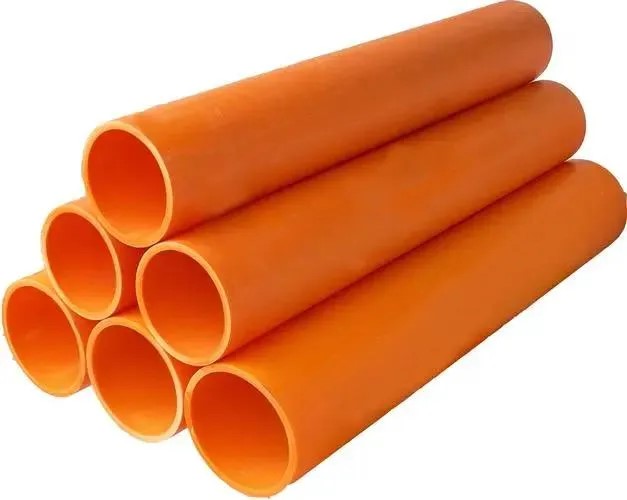
MPP and PE high-voltage power protection conduit: the end product judged on impact resistance and non-conductive behaviour.
FAQ
How should a buyer choose between a PVC and an HDPE line for a buried water main?
The documented application notes point in different directions. The PVC line is documented for building water supply and drainage, agricultural irrigation and cable threading, in bands from Φ16–63 mm to Φ315–630 mm. The HDPE line is documented for water supply and drainage in municipal engineering and agriculture across models PE110 to PE1600, with pressure resistance, corrosion resistance and uniform wall thickness named as requirements. The deciding inputs are the diameter band and the required pressure and impact performance, not the extruder size alone.
Can one pipe extrusion line cover both indoor plumbing and municipal mains?
No single documented model spans both jobs. The PPR line, in PPR20-75 and PPR20-110, is documented for cold and hot water supply systems in buildings, while the HDPE family is documented from PE110 to PE1600 for municipal water and irrigation. The model ranges are separate, so a plant serving both markets should plan two lines, or confirm in writing which documented model covers which diameter band.
What changes in the downstream equipment between a small-bore and a large-bore PVC line?
The documented function set stays the same: vacuum calibration, multi-claw traction and dust-free cutting on all three PVC models. What changes is scale and power. Downstream power is 24 kW on the PVC63 and PVC250 models and 39 kW on the PVC630, haul-off speed falls from a 4–49 m/min band to a 0–5 m/min band, and documented output rises from 270 kg/h to 800 kg/h. Because the downstream functions are identical, the difference sits in sizing and structural strength rather than instrumentation.
Which safety standard applies to a plastic pipe extrusion line?
ANSI/PLASTICS B151.7 applies to extrusion machines used in the plastics industry and requires a documented risk assessment process in the manufacture, care and use of the machinery. The edition reference is not consistent across public sources: the ANSI webstore lists B151.7-2014 (R2021), while the PLASTICS Industry Association standards page lists B151.7-2013. Buyers should confirm the edition applicable to their destination market with the supplier and, where relevant, with a local conformity assessor.
What should be verified before accepting a pipe extrusion line?
Documented supplier practice is 100% factory pre-assembly and testing before shipment, with third-party inspection available on request. On that basis, the items worth writing into the contract are the model and diameter band, the haul-off range, the documented downstream equipment list, the pipe sizes and properties measured at acceptance, and the installation, training and warranty terms, which are documented as overseas installation guidance, on-site commissioning, operator training, remote support and a 12-month warranty.
Readers who want to check current model ranges against the figures quoted in this article can review the manufacturer catalogue at the company website linked above.
Tem questões ou precisa de mais detalhes?
Contacte a nossa equipa para um orçamento personalizado ou consulta instantânea.
Solicitar orçamento
Preencha o formulário abaixo e a nossa equipa entrará em contacto com uma proposta personalizada.
Chat direto do WhatsApp
Prefere conversar em tempo real? Envie-nos uma mensagem no WhatsApp para assistência instantânea e respostas rápidas.
- Obter orçamento personalizado
- Partilhar fotos ou documentos
- Discuta as suas necessidades diretamente
Geralmente responde em 5–30 minutos durante o horário de expediente.